
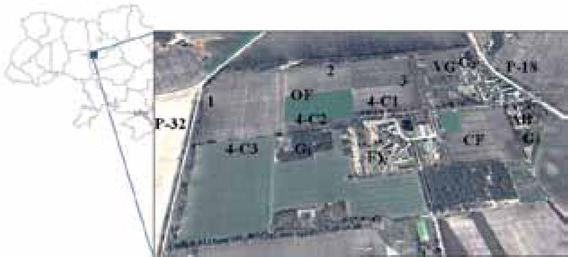
Figure 1
Structure of the studied organic agrolandscape (demonstration site of Institute of Agroecology and Environmental Management of NAAS of Ukraine): OF – organic fields; CF – conventional fields; 1, 2, 3, 4 – forest shelter belts No. С1, С2, С3 – sections of the forest belt No. 4; G1, G2 – fruit gardens, G3 – dendrological garden; VG – vegetable garden; AB – administrative buildings; FY – farmyard; Р-32, Р-18 – regional routes
Table 1
Assessment and sanitary characteristics of field protective forest shelter belts around the organic experimental fields (Institute of Agroecology and Environmental Management of NAAS of Ukraine)
| No FSB, trial plots (TP) – sections (C), placement relative to organic fields | FSB construction | Number of rows of tree species, pieces | Species composition | FSB parameters, m | Density of canopy* | Plantation condition | ||||
|---|---|---|---|---|---|---|---|---|---|---|
| main tent | undergrowtli and understorey | H | B | Ic | sanitary | forestry | ||||
| 1 | 2 | 3 | 4 | 5 | 6 | 7 | 8 | 9 | 10 | 11 |
| FSB No 1, TP1, west side of the field | two-tier, dense | 4 | main speices – Fraxinus excelsior L.; accompanying – Ulmus laevis Pall., Populus nigra L., P. laurifolia Ledeb., Robinia pseudoacacia L., F. excelsior, Ulmus laevis Pall., U. minor Mill.; invasive – Jugions regia L., Populus tremula L., Acer negundo L. | UNDERGROWTH: A. negundo, Acer pseudoplatanus L., U. minor, F. excelsior, J. regia, Malus domestica Borkh.; UNDERSTOREY: Prunus serotina Ehrh., Sambucus nigra L.,Ligustmm vulgare L. Crataegus monogyna JACQ., Padus avium Mill. | 17.4 | 20.0 | 0.58 | 2.43 | weakened | good, TPC –38.1% |
| FSB No 2, TP2, north side of the field | three-tier, dense | 7** | main speices – Populus nigra L.; accompanying – P. laurifolia, Ouercus robur L., Fraxinus pennsylvanica Marshall, U. laevis; invasive – R. pseudoacacia, Cerasus avium (L.) Moench, J. regia, A. negundo | UNDERGROWTH: R. pseudacacia, Q. robur, C. avium, F. excelsior, A. negundo; UNDERSTOREY: S. nigra, Prunus cerasifera Ehrh., P. serotino, Padus avium Mill., Swida sanguinea (L.) Opiz., Ligustrum vulgare L. | 24.3 | 35.0** | 0.81 | 2.28 | weakened | good, TPC –25.6% |
| FSB No 3, TP3, east side of the field | one-tier, dense | 2 | main speices – P. laurifolia; accompanying – Q. robur, F. pennsylvanica, F. excelsior, U. laevis; invasive – Q. rubra L.,Pyrus communi s L., J. regia, A. negundo, P. tremula, C. avium | UNDERGROWTH: Q. robur, F. excelsior, LF. laevis, P. communis, J. cinerea L., M. domestica, C. avium, A negundo; UNDERSTOREY: Sorbus aucupariaL.,P. serotino, S. nigra, S. sanguinea, Cerasus vulgaris Mill., L. vulgare, Rosa canina L. | 22.6 | 16.0 | 0.72 | 2.23 | weakened | good, TPC –31.2% |
| FSB No 4, TP4-C1 south side of the field | dense | 3 | main speices – U. minor, accompanying – F. excelsior, invasive – R. pseudoacacia, A. negundo, J. regia | UNDERGROWTH: J. regia, A. negundo, C. avium, M. domestica; UNDERSTOREY: P. serotino, Salix caprea L., S. sanguinea (L.) Opiz., S. nigra, C. monogyna | 14.2 | 12.0 | 0.62 | 1.48 | healthy | good, TPC – 17.6% |
| FSB No 4, TP4-C2 south side of the field | wind-per- meable, there are gaps in the forest belt up to 20 m wide | 1 | main speices – U. laevis; invasive – J. regia, A. negundo, R. pseudoacacia, S. caprea | UNDERGROWTH: Al. domestica, J. regia, A. negundo, P. communis, C. monogyna; UNDERSTOREY: P. serotino, S. nigra, L. vulgare, S. caprea, S. sanguinea | 12.5 | 4.0 | 0.51 | 1.42 | healthy | satisfactory, the stand is liquefied, TPC –42.8% |
| FSB No 4, TP4-C3 south side of the field | semi- permeable | 2 | main speices – F. excelsior, accompanying – Acer pseudoplatanus L., U. minor, invasive – R. pseudoacacia, J. regia, A. negundo, S. caprea | UNDERGROWTH: P. communis, J. regia, A. C. negundo, avium, M. domestica; UNDERSTOREY: P. serotino, S. caprea, C. monogyna, P. avium, Rubus caesius L. | 13.4 | 8.0 | 0.55 | 1.37 | healthy | satisfactory, the stand is liquefied, TPC –26.4% |
[i] Note: C– sections of TP are distinguished by the difference in structure (according to the degree of degradation) of the for est shelter belt No 4; * – for one-row FSB – density in a row; ** – TP2 had a projective width of 50.0 m (10 rows of trees, row spacing –5 m, between rows – shade-tolerant shrubs (Sambucus nigra L., Swida sanguinea (L.) Opiz., Ligustrum vulgare L.). In 2018, reforestation of the field belt 15 m wide (three rows of trees) was carried out, so FSB became 7-row, width – 35 m. As a resuit of felling there is an active restoration of trees from stumps (stump growth), free areas are occupied by a dense cover of grass in the form of biogroups. H is the height of FSB, B is the width of FSB, Ic is the index of the stand sanitary condition, TPC is the total projective cover of the grass layer in the FSB (%).
Table 2
The structure of bio- and ecomorphs of FSB dendroflora
| Factors | Life form | Share of species, % |
|---|---|---|
| Biomorphs by IG Serebryakov (1962) | trees | 77.4 |
| shrubs | 21.3 | |
| lianas | 1.3 | |
| Type of vegetative mobility | vegetatively sedentary | 38.6 |
| vegetatively immobile | 32.3 | |
| vegetatively mobile | 29.1 | |
| Heliomorphs | heliophytes | 64.5 |
| scioheliophytes | 6.5 | |
| heliosciophytes | 29.0 | |
| Hydromorphs | xeromesophytes | 9.7 |
| mesohygrophytes | 3.2 | |
| mesoxerophytes | 12.9 | |
| mesophytes | 74.2 | |
| Trophomorphs | megatrophs | 12.9 |
| mesotrophs | 80.6 | |
| oligotrophs | 6.5 | |
| of which nitrophils | 16.1 |
Table 3
The structure of bio- and ecomorphs of FSB wood nitrophils
| Species | Biomorph | Cenomorph | Trophomorph | Hygromorph |
|---|---|---|---|---|
| Acer negundo L. | tree | Ru, @ | MgTr | Ms |
| Sambucus nigra L. | bush | Sil | MgTr | Ms |
| Swida sanguineа (L.) Opiz. | bush | Sil | MgTr | Ms |
| Rubus caesius L. | bush | Sil | MgTr | MsHg |
| Parthenocissus quinquefolia (L.) Planch. | liana | Sil, @ | MsTr | Ms |
Table 4
Systematic structure of FSB dendroflora
| Classes and species | Number of species | Share of species (%) |
|---|---|---|
| Division Pinophyta | ||
| Pinaceae | 1 | 3.2 |
| Division Magnoliophyta | ||
| Aceraceae | 2 | 6.5 |
| Adoxaceae | 1 | 3.1 |
| Betulaceae | 1 | 3.2 |
| Cornaceae | 1 | 3.2 |
| Fabaceae | 3 | 9.7 |
| Juglandaceae | 2 | 6.5 |
| Oleaceae | 3 | 9.7 |
| Rosaceae | 8 | 29 |
| Salicaceae | 4 | 12.9 |
| Ulmaceae | 3 | 9.7 |
| Vitáceae | 1 | 3.3 |
| Total | 30 | 100.0 |
Table 5
Comparative spectra of leading families of different flora
| Family | The place of the family in the flora | |||||||
|---|---|---|---|---|---|---|---|---|
| 1 | 2 | 3 | 4 | 5 | 6 | 7 | 8 | |
| Asteraceae | 1 | 1 | 1 | 1 | 1 | 1 | 1 | 1 |
| Poaceae | 2 | 3 | 3 | 2 | 2 | 2 | 2 | 2 |
| Fabaceae | 3 | 2 | 4 | 4 | 4 | – | 3 | 3 |
| Brassicaceae | 9 | 5 | 2 | 6 | 3 | 3 | 5 | 4 |
| Caryophyllaceae | 18 | 6 | 9 | 5 | 5 | 4 | 4 | 6 |
| Lamiaceae | 6 | 8 | 5 | 7 | 5 | 7 | 2 | 5 |
| Apiaceae | 10 | 10 | 6 | 11 | 7 | 5 | 12 | 9 |
| Cyperaceae | 4 | 11 | – | 10 | – | – | + | 11 |
| Rosaceae | 8 | 4 | – | 3 | 7 | – | 11 | 7 |
| Chenopodiaceae | 19 | – | 7 | 18 | 8 | + | + | 12 |
| Scоrphulariaceae | 5 | 7 | 8 | 9 | 8 | + | 4 | 10 |
| Boraginaceae | 16 | – | 10 | 12 | 6 | – | – | 13 |
| Ranunculaceae | 17 | 9 | – | 14 | 8 | + | 3 | 8 |
| Poligonaceae | 25 | – | – | 14 | 4 | 5 | 4 | 15 |
| Euphorbiaceae | 12 | – | – | 16 | 6 | 5 | + | + |
| Convolvulaceae | + | – | + | – | 8 | 5 | – | - |
| Geraniaceae | + | + | + | – | 6 | 5 | – | - |
| Urticaceae | – | + | – | + | 6 | 6 | + | - |
| Violaceae | – | – | – | + | – | 6 | + | + |
| Plantaginaceae | – | – | – | – | 7 | 7 | + | 14 |
| Papaveraceae | – | – | – | – | 7 | – | – | – |
| Oxalidaceae | – | – | – | – | 7 | – | – | – |
| Equisetaceae | – | – | – | – | 7 | – | – | – |
[i] Notes: Flora: 1 – Holarctic (Hohrjakov 2000); 2 – Ukraine (Didukh 2004); 3 – synanthropic Ukraine (Protopopova et al. 2006); 4 – Northern Bukovina (Termena et al. 1992); 5 – FSB studied by us; 6 – FSB in the area of Cherkasy (Lavrov et al. 2019); 7 – valleys of the Tyasmin River (Lavrov et al. 2016); 8 – Left-Bank Forest-Steppe of Ukraine (regional landscape park ‘Gadyatsky’ (Poltava region, Ukraine)) (Khannanova 2015); ‘–’ – are below the 20th place; ‘+’ – are below the 15th place.
Table 6
The structure of life forms of the FSB grass tier
| Signs forms of life | Life forms | Number, individuals | Share of all herbaceous plants on TP,% |
|---|---|---|---|
| Life cycle duration | Annuals | 40 | 50.6 |
| Perennials | 39 | 49.4 | |
| The structure of aboveground shoots | Creeping | 5 | 5.8 |
| Rosette | 16 | 20.1 | |
| Without rosette | 54 | 70.7 | |
| Turf | 3 | 2.3 | |
| Creepers (climbing) | 1 | 1.1 | |
| The structure of underground shoots | Long-rhizome | 20 | 24.1 |
| Short-rhizome | 16 | 19.3 | |
| Without formations | 40 | 48.2 | |
| Bunch-root | 7 | 8.4 | |
| Type of root system | Taproot | 65 | 63.7 |
| Fibrous root | 37 | 36.3 | |
| Type of vegetative mobility | Vegetatively mobile | 20 | 26.3 |
| Vegetatively sedentary | 13 | 16.2 | |
| Vegetatively immobile | 46 | 57.5 | |
| Climamorphs (Raunkier life forms) | Phanerophytes | 1 | 1.4 |
| Hamephytes | 2 | 2.5 | |
| Therophytes | 31 | 39.2 | |
| Hemicryptophytes | 34 | 41.4 | |
| Geophytes | 12 | 15.5 | |
| Ratio | Therophytes/Geophytes | – | 2.4 |
| ITG, c.u. | – | –0.4 | |
| Heliomorphs | Heliophytes | 61 | 74.4 |
| Scioheliophytes | 19 | 23.2 | |
| Sciophytes | 2 | 2.4 | |
| Cenomorphs (by Belgard) | Silvants | 18 | 18.4 |
| Pratants | 15 | 13.1 | |
| Stepants | 8 | 7.5 | |
| Ruderants | 40 | 36.5 | |
| Adventives | 32 | 24.5 | |
| of which nitrophils (%) | 15 | 14.7 |
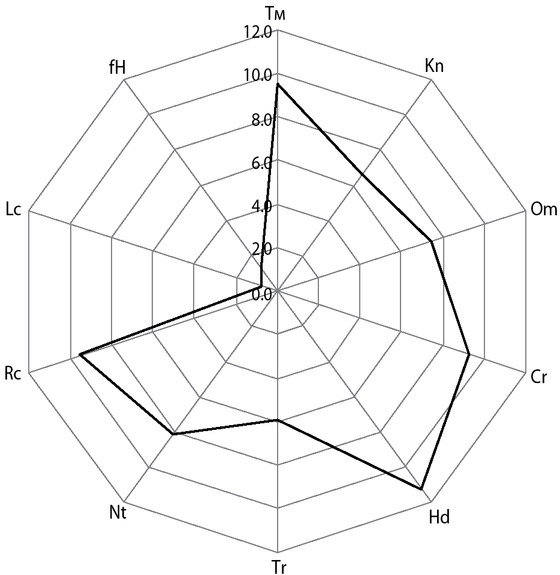
Figure 2
Ecological characteristics of the biotope on the phytoindication scales of Tsyganov, points
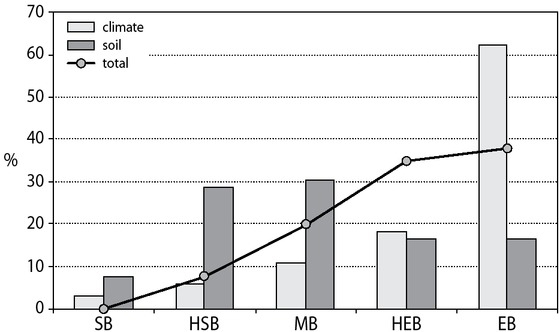
Figure 3
The ratio of grass tier species in relation to climatic and soil factors according to the index of ecological tolerance, where SB – stenobionts, HSB – hemistenobionts, MB – mesobionts, HEB – hemieuribionts, EB – euribiont species
Table 7
Distribution and status of birds nesting in FSB (pairs/ha)
| Species | № FSB | Protected categories | |||
|---|---|---|---|---|---|
| 1 | 2 | 3 | 4 | ||
| Milvus migrans Boddaert | 0.3 | Bk2; Bo1,2; W2, RBU | |||
| Columba palumbus L. | 1.7 | – | |||
| Streptopelia turtur L. | 3.3 | Bk3 | |||
| Cuculus canorus L. | 0.3 | Bk3 | |||
| Lanius collurio L. | 0.6 | Bk2 | |||
| Lanius minor Gmelin | 0.3 | Bk2 | |||
| Oriolus oriolus L. | 0.3 | 1.7 | Bk2 | ||
| Sturnus vulgaris L. | 1.7 | 1.7 | – | ||
| Sylvia atricapilla L. | 1.3 | 0.6 | 3.3 | Bk2 | |
| Sylvia borin Boddaert | 1.4 | Bk2 | |||
| Sylvia communis Latham | 0.3 | 1.7 | Bk2 | ||
| Phylloscopus collybita Vieillot | 0.6 | 0.6 | 3.3 | Bk2 | |
| Phylloscopus sibilatrix Bechstein | 0.3 | Bk2 | |||
| Ficedula albicollis Temminck | 0.6 | Bk2; Bo2 | |||
| Muscicapa striata Pallas | 0.3 | 1.7 | Bk2; Bo2 | ||
| Phoenicurus phoenicurus L. | 0.6 | 0.3 | Bk2; Bo2 | ||
| Erithacus rubecula L. | 0.6 | 0.9 | 5.0 | 3.3 | Bk2; Bo2 |
| Luscinia luscinia L. | 0.6 | 1.7 | Bk2; Bo2 | ||
| Turdus merula L. | 1.7 | 5.0 | Bk2; Bo2 | ||
| Turdus philomelos C.L. Brehm | 0.6 | 0.6 | 1.7 | Bk2; Bo2 | |
| Parus caeruleus L. | 0.6 | 0.9 | 3.3 | Bk2 | |
| Parus major L. | 1.9 | 2.9 | 5 | Bk2 | |
| Sitta europaea L. | 1.9 | 0.6 | 3.3 | Bk2 | |
| Certhia familiaris L. | 0.6 | 3.3 | Bk2 | ||
| Passer montanus L. | 1.4 | 1.7 | Bk3 | ||
| Fringilla coelebs L. | 1.3 | 2.3 | 3.3 | Bk3 | |
| Carduelis carduelis L. | 0.3 | Bk2 | |||
| Acanthis cannabina L. | 0.3 | Bk2 | |||
| Emberiza citrinella L. | 1.1 | Bk2 | |||
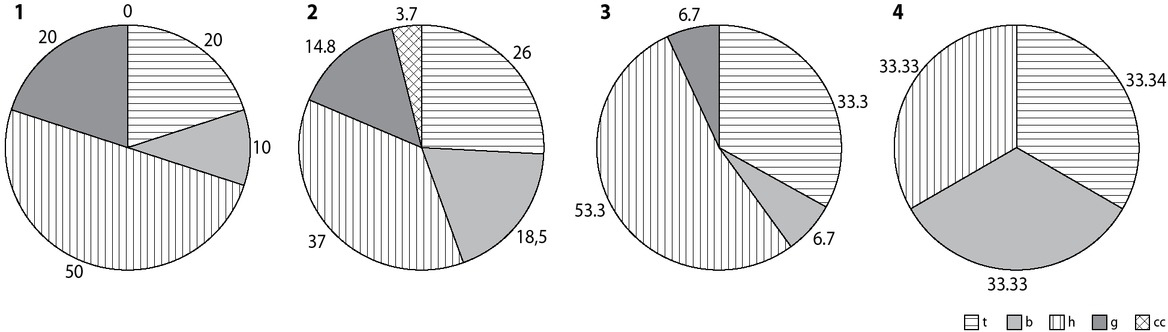
Figure 4
Distribution of birds by types of nesting strategy (%): t – crown-nesting, b – nest in understorey, h – hollow-nesting, g – terrestrial, cc – nesting parasite; 1, 2, 3, 4 – FSB
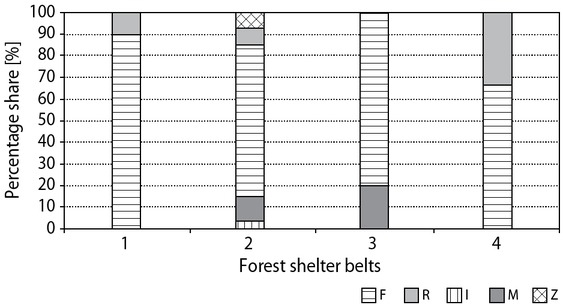
Figure 5
Distribution of birds by feeding types (%): F – predators, Z – zoophages, I – entomophages, M – phytoentomophages, R – phytophages