
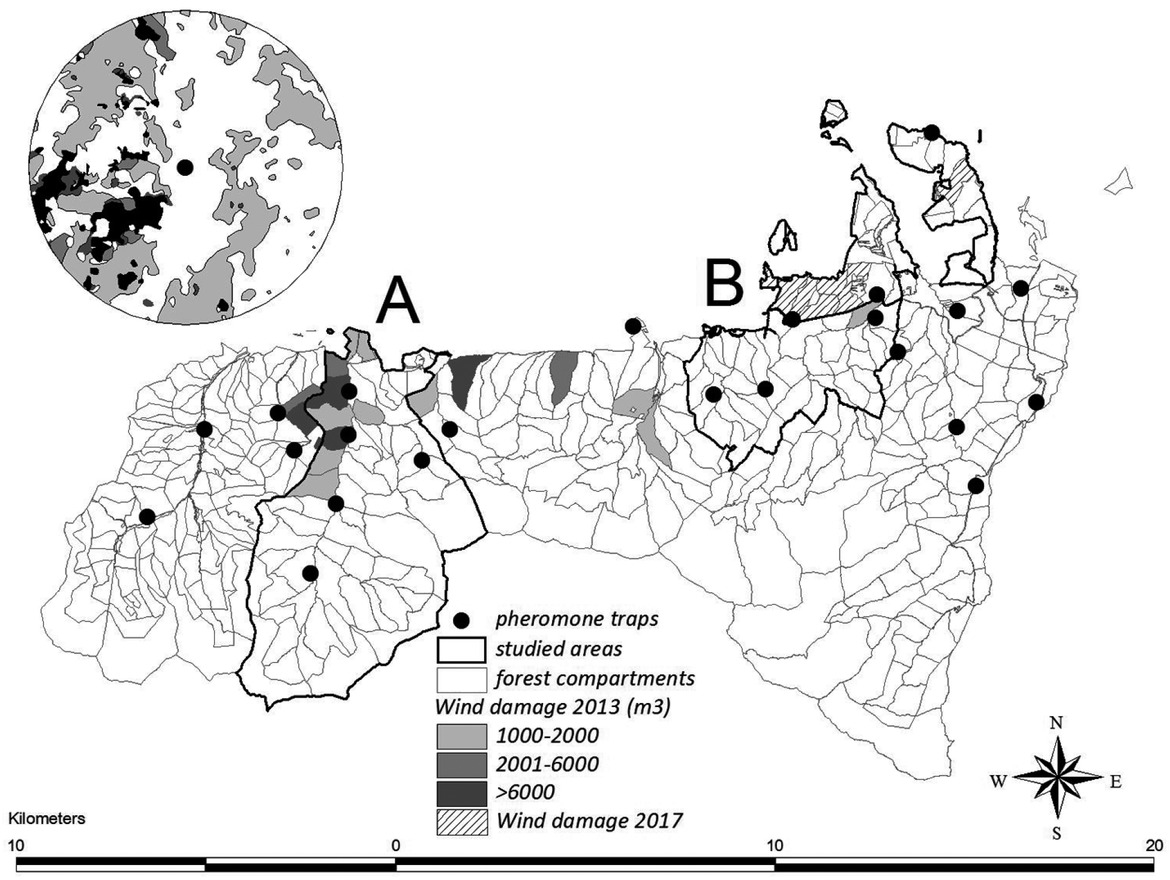
Figure 1
The area of the Tatra National Park with the location of pheromone traps and the “western” and “eastern” areas affected by wind damage used for the analysis; an example of spots with standing dead trees detected in the subsequent years in a circular zone of 500 m around the trap is shown in the upper left corner
Table 1
Area of detected occurrence of new standing dead trees detected in subsequent years in the concentric zones around the 23 locations of pheromone traps in the entire TPN area, using 100, 200 and 500 m radius
| Radius of concentric zone (m) | Area (ha) with standing dead trees within the zones in the year | |||||
|---|---|---|---|---|---|---|
| 2011 | 2012 | 2013 | 2014 | 2015 | 2017 | |
| 100 | 0.00 | 0.06 | 0.00 | 0.00 | 0.08 | 1.15 |
| 200 | 1.30 | 0.28 | 0.49 | 0.35 | 0.10 | 12.48 |
| 500 | 28.10 | 8.37 | 13.57 | 3.62 | 1.17 | 126.07 |
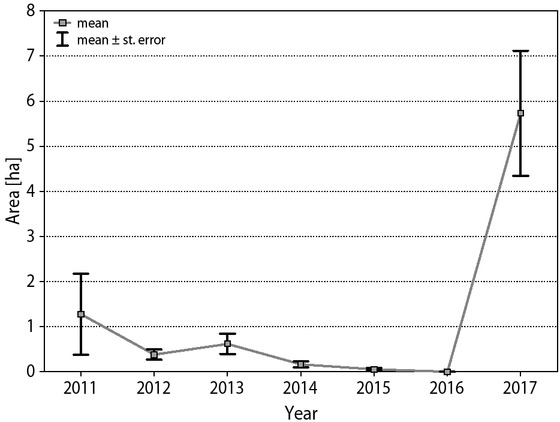
Figure 2
Mean area with standing dead trees detected in 500 m circular zone around 23 locations with the traps in the TPN area in individual years (2016 – no data)
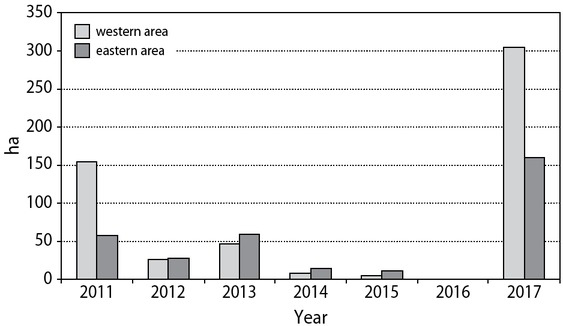
Figure 3
The total area with standing dead trees detected in the “western” and “eastern” area of study in individual years (2016 – no data)
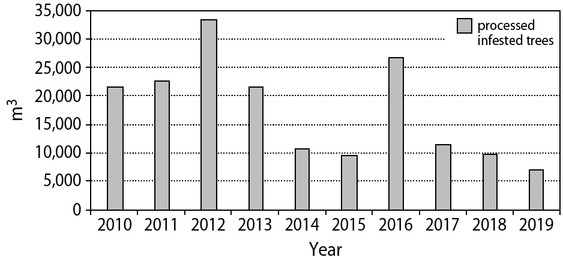
Figure 4
Volume of trees infested by bark beetles processed in the entire active protection zone of the Tatra National Park in the years 2010–2019
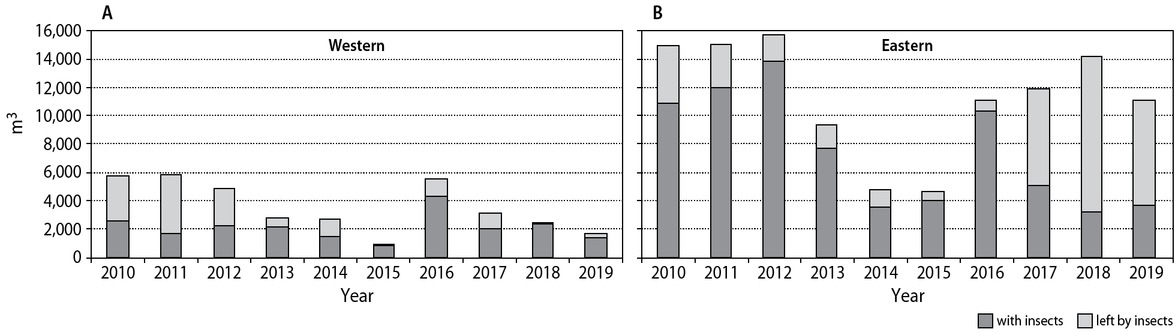
Figure 5
Volume of trees infested by bark beetles processed in the “western” (A) and “eastern” (B) area of study in individual years in 2010–2019
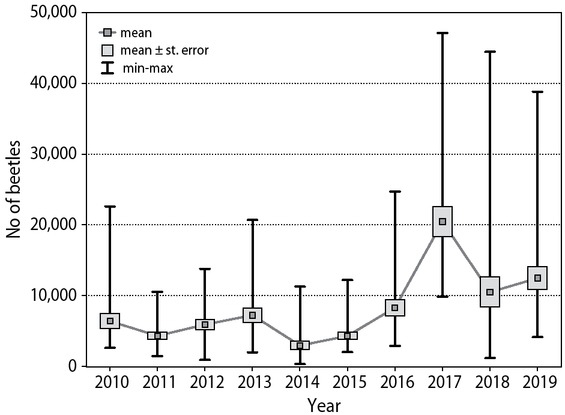
Figure 6
Mean number of I. typographus beetles captured in one trap in individual years, calculated from all 23 traps operated in the TPN
Table 2
Share of beetles captured in all the 23 pheromone traps in individual years till the end of June and July and correlation coefficients related to the captures from entire trapping period (May–August). All the correlations are significant at p < 0.01
| Year | Beetles captured till the end of June | Beetles captured till the end of July | ||
|---|---|---|---|---|
| share [%] | correlation r | share [%] | correlation r | |
| 2010 | 52.6 | 0.845 | 87.0 | 0.987 |
| 2011 | 57.3 | 0.980 | 86.4 | 0.998 |
| 2012 | 60.4 | 0.975 | 85.4 | 0.991 |
| 2013 | 49.8 | 0.916 | 76.2 | 0.980 |
| 2014 | 45.8 | 0.942 | 77.8 | 0.983 |
| 2015 | 23.6 | 0.815 | 79.9 | 0.964 |
| 2016 | 32.2 | 0.846 | 76.3 | 0.981 |
| 2017 | 31.8 | 0.519 | 71.6 | 0.969 |
| 2018 | 70.2 | 0.933 | 85.9 | 0.990 |
| 2019 | 54.7 | 0.935 | 81.6 | 0.969 |
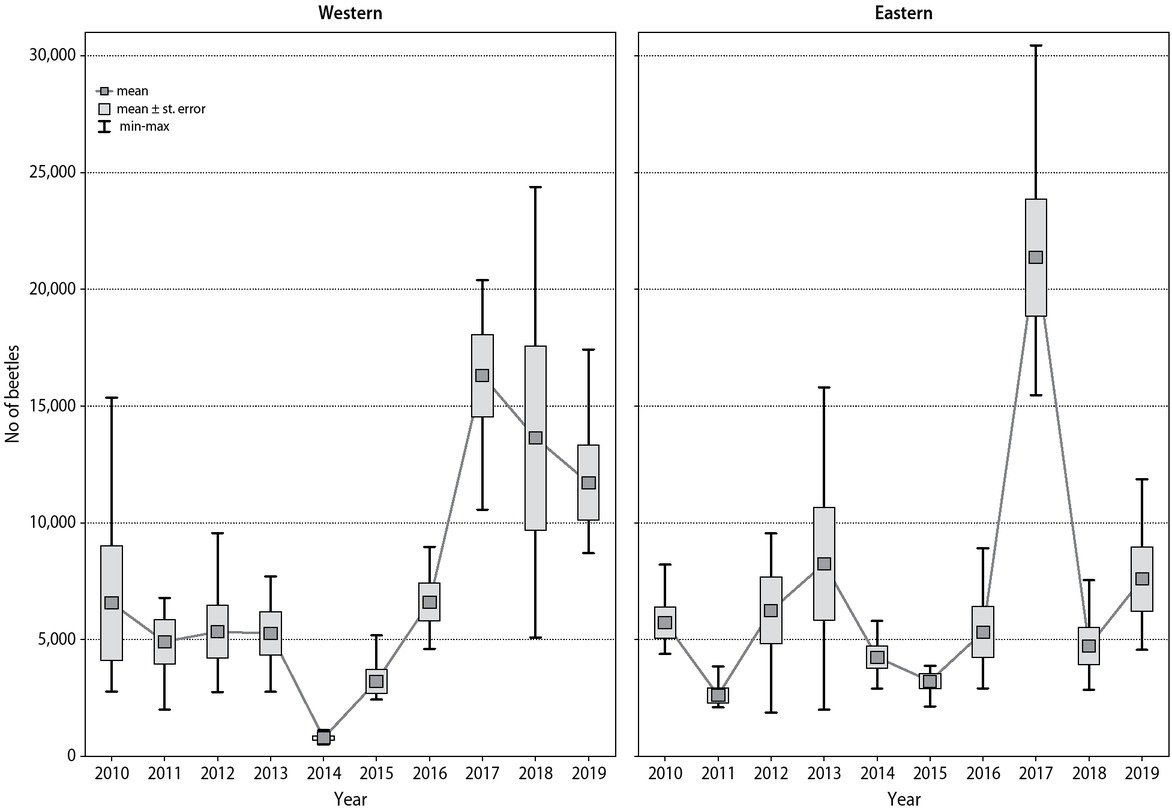
Figure 7
Mean number of I. typographus beetles captured in one trap in individual years, calculated for “western” (5 localities) and “eastern” (5 localities) study area in the TPN
Table 3
Spearman rank correlation coefficients between mean yearly captures per trap and tree mortality
| Tree mortality expressed by | Western area | Eastern area | ||
|---|---|---|---|---|
| rs | p | rs | p | |
| Area of spots with dead trees | 0.714 | n.s. | 0.657 | n.s. |
| Volume with and of left processed by insects trees | 0.018 | n.s. | 0.055 | n.s. |
| Volume with insects of processed trees | 0.430 | n.s. | 0.067 | n.s. |