
1. Practitioner Points
1.1. Clinical Vigilance
Healthcare providers should maintain a high index of suspicion for myasthenia gravis (MG) and myocarditis in patients receiving immune checkpoint inhibitors (ICIs). Timely recognition of symptoms is crucial for prompt intervention and improved outcomes. Implementing regular monitoring and surveillance for patients receiving ICIs is important, focusing on both early- and late-onset adverse events. Establishing a systematic approach to detect potential complications aids in timely intervention and minimizes treatment-related morbidity.
1.2. Multidisciplinary Collaboration
The complexity of ICI-induced MG and myocarditis warrants collaborative efforts between oncologists, neurologists, cardiologists and other specialists. A multidisciplinary approach ensures comprehensive patient assessment, accurate diagnosis and tailored management strategies.
1.3. Temporal Relationship
Understanding the temporal relationship between ICI administration and the onset of MG and myocarditis is essential. Some cases may present concurrently, while others may exhibit delayed manifestations. Clinicians should be attentive to diverse temporal patterns. The overlap in clinical manifestations between MG and myocarditis necessitates a thorough differential diagnosis. Differentiating symptoms, conducting relevant diagnostic tests and considering the possibility of concurrent occurrence are critical for accurate identification and management.
2. Introduction
Myasthenia gravis (MG) is an autoimmune disorder affecting neuromuscular junction with a wide range of clinical manifestations. In recent years, the advent of immune checkpoint inhibitors (ICIs) in cancer therapy has introduced a new layer of complexity to the understanding of MG. This introduction aims to comprehensively explore the intricate relationship between myasthenia gravis and checkpoint inhibitors, shedding light on the clinical implications, mechanisms and challenges associated with this emerging phenomenon.
The introduction of ICIs has revolutionized cancer treatment by unleashing the immune system to target cancer cells. However, the non-specific nature of this immunomodulation can lead to unintended consequences, such as the development of autoimmune disorders.
The literature has witnessed a growing number of reported cases where MG emerges as a side effect of checkpoint inhibitor therapy. This phenomenon challenges the conventional understanding of MG as a primarily idiopathic autoimmune disorder and prompts an exploration into the specific mechanisms triggering its onset in the context of ICIs.
Understanding the immunopathogenesis behind MG induced by checkpoint inhibitors is crucial. Mechanisms involving dysregulated T-cell activation, autoantibody production and disruption of neuromuscular junctions contribute to the manifestation of MG symptoms.
The overlap of symptoms between ICI-induced MG and traditional MG poses diagnostic challenges for clinicians. Distinguishing between drug-induced and idiopathic forms is crucial for appropriate management and treatment strategies.
Managing ICI-induced MG involves a delicate balance between controlling the autoimmune response and preserving the anti-tumour effects of the immunotherapy. This necessitates a multidisciplinary collaboration between oncologists, neurologists, immunologists and other healthcare providers to tailor treatment plans based on individual patient profiles.
The intersection of myasthenia gravis and immune checkpoint inhibitors represents a compelling area of exploration in both oncology and neurology. As the use of ICIs continues to grow, the medical community must remain vigilant in understanding, diagnosing and managing the unique challenges posed by ICI-induced MG. Further research is imperative to unravel the intricacies of this complex relationship and refine therapeutic approaches, ensuring the optimal balance between effective cancer treatment and the prevention of autoimmune complications.
3. Case Report
A 72-year-old man presented for routine pre-treatment evaluation complaining of progressive neck and bilateral lower limb weakness. The patient had been in his usual state of health and until the onset of symptoms three days prior. He also reported increased fatigue as well as new-onset dysarthria and dysphagia. He denied any dyspnoeas, chest pain or palpitations. On examination, there was dysarthria, bilateral ptosis and MRC Grade 2 weakness in neck extension. Upper limb power was Grade 5 initially but with evidence of fatigable weakness. Lower limb power was 4/5 proximally, also with evidence of fatigable weakness. Reflexes were within normal limits. Initial peak expiratory flow rate was 150L/min, and cardiorespiratory examination was otherwise unremarkable. Four weeks prior to presentation, he commenced adjuvant nivolumab for stage III melanoma. His other medical history included dyslipidaemia, obesity, osteoarthritis, obstructive sleep apnoea requesting continuous positive airway pressure therapy and bilateral total hip replacement. He did not have a personal or family history of autoimmune disease.
Electrocardiogram showed sinus rhythm with new-onset right bundle branch block without evidence of acute ischemia. Laboratory evaluation revealed a creatine kinase (CK) of 9520 with associated aspartate aminotransferase (AST) of 700 and alanine aminotransferase (ALT) of 441 as well as troponin I (Atellica) of 10678. Anti-cholinesterase receptor antibody and anti-muscle-specific kinase antibody were negative. Total white cell count was 11.2 associated with C-reactive protein (CRP) of 35 and erythrocyte sedimentation rate (ESR) of 65. Urgent computed tomography (CT) brain with contrast enhancement did not reveal any structural abnormalities. An echocardiogram was also performed, and this demonstrated normal biventricular function and no significant valvular pathology.
The patient was admitted to hospital, and on urgent neurology review, a diagnosis of severe immunotherapy-related myasthenia gravis (MG) with myasthenia gravis composite score (MGCS) of 24 was made. A cardiology opinion was also sought, and in consultation with the oncology team, the patient was diagnosed with immunotherapy-related myocarditis. In view of the concurrent multisystem involvement, an overall diagnosis of immunotherapy-related overlap system consisting of MG, myositis and myocarditis was made. Intravenous methylprednisolone 2 mg/kg/day and intravenous immunoglobulin (IVIG) 2g/kg over 5 days were commenced. The methylprednisolone dose was subsequently escalated to 1000 mg on Day 3.
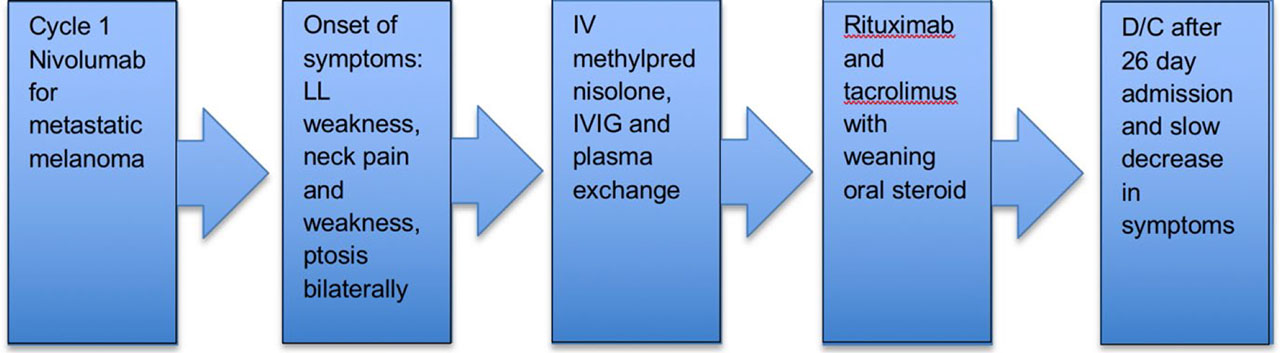
Figure 1:
Graphic timeline of events.
On Day 4 of admission, he reported little improvement. Examination revealed persistent bilateral ptosis with fatigability of the facial muscles, Grade 3 neck extension weakness and proximal weakness to Grade 4 in the lower limbs. There was no deterioration in peak expiratory flow rate and CK, and troponin I had improved markedly. In view of the mixed response, corticosteroid therapy was de-escalated to oral prednisolone 1 mg/kg (110 mg), and five sessions of plasma exchange (PLEX) were completed (admission Days 6, 7, 10, 12 and 14). An immunology consultation was sought, and oral tacrolimus (target trough level 8–12) was commenced during PLEX due to its rapid T-cell suppressing effect.
The patient reported subjective improvement during PLEX, and prednisolone was further tapered to 80 mg on Day 11. On completion of PLEX, the patient had no ptosis, Grade 4+ neck extension weakness and fatigable weakness of the proximal upper limbs only. Rituximab was planned but delayed due to a finding of variable hepatitis B core antibody positivity. Infectious disease consultation was sought, and entecavir 0.5 mg daily was commenced with advice to continue to 18 months post final rituximab infusion. Prednisolone was further reduced to 60 mg on Day 18 and 50 mg on Day 23 with a further taper of 10 mg every 2 weeks. Rituximab 1000 mg was administered intravenously on Day 25 with a further 1000 mg delivered after 7 days. The patient was discharged home on Day 26.
He continued to report non-progressive neck weakness and general fatigability during outpatient follow-up and was subsequently commenced on oral pyridostigmine, 60 mg twice daily. Due to ongoing symptoms at 7 weeks post discharge, he received re-induction IVIG 2 g/kg over 3 days. He reported an excellent but not complete response. Maintenance IVIG 1 g/kg monthly was continued, and prednisone tapering was slowed to 1 mg every 4 weeks once the patient reached a dose of 10 mg.
On further follow-up, IVIG frequency was increased to three weekly due to subjective deterioration in weakness between week three to four post IVIG. Further rituximab 1000 mg was administered at 6 and 12 months post discharge. Prednisone was not tapered beyond 5 mg, and at 12 months post discharge, tacrolimus was ceased and mycophenolate mofetil 1000 mg was added twice daily. The patient did not report further improvement in his general fatiguability despite these measures, though he remained functionally independent. He did not received further immunotherapy, and no evidence of recurrence has been identified on follow-up.
4. Discussion
A literature review was conducted to analyse published case reports exploring the intersection of immune checkpoint inhibitor (ICI) therapy with the concurrent development of myasthenia gravis (MG) and myocarditis. The findings reveal a growing body of evidence suggesting a complex interplay between these two immune-related adverse events (irAEs).
Multiple case reports highlight the co-occurrence of MG and myocarditis following ICI treatment, emphasizing the need for heightened awareness among clinicians.[1,2,3,4] The temporal relationship between the onset of these adverse events varies, with some cases presenting concurrently, while others manifest sequentially during or after ICI therapy.[3,5,6]
Published cases involve a range of ICIs, including anti-CTLA-4 and anti-PD-1/PD-L1 agents, indicating a potential class effect rather than drug-specific causality. The diversity in reported cases underscores the importance of understanding the broader immunomodulatory effects shared by different checkpoint inhibitors.[1,7]
MG and myocarditis often present with non-specific symptoms, contributing to diagnostic challenges. Weakness, dyspnoea and chest pain may be attributed to either condition, necessitating a multidisciplinary approach for accurate diagnosis. The overlap in clinical manifestations underscores the importance of comprehensive patient assessments.[3]
Mechanistic insights into the simultaneous development of MG and myocarditis are limited but suggest a shared immune dysregulation. The disruption of immune tolerance, T-cell activation and autoantibody production are implicated in both conditions, pointing towards a complex interplay of immunological pathways.[4,8]
The management of combined MG and myocarditis poses significant therapeutic challenges. Case reports describe the use of immunosuppressive agents, corticosteroids and, in severe cases, advanced interventions such as plasmapheresis. However, the heterogeneity in treatment approaches and outcomes highlights the need for personalized strategies based on the severity and specific manifestations of each case.[1,3]
The cumulative evidence from case reports underscores the importance of continued research into the pathophysiological mechanisms underlying the simultaneous occurrence of MG and myocarditis in the context of ICIs. This exploration is critical for refining diagnostic criteria, developing targeted therapies and optimizing patient outcomes.[2,5,6,9]
This synthesis of published case reports highlights the complex relationship between immune checkpoint inhibitor therapy, myasthenia gravis and myocarditis. While providing valuable insights into the clinical and mechanistic aspects, these reports also underscore the need for heightened vigilance, collaborative management and further research to unravel the intricacies of this emerging phenomenon.[4,6,7,10,11]
5. Conclusion
In summary, addressing the complexities of ICI-induced myasthenia gravis and myocarditis requires a nuanced approach, combining clinical vigilance, interdisciplinary collaboration and ongoing research efforts. These learning points serve as a guide for healthcare professionals navigating the challenges posed by these immune-related adverse events in the context of immune checkpoint inhibitor therapy.[12]