
Table 1:
Demographic characteristics of the population.
| Variables | Measurements |
|---|---|
| Age group, n (%) | |
| 21–30 | 33 (42.9%) |
| 31–40 | 34 (44.2%) |
| 41–50 | 9 (11.5%) |
| >50 | 1 (1.4%) |
| Sex, n (%) | |
| Female | 50 (64.9%) |
| Male | 27 (35.1%) |
| Living alone, n (%) | |
| Yes | 37 (48%) |
| No | 40 (52%) |
| Workplace location, n (%) | |
| Athens or Thessaloniki | 59 (76.6%) |
| Peloponnese | 5 (6.5%) |
| Central Greece/Thessalia/Epirus | 7 (9.1%) |
| Macedonia/Thrace | 1 (1.3%) |
| Greek islands | 1 (1.3%) |
| Living abroad | 4 (5.2%) |
| Workplace type, n (%) | |
| University Hospital | 42 (54.5%) |
| General Public Hospital | 15 (19.5%) |
| Anti-cancer Hospital | 8 (10.4%) |
| Private Clinic | 9 (11.7%) |
| Pharmaceutical company | 1 (1.3%) |
| Laboratory | 1 (1.3%) |
| Military Hospital | 4 (5.2%) |
| Specialty, n (%) | |
| Pathological Oncology | 68 (88.3%) |
| Oncology–Hematology | 3 (3.9%) |
| Research | 1 (1.3%) |
| Pathology | 3 (3.9%) |
| Nuclear medicine | 1 (1.3%) |
| Rural service | 1 (1.3%) |
| Specialty training, n (%) | |
| Completed | 28 (36.4%) |
| Undergoing | 49 (63.6%) |
| Years undergoing training, n (%) | |
| <2 | 14 (29.2%) |
| 2–4 | 22 (45.8%) |
| 5–6 | 12 (25%) |
| Years on practice post training, n (%) | |
| <5 | 23 (82.1%) |
| 5–10 | 3 (10.7%) |
| >10 | 2 (7.2%) |
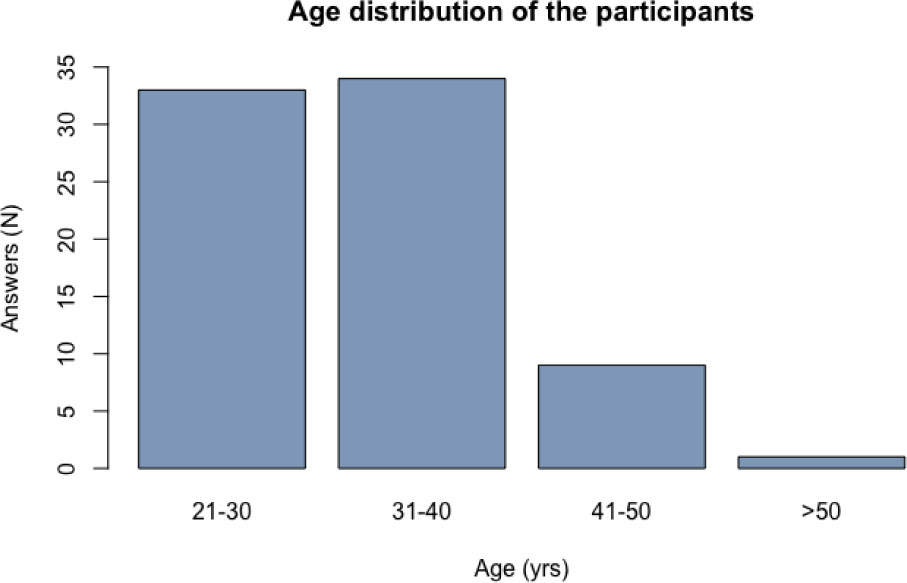
Figure 1:
Age distribution of the participants.
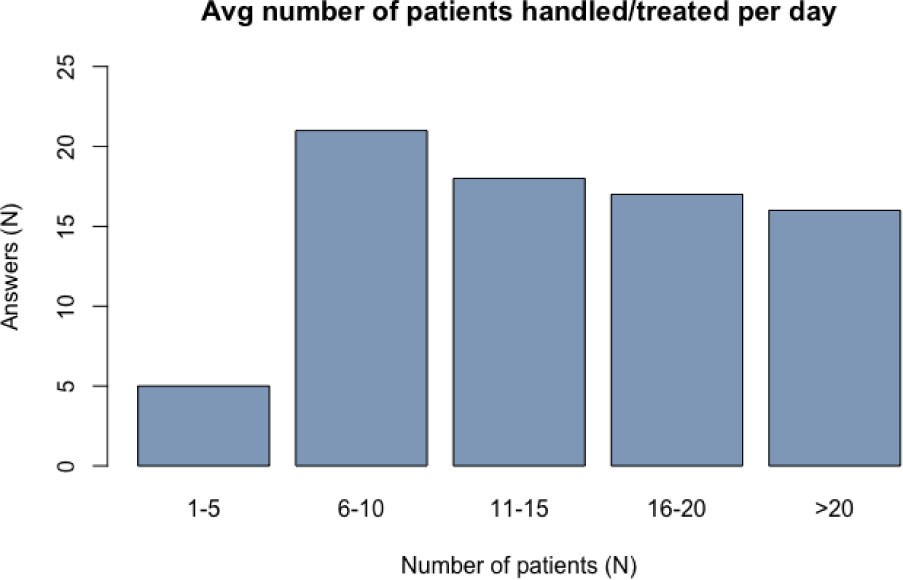
Figure 2:
Average number of patients handled/treated per day.
Table 2:
Clinical experiences of the population.
| Variables | Measurements |
|---|---|
| Average patients per day, n (%) | |
| 1–5 | 5 (6.5%) |
| 6–10 | 21 (27.3%) |
| 11–15 | 18 (23.4%) |
| 15–20 | 17 (22.1%) |
| 20 | 16 (20.7%) |
| Everyday life at work at pro COVID-19 levels, n (%) | |
| Yes | 25 (32.5%) |
| No | 52 (67.5%) |
| New duties during COVID-19? n (%) | |
| Yes, COVID-19 clinic duties | 18 (23.4%) |
| Yes, Partial change of duties | 39 (50.6%) |
| No | 20 (26.0%) |
| Duration of new duties, n (%) | |
| <1 month | 7 (9.0%) |
| 1–3 months | 16 (20.8%) |
| >3 months | 32 (41.6%) |
| No new duties | 22 (28.6%) |
| COVID-19 clinic duties, n (%) | |
| Yes, <3 months | 19 (24.6%) |
| Yes, >3 months | 25 (32.5%) |
| No | 33 (42.9%) |
| Remote patient consulting, n (%) | |
| Increase | 58 (75.3%) |
| Decrease | 0 (0.0%) |
| Unchanged | 19 (24.7%) |
| Remote (oncology) meetings, n (%) | |
| Increase | 61 (79.2%) |
| Decrease | 3 (3.2%) |
| Unchanged | 3 (16.9%) |
| Work from home, n (%) | |
| Yes | 28 (36.4%) |
| No | 49 (63.6%) |
| Working hours, n (%) | |
| Increase | 57 (74.0%) |
| Decrease | 2 (2.6%) |
| Unchanged | 18 (23.4%) |
| Overtime working hours, n (%) | |
| Increase | 53 (68.8%) |
| Decrease | 1 (1.3%) |
| Unchanged | 23 (29.9%) |
| Overnight shifts, n (%) | |
| Increase | 40 (51.9%) |
| Decrease | 0 (0.0%) |
| Unchanged | 37 (48.1%) |
| Overnight shifts during holidays, n (%) | |
| Increase | 34 (44.2%) |
| Decrease | 1 (1.3%) |
| Unchanged | 42 (54.5%) |
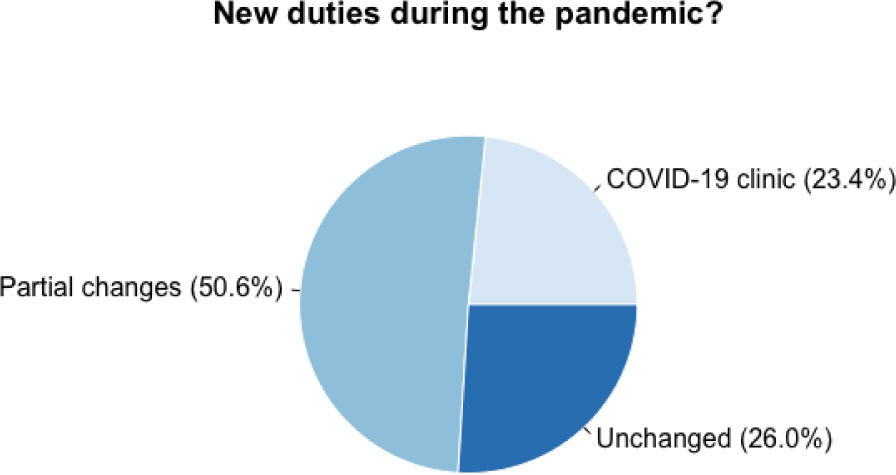
Figure 3:
New duties during the pandemic – as reported by the respondents.
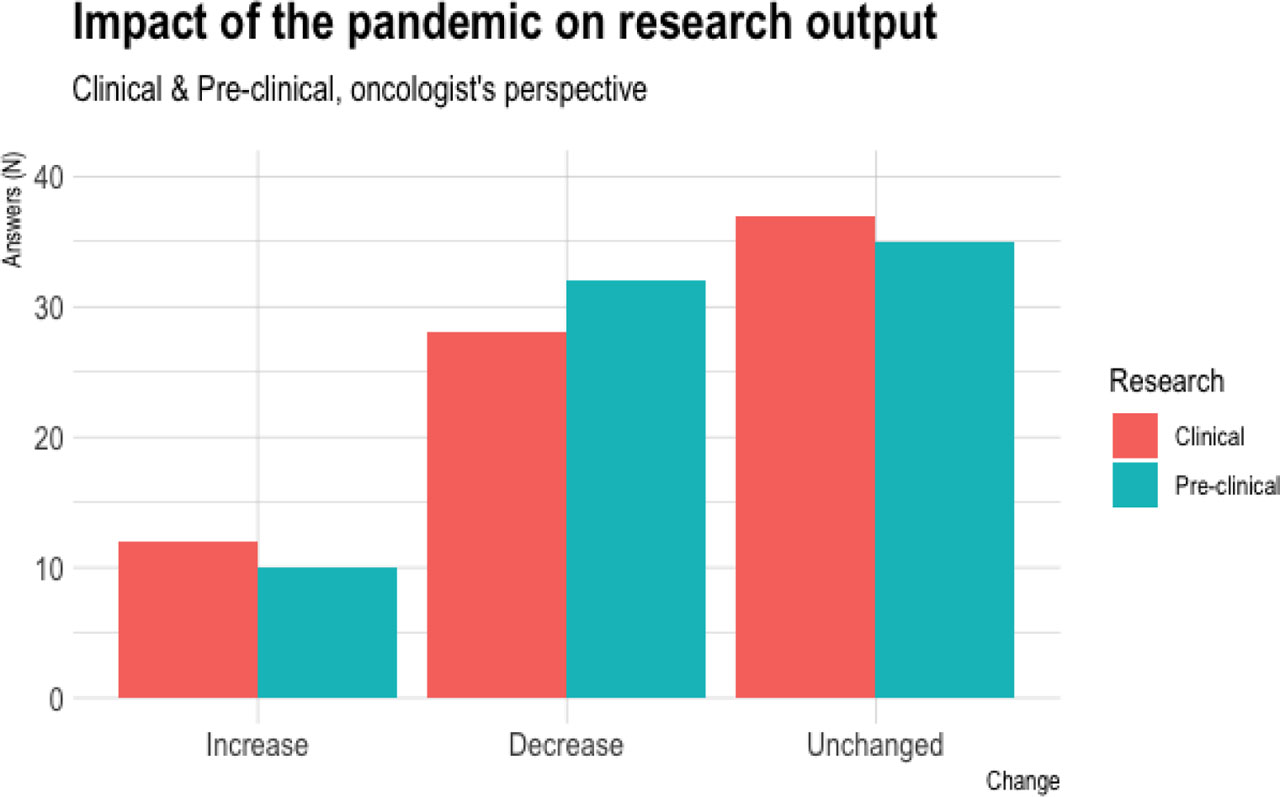
Figure 3:
Impact of the pandemic on clinical and pre-clinical research output.
Table 3:
Impact on research.
| Time allocated on clinical research (clinical trials), n (%) | |
| Increase | 12 (15.6%) |
| Decrease | 28 (36.4%) |
| Unchanged | 37 (48.1%) |
| Time allocated on pre-clinical research, n (%) | |
| Increase | 10 (12.9%) |
| Decrease | 32 (41.6%) |
| Unchanged | 35 (45.5%) |
| COVID-19 related pre-clinical/clinical research, n (%) | |
| Increase | 16 (20.8%) |
| Decrease | 13 (16.9%) |
| Unchanged | 48 (62.3%) |
Table 4:
COVID-19 first-line safety and fear of spread.
| Access to COVID-19 protective measures and equipment, n (%) | |
| Optimal | 14 (18.2%) |
| Sub-optimal | 47 (61.0%) |
| Sufficient | 13 (16.9%) |
| Insufficient | 3 (3.9%) |
| Fear of being infected with SARS-CoV-2 or spreading it during work, n (%) | |
| Constantly | 42 (54.5%) |
| Sometimes | 29 (37.7%) |
| Rarely | 3 (3.9%) |
| Never | 3 (3.9%) |
Table 5:
Participant's perceptions of the effects of the pandemic on their development.
| COVID-19 will adversely affect my professional training, n (%) | |
| Strongly agree | 30 (38.9%) |
| Agree | 32 (41.6%) |
| Disagree | 4 (5.2%) |
| Strongly disagree | 1 (1.3%) |
| Uncertain | 10 (13%) |
| COVID-19 will adversely affect my career, n (%) | |
| Strongly agree | 13 (16.9%) |
| Agree | 23 (29.9%) |
| Disagree | 15 (19.4%) |
| Strongly disagree | 3 (3.9%) |
| Uncertain | 23 (29.9%) |
| COVID-19 has had a detrimental effect on potential opportunities for observerships/fellowships, n (%) | |
| Strongly agree | 38 (49.4%) |
| Agree | 27 (35.1%) |
| Disagree | 5 (6.5%) |
| Strongly disagree | 0 (0.0%) |
| Uncertain | 7 (9.0%) |
Table 6:
Participants’ perception of the effects of the pandemic on their personal lives and habits.
| During the pandemic, I reassessed the value of work–life balance, n (%) | |
| Strongly agree | 25 (32.5%) |
| Agree | 38 (49.4%) |
| Disagree | 2 (2.6%) |
| Strongly disagree | 1 (1.3%) |
| Uncertain | 11 (14.2%) |
| Role of family during COVID-19, n (%) | |
| Supportive and helped in reducing stress | 22 (28.6%) |
| Elevated stress caused by concerns about the intra-family transmission of COVID-19 | 19 (24.7%) |
| I had to stay apart from my family for a period due to concerns about the transmission of SARS-CoV-2. | 26 (33.8%) |
| Neutral impact during the pandemic | 10 (12.9%) |
| Smoking during the pandemic, n (%) | |
| Started | 0 (0.0%) |
| Increased | 6 (7.8%) |
| Decreased | 8 (10.4%) |
| Stopped | 2 (2.6%) |
| Non-smoker | 61 (79.2%) |
| Alcohol during the pandemic, n (%) | |
| Started | 1 (1.3%) |
| Increased | 14 (18.2%) |
| Decreased | 10 (12.9%) |
| Stopped | 3 (3.9%) |
| Non-drinker | 49 (63.7%) |
| Psychotropic substances during the pandemic, n (%) | |
| Started | 1 (1.3%) |
| Increased | 0 (0.0%) |
| Decreased | 0 (0.0%) |
| Stopped | 0 (0.0%) |
| Non-user | 76 (98.7%) |
| Exercise during the pandemic, n (%) | |
| Started | 3 (3.9%) |
| Increased | 14 (18.2%) |
| Decreased | 40 (51.2%) |
| Stopped | 7 (9.1%) |
| Does not exercise | 13 (17.6%) |
| COVID-19 had a negative impact on sexual health, n (%) | |
| Strongly agree | 6 (7.8%) |
| Agree | 21 (27.3%) |
| Disagree | 23 (29.9%) |
| Strongly disagree | 4 (5.1%) |
| Uncertain | 23 (29.9%) |
| Sleep disorders during COVID-19, n (%) | |
| Strongly agree | 9 (11.7%) |
| Agree | 23 (29.9%) |
| Disagree | 23 (29.9%) |
| Strongly disagree | 7 (9.1%) |
| Uncertain | 15 (19.4%) |
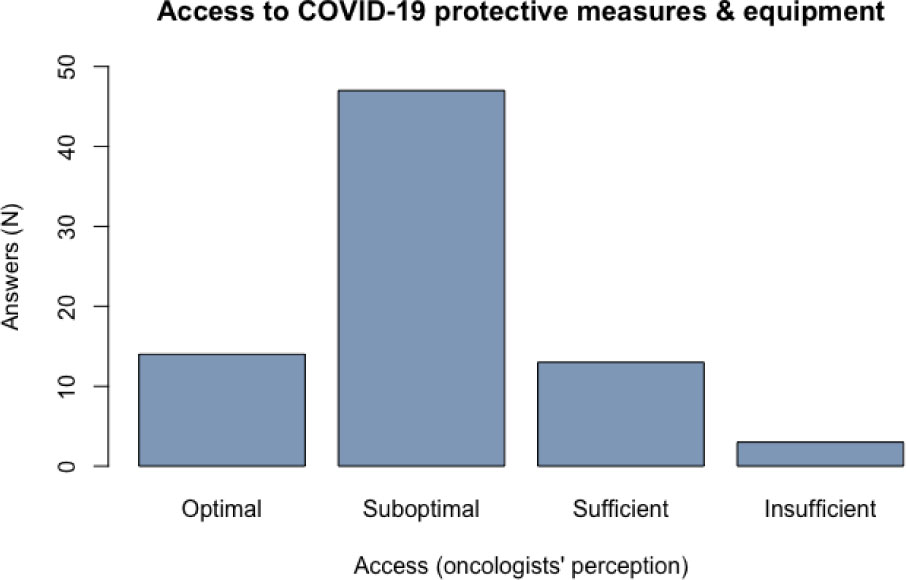
Figure 4:
Access to COVID-19 protective measures and equipment.
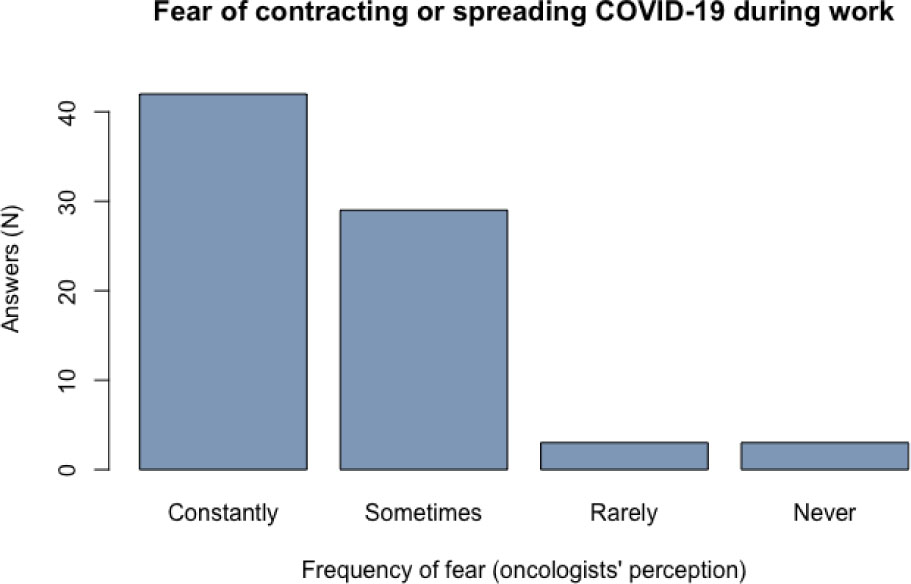
Figure 5:
Fear of contracting or spreading COVID-19 during work.