
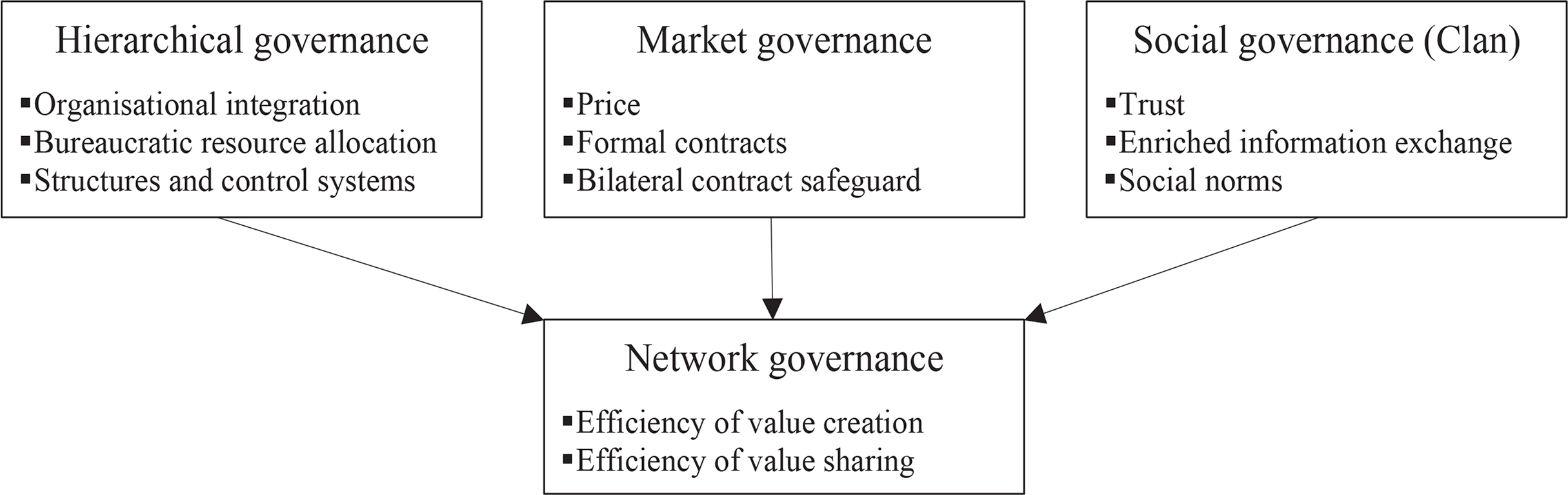
Fig. 1
Network as a plural form of governance
Source: (Czakon, 2012).
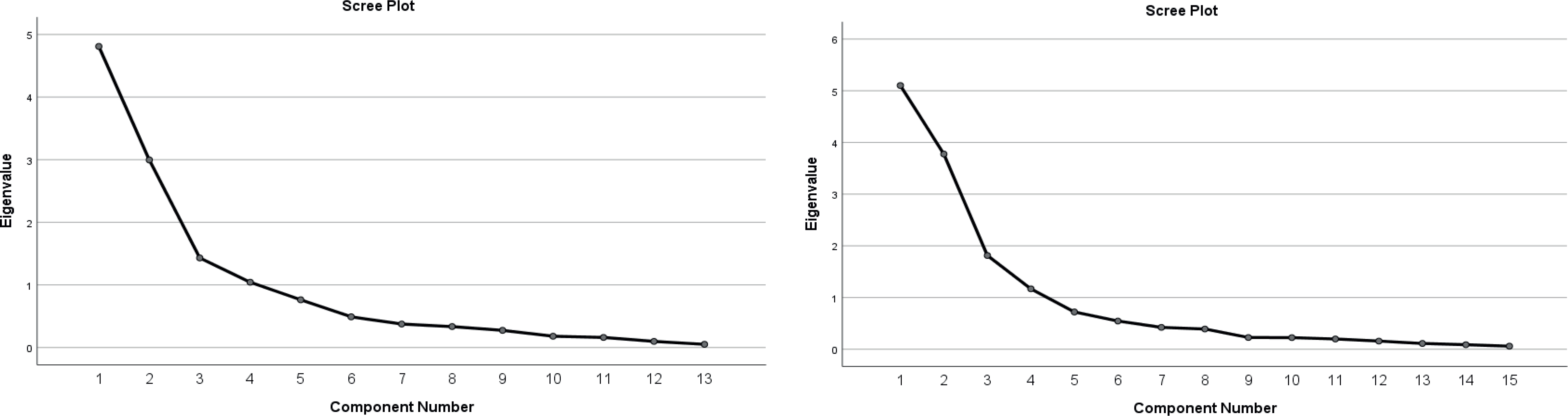
Fig. 2
Scree plots within two groups of variables (left for the upstream dyad, right for the downstream dyad)
Tab. 1
Rotated Component Matrices (left for the upstream dyad, right for the downstream dyad)
| Component | ||||
|---|---|---|---|---|
| HUD1 | HUD2 | MUD | CUD | |
| MUD_1 | 0.896 | |||
| MUD_2 | 0.715 | |||
| MUD_4 | 0.805 | |||
| MUD_5 | 0.870 | |||
| HUD_1 | 0.856 | |||
| HUD_2 | 0.790 | |||
| HUD_3 | 0.774 | |||
| HUD_4 | 0.716 | |||
| HUD_5 | 0.827 | |||
| HUD_6 | 0.867 | |||
| CUD_1 | 0.791 | |||
| CUD_2 | 0.781 | |||
| CUD_3 | 0.819 | |||
| Component | ||||
|---|---|---|---|---|
| M-C_DD | HDD1 | HDD2 | MDD | |
| MDD_1 | 0.895 | |||
| MDD_2 | 0.778 | |||
| MDD_3 | 0.756 | |||
| MDD_4 | 0.842 | |||
| MDD_5 | 0.802 | |||
| HDD_1 | 0.853 | |||
| HDD_2 | 0.910 | |||
| HDD_3 | 0.611 | |||
| HDD_4 | 0.856 | |||
| HDD_5 | 0.848 | |||
| HDD_6 | 0.849 | |||
| CDD_1 | 0.749 | |||
| CDD_2 | 0.659 | |||
| CDD_3 | 0.891 | |||
| CDD_4 | 0.930 | |||
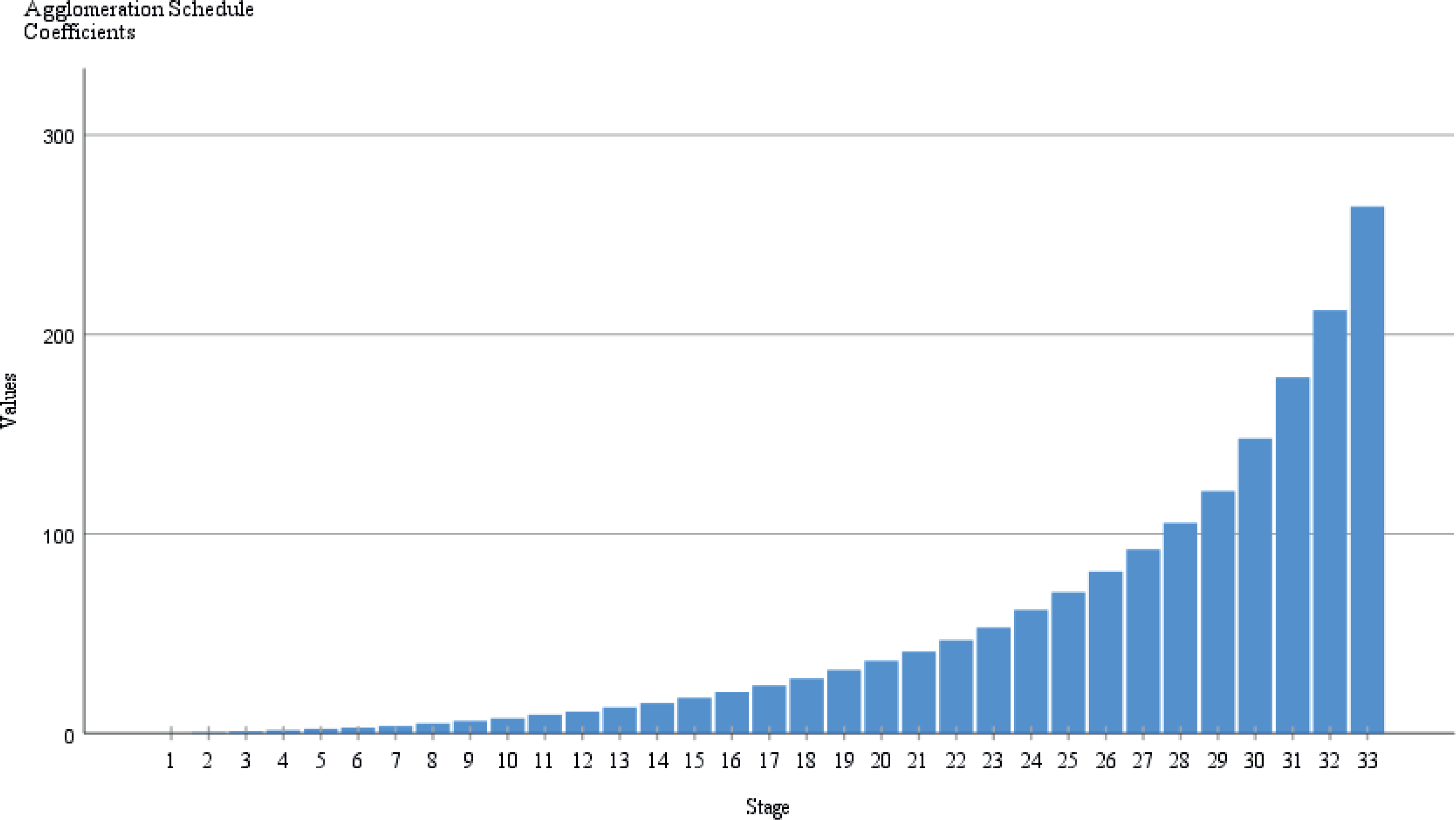
Fig. 3
Agglomeration schedule coefficients
Tab. 2
Contingency table
| K-means Cluster Analysis | Total | ||||
|---|---|---|---|---|---|
| Clusters | 1 | 2 | 3 | ||
| Hierarchical Cluster Analysis | 1 | 11 | 12 | 0 | 23 |
| 2 | 0 | 5 | 2 | 7 | |
| 3 | 0 | 0 | 4 | 4 | |
| Total | 11 | 17 | 6 | 34 | |
Tab. 3
Kruskal-Wallis H Test for the network governance constructs in three clusters
| HUD1 | HUD2 | MUD | CUD | M-C_DD | HDD1 | HDD2 | MDD | |
|---|---|---|---|---|---|---|---|---|
| Kruskal-Wallis H | 6.490 | 15.305 | 14.183 | 5.368 | 10.805 | 2.965 | 8.185 | 17.475 |
| df | 2 | 2 | 2 | 2 | 2 | 2 | 2 | 2 |
| Asymp. Sig. | 0.039 | 0.000 | 0.001 | 0.068 | 0.005 | 0.227 | 0.017 | 0.000 |
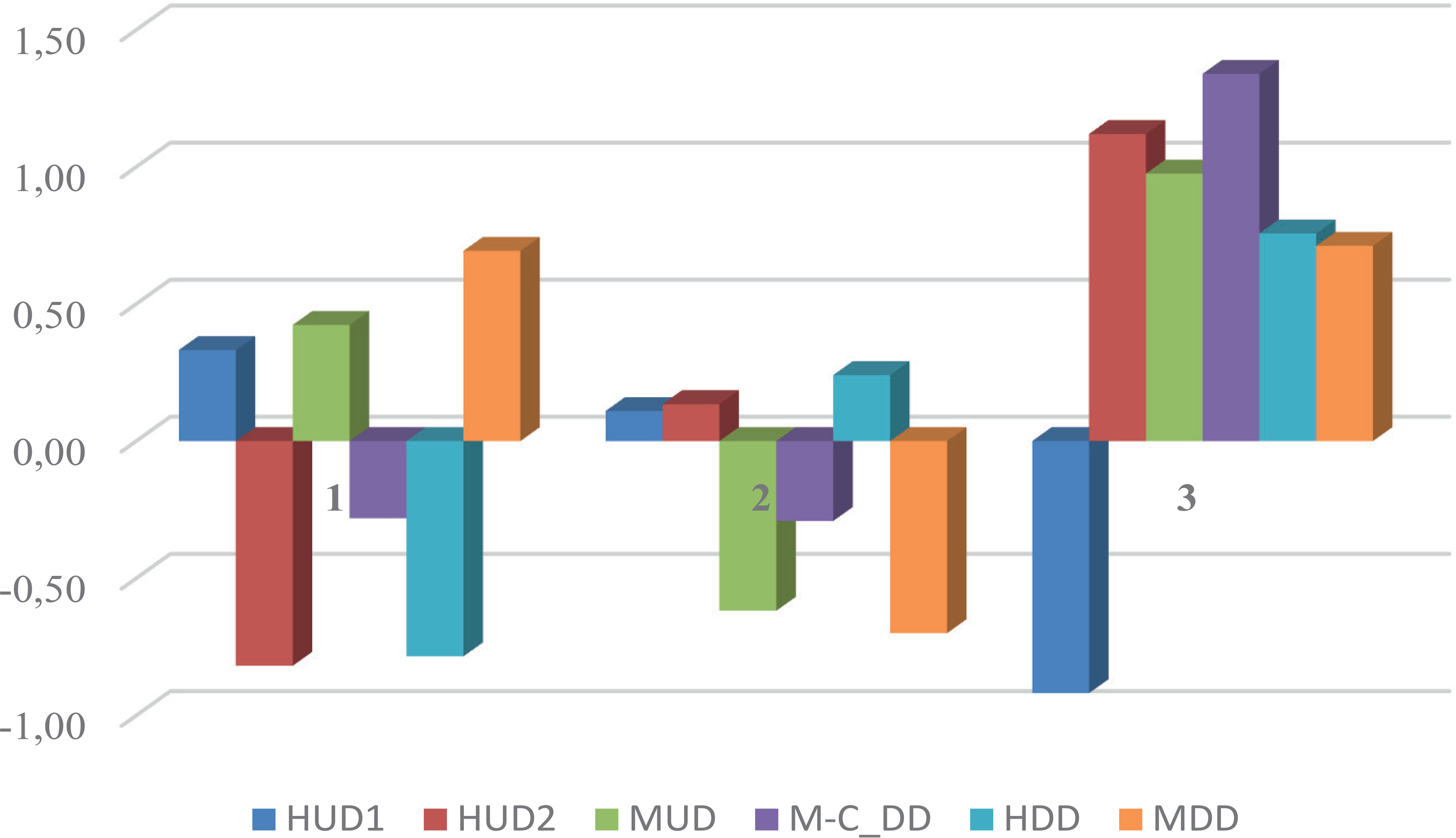
Fig. 4
Characteristics of clusters regarding the intensity of network governance
Tab. 4
Mann-Whitney U test statistics for clusters
| Cluster | Relational benefits in the upstream dyad | Relational benefits in the downstream dyad | |
|---|---|---|---|
| Market governance - Low hierarchical governance | Mann-Whitney U | 80.000 | 67.000 |
| Wilcoxon W | 146.000 | 133.000 | |
| Z | −0.635 | −1.247 | |
| Asymp. Sig. (2-tailed) | 0.525 | 0.212 | |
| Market governance - Network governance | Mann-Whitney U | 5.000 | 3.000 |
| Wilcoxon W | 71.000 | 69.000 | |
| Z | −2.814 | −3.017 | |
| Asymp. Sig. (2-tailed) | 0.005 | 0.003 | |
| Low hierarchical governance - Network governance | Mann-Whitney U | 10.000 | 8.000 |
| Wilcoxon W | 163.000 | 161.000 | |
| Z | −2.871 | −3.011 | |
| Asymp. Sig. (2-tailed) | 0.004 | 0.003 |
Tab. 5
Mann-Whitney U test ranks for clusters
| Cluster | N | Mean Rank | Sum of Ranks | |
|---|---|---|---|---|
| Relational benefits in the upstream dyad | Market governance | 11 | 13.27 | 146.00 |
| Low hierarchical governance | 17 | 15.29 | 260.00 | |
| Total | 28 | |||
| Relational benefits in the downstream dyad | Market governance | 11 | 12.09 | 133.00 |
| Low hierarchical governance | 17 | 16.06 | 273.00 | |
| Total | 28 | |||
| Relational benefits in the upstream dyad | Market governance | 11 | 6.45 | 71.00 |
| Network governance | 6 | 13.67 | 82.00 | |
| Total | 17 | |||
| Relational benefits in the downstream dyad | Market governance | 11 | 6.27 | 69.00 |
| Network governance | 6 | 14.00 | 84.00 | |
| Total | 17 | |||
| Relational benefits in the upstream dyad | Low hierarchical governance | 17 | 9.59 | 163.00 |
| Network governance | 6 | 18.83 | 113.00 | |
| Total | 23 | |||
| Relational benefits in the downstream dyad | Low hierarchical governance | 17 | 9.47 | 161.00 |
| Network governance | 6 | 19.17 | 115.00 | |
| Total | 23 | |||
Tab. 6
Kruskal-Wallis Test Statistics for three clusters
| Supply Chain Performance | |
|---|---|
| Kruskal-Wallis H | 11.203 |
| df | 2 |
| Asymp. Sig. | 0.004 |
| Cluster | N | Mean Rank | |
|---|---|---|---|
| Supply Chain Performance | Market governance | 11 | 16.18 |
| Low hierarchical governance | 17 | 14.06 | |
| Network governance | 6 | 29.67 | |
| Total | 34 |
Tab. 7
Mann-Whitney U test statistics for clusters
| Cluster | Supply Chain Performance | |
|---|---|---|
| Market governance - Low hierarchical governance | Mann-Whitney U | 79.000 |
| Wilcoxon W | 232.000 | |
| Z | −0.683 | |
| Asymp. Sig. (2-tailed) | 0.494 | |
| Market governance - Network governance | Mann-Whitney U | 4.000 |
| Wilcoxon W | 70.000 | |
| Z | −2.922 | |
| Asymp. Sig. (2-tailed) | 0.003 | |
| Low hierarchical governance - Network governance | Mann-Whitney U | 7.000 |
| Wilcoxon W | 160.000 | |
| Z | −3.081 | |
| Asymp. Sig. (2-tailed) | 0.002 |
Tab. 8
Mann-Whitney U test ranks for clusters
| Cluster | N | Mean Rank | Sum of Ranks | |
|---|---|---|---|---|
| Supply Chain Performance | Market governance | 11 | 15.82 | 174.00 |
| Low hierarchical governance | 17 | 13.65 | 232.00 | |
| Total | 28 | |||
| Market governance | 11 | 6.36 | 70.00 | |
| Network governance | 6 | 13.83 | 83.00 | |
| Total | 17 | |||
| Low hierarchical governance | 17 | 9.41 | 160.00 | |
| Network governance | 6 | 19.33 | 116.00 | |
| Total | 23 | |||
| Categories | No. | Abbreviation | Question |
|---|---|---|---|
| Please rate the relational performance of a dyad with reference to company B in each of the following areas: (1—‘strongly disagree’, 3—‘neutral’, 5—‘strongly agree’) | |||
| 1. Relational benefits of upstream / downstream | 1.1. | RB_UD_1/RB_DD_1 | Two companies are more profitable or more competitive together than they would have been alone |
| 1.2. | RB_UD_2/RB_DD_2 | The benefits derived from the combination must be greater than the capabilities of each individual | |
| 1.3. | RB_UD_3/RB_DD_3 | Working with B has allowed overcoming some problems, and thus derive substantial benefits for the dyad | |
| 1.4. | RB_UD_4/RB_DD_4 | Sharing opinion and discussion with B often lead to increased benefits for both actors of the dyad | |
| 1.5. | RB_UD_5/RB_DD_5 | The ongoing costs of coordination of a dyadic relationship are balanced by its benefits | |
| Please rate your customer-focused performance to measure customer satisfaction in each of the following areas: (1—‘strongly disagree’, 3—‘neutral’, 5—‘strongly agree’) | |||
| 2. Supply chain performance | 2.1. | SP_1 | The customers are satisfied with the product quality |
| 2.2. | SP_2 | The customers are satisfied with the product conformance to the market expectations | |
| 2.3. | SP_3 | The customers are satisfied with the product volume/variety/flexibility | |
| 2.4. | SP_4 | The customers are satisfied with manufacturing efficiency | |
| 2.5. | SP_5 | The customers are satisfied with the product development cycle time | |
| 2.6. | SP_6 | The customers are satisfied with the response to changes in manufacturing | |
| Please rate mechanisms of network governance with reference to company B in the following areas: (1—‘strongly disagree’, 3—‘neutral’, 5—‘strongly agree’) | |||
| 3. Market | 3.1. | MUD_1/MDD_1 | The price is a predominant factor that determines my collaboration with B |
| 3.2. | MUD_2/MDD_2 | My company is very active in searching for new partners who can potentially substitute B | |
| 3.3. | MUD_3/MDD_3 | My company can easily switch to another partner, dropping out of the collaboration with B | |
| 3.4. | MUD_4/MDD_4 | The goods delivered by my company to B can be easily delivered by my competitors | |
| 3.5. | MUD_5/MDD_5 | My company keeps reminding our partner that it can be easily replaced if it does not offer good deals | |
| 4. Hierarchy | 4.1. | HUD_1/HDD_1 | My company very actively interferes in the operations performed by B |
| 4.2. | HUD_2/HDD_2 | My company controls B using certain formal methods | |
| 4.3. | HUD_3/HDD_3 | My company would be exposed to high costs when switching from B | |
| 4.4. | HUD_4/HDD_4 | My company provides B with formal guidelines concerning how to solve problems and/or deal with disruptions | |
| 4.5. | HUD_5/HDD_5 | My company resolves ongoing disputes with B by referring to clauses in signed contracts | |
| 4.6. | HUD_6/HDD_6 | My company tends to closely monitor opportunistic behaviours of partner B, such as ignorance of responsibilities, price inflation, late deliveries and partial information disclosure | |
| 5. Clan | 5.1. | CUD_1/CDD_1 | My company strives to build trust and a sense of community by organising meetings and training to encourage B to be empathic and have a mutual understanding |
| 5.2. | CUD_2/CDD_2 | My company maintains a discussion with B concerning all relevant issues of its operations and strategy | |
| 5.3. | CUD_3/CDD_3 | My company keeps trying to develop trust with B | |
| 5.4. | CUD_4/CDD_4 | Disruptions in collaboration with B are productively resolved in the spirit of mutual understanding | |