
Tab. 1
Comparison of selected process reengineering methods
| PROCEDURE | METHODOLOGY BY HAMMER AND CHAMPY | METHODOLOGY BY DAVENPORT | METHODOLOGY BY MANGANELLI AND KLEIN | METHODOLOGY BY KODAK |
|---|---|---|---|---|
| Project preparation | Introduction to reengineering | Vision and goals | Preparation of project | Initiation of a project |
| Identification of business processes | Identification of business processes | Identification of project | ||
| Choosing business processes for reengineering | ||||
| Process reconstruction | Knowledge of selected business processes | Knowledge and measurement of processes | Vision | Knowledge of processes |
| Redesign of selected business processes | Information technologies | Redesign - technical - personnel | Design of new processes | |
| Implementation | Implementation of new business processes | Prototyping processes | Transformation | Transformation of the business |
| Implementation processes | Change management |
Tab. 2
Six phases of the Hammer and Champy methodology
| PHASE | OBJECTIVE |
|---|---|
| Introduction into business reengineering | The “case for action” is a description of the organisation’s business problem and current situation; it justifies the need for change. The “vision statement” describes how the organisation is going to operate and outlines the kind of results it must achieve. The top management should inform other employees about the visions |
| Identification of business processes | In this step, the most important business processes are identified and are described from a global perspective using a set of process maps. Process maps give a picture of the workflows through the company. The output of this phase is a number of process maps reflecting how these high-level processes interact within the company and in relation to the outside world |
| Selection of business processes | Candidates for reengineering are the most problematic processes, those with great impact on customers, processes with more chances to be successfully re-engineered or processes that contribute to the organisation’s objectives. According to an organisation’s strategic objectives, more criteria could be defined for selecting processes for redesign, such as increased customer value |
| Understanding of selected business process | The reengineering team needs to gain a better understanding of the existing selected processes. The objective is the provision of a high-level view of the process under consideration, for the team members to have the intuition and insight required to create a totally new and superior design |
| Redesign of the selected business processes | This is the most creative phase of the methodology because new rules and new ways of work should be invented. Imagination and inductive thinking should characterise this phase. Redesigning a process is not algorithmic or routine |
| Implementation of redesigned business processes | The last phase covers the implementation phase of the BPR project. Hammer and Champy believe that the success of the implementation depends on whether the five previous phases have been properly performed |
[i] Source: elaborated by the authors according to (Hammer and Champy, 2000).
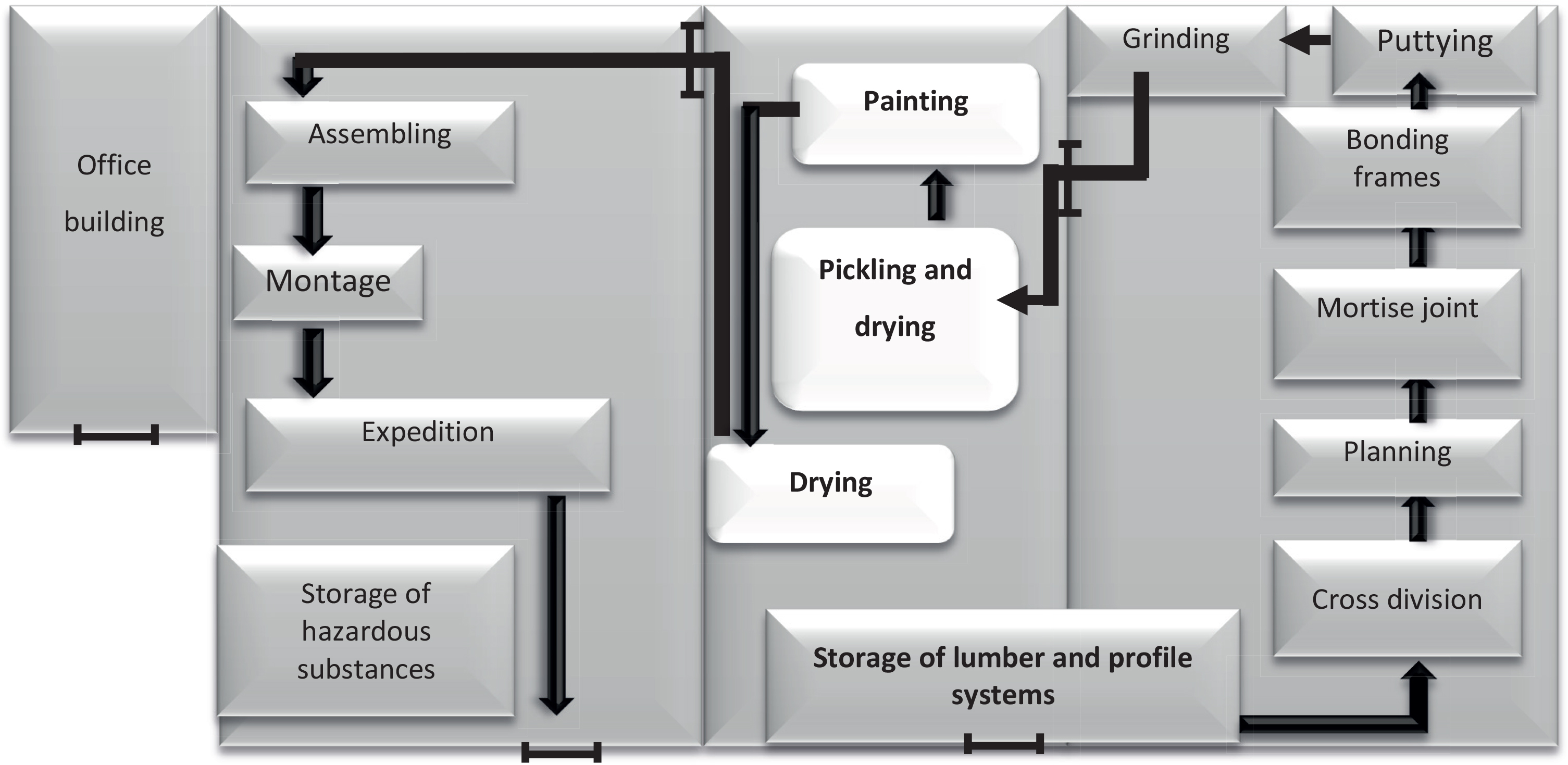
Fig. 1
Process map before reengineering
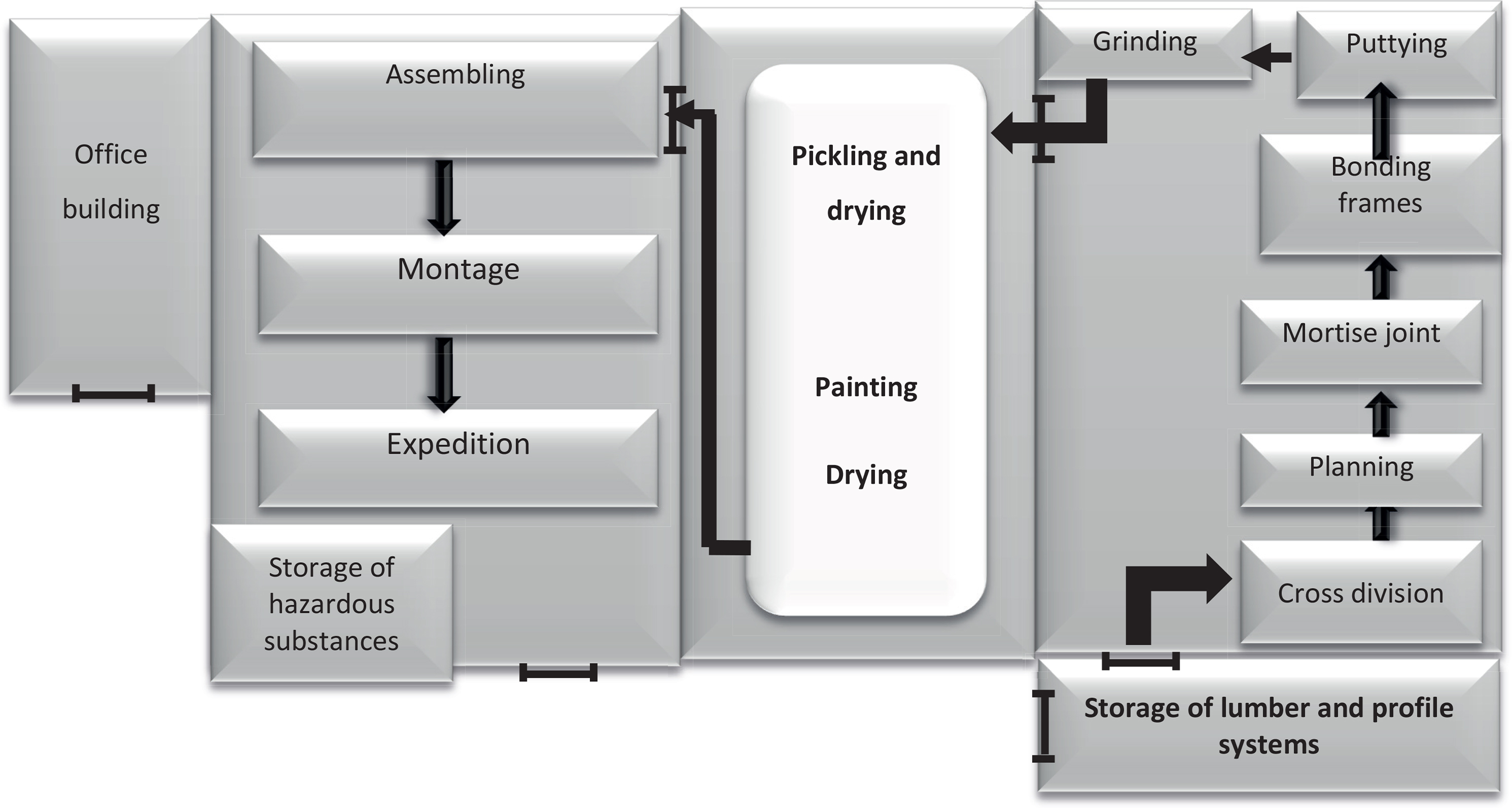
Fig. 2
Process map after reengineering
Tab. 3
Profitability ratios
| PROFITABILITY RATIOS | 2015 | 2016 | 2017 | 2018 |
|---|---|---|---|---|
| Return on assets ROA | 1.36 | 1.24 | 1.17 | 2.26 |
| Return on equity ROE | 17.80 | 17.48 | 8.11 | 43.73 |
| Return on net assets RONA | 0.63 | 0.84 | 0.82 | 0.71 |
| Return on share capital ROSC | 1.36 | 1.12 | 1.10 | 1.76 |
| Return on sales ROS | 1.07 | 0.72 | 0.78 | 1.31 |
Tab. 4
Activity indicators
| ACTIVITY INDICATORS | 2015 | 2016 | 2017 | 2018 |
|---|---|---|---|---|
| Total Assets Turnover [year] | 1.04 | 1.39 | 1.22 | 1.40 |
| Inventory turnover [days] | 223.30 | 224.70 | 245.30 | 254.40 |
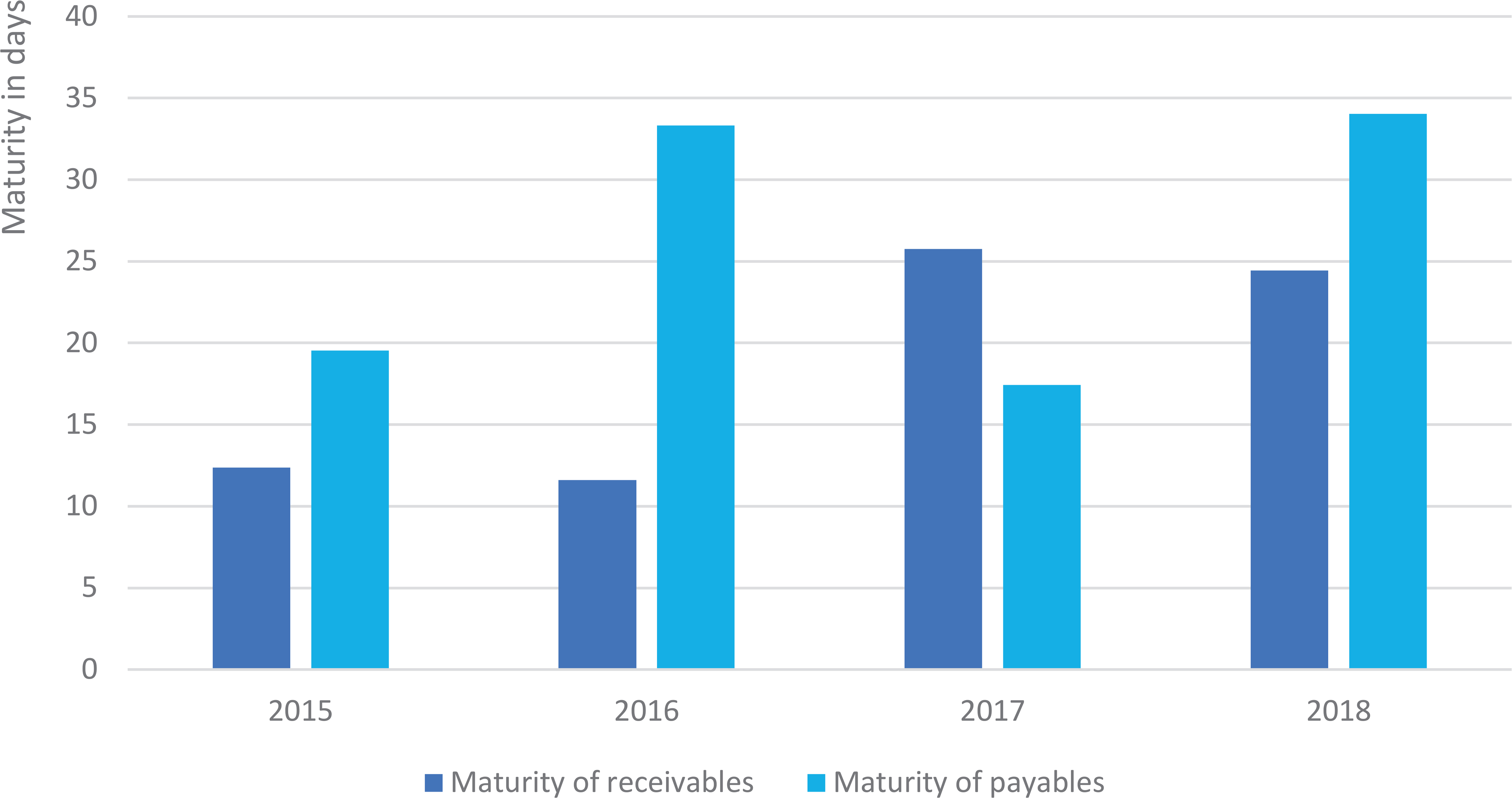
Fig. 3
Maturity of receivables and payables
Tab. 5
Debt indicators
| DEBT INDICATORS | 2015 | 2016 | 2017 | 2018 |
|---|---|---|---|---|
| Degree of self-financing | 4.10 | 4.03 | 7.66 | 2.29 |
| Total indebtedness | 95.90 | 95.97 | 92.35 | 97.71 |
| Financial leverage | 16.10 | 17.36 | 8.52 | 23.89 |
Tab. 6
Cash-flow indicators
| CASH FLOW INDICATORS [€] | 2015 | 2016 | 2017 | 2018 |
|---|---|---|---|---|
| Operating Cash-Flow | −73 272.00 | 179 586.45 | 65 968.79 | 54 562.31 |
| Cash-Flow from investment activities | 42 104.36 | 449 178.38 | 7 594.80 | 13 604.33 |
| Cash-Flow from financial activities | 46 120.45 | 519 247.68 | − 30 752.48 | 64 534.17 |
| Total-Cash Flow | 14 952.81 | 1 148 012.51 | 42 811.11 | 132 700.81 |
Tab. 7
EVA indicator, net working capital and cost of foreign capital
| EVA INDICATOR [€] | 2015 | 2016 | 2017 | 2018 |
|---|---|---|---|---|
| Net operating profit after tax NOPAT | 9 402.77 | 12 380.59 | 13 189.21 | 9 933.77 |
| Net working capital | 565 865.00 | 643 429.00 | 739 108.00 | 678 921.00 |
| Net Operating Assets NOA | 1 395 870.00 | 1 187 149.00 | 1 340 456.00 | 1 320 861.00 |
| Cost of foreign capital | 3.60 | 3.69 | 3.60 | 3.59 |
| Weighted Average Cost of Capital WACC | 0.41 | 0.42 | 1.02 | 0.66 |
| EVA | 3 676.00 | 7 558.00 | −508.00 | 1 281.00 |
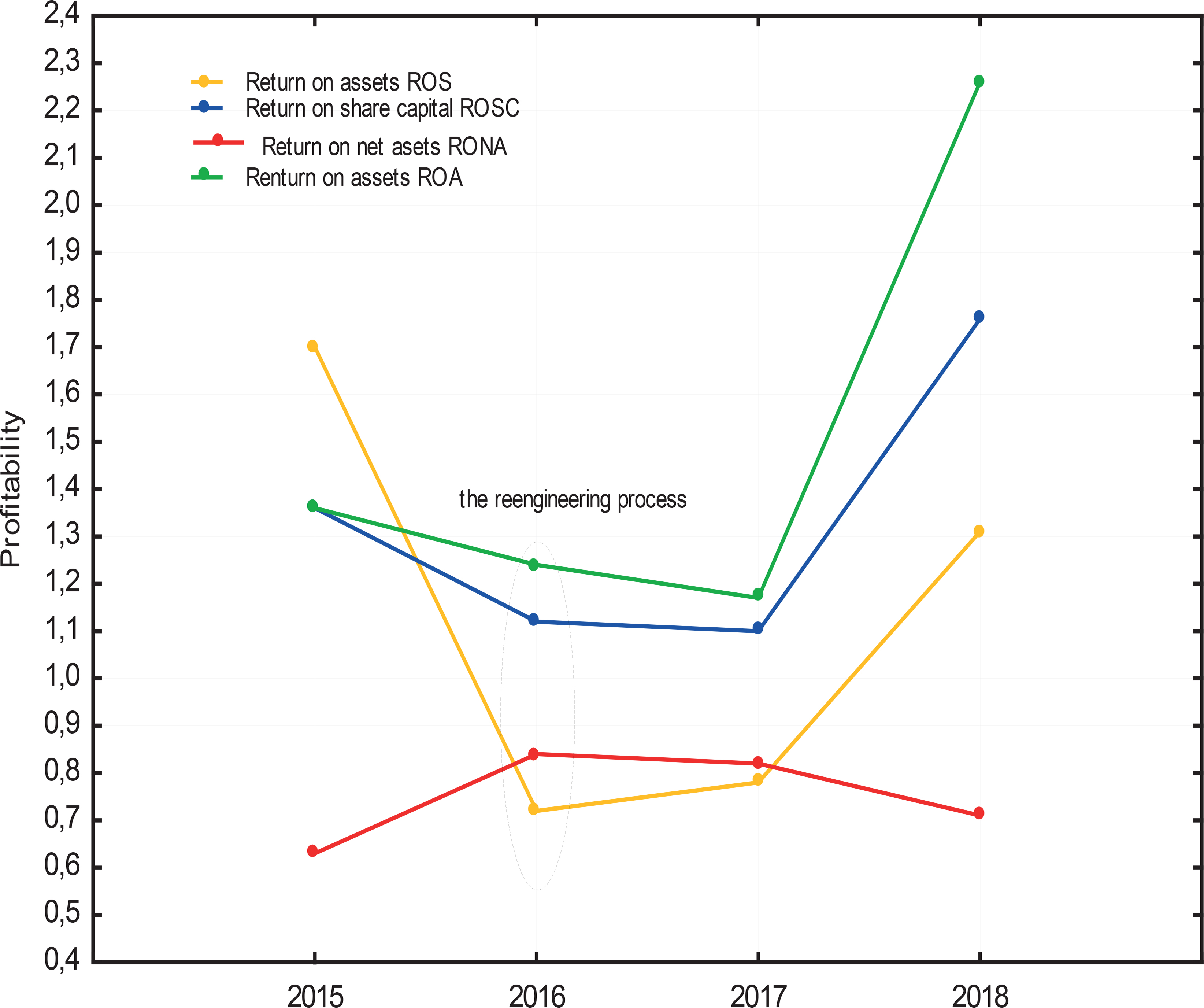
Fig. 4
Development of profitability indicators