
Tab. 1
Openness of business innovation processes
| Type of innovation | Sources of knowledge |
|---|---|
| Closed innovators: enterprises with innovations developed mainly through their own efforts (they have neither cooperated nor bought external R&D) | Internal knowledge is the most important source |
| Hybrid innovators: enterprises with innovations developed mainly through research and development activities, but having cooperated or bought external R&D | Both internal and external knowledge is just as important |
| Open innovators: enterprises with innovations developed mainly through cooperation with other entities or by other entities | At least one external source is more important than internal knowledge |
[i] Source: (Barge-Gil, 2010).
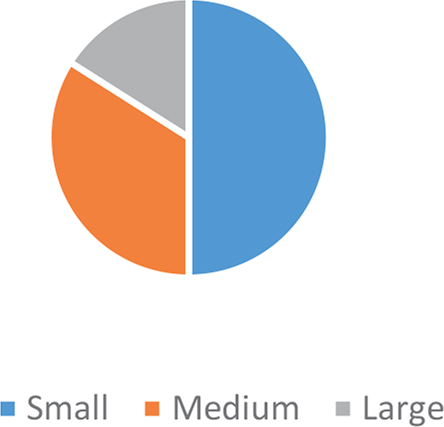
Fig. 1
Size of the enterprise
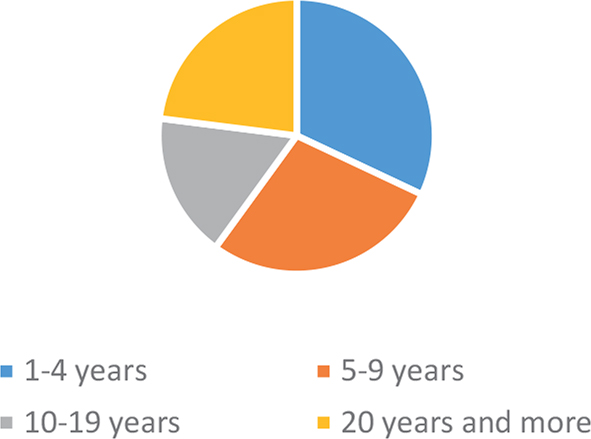
Fig. 2
Age of the enterprise
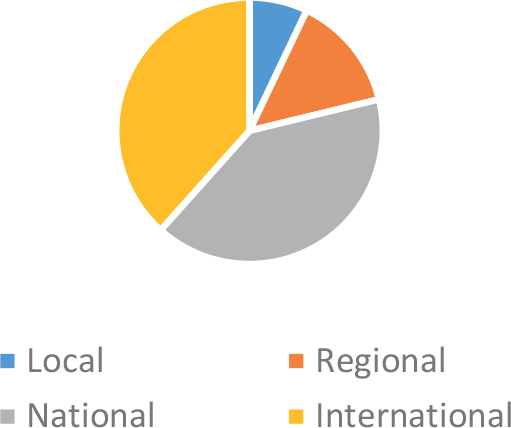
Fig. 3
Operational range of the enterprise
Tab. 2
Coefficients of the Anova regression analysis (with Open_Innovation as dependent variable)
| Model B | Non-standardised coefficient | Standardised coefficient | t | Significance | ||
|---|---|---|---|---|---|---|
| standard error | Beta | |||||
| 1 | (Constant) | 2.819 | 1.304 | 2.161 | 0.033 | |
| Size | 0.099 | 0.056 | 0.162 | 1.766 | 0.081 | |
| Age | 0.084 | 0.058 | 0.137 | 1.459 | 0.148 | |
| Operational range | 0.134 | 0.060 | 0.178 | 2.239 | 0.028 | |
| Cost leadership | 0.238 | 0.265 | 0.169 | 0.899 | 0.371 | |
| Differentiation | −0.656 | 0.278 | −0.431 | −2.357 | 0.021 | |
| Diversification | −0.174 | 0.262 | −0.120 | −0.665 | 0.508 | |