
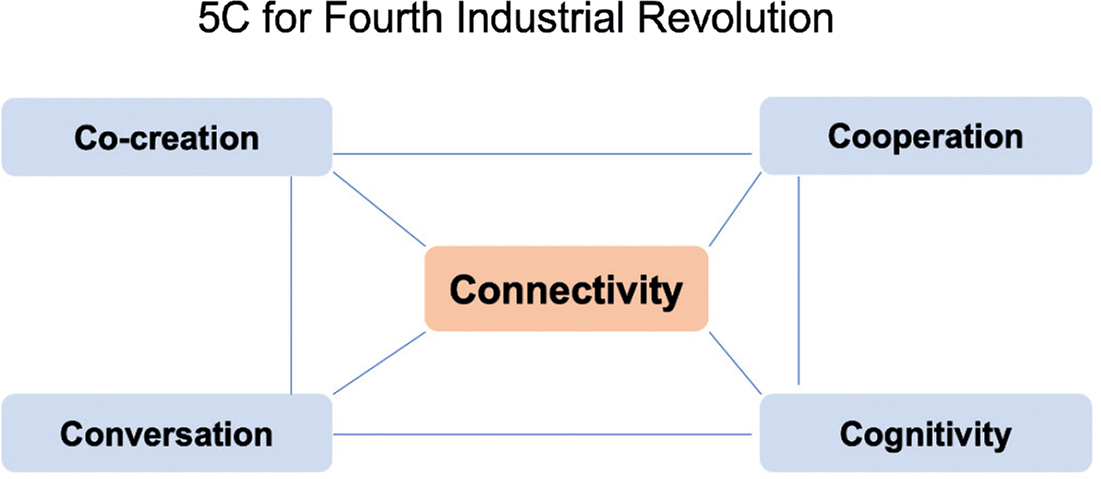
Fig. 1
Marketing Principles for Industry 4.0
Tab. 1
Examples of technologies supporting Marketing Principles in Industry 4.0
| Marketing Principles (5Cs) | Supporting technology | Changes brought by the supporting technologies |
|---|---|---|
| Connectivity Cooperation Communication Co-creation | IoT and 5G | The technologies make it possible to obtain data on the use of products directly from the customer in real-time Such technologies connect multiple devices and products into a network of independent objects, which are additionally supported by artificial intelligence algorithms that can make autonomous decisions |
| Connectivity Cooperation Communication Co-creation | Cloud Computing | It enables the formation of a network for the exchange of transparent data available to every network participant. It facilitates the building of a digital ecosystem and the creation of new business models (e.g. a business platform model or Product as a Service) |
| Cognitivity | Big Data | An analysis of large data volumes makes it possible to identify regularities and market trends, thereby offering cognitive conclusions on the use of products and customer behaviour previously unavailable to marketing planning. This focus enables more dynamic pricing |
| Cognitivity | AI | It facilitates the identification of customer behaviours and the prediction of their preferences and needs and makes it possible to offer a more personalised complementary value to customers |
| Co-creation | 3D Printing | It enables customers to take part in fast prototyping and testing of products already at the research and development stage and extends the spectrum of product personalisation, offering the highest possible level of customisation |
| Co-creation Cooperation | VR/AR | It enables better visualisation of a company’s offer through the use of each customer’s personal sense of space. This facilitates designing products in a three-dimensional virtual space |
| Co-creation Cooperation | Simulation | It makes it possible to create a digital twin that gives an opportunity to test the functionality of a given product before buying it |