
1. Introduction
Airlines have witnessed numerous flight cancellations and schedule disruptions in recent years, spurred by dangerous accidents, climate change impacts and infectious diseases. One such example was the 2025 overturning of a United Airlines plane at the Toronto Pearson International Airport, Canada (Lang, 2025) due to snowfall on the runway. Another unfortunate plane accident was the JeJu Air flight bound from Bangkok, Thailand, to Muan, South Korea, that made an emergency belly landing, slipped and struck the boundary wall of the airport. The subsequent fire killed 179 people on board (Ng and Mackenzie, 2025; Reuters, 2025). Climate change is another main source of disruption in flight schedules. Countries with stable weather conditions have not developed their capacity and resilience to cope with climate disruptions. For example, the United Arab Emirates (UAE) witnessed rainfall of 254 mm in less than 24 hours, the most since the records began in 1949. Thus, as a consequence, Dubai International Airport faced significant disruptions after heavy rains in the form of long layovers and cancellations (Mujahid, 2024). There is rarely heavy rains in the UAE; as such, the country had not developed the capacity to cope with dangerous and disruptive weather conditions.
The world has recently encountered increasingly agitated weather conditions, natural disasters and infectious diseases. Thus it is important to research the causes and factors of flight disruptions, and methods of resilience building to cope with disruptions and emergencies. Data from the US airline industry showed a total of 282,926 flight cancellations from January 2020 to June 2020 (Bureau of Transportation Statistics, 2021; Kaggle, 2020). To control the spread of COVID-19, strict restrictions were adopted. Travel restrictions drastically affected the airline industry (McClanahan, 2020).
Flight cancellations have been previously studied in normal conditions, but there has not been sufficient research into flight cancellations resulting from COVID-19. Studies have concluded that flight disruptions have profound economic, social and environmental effects (Britto et al., 2012; Chen et al., 2017). Researchers such as Zhixing et al. (2021) have studied the relationship between flight network attributes, network resilience and airline delays. Wang et al. (2020) studied the remarkable features of the flight network to minimize the delays. In Zhixing et al.’s and Wang et al.’s study, the flight networks of USA and China were considered. Zhou et al., (2022) studied the effect of airline delays and utilized the data of airline departures and arrivals from the first to the 31st of December 2000, in China. Information on flight schedule disruptions provides necessary insight for decision-makers to better control airports, airlines and traffic. Timely information to passengers enables them to reschedule their itinerary in advance. The anticipated rescheduling can lower the loss of money, time and resources.
This study presents significant research for the future of flight schedule planning for airlines in times of disruptions. Flight schedule disruptions have always been associated with negative performance indicators from the airlines’ side. Moreover, when it comes to the general safety and health of the public, it becomes necessary for action to take place. The implementation of flight schedule planning during disruptions is accomplished by rules, regulations, public health, law enforcement and public safety policy.
The literature reflects that flight operations during highly infectious and viral disease spread situations further circulation of the disease or virus. Transmission of viruses and the danger of the spread of the outbreak were the main driving forces causing bans on flights and air transportation during the height of the COVID-19 pandemic. The imposition of the flight bans was supported by previous studies in the literature. The fear of the spread of the COVID-19 virus caused delays in flight schedules, as was addressed in Baspinar and Koyuncu (2016). The aftershocks of COVID-19 have not stopped completely, and in 2025, scientists discovered another corona virus, namely HKU5-CoV-2 (Andrews, 2025; Geddes, 2025). There remains a continued fear that history could repeat itself, and therefore, the resilience and capacity built during COVID-19 can’t be overlooked.
Recent studies have used machine learning and deep learning models to further research Nguyen et al. (2018) reviewed studies utilizing deep learning for processing traffic data, transportation networks, traffic flow predictions, signals control, traffic incidents, vehicle detection, demand forecasting, driver behaviour and autonomous driving. Pineda-Jaramillo (2019) a state-of-the-art review, has been presented for using machine learning methods for transportation planning. Karami and Kashef (2020) highlighted methods and algorithms for intelligent transportation system. The techniques reviewed include clustering analysis, ARIMA, Holt winter’s Exponential smoothing, Kalman filter, random walk and KNN Algorithm. Abdi et al., (2023) studied the effect of the pandemic on airlines, tourism, accommodation, hotel bookings, taxicabs and other relevant businesses. Penela and Palma (2023) studied factors effecting risk management and airline investors during the pandemic. MacRury et al., (2024) explored possibilities of avoiding crowd in the city of Toronto, Canada at public transit points.
2. Literature Review and Gap
It is necessary to critically analyze the influence of flight schedules and delays on issues such as the transmission of disease in flights and planes, and the impact to business within the industry. Bans on air travel can serve to control the spread of disease, but they can also adversely affect the business of the airline industry. The series of flight cancellations during the COVID-19 pandemic negatively affected the financial performances of airlines. In today’s modern era, where airline customers are increasingly service-quality sensitive, massive flight cancellations adversely influence the airline’s good name, satisfaction, money, time and resources. Thus, it is valuable to correctly predict the status of flights during the COVID-19 disruption. Moreover, the assurance of reliability and accuracy of the prediction is paramount for understanding future disruptions. It is vital to select correct, proper, accurate and reliable techniques of prediction in disruptive situations. It is reported that state-of-the-art methods using artificial intelligence (AI) possess remarkably incredible forecasting capabilities. Prediction of flight cancellation status can save money, energy and time, resulting in better services and satisfied customers. Therefore, the overarching problem statement is “How best to utilize the prediction capabilities of artificial intelligence for airline flight cancellation status in COVID-19-like situations”. The current study addresses the following objectives.The first objective is to explore the trends of flight cancellations in the COVID-19 disruption using modernized AI techniques.
Further studies have looked specifically at airline delays and cancellations using data-driven methods. (Tu et al., 2008; Rebollo and Balakrishnan, 2014; Rodr´ýguez-Sanz et al., 2019; Yu et al., 2019). Kalliguddi and Leboulluec (2017) utilised machine learning regression for airline delays. The authors used delay states and schedule data as input factors to the model. It was observed that flight delays affected the airline schedule. A multiple regression model was used by Ding (2017) with 79.1% prediction accuracy. Kenan et al. (2018) introduced the idea of optional flights to potentially minimize flight delays. The Random Forest program was used for the prediction of delays and obtained an accuracy of 90.2% in Gui et al. (2019). Lambelho et al. (2020) used the algorithms of Random Forests, Light GBM and Multi layer Perceptron for the prediction of cancellations and delays in Heathrow Airport. Machine learning was used to compare the actual and the predicted flight schedule for Lithuanian airports in Stefanovi¡c et al. (2020). The Levenberg-Marquart technique was applied for prediction of flight delays in Yazdi et al. (2020). Though AI techniques have been used for flight schedule disruption in the everyday scenarios, there is a need to test them on highly disruptive situations. Thus, our first objective is to use data-driven AI techniques for exploring cancellation trends in the wake of disruption and infectious disease. The second objective is to adopt two-class neural network regression, two-class decision forest, two-class locally deep support vector machine (SVM) and two-class logistic regression techniques to forecast the event of flight cancellations in the COVID-19 disruption.
The literature supports the adoption of machine learning models— neural networks, SVM, decision forests and logistic regression—to forecast flight cancellations during COVID-19. Studies have shown the effectiveness of machine-learning models for prediction under uncertain conditions. For example, Kaensar and Wongnin (2023 have applied classifiers, neural networks, SVM, decision trees, random forests and logistic regression to predict the performance of students during COVID-19. Abedin et al. (2021) utilized logistic regression, random forest and support vector regression to forecast exchange rates during the disruption of COVID-19. Utku (2023) developed a deep learning model to predict spreading patterns of COVID-19 across different countries. Karthikeyan et al. (2021) utilised XGBoost and neural networks to predict mortality risk due to COVID-19. Thus, the widespread utilization of these methods motivates us to use them for predicting flight cancellations during the COVID-19 disruption.
The third objective is to identify factors affecting the event of flight cancellation in COVID-19 disruption.
In this study, the data set of flight patterns was taken from Kaggle (2020). Kaggle obtained the data from the Department of Transportation and the Bureau of Transportation Statistics (2021) of the United States. Alla et al., (2021) used a multilayer perceptron model to predict arrival delays. In Zeng et al., (2021), arrival delays were predicted using datasets from 2015 to 2018 of 325 airports in the US. Niu et al. (2021) used controlled variables to minimize arrival delays in their model. Zoutendijk and Mitici (2021) used AI techniques to minimize delays at Rotterdam The Hague Airport using 17,365 departures and 17,336 arrivals. A thorough study of the existing literature reveals that most of the studies have predicted flight schedule disruption in normal conditions. Therefore, the proposed research attempts to predict flight cancellations in the event of a disruptive situation, such as disease transmission.
Our hypotheses are listed below.
Hypothesis One: Flight cancellation is directly related to the departure delay in the COVID-19 situation.
This hypothesis is supported by numerous studies that highlight the interconnections of cancellations during the COVID-19 disruption. The existing literature reveals a relationship between delays and cancellations during the COVID-19 pandemic. Operational delays occurred due to safety protocols, checking, screening and crew shortages (Yimga, 2021). Cancellations were due to strict bans on air travel and reduced travel demand (AirHelp; 2025). It was reported that 40–60% fewer aircraft movements than 2019 were recorded (Wikipedia, 2025). Airlines experienced a sharp reduction in air travel demand, thus empty ghost flights were operated to keep the routes active (Wikipedia, 2025). Calli and Calli (2022) highlighted that passenger behaviour showed significant dissatisfaction. Passengers lodged complaints about massive flight schedule disruptions. Most of the airlines canceled flights because of long layovers due to operational restrictions. A few were operating with empty planes and low profitability because of the fear of losing their routes during the pandemic. These studies strongly support our hypothesis.
Hypothesis Two: Flight cancellation is directly related to airtime in the COVID-19 situation.
During the pandemic, most of international flights were canceled (Wikipedia, 2025). Flights with long flight times had a greater possibility of disease transfer. The travel ban was supported by previous studies in the literature. Baspinar and Koyuncu (2016) pointed to the fear of spreading the pandemic on flights. Nowzari (2016) further studies the spreading dynamics of a pandemic in the structural network of flight operations. In another study, Mou et al. (2017) observed that lowering the inter-event interaction time, also called temporal sparsity, led to lower disease transmission. Control theory methods were utilized in Bussell et al. (2019) to illustrate the control of the dynamics of spreading infections in humans, animals and plants. Alamo et al. (2021) proposed a strategy to monitor virus transmission and better manage the spread of virus infections. Li et al. (2020) integrated a controlling model with spread dynamics of infected, suspected and recovered patients to better model the COVID-19 pandemic. Thus, from past studies in the literature, it was deemed necessary to impose flight bans on air travel for the benefit of the general public, safety and public health. Thus, our choice to formulate this hypothesis is justified by the existing literature.
Hypothesis Three: Flight cancellation and carrier delay have a positive relationship in the COVID-19 situation.
The existing literature supports the hypothesis that cancellations and carrier delays are directly related in the disruptions caused by COVID-19. COVID-19 significantly affected the airline industry, in the form of widespread cancellations and schedule disruptions (Bao et al., 2021; Sun et al., 2021). The structural properties of flight data during COVID-19 showed an increase in the average distances between airports and a surge in the number of long haul routes (Bao et al., 2021). This phenomenon may be connected to flight diversions, delays due to crew unavailability, crew sickness, strict cleanliness and the time required to clean the airplane for the next flight. This clearly suggest that cancellations and carrier delays were interconnected during COVID-19. Yimga (2021) observed a reduction in travel demand and surge in flight cancellations. Staff shortages and operational disruptions led to a surge in cancellations and delays in network carriers (Kaffash and Khezrimotlagh, 2023). Operational inefficiencies, like staff shortages and sudden demand fluctuations, created problems when carriers increased cancellations and experienced delays on other services during the COVID-19 pandemic. Thus, our third hypothesis is supported by the existing literature.
Hypothesis Four: Flight cancellation is directly related to weather delays in the COVID-19 situation.
There are studies available in the literature focusing on the relationship between weather delays and cancellations in disruptive times. A multilayered, complex network has been utilized to investigate cancellations due to weather in Kim et al. (2023). The study incorporates factors like airplane, rainfall and wind speed to investigate cancellations. The results show that rainfall has a greater impact on cancellations than the wind speed (Kim et al., 2023). Machine learning models have been used to predict airline disruptions due to weather. Random Forest, decision trees, kK-Nearest-Neighbors and AdaBoost have been applied to predict flight disruptions based on weather conditions (Choi et al., 2016). These models study the relationship between cancellations and weather delays. Aktürk et al. (2014) have developed optimization models considering weather and operational factors. Faiza and Khalil (2024) studied the importance of weather in predicting monthly cancellations of flights. Thus, in the literature, there are studies using complex network analysis, machine learning and AI techniques to understand the relationship between weather delays and cancellations in the wake of disruptions.
Hypothesis Five: Flight cancellations and National Airspace System (NAS) delays have a positive relation in the COVID-19 situation.
COVID-19 significantly halted the operational performance of the NAS. These problems were associated with a reduction in air traffic, unavailability of workforce, delays in the modernization projects and building resilient adaptive strategies. Due to significant reduction in travel demand, air traffic control (ATC) faced reduced congestion and managed closures. Dozens of ATC operations remained closed or transferred traffic to the nearest facility centers. The restrictions of social distancing, facility cleanliness and sanitation decreased trained availability. Protecting experts’ health was prioritized. This led to delayed services and schedule disruption. Churchill et al. (2010) highlighted that there exists a relationship between different disruptions, delays and cancellations. Gopalakrishnan and Balakrishnan (2021) used dynamic network analysis to comprehend the relationship in air transportation systems and the propagation of delays. Thus, from the literature, there may exist a relationship between cancellations and NAS delays in disruption that can either validate or refute the proposed hypothesis.
Hypothesis Six: Flight cancellation is directly related to security delays in the COVID-19 situation.
Literature offers insights into the broader effects of the COVID-19 disruption on air travel. The United States and the European States restricted entry of all non-US and non-European passengers, respectively (State, 2020). Bao et al. (2021) pointed out that COVID-19 disruptions resulted in numerous cancellations and airport closures due to strict travel restrictions. The strict restrictions imposed were to contain the spread of the virus. Law enforcement agencies, security agencies and health departments imposed strict travel checks to restrict virus transmission (Sun et al., 2021). These schedule disruptions were related to virus containment, nonavailability of services, travel behavior and staff shortages (Sulu et al., 2021). Based on the extra testing, checking and sanitizing measures adopted at airports, we assume that security delays and flight cancellations would have a positive relationship.
Hypothesis Seven: Flight cancellation is positively related to the departure delay in the COVID-19 situation.
There is sufficient logical information to assume this hypothesis. The relationship between departure delay and cancellations can be traced back to strict checking, screening, virus testing, sanitation, cleanliness measures and fifteen-day quarantine requirements. Due to these restrictions and implementations, departure delays arose. Sun et al. (2021) identified more flight cancellations and unprecedented changes than ever observed. In their study, they analyzed the air transport systems and disruption impact in Europe, the United States and China. The study noted that the peak impact on aviation was found during April through May of 2020. This period was followed by a recovery stage (Sun et al., 2021). Bao et al. (2021) observed cancellations and airport closures cause by restrictions. The disruptions were related to stopping the spread of the virus, public health safety and staff shortages (Sulu et al., 2021). Thus, we can conclude that the formulation of the hypothesis is justified by the existing literature.
3. Methodology
This section focuses on the methodology adopted for proposed methods of flight cancellation modelling using AI techniques. A neural network comprises nodes and edges interconnected to each other, forming the layers of the network. In deep network architecture, there may be hundreds of hidden layers. Training the data means teaching the input and output patterns to the network. Testing the data means recalling the patterns to test the network’s learning performance. The nodes in the layers are interconnected to the succeeding layer with weighted edges. Computing output for input requires an activation function at the nodes. The product of the inputs and weights is calculated in the hidden layers, creating node ‘j’. For instance, equation (1) presents the output at the first hidden layer. Where b1j present bias and h1j. the output at the first layer.
The output at the second layer is (2).
Likewise, at node “j” of third layer, output is presented as (3).
Finally, at the node “j” of the output layer, the output presented as (4).
For network with “k” layers, the “k” th layer has the output (5).
Moreover, at the output layer, the output is given in (6).
The precision, accuracy, recall and F1score are the performance metrics for the techniques. True positive (TP) is a statement that is actually true and predicted as true. True negative (TN) is a statement that is actually false, and is predicted as false, or a correct prediction. False positive (FP) is a statement that is actually false but is wrongly predicted as true. False negative (FN) is a statement which is actually true but is wrongly predicted as false. From these decisions, the accuracy (A), precision (P), recall (R) and F1 score are calculated as (7-10). Equation (7) shows accuracy is the fraction of the correct decision with the total decisions.
Equations (7-10) are utilized for evaluating the testing performance of the proposed techniques.
4. Results
This section is dedicated to comprehensive discussions on the results obtained. Data consisting of 2,745,847 flights was subdivided into a training set with 2,196,678 and a testing set with 549,169 flights. Table 1 shows the performance of the four methods. It is clear that all four methods predict the status of the flight with 90% to 100% support of its prediction.
Table 1:
Performance of the Proposed Methods
| Method | Accuracy | F1 Score | Recall | Precision |
|---|---|---|---|---|
| Two-Class Neural Network | 1.000 | 1.000 | 1.000 | 1.000 |
| Two-Class Decision Forest | 1.000 | 1.000 | 1.000 | 1.000 |
| Two-Class Locally Deep SVM | 1.000 | 1.000 | 1.000 | 1.000 |
| Two-Class Logistics Regression | 1.000 | 1.000 | 1.000 | 1.000 |
The confusion matrices of the four methods are shown in Table 2. The confusion matrices show that all four methods correctly predict the outcome of flight cancellation for 549,168 flights. It shows that the methods have predicted the status only in one instance during the testing.
Table 2:
Confusion Matrices of the Proposed Methods
| Two Class Neural Network | Two Class Decision Forest | Two Class Locally Deep SVM | Two Class Logistic Regression | ||||
|---|---|---|---|---|---|---|---|
| True | False | True | False | True | False | True | False |
| Positive | Negative | Positive | Negative | Positive | Negative | Positive | Negative |
| 549168 | 0 | 549168 | 0 | 549168 | 0 | 549168 | 0 |
| False | True | False | True | False | True | False | True |
| Positive | Negative | Positive | Negative | Positive | Negative | Positive | Negative |
| 1 | 0 | 1 | 0 | 1 | 0 | 1 | 0 |
Figure 1, illustrates that cancellations have no significant relationship with any factor such as carrier delay, weather delay, departure delay, late aircraft delay and NAS delay. For all the factors, the cancellations show unrelated/weak related trend.
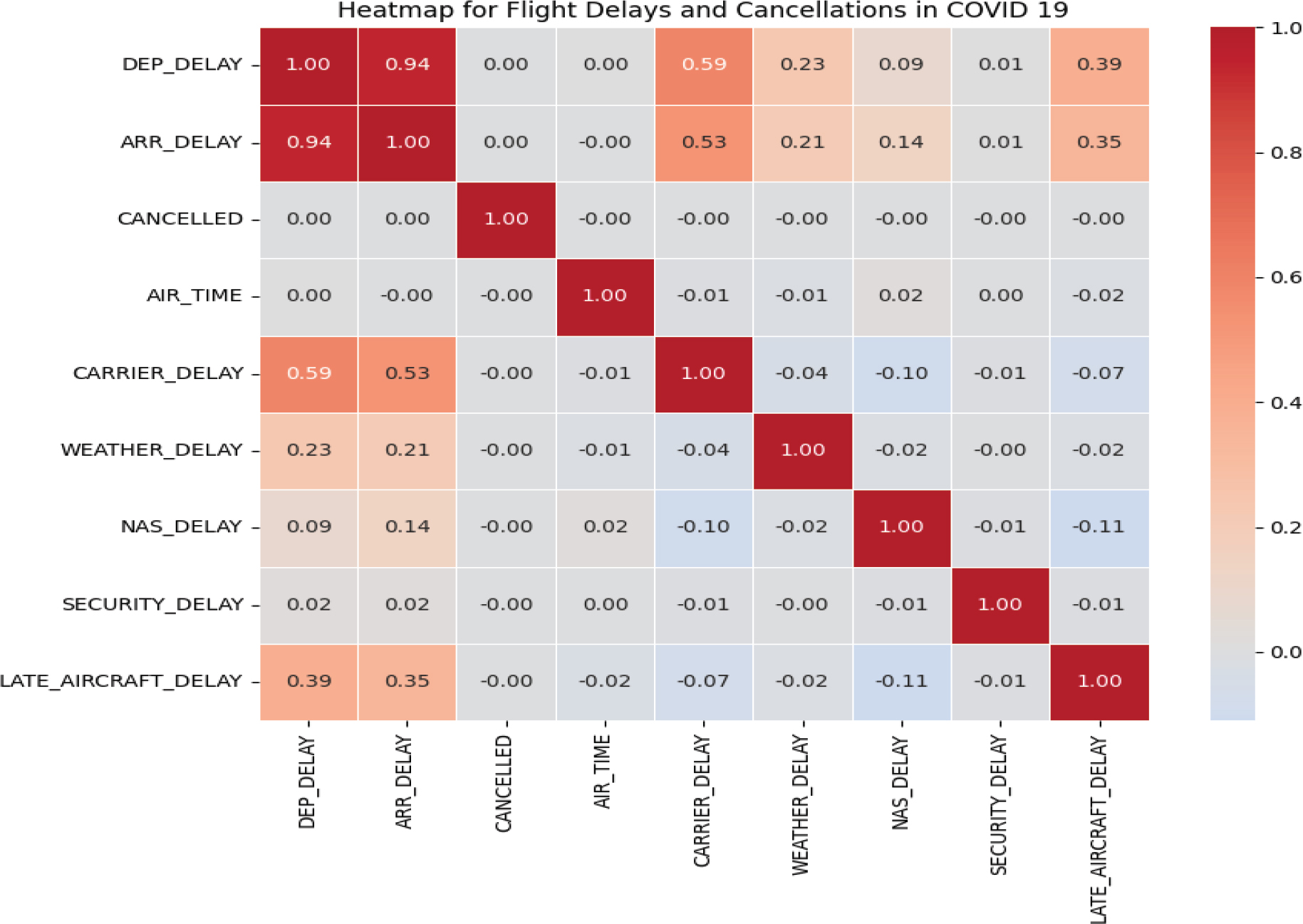
Figure 1:
Relations of the Cancellation with Factors
The responses of the hypothesis are presented below.
Hypothesis One: Flight cancellation is directly related to the departure delay in the COVID-19 situation.
Reject the null hypothesis. There exists a fragile relationship of 0.00093% between them. Flight cancellations and departure delay are correlated insignificantly. Both are not related.
Hypothesis Two: Flight cancellation is directly related to airtime in the COVID-19 situation.
Reject the null hypothesis. There is a frail negative relation (-0.000000000000053%) of the airtime with cancellation. No significant relationship exists.
Hypothesis Three: Flight cancellation and carrier delay have a positive relationship in the COVID-19 situation.
Reject the null hypothesis. There is a fragile negative relation (-0.000000000000059%) of carrier delays with cancellations. The relationship is insignificant. Both have no relationship.
Hypothesis Four: Flight cancellation is directly related to weather delays in the COVID-19 situation.
Reject the null hypothesis. There is a frail negative relation (-0.000000000000028%) of weather delays with cancellations. The relationship is insignificant.
Hypothesis Five: Flight cancellations and NAS delays have a positive relation in the COVID-19 situation.
Reject the null hypothesis. There is a fragile negative relation (-0.000000000000026%) of the NAS delays with cancellations. The relationship is insignificant. There is no positive relation.
Hypothesis Six: Flight cancellation is directly related to security delays in the COVID-19 situation.
Reject the null hypothesis. There is a frail negative relation (-0.0000000000000046%) of security delays with cancellation. The relationship is insignificant. There is no relationship.
Hypothesis Seven: Flight cancellation is positively related to the departure delay in the COVID-19 situation.
Reject the null hypothesis. There is a fragile negative relation (-0.000000000000024%) of departure delays with cancellations. The relationship is insignificant. Both have no relationship.
Cancellation has a very frail positive relationship with departure and arrival. Moreover, it has a fragile negative relationship with airtime, weather delays, carrier delays, security delays, NAS delays and late aircraft delays. The negative relationship depicts that increasing one factor decreases the other factor. The maximum for the cancellation event is ‘1’ and the minimum is ‘0’. The negative relation of increasing airtime, carrier delays, weather delays, NAS delays, security delays and late aircraft delays, decreases the event of flight cancellation to the minimum level ‘0’, meaning that the flight has not been canceled. Likewise, decreasing the airtime, carrier delays, weather delays, NAS delays, security delays and late aircraft delays to the minimum level of “0” increases the event of flight cancellation to the maximum level ‘1’, meaning that the flight has been canceled. Thus, the results logically support the event of flight cancellation, although the relationships are fragile.
Finally, the results of the proposed techniques are compared with those present in the existing literature. Firstly, we compare with the results of Lambelho et al. (2020), where the accuracy, precision and recall were 0.79, 0.56 and 0.55, respectively. In the proposed case, the accuracy, precision and recall obtained were 100%. Therefore, our results are better than Lambelho et al. (2020). Additionally, the accuracy obtained is better than that obtained in Pampolana et al. (2018). The accuracy obtained in Henrique and Feiteira (2018), Stefanovic et al. (2020) and Jiang et al. (2020) was 0.85, 0.96 and 0.89, respectively. Thus, our obtained accuracy is better than these studies. In Bandyopadhyah et al. (2020), the accuracy of the gated recurrent unit model was 98.7%, and that of multi-layer perceptron model was 97.3%. The proposed models resulted in an accuracy of 100%, thus it is better than that obtained in Bandyopadhyah et al. (2020). Thus, the results of the proposed study are better than those presented in existing literature.
5. Discussion
The proposed study has meaningful insights and implications for better management of flight cancellations in pandemic circumstances. The first insight is the models’ ability to accurately predict cancellations in pandemic situations. The models’ capabilities emphasis the value of AI in planning to reduce the impact of health crises in air transport. The second insight is the emphasis on improved coordination and communication with all the stakeholders of the air transport industry, so that all of them may avoid unnecessary resource allocations, costs and frustration. Thus, a well-prepared and resilient air transport network can better cope with the disruptive emergency situations. The third insight is the importance of an improved customer-centric air transport system, which would mitigate the frustration, anxiety and mental impact of cancellation on customer experience. The fourth insight is saving unnecessary costs better operational performance, obtained from the forecast of flight cancellations beforehand. Moreover, predictive flight cancellation information can help regulatory authorities continue operating in a COVID-19-like emergency, while minimizing the impact of disease transmission and avoiding unnecessary bans, restrictions and strict rules. Lastly, the most important insight is the key role played by the AI-based prediction models, helping all the relevant stakeholders by increasing disaster preparedness, cost savings, safety and mitigating virus spread in pandemic situations.
Predicting airline flight cancellations in pandemic scenarios carries significant benefits for all the relevant stakeholders in the air transport industry. The main stakeholders are the airlines, airports, passengers, policymakers, air travel insurance companies and the service providers. The benefits to the airlines can be increased operational efficiency, reduced costs and maintaining customers’ loyalty. The airlines can reschedule flights and avoid idle resource allocations. Accurate and timely information mitigates the cost of last-minute schedule disruption, re-bookings and customer dissatisfaction. Proactive information can help airport authorities allocate gates, ground handling staff, baggage handling and safety. Timely cancellation notifications can help passengers reschedule their travel plans, and minimize travel inconveniences and frustration.
Cancellation notices can help policymakers and regulators maintain rules and regulations, ensure public safety and reduce virus spread. The information can help travel insurance companies better assess the associated risk factors and maintain better customer relationships. Last but not least, the on-time cancellation information can help airport service providers, like catering, ground services, taxicabs and fuel providers, allocate resources as needed, thus reducing the waste and cost of idle allocations.
This study has some limitations. Firstly, the uncertainty of the COVID-19 situations may result in varying travel behaviour, bans, restrictions and infection rates. Secondly, the model is best suited for pandemic situations, and flight cancellation patterns differ in normal situations. Thirdly, the government interventions, rules, regulations and bylaws during pandemic situations can introduce variability in the AI-based models. Fourthly, predictive models are more dependent on historical data, whereas pandemic situations have few precedent patterns. Fifthly, there is a certain cost associated with adopting AI technologies, leading to some some airline companies deciding to rely on their own developed mechanisms and resist adopting AI-predictive systems. Lastly, there is a long-term uncertainty associated with pandemic situation assessments in times of serious disruption.
Research in the airline industry poses significant complexities. These complexities arise due to the use of advanced AI tools, data collection, dynamic real-world case studies and computational complexities. The main complexity necessitates technical and industry knowledge, proficiency, and proficiency to use the AI techniques. Several challenges include acquiring the datasets, conducting data engineering, data sampling, training, testing and validating and then implementing the models. These challenges requires highly competitive AI skills to implement and run seamless AI models. Another challenge is the highly unprecedented nature of pandemic situations, causing the complexity in disruption scenarios to increase. Lastly, the government interventions, rules, restrictions and regulations pose highly uncertain complexities in the planning and scheduling of airlines in pandemic situations.
6. Conclusions
The artificial intelligence techniques used in this study are two-class neural network regression, two-class decision forest, a two-class locally deep SVM and two-class logistic regression. The results depict that the precision, accuracy and recall performances of all the methods used are 100%. The correlation shows that flight cancellations have a frail positive relation with departure and arrival delays. The accuracy, precision and recall performances of all the techniques are superior to other models. Alternative schedules need to be sorted out for planning in disruptions.
The ability to predict flight cancellations is significant for all relevant stakeholders in the air transport industry. Airlines, airports, passengers, policymakers, air travel insurance companies and the service providers can benefit from flight cancellation status prediction, and save money, time and resources.
This study has meaningful insights for better managing the situation of flight cancellations in pandemic circumstances. The ability of the models to accurately predict cancellations in pandemic situations bears special importance in planning air travel and rescheduling travel plans. This study focuses on the use of AI in airline planning to reduce the impact of a health crisis on air transport.
In the future, further work can expand in various directions. One extension may be to adopt the concept of transfer learning to use this model as a basis to predict flight cancellations in times of political unrest, natural disasters and economic downturn. Another extension may be to predict not only the cancellations but also the customer behaviour after the cancellations, and study the re-booking, customer loyalty and satisfaction of the affected passengers. Moreover, the techniques of explainable AI can be exploited to explain the causes of the cancellations to all the relevant stakeholders.
Notes
[1] Compliance with Ethical Standards
[2] Ethical approval
The article does not contain any studies with human participants performed by any of the authors.
[3] Informed Consent
The research does not involve any treatment performed on human participants or animals.