
1. Introduction
In recent years, niche tourism, particularly health tourism, has emerged as a significant driver for the development of rural destinations (Zhang et al., 2024). This form of tourism encompasses various specialised areas focused on wellness, relaxation, and recuperation, attracting a demographic of travellers who are increasingly seeking unique experiences. According to Fotiadis et al. (2019) most EU countries have large rural areas (91%) where more than 56% of the population lives, therefore it is very important to investigate the ways in which it is possible to activate these rural areas and make them attractive both for the local population and for tourists. The policy of rural development in the EU is defined in the Common Agricultural Policy (CAP), for the financing of which, in the program period 2007-2013, €368.2 billion or 43% of the total EU budget was allocated. The CAP 2023-27 is a modernised policy, where the emphasis is on a greener and more performance-based CAP. Rural destinations and rural development (at least 35% of funds) are central to the European Green Deal. The EU has accepted the concept of encouraging the sustainable development of rural destinations based on economic, sociological and ecological indicators of sustainability (Nastić et al., 2024). Also, this concept implies the development of special forms of tourism (i.e. niche tourism) such as health tourism (An & Alarcon, 2020). In this way, rural destinations are transformed into ecologically preserved environments where rural development is reflected in organic agriculture and local entrepreneurship (Chen et al., 2023).
Special forms of tourism (i.e. niche tourism), such as health tourism, are in the function of the development of rural destinations (Gao & Wu, 2017). When rural destinations have resources suitable for the development of special forms of tourism, such environments become attractive for investments, they have the perspective of development through the creation of new jobs and an ever-improving standard (Gautam & Bhalla, 2023). The natural and cultural heritage of rural destinations represents a rich basis for the development of rural tourism, which then synchronously represents the ‘push up’ effect of the development of rural destinations. When it comes to natural attractions, thermal mineral springs or magnetic springs are especially important, where it is possible to develop various forms of health tourism.
Given that rural destinations ‘struggle’ with the problem of depopulation, rural sustainable development must be based on a solid connection between tradition and trends. The modern trend in the development of tourism is definitely health tourism, especially tourism that deals with prevention (Wen et al., 2022; Peng et al., 2023). By developing this form of tourism in rural destinations, the benefit would be multiple. Employment opportunities for the local population would be created, and thus young and educated people would be given the chance to stay, work and live in such destinations.
The integration of health tourism into rural development plays a pivotal role in promoting sustainable economic growth and enhancing community well-being. Health spas, as a central component of health tourism, contribute significantly to this dynamic by offering both health and wellness benefits while respecting ecological and community dynamics (Cheng et al., 2025). These establishments often utilize local natural resources and landscapes, such as mineral springs and botanical diversity, to provide unique sensory and therapeutic experiences, which in turn attract tourists to rural areas (Arslan Ayazlar & Yüksel, 2018). This influx of visitors not only stimulates the local economy but also fosters social and cultural development through interactions with visitors, ultimately improving the quality of life and health status of the local population (Bojović et al., 2024). Moreover, the presence of wellness tourists encourages communities to appreciate their environment and strengthens their attachment to their surroundings (Chen et al., 2022). However, for these benefits to be maximised, it is crucial to align tourism development with sustainability principles that emphasise long-term planning, environmental protection, and community participation (Jia et al., 2022). Policymakers and local stakeholders must work collaboratively to create strategies that capitalise on these opportunities, ensuring that health tourism contributes to sustainable economic growth and the enhancement of community well-being in rural areas.
The paper started from the initial hypothesis H that the ‘Sofija’s Springs’ site is a potential for the development of rural tourism, recognised as a tourist attraction by tourists and that as such it represents a significant catalyst for the development of rural destinations. The present study examines the polyvalent tourism value of the Sofia’s springs located in Serbia using modified GAM model. Visitors to this place believe that it has special magnetic fields that positively affect the nervous system and heal many other diseases. The radiesthetists claim that these magnetic fields in that place have the strongest positive radiation in the world (Elerian et al., 2021) and it has an overall positive effect on many illnesses including the regeneration of the human immune system by repairing immune agents. The studies show that the magnetic field of dry spa has a health benefit such as reducing stress and obesity and represents the potential for rural development (Chen & Cai, 2025). It is precisely these localities that contribute to sustainable rural development, pointing to the importance of the diversity of the offer, which is a key aspect of tourism niches. The activation of various tourist attractions in rural destinations contributes to a larger tourist offer and provides the possibility of meeting a wider range of tourist needs.
2. Literature review
There are numerous papers that support the statement that rural destinations use all the potentials found there and transform them into tourist attractions (Suárez, 2011). According to Gabor and Oltean (2019) tourism of special interests (i.e. niche tourism) represents such forms of tourism that have the power of sustainable development indicators of rural destinations. Whether it’s about gastronomy (Vuković et al., 2019; da Silva, 2021; Čehić et al., 2021), cultural attractions (Meng et al., 2024), or natural attractions of rural destinations (Antić et al., 2020), these are strong attraction factors and represent strong contractive zones.
Health tourism is one of the fastest growing segments of the tourism economy and has direct influence in the economic developments (Connell, 2006; 2013; Han, 2013; Wongkit & McKercher, 2013; Taheri et al., 2021). Today, the medical tourism sector is growing at the fastest rate and is expected to reach USD 207.9 billion by 2027 (Market Analysis Report, 2020). The terms ‘health tourism’ and ‘health tourists’ are well detailed in the prevailing literature (Connell, 2006; Garcia-Altes, 2005; Heung et al., 2011; Ghosh & Mandal, 2019; Mathijsen, 2019; Yu & Ko, 2012). It refers broadly to people traveling away from their home for health-related purposes (Reed, 2008; Chuang et al., 2014). This form of tourism has the power to attract tourists, and its impact on the development of rural destinations is multiple. A health tourist is different from a common traveling tourist on several aspects such as quality of the service (Lu et al., 2016), price (Wang, 2012), speed of access to care, and tourism factors associated with the destination (Crooks et al., 2011).
To fight with the illnesses people often embrace several methods including the placebo effect (Benedetti & Shaibani, 2024; Thomas & Colloca, 2024). According to Zečević et al. (2022) healing energy of dry spa represents a powerful means that often positively influences human health and often it has a longer duration (Macklis, 1993; Lin & Hopf, 2003; Oschman, 2005). This classifies tourists visiting the site as special interest tourists (Macleod, 2006). Tourism as a phenomenon has more of its manifestations that concern the satisfaction of the most diverse spectrum of tourist needs (Cazorla-Artiles & Eugenio-Martin, 2023). So, the potential that has the power of transformation into a tourist attraction with a strong competitive advantage has been recognised.
One of the most salient advantages of special forms of tourism, such as health tourism, is their capacity to significantly boost local economies (Arsić et al., 2024). When health tourists visit rural areas, they contribute to the local economy by spending money on a variety of services and products, from accommodation to wellness treatments, dining, and recreational activities. This influx of cash can invigorate rural economies that may have previously struggled with limited financial resources. Furthermore, increased tourism can lead to the creation of jobs for local residents, as businesses expand to meet the demand of incoming tourists. Positions in hospitality, wellness services, and retail become more readily available, directly addressing unemployment in these areas. Additionally, the arrival of niche tourists often spurs the development of local businesses that cater specifically to these travellers. Entrepreneurs may seize the opportunity to create unique offerings, such as organic farms, artisanal crafts, or local cuisine experiences, thereby diversifying the economic landscape of rural areas. This economic revitalization fosters a sense of community and pride among residents, as they witness their local area flourishing through the participation of visitors. The convergence of health tourism and local economies thus creates a symbiotic relationship, where both the tourists and the community benefit.
Beyond economic benefits, niche tourism plays a vital role in promoting the preservation of local culture and heritage (Frochot, 2005). Health tourism often integrates traditional practices, such as herbal medicine, holistic treatments, and community rituals, which serve to maintain and celebrate local customs (Vujko & Gajić, 2014). This cultural infusion not only enriches the visitor experience but also instils a sense of pride within the community as they share their heritage with outsiders. Moreover, as rural destinations gain popularity among tourists, increased interest can lead to funding for cultural preservation initiatives, enabling local governments and organizations to restore historical sites, support local artisans, and promote indigenous practices. Maintaining cultural identity is crucial, as it enhances the attractiveness of rural destinations, allowing them to stand out in a competitive tourism market. Tourists are often drawn to authentic experiences that connect them to the place they are visiting, which makes the preservation of local culture essential. By fostering an environment where tradition is valued and showcased, niche tourism becomes a powerful tool for sustaining the cultural fabric of rural areas, ensuring that these communities thrive while retaining their unique identity.
Niche tourism also encourages sustainable development, which is increasingly important in today’s environmentally conscious society. Special forms of tourism such as health tourism can promote environmentally friendly practices among local businesses, as the demand for sustainable options grows among health-conscious travellers (Lee et al., 2020). As a result, rural enterprises may adopt green practices, such as sourcing products locally, reducing waste, and implementing eco-friendly technologies. Health tourism can also lead to significant investments in infrastructure that benefit both tourists and residents. Upgrades to roads, public transport, and amenities can improve the quality of life for locals while making these areas more accessible to visitors (Bojović et al., 2024). Additionally, sustainable practices within niche tourism can help protect natural resources and biodiversity. By promoting responsible tourism, rural destinations can ensure that their natural landscapes are preserved for future generations, fostering a harmonious relationship between tourism and the environment (Zhang et al., 2024). This balance between development and conservation not only benefits the economy but also contributes to the overall well-being of the community and its natural surroundings (Zhang et al., 2024).
The Geosite Assessment Model (GAM) was developed to examine the value or quality of the geosite (Pralong, 2005; Reynard et al., 2007, Pereira et al., 2007; Zouros, 2007). A group of studies was considering scientific factors such as the environmental impact assessment (EIA) (Rivas et al., 1997, Bonachea et al., 2005; Coratza & Giusti 2005). While another set of the studies additionally considered other factors, such as the ecological, aesthetical, cultural, and economic factors (Reynard et al., 2007). Then few studies considered both the quality as well as the value of the geosite in model development (Bruschi & Cendrero, 2005; Serrano & Gonzales-Trueba, 2005; Pralong 2005; Pereira et al., 2007). In his study, Jonić (2018) highlights the significance of geomorphological locations as natural resources for tourism development that attracts visitors as one of the crucial factors. The trade-off between health tourism, and tourist attractions depends on many factors such as curiosity, notability, aesthetics, and other pull characteristics (Božić & Tomić, 2015; Višnić et al., 2016; Petrović et al., 2017; Pal & Albert, 2018). The earlier studies based on the GAM model indicate that geomorphological locations have polyvalent touristic values (Casey, 2013; Suzuki & Takagi, 2018; Pal & Albert, 2021).
According to Fan et al. (2016), measurement and analysis of observed and latent variables are accomplished through the utilization of structural equation modelling (SEM), a collection of statistical methods. This approach, which surpasses regression analyses in terms of effectiveness, not only evaluates linear causal connections between variables but also takes into consideration the presence of measurement error. One distinguishing factor of SEMs is their ability to examine both the direct and indirect impacts on assumed causal relationships, setting them apart from other modelling approaches (Bollen et al., 2022). The amalgamation of confirmatory factor analysis and path analysis forms SEM, a statistical approach that combines two distinct methodologies. Confirmatory factor analysis, a technique rooted in psychometrics, aims to gauge latent psychological attributes like attitude and satisfaction. In contrast, path analysis originated in the field of biometrics and sought to uncover the causal connections between variables through the construction of a path diagram (Fan et al., 2016).
3. Data and Methodology
3.1. Data
The data is collected from the visitors of Sofia’s springs through the paper questionnaire survey using random sampling method over a period of 2018. and 2023. (between April and October). Out of 687 respondents, 221 have visited the location more than once. These are the data which show that the location is ‘verified’ and that destination ‘possesses’ the healing energy, i.e. development potential. A total of valid six hundred eighty-seven responses is used by the study.
The cyclists under consideration were traversing the Danube bicycle route (EuroVelo 6). The timeframe for cycling along this path falls within the observed period from April to October. Typically, the Danube bicycle route does not extend through Fruška gora national park; thus, this research was undertaken to evaluate this segment as a potential retraceable section. Data collection was facilitated by the Bicycle Association of Vojvodina, which established contact with prospective participants—cyclists already registered to ride the Route. Cyclists gathered at the Ilok border crossing in Croatia before proceeding through Fruška gora national park, covering approximately 100 km of the retraced route until reaching Banstol, where it intersects with the standard route. The locality known as ‘Sofijini izvori’ is situated along the retraced portion of the Danube bicycle route. The total number of respondents corresponds to the cyclists who registered to enter Serbia and consented to attempt the retraced Danube cycling route (Bojović et al., 2024). Regrettably, the figure is not substantial due to the unofficial nature of the retraced route, which deters many foreign cyclists from traversing Serbia on unmarked paths for safety reasons. The respondents aged under 15 are children who rode bicycles in the company of their parents. Cyclists are introduced to key tourist attractions and the tourism potential inherent in this national park. Among the notable sites that left a significant impression was Sofia’s springs, evidenced by the fact that 221 cyclists visited the location multiple times. These springs are recognised as geo-heritage sites, suited for health and preventive needs, situated in the rural mountainous region, thereby representing a potential avenue for the sustainable development of rural tourism.
The Geosite Assessment Model (GAM), particularly in its modified form (M-GAM) by Tomić and Božić (2014), has emerged as a pivotal tool in the domain of sustainable rural development and community empowerment due to its enhanced assessment process. The M-GAM’s integration of visitor perspectives alongside expert evaluations stands out as a significant improvement, as it facilitates a more holistic understanding of a geotope’s value, thereby aligning tourism and conservation efforts with community interests and needs. This dual-perspective approach not only enriches the geotope evaluation process but also directly contributes to sustainable rural development by ensuring that the local community’s voices are heard and considered in decision-making processes, which is crucial for community empowerment. Furthermore, the GAM model’s inclusion of diverse factors such as scientific, educational, scenic, aesthetic, protection, functional and touristic values underscore its comprehensive nature, making it an indispensable tool for promoting sustainable management and conservation of geoheritage. In the adaptation employed by the authors, an additional health value was incorporated with the intention of illustrating this value as sustainable for rural development. Structural equation modelling (SEM) serves as a multivariate statistical framework designed to analyse intricate relationships among both directly observed and indirectly observed (latent) variables. We wanted to show how certain variables affect each other. That is, how the central value: health value corresponds among other values of the geological locality. The complete structure of modified GAM is presented in Table 1.
Table 1:
The Modified GAM factors
| Indicators/Sub indicators name | Description |
|---|---|
| Main values (MV) | |
| Scientific/Educational value (VSE) | |
| VSE1: Rarity | Number of highly similar/comparable sites in proximity |
| VSE2: Representativeness | Didactic and exemplary site characteristics due to its own quality and general configuration |
| VSE3: Knowledge on geo-scientific issues | Number of written papers in acknowledged journals, thesis, presentations and other publications |
| VSE4: Level of interpretation | Level of interpretive possibilities on geological and geomorphologic processes, phenomena and shapes and level of scientific knowledge |
| Scenic/Aesthetic values (VSA) | |
| VSA1: Viewpoints | Number of viewpoints accessible by a pedestrian pathway. Each must present a particular angle of view and be situated less than 1 km from the site. |
| VSA2: Surface | Whole surface of the site. Each site is considered in quantitative relation to other sites |
| VSA3: Surrounding landscape and nature | Panoramic view quality, presence of water and vegetation, absence of human induced deterioration, vicinity of urban area, etc. |
| VSA4: Environmental fitting | Level of contrast to the nature, contrast of colours, appearance of shapes, etc. |
| Protection (VPr) | |
| VPr1: Current condition | Current state of geo-site |
| VPr2: Protection level | Protection by local, regional groups, national government, international organizations, etc. |
| VPr3: Vulnerability | Vulnerability level of geo-site |
| VPr4: Suitable number of visitors | Proposed number of visitors on the site at the same time, according to surface area, vulnerability and current state of geo-site |
| Additional values (AV) | |
| Functional values (VFn) | |
| VFn1: Accessibility | Possibilities of approaching to the site |
| VFn2: Additional natural values | Number of additional natural values in the in radius of 5 km |
| VFn3: Additional anthropogenic values | Number of additional anthropogenic values in the in radius of 5 km |
| VFn4: Vicinity of emissive centres | Closeness of emissive centres (big cities) |
| VFn5: Vicinity of important road network | Closeness of important road networks in the in radius of 20 km |
| Additional functional values | Parking lots, gas stations, mechanics, etc. |
| Touristic values (VTr) | |
| VTr1: Promotion | Level and number of promotional resources |
| VTr2: Organised visits | Annual number of organised visits to the geo-site |
| VTr3: Vicinity of visitors’ centre | Closeness of visitors’ centre to the geo-site |
| VTr4: Interpretative panels | Text and graphics, material quality, size, fitting to surroundings, etc. |
| VTr5: Number of visitors | Annual number of visitors |
| VTr6: Tourism infrastructure | Pedestrian ways, resting places, garbage cans, toilets, wellsprings etc. |
| VTr7: Tour guide service | Expertise level, knowledge of foreign language(s), interpretative skills, etc. |
| VTr8: Hostelry service | Hostelry service close to geo-site |
| VTr9: Restaurant service | Restaurant service close to geo-site |
| Health values (VHt) | |
| VHt1: Rehabilitation | Rehabilitation of various injuries |
| VHt2: Place of power | Place where the power of faith is felt |
| VHt3: Peace and quietness | Motive for which visitors choose the geo-site |
| VHt4: Healing | Place where the visitors can feel the healing energy |
| VHt5: Illness recovery | Recovery from many conditions including Covid-19 |
The questionnaire consists of 32 questions and responses are recorded on a five-point Likertlike scale (0, 0.25, 0.50, 0.75, 1), (Table 2).
Table 2:
Scale details
| 0 | 0.25 | 0.5 | 0.75 | 1 | |
|---|---|---|---|---|---|
| VSE1 | Common | Regional | National | International | Completely unique |
| VSE2 | None | Low | Moderate | High | Utmost |
| VSE3 | None | Local publications | Regional publications | National publications | International publications |
| VSE4 | None | Moderate level of processes but hard to explain to non-experts), | Good example of processes but hard to explain to non-experts | Moderate level of processes but easy to explain to common visitor | Good example of processes and easy to explain to common visitor |
| VSA1 | None | 1 | 2 to 3 | 4 to 6 | More than 6 |
| VSA2 | Small | - | Medium | - | Large |
| VSA3 | - | Low | Medium | High | Utmost |
| VSA4 | Unfitting | - | Neutral | - | Fitting |
| VPr1 | None | Local | Regional | National | International |
| VPr2 | Irreversible (with possibility of total loss) | High (could be easily damaged) | Medium (could be damaged by natural processes or human activities) | Low (could be damaged only by human activities) | None |
| VPr3 | 0 | 0 to 10 | 10 to 20 | 20 to 50 | More than 50 |
| VPr4 | Inaccessible | Low (on foot with special equipment and expert guide tours) | Medium (by bicycle and other means of man-powered transport) | High (by car) | Utmost (by bus) |
| VFn1 | None | 1 | 2 to 3 | 4 to 6 | More than 6 |
| VFn2 | None | 1 | 2 to 3 | 4 to 6 | More than 6 |
| VFn3 | More than 100km | 100 to 50km | 50 to 25km | 25 to 5km | Less than 5km |
| VFn4 | None | Local | Regional | National | International |
| VFn5 | None | Low | Medium | High | Utmost |
| VTr1 | None | Local | Regional | National | International |
| VTr2 | None | Less than 12 per year | 12 to 24 per year | 24 to 48 per year | More than 48 per year |
| VTr3 | More than 50km | 50 to 20km | 20 to 5km | 5 to 1km | Less than 1km |
| VTr4 | None | Low quality | Medium quality | High quality | Utmost quality |
| VTr5 | None | Low (less than 5000) | Medium (5001 to 10.000) | High (10.001 to 100.000) | Utmost (more than 100.000) |
| VTr6 | None | Low | Medium | High | Utmost |
| VTr7 | None | Low | Medium | High | Utmost |
| VTr8 | More than 50 km | 25-50 km | 10-25 km | 5-10 km | Less than 5km |
| VTr9 | More than 25 km | 10-25 km | 10-5 km | 1-5 km | Less than 1 km |
| VHt1 | None | Low | Moderate | High | Utmost |
| VHt2 | None | Low | Moderate | High | Utmost |
| VHt3 | None | Low | Moderate | High | Utmost |
| VHt4 | None | Low | Moderate | High | Utmost |
| VHt5 | None | Low | Moderate | High | Utmost |
3.2. Methodology
The present study has used two methodologies to derive the study conclusions. First modified GAM model for initial analysis and finally SEM model to check robustness of the analysis.
3.2.1. Modified GAM Framework
The modified GAM model is primarily derived from the models introduced by Vujičić et al. (2011), and Tomić and Božić (2014). The original GAM model used by these studies is based on the 27 factors grouped by 5 groups. However, the modified GAM model has 6 groups and 32 sub-groups of variables in total as shown in table no. 1 and 2. This group of indicators helps experts in sustainable planning, management and in transformation of potential into tourist destinations. This is especially important for the developing countries on whose territory many springs of healing waters or magnetic fields exist. The proposed model is shown in equation 1 below:
Where, MV = VSE + VSA + VPr, and AV = VFn +VTr +VHt3.2.2. Structural Equation Modelling (SEM Model)
After calculating the scores for modified GAM model as discussed above, for more robustness check and model fitting the present study deployed SEM model. Previous studies have used GAM to determine the current state and potential tourism assessment for different geo-heritage locations (Tomić, 2011; Vujičić et al., 2011; Tomić & Božić, 2014). This method is a pretty straightforward method and generally does average estimations. A score between 0 and 1 is assigned to each sub variable based on the main and additional values. Here variables of interest are 32, and the Linear model method might not be able to measure all of them perfectly. Analysis of such complex structural relationships demands more sophisticated multivariate statistical analysis. Keeping this in mind the present study used a structural equation model (SEM) to analyse the structural relationship of the healing energy of Sofia’s springs and its tourism potential assessment using the modified GAM framework. Then unlike the (Im) method, SEM can predict the causal relationships between the variables.
4. Results
By analysing descriptive statistics as shown in table no. 3, we can conclude that most tourists come from Austria and Germany. This is not surprising since certain previous research showed that these two Germanic nations precede when it comes to recreation and sports tourism, and cycling as well (Vujko & Gajić, 2014; Hudde, 2021; Bojović et al., 2024). An interesting fact is that there were more respondents of female than male gender, and that among respondents there were children younger than 15, and those who were older than 76.
Table 3:
Descriptive statistics
| Country of origin | Frequency |
|---|---|
| Croatia | 60 |
| Austria | 224 |
| Germany | 235 |
| Switzerland | 72 |
| Slovenia | 42 |
| Hungary | 54 |
| Total | 687 |
| Gender | Frequency |
| Male | 292 |
| Female | 395 |
| Total | 687 |
| Age | Frequency |
| Under 15 | 13 |
| 16-30 | 282 |
| 31-45 | 326 |
| 46-60 | 43 |
| 61-75 | 16 |
| Over 76 | 7 |
| Total | 687 |
| First time or more than once? | Frequency |
| First time | 466 |
| More than once | 221 |
| Total | 687 |
From table 4 data, we can conclude that tourists assessed both groups of variables with very high grades (Main values 8.27 and Additional values 11.61). Especially high grades were given to a group of variables which refer to Health values (Vht), Functional values (VFn), and Scenic/Aesthetic values (VSA) respectively.
Table 4:
Modified GAM Estimates
| Main | Additional | |
|---|---|---|
| VSE + VSA +VPr | VFn + VTr+VHt | |
| G1 | 2.83+3.41+2.03 8.27 | 3.81+2.95+4.85 11.61 Z33 |
| Mean | 3.61 | 2.73 |
4.1. SEM estimates
The present study initiated the structural equation model with 32 variables. After removing all the variables with low loading, the final best fitted model arrived as shown in figure no. 1. In figure no.1 circle represents latent variables whereas the box represents the observed variables. The above SEM in figure no. 1 shows standardised estimates obtained using maximum likelihood estimation method and mean structure denotes saturated means. The SEM selected 10 sub variables namely VSE1, VSE4, VSA3, VSA4, VFN1, VFN2, VHT1, VHT2, VHT3, and VHT4 respectively. Remarkably the age and country loadings of the respondents are higher as shown in figure no. 1. All the model fitting indicators as shown in table no. 5 indicates an acceptable fit. A RMSEA value of 0.076 (between 0.05 and 0.08) indicates a good fit. A lower SRMR value of 0.04 (<0.08) indicates a good fit (Hu & Bentler, 1999). Similarly higher values (>0.90) of both CFI (0.978) and TLI (0.967) indicates a good fit. SEM analysis also yields similar estimates in the line of modified GAM framework.
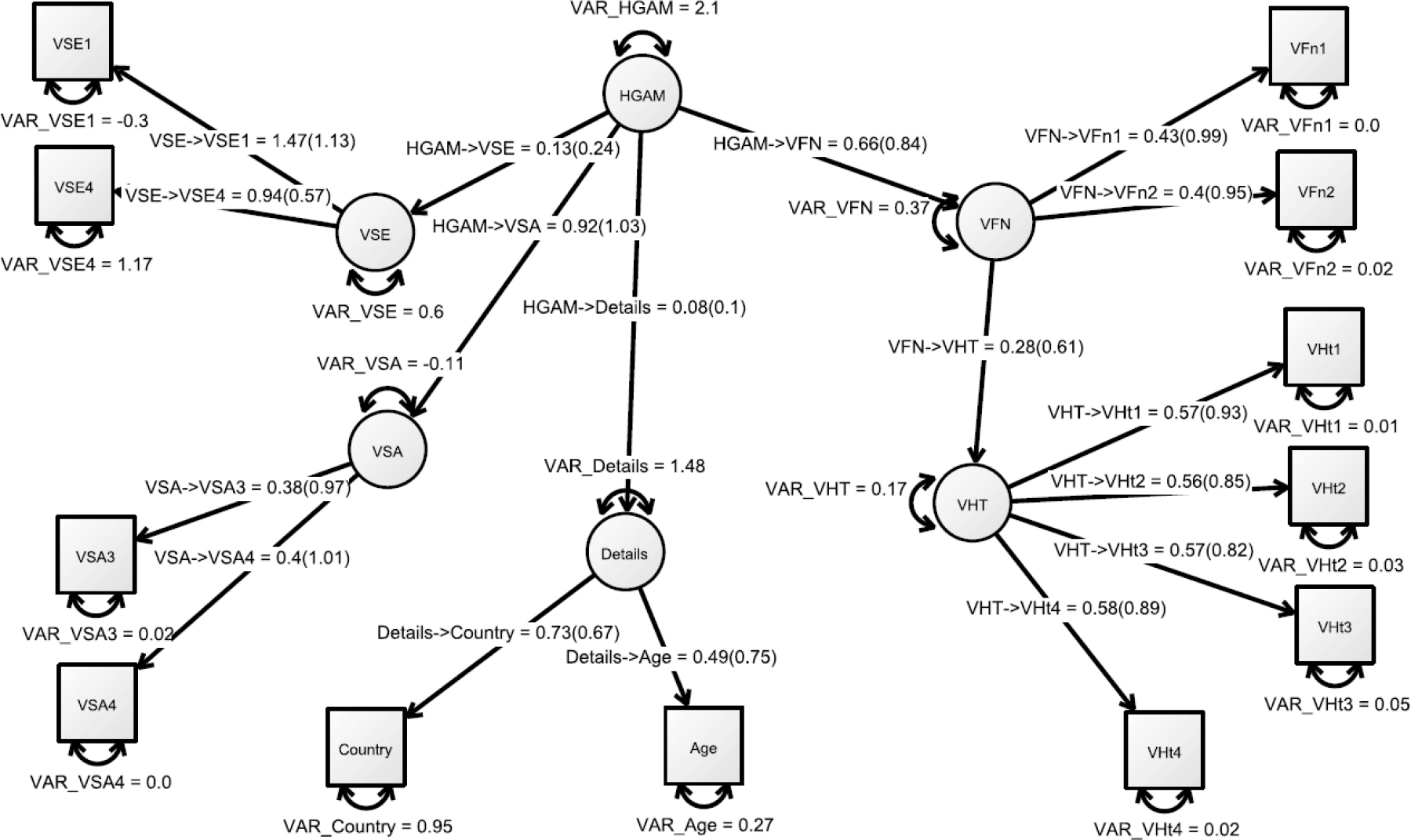
Figure 1:
Structural equation model diagram with standardised estimates
5. Discussion
Grade 1 (highest score) signifies that the location helps rehabilitation of various injuries with total of 623 replies (VHt1). While grade 0.75 gave by 59 respondents. For (VHt2) ‘Place where the power of faith is felt’, 609 respondents gave the highest score, and 73 respondents 0.75. The third statement, related to motives (peace and quiet), for the location choice, should be said that 595 respondents gave the highest grade, and 87 respondents 0.75. The fourth statement (VHt4) is marked with highest grade by 614 tourists and 68 of them gave grade 0.75. Similar trend is observed for (VHt5). These confirm the importance of health factors (VHt) associated with the Sofia’s spring. Similarly, Functional values (VFn), and Scenic/Aesthetic values (VSA) shows next higher scores respectively, whereas the Touristic (VTr), Scientific/Educational (VSE), and Protection (VPr) factors shows comparatively lower scores. This is primarily because the location has not gone through the process of valorisation and urbanization and it may be in a part of the national park which is in the protection regime of the first degree and where there is no tourism infrastructure. The respondents came from different countries, and each of them agreed that the location had something special that is worth continually coming to the location.
The response analysis shows that geo-locations of Serbia with high health values (VHt) such as the Sofia’s spring attract more tourists. On the other hand, it also indicates that upgradation of the touristic values (VTr) is also essential for polyvalent tourism experience. The first thing respondents scored was promotion activity (Vtr1). We should point out that 627 respondents answered that there was not any promotional activity regarding this location (scored 0), and 60 respondents gave score 0.25 (while talking to them we could conclude that this was a promotional activity ‘mouth to mouth’). The second question (Vtr2) all respondents marked 0 (there is no organised visit to the location). Looking at the answers to the first question, the attitude of state and all authorities, responsible for the promotion and development of tourism, towards such a geo-site is evident. There is little information about geo-site on the internet, and there are no organised visits to the geo-site. Referring to the third question (Vtr3) and ‘Vicinity of visitors’ centre’, the answers to the question are such that 643 respondents replied that visitors’ centre can be found in the range of 5 to 20km. Namely, information centre is in the vicinity, towards Iriški venac. Furthermore, the capital city of the province Vojvodina is in the surrounding area, which gives geo-site a status of good tourist-geographical location. The question (Vtr4) ‘Interpretative panels’, like promotion, gave data which showed that on the mountain and in the national park there is no ‘health tourism’.
Referring to the fifth question (Vtr5), the respondents answered that the geosite is visited annually by less than 5.000 tourists. These data are true since an official record of number of visitors has not been made. The answers to the question (Vtr6), are such that 442 respondents marked 0 (nothing from the mentioned exist on the geo-site), and 245 respondents marked 0.25 (there is something, which probably refers to marked walking trails through the national park). Even though marked walking trails exist, they are made especially for climbers, and those trails are hard to use for cycling. Thus, cycling paths through the National Park do not exist. So, bikers’ cycle on the car road that goes through the centre of the mountain. When one gets to the geo-site, one can miss it, as there are no signs, nor marks that Sofia’s springs is there. However, during the summer, there are always bikers and visitors there, so it is hard to miss it. Apart from that, on the geo-site you cannot find anything of the tourism superstructure. The question (Vtr7) which refers to ‘Tour guide service’, the answers are like the previous ones. The majority answered that there is no tour guide (459 respondents), while 228 respondents replied with 0.25 (which mainly refers to bikers from Serbia which waited them near Bačka Palanka, at the part of the road where Danube Cycle Path separates and partly continues through the National Park Fruška gora). Referring to the question (Vtr8) ‘Hostelry service close to geo-site’, the respondents answered that the accommodation can be found in the range of 25 to 50km. Namely, the nearest accommodation can be found in the rest area Letenka, where it is possible to set up a tent. There are several villages in the vicinity (Sviloš, Ležimir and others), where one can ask for a private accommodation, and in the surrounding area are cities: Novi Sad, Sremska Mitrovica, Irig, etc. The situation is the same when it comes to the restaurants service (Vtr9).
Geo-site possesses certain characteristics which have been confirmed by respondents. To the question (VSA1), respondents, who came to the geosite only for health reasons, answered that on the geo-site i.e. its surroundings, there are more than 6 ‘Viewpoints’ (302 respondents) followed by 233 respondents that answered 4 to 6 ‘Viewpoints’. This is very logical response since this is the National Park and nature at this part of the mountain is unspoiled and breathtaking. Fruška gora is the National Park since 1960 and is very famous for its viewpoints which are numerous in this part of the mountain. The viewpoints are arranged with benches, bins, barbecue spots, as well as gazebos. Whether it is the viewpoint on the hill Šakotinac, Čerević, Ležimir, Sviloš, Brankovac, Jabuka or others, views on Vojvodina and Dunube, are breathtaking. Referring to the second question from this group of variables (VSA2), it should be said that the respondents also gave answers which are in favour of the National park’s flora and fauna richness. Namely, most respondents (625) answered that the whole area of the park is fascinating and that they really enjoy in spending time in nature. Greenery, the beauty of the park and its rare values contribute to the enhanced experience of energy which can be felt on the geosite. The question (VSA3) confirms that curiosity, rarity, fitting into ambient and specificity of the geosite and its surroundings, are one of the comparative advantages of this dry spa. Almost all respondents gave the highest grade to this question. Same as for the following question (VSA4).
The analysis of responses regarding the Sofia’s spring in Serbia indicates that it is highly valued for its health benefits, with a significant number of respondents rating it highly for rehabilitation and the power of faith, while also appreciating its peaceful environment. Despite its natural beauty and potential for health tourism, the site lacks promotional activities, organised visits, and adequate tourism infrastructure, which limits its appeal to a broader audience. The findings suggest that while health tourism is currently underdeveloped, the site’s natural and recreational attributes, along with its unique characteristics, position it as a promising candidate for the growth of rural tourism in the region. This supports the preliminary hypothesis H, suggesting that the ‘Sofija’s Springs’ site possesses potential for rural tourism development, acknowledged by visitors as a tourist attraction, thereby serving as a crucial catalyst for the advancement of rural destinations.
6. Conclusions
The potential benefits of health tourism in rural areas are manifold, with economic impact being one of the most significant advantages. By attracting health tourists, rural communities stand to benefit from job creation and revenue generation. Establishing health-related facilities and services can lead to new employment opportunities, not only within healthcare but also in hospitality, transportation, and local businesses. According to Deepu et al. (2020), a study conducted in Kerala, India, highlighted how the influx of health tourists led to the creation of numerous jobs in both the medical and service sectors, significantly boosting the local economy. Moreover, health tourism can catalyse the improvement of local healthcare services and infrastructure, as the need for quality medical facilities and trained professionals increases. This enhancement can elevate the standard of healthcare for local residents, ensuring that they also reap the benefits of improved services. Additionally, health tourism initiatives can promote local culture and traditions, as many health tourism experiences are rooted in regional practices, whether it be Ayurveda in India (Ansari & Singh, 2024) or traditional healing in African communities (Nchimbi & Alawi, 2024). This cultural promotion not only attracts tourists but also fosters pride among locals, creating a sense of community and shared identity.
Rural regions are often rich in natural resources, including mineral springs, therapeutic mud, and a variety of plants used in traditional medicine. For instance, many rural areas in countries like Hungary (Csákvári et al., 2020) and the Czech Republic (Speier, 2011) are renowned for their thermal baths, which are believed to have healing properties for various ailments. Moreover, access to clean air and water is another significant advantage of rural settings, as they tend to have lower pollution levels than urban counterparts. This element of health tourism is especially appealing in a world increasingly aware of the negative impacts of environmental toxins on health. Alongside these benefits, rural areas often provide opportunities for nature-based therapies, such as hiking, yoga retreats, and herbal remedy workshops, which have been shown to reduce stress and improve overall wellbeing. The combination of these factors creates an enticing package for health-conscious travellers seeking an escape from the hustle and bustle of urban environments, thereby establishing the relevance of rural areas in the health tourism landscape.
Fruška Gora National Park and the rural areas of the mountain have numerous attractions, and Sofia’s springs are just one of them. It is necessary to invest in the development of tourism, and then to connect local actors with other actors at all levels. Also, it is very important to empower and educate rural communities and the local population about the importance of their potential. The goal of transforming the potential of Sofia’s springs into a tourist attraction is the development of a rural destination and the inclusion of the entire local community in that development. This would bring several important positive effects to the rural destination and the local population: the creation of new jobs, and thus the rejuvenation of the local population through the return of young people to rural households, investment in the development of infrastructure and superstructure, empowerment of women and female entrepreneurship, especially in the field of rural, sustainable and eco-tourism. These factors should be the main arguments for the development of such a policy that supports investments in rural destinations. It is necessary to listen to the market and follow the needs of tourists, who are increasingly sophisticated and sensitive. Natural potentials, such as Sofia’s springs, represent multivalent tourist attractions, exactly the kind that destinations need. They satisfy the widest range of tourist needs, of different interest groups, which is a prerequisite for achieving efficient and effective rural development.
The transformation of the potential into attractions at the Sofia springs site can be carried out in several stages: as a complementary tourist offer to other tourist products and attractions (visits to the site by cyclists on the retraced EuroVelo 6 route; site visits of religious tourist which visiting numerous monasteries and the like), as a specialised tourist offer that would gather suitable partners together with the aim of forming the most complex and attractive tourist offer. The second approach aims at long-term inclusion, that is, responsible management of human resources and cooperation between management of tourist destinations, of the local population and tourists. The potential exists, but in itself it is not enough to be a tourist attraction. Activation of the potential must be planned and agreed with the interests of the local community, and then in coordination with all levels of government. Only in this way, the development of a special form of tourism, such as the health tourism, in Sofia’s springs will condition the development of the rural destination.
Moreover, evaluating the demographic profile of health tourists visiting Sofia Springs can provide insights into visitor preferences, which are vital for tailoring services. For instance, data may indicate that a significant portion of health tourists are older adults seeking relaxation and rehabilitation, suggesting a need for agefriendly services. Additionally, understanding the economic impact of health tourism on the local community is critical. Preliminary assessments may show that health tourism generates employment opportunities and stimulates local businesses, but a comprehensive economic impact analysis should be conducted to quantify the benefits and ensure that the local population sufficiently reaps the rewards of the tourism influx.
6.1. Limitations and future research
A tourist destination such as ‘Sofia’s springs’, due to its location within the Fruška Gora national park, and its polyvalent tourist value, could have an international contraction zone. Those characteristics stand out as a comparative advantage, which could be used for better positioning and achieving a competitive advantage in the future. In order to ensure the attractiveness of the destination for a longer period of time, it is necessary to regularly monitor the impact of the development of the infrastructure network, as well as the connection of the locality with international flows, especially the EuroVelo 6 route. It is necessary to build a superstructure and accompanying contents for a more complex tourist supply that is able to satisfy the most diverse tourist needs centred around the motive of health. Also, further research on the impact of promotional activities on the number of visitors and their satisfaction is necessary.
Identifying gaps in current research and outlining future research directions is essential for advancing knowledge in the field of health tourism, particularly as it relates to Sofia Springs. Existing literature may reveal under-researched areas, such as the impacts of health tourism on social cohesion within rural communities or the psychological effects of health tourism on visitors. To address these gaps, it is important to suggest methodologies for future studies that can quantitatively and qualitatively analyse health tourist preferences and behaviours. For example, employing mixed-method approaches, including surveys and interviews, could yield comprehensive insights into what attracts tourists to Sofia Springs and how their experiences can be improved. Additionally, recommending collaborative research opportunities between local stakeholders—such as health service providers, tourism boards, and community organizations—and academic institutions can foster a collaborative environment where knowledge is shared, and research is grounded in real-world contexts. Such partnerships can lead to targeted research initiatives that directly address the needs of the community while contributing to the academic discourse on health tourism.
Notes
[1] 8 Data availability statement
The aggregated data analysed in this study are available from the corresponding author upon reasonable request.
[2] Conflicts of interest 9 Conflicts of Interest
The authors of thearticle declare no conflict of interest.