
Table 1:
Summary Table of RevPAR determinants based on the literature.
| RevPAR determinants | Authors | |
|---|---|---|
| Hotel internal factors | Average daily rate | (Chattopadhyay & Mitra, 2019; Enz et al., 2016; Singh et al., 2014) |
| Employees | (Sainaghi, 2011) | |
| Years since last renovation | ||
| Hotels/number of rooms | (Jiang & Taylor, 2020; Kim et al., 2013; Sainaghi, 2011) | |
| Hotel owner | (Jiang & Taylor, 2020; Xiao et al., 2012) | |
| Quality of service and product | (Cross et al., 2009; Kimes, 1999) | |
| Sales effectiveness | (Cross et al., 2009) | |
| Sustainability certificate | (Bianco et al., 2023) | |
| Marketing policies | Social presence/social media usage | (Anderson, 2012; De Pelsmacker et al., 2018) |
| Brand positioning/Brand affiliation | (Cross et al., 2009; Xiao et al., 2012) | |
| Total marketing expenses | (Singh & Dev, 2015) | |
| Digital innovation | (Alrawadieh et al., 2021; Bovsh et al., 2022) | |
| Customer mix/market orientation | (Kim et al., 2013; Sainaghi, 2011) | |
| Consumers | Consumer confidence | (Chen, 2015; Liu et al., 2013; Pacheco, 2016) |
| Customer satisfaction | (Kim et al., 2013; Kimes, 1999) | |
| International tourist arrival | (Chen, 2011; Liu et al., 2013; Pacheco, 2016) | |
| Number of residents and non-residents overnight stays | (Pacheco, 2016) | |
| Online review sites | (Anderson, 2012; De Pelsmacker et al., 2018; Phillips et al., 2016) | |
| Demand for hotel rooms | (Chattopadhyay & Mitra, 2019) | |
| Hotel uncontrollable factors | Abnormal weather conditions | (Mun & Park, 2022) |
| Economic growth | (Pacheco, 2016) | |
| Seasonality/trend | (Chattopadhyay & Mitra, 2019; Jiang & Taylor, 2020) | |
| Grand impact events (Olympic games, tsunami, hurricane) | (Choi et al., 2019; Liu et al., 2013) | |
| Government's role | (Subedi & Kubickova, 2023) | |
| Stock index | (Liu et al., 2013) | |
| Real-estate development | ||
| Exchange rate Trade balance | ||
| Growth of room supply | (Zheng, 2014) |
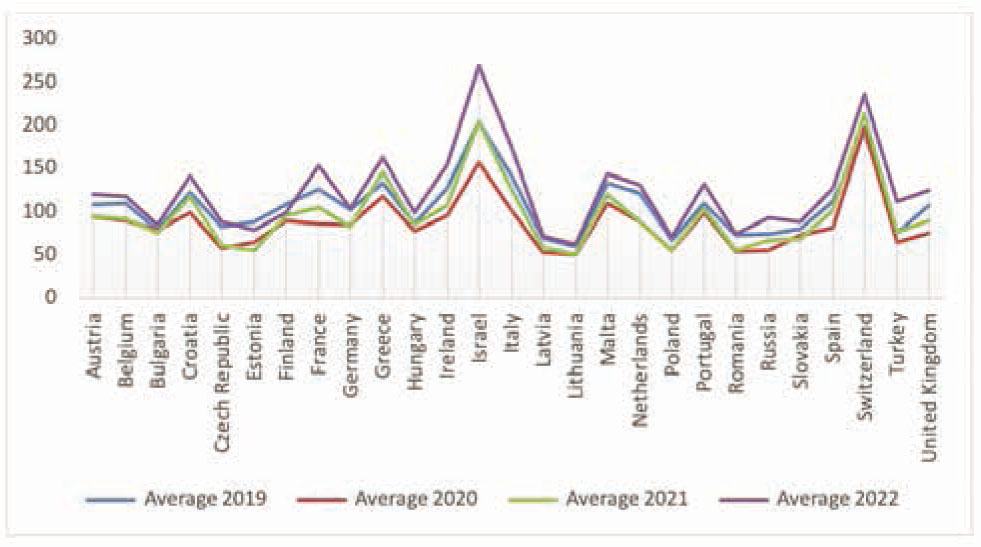
Figure 1:
ADR average from 2019–2022
Data retrieved from STR Global
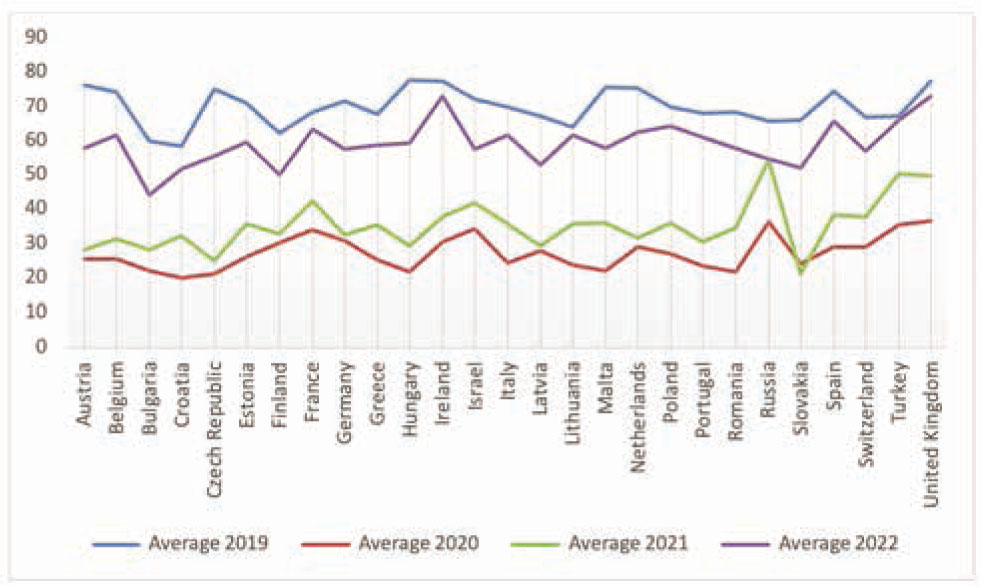
Figure 2:
Occupancy rate average 2019–2022
Data retrieved from STR Global
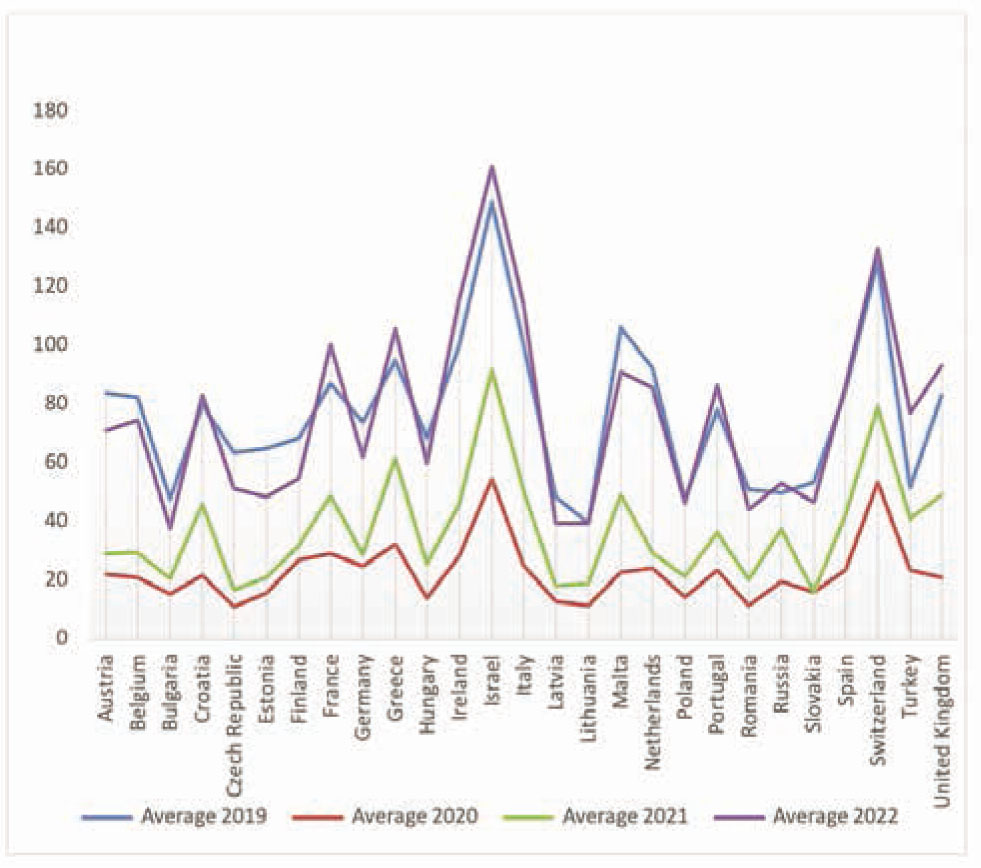
Figure 3:
RevPAR average from 2019–2022
Data retrieved from STR Global
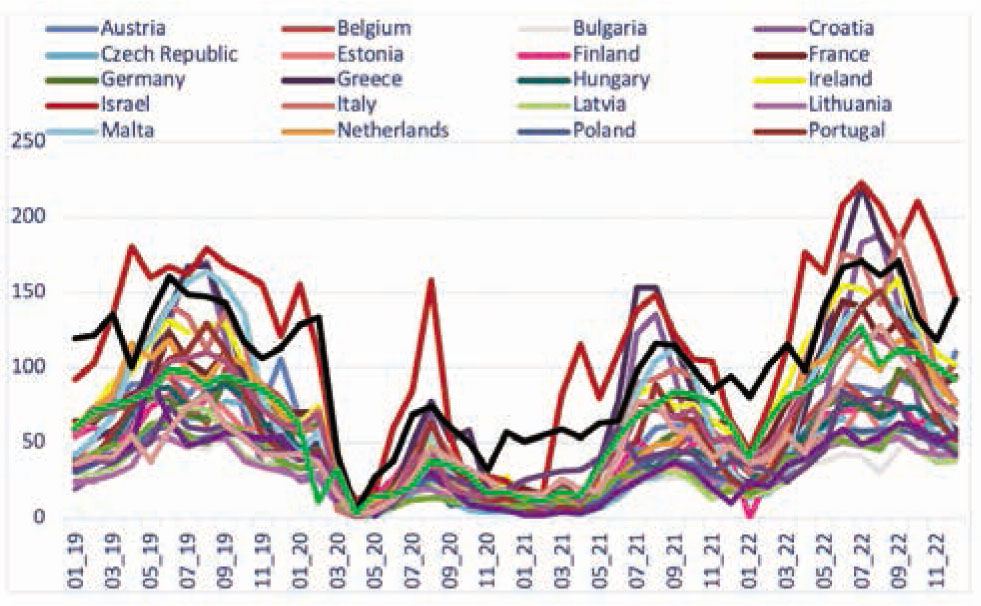
Figure 4:
RevPAR co-movement since 2019 to 2022
Data retrieved from STR Global
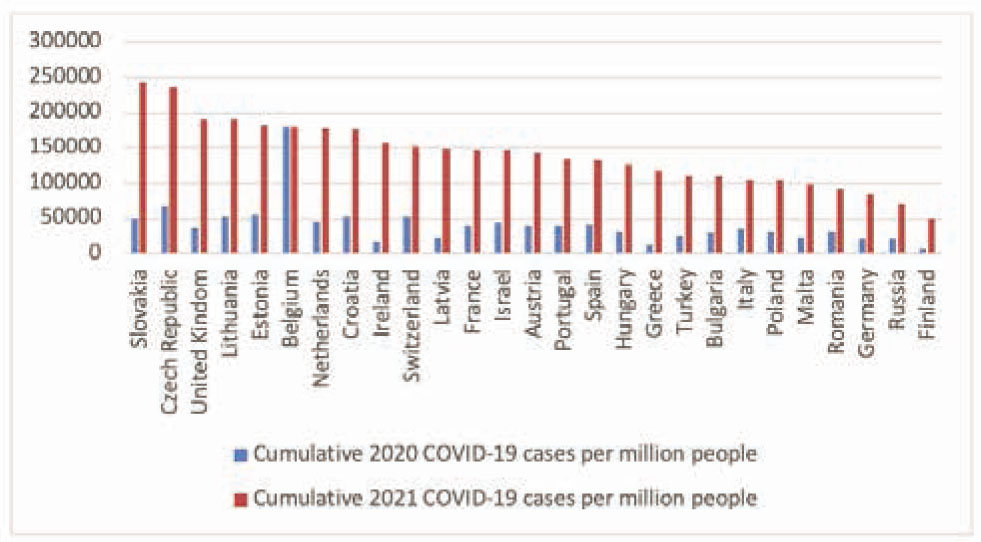
Figure 5:
Cumulative confirmed COVID-19 cases per million people in 2020 and 2021
Data retrieved from Our world in data.
Table 2:
Countries grouped according to RevPAR variation between 2021 and 2022
| Lowest | Median | Highest |
|---|---|---|
| Bulgaria | Estonia | Austria |
| Croatia | France | Belgium |
| Finland | Germany | Czech Republic |
| Greece | Italy | Hungary |
| Israel | Latvia | Ireland |
| Malta | Lithuania | Netherlands |
| Russia | Poland | Portugal |
| Switzerland | Romania | Slovakia |
| Turkey | Spain | |
| United Kingdom |
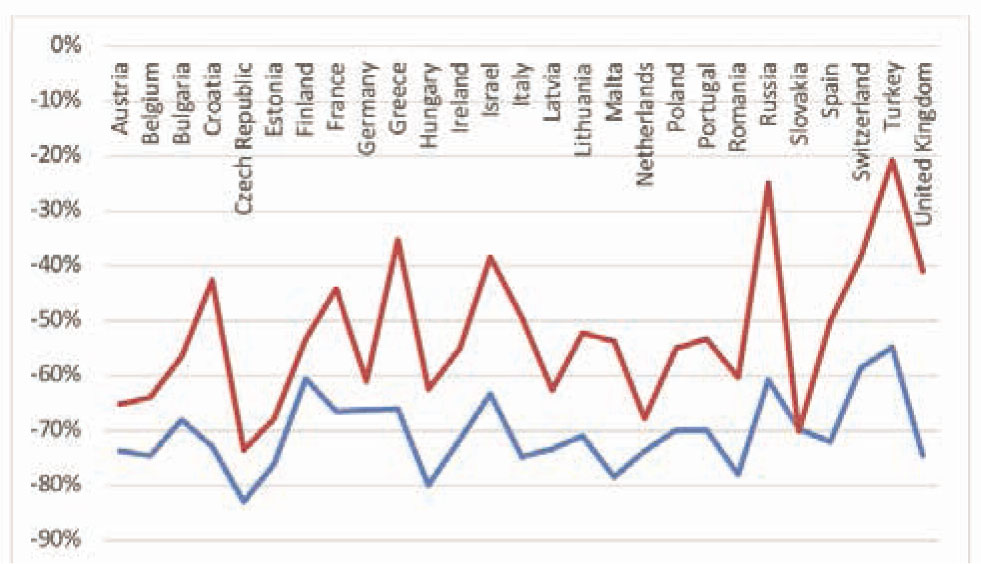
Figure 6:
RevPAR variation from 2019 to 2020 and 2021
Data retrieved from STR Global.
Table 3:
Spearman’s rank correlation coefficient of RevPAR with occupancy rate and ADR
| Country | Occupancy rate | ADR |
|---|---|---|
| Switzerland | 0.930 | 0.084 |
| Bulgaria | 0.999 | 0.308 |
| Finland | 0.972 | 0.706 |
| Lithuania | 0.981 | 0.727 |
| Slovakia | 0.916 | 0.790 |
| Austria | 0.951 | 0.801 |
| Poland | 0.944 | 0.874 |
| Ireland | 0.993 | 0.944 |
| Croatia | 0.972 | 0.958 |
| Germany | 0.972 | 0.965 |
| Latvia | 0.972 | 0.965 |
| Netherlands | 0.972 | 0.965 |