
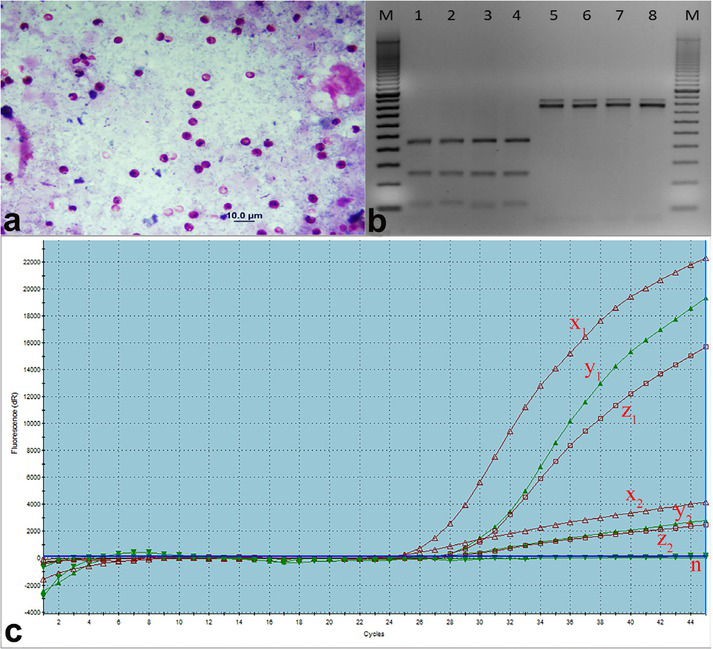
Figure 1
a: Cryptosporidium oocysts in fecal smears stained with the Ziehl-Neelsen by microscopic examination (×1000); b: Electrophoretic profiles of the SSU rRNA PCR products of C. parvum isolates digested with the endonucleases SspI (lanes 1 to 4) and MboII (lanes 5 to 8). M: Molecular size marker (100bp); c: Amplification curves with TaqMan real-time PCR analyses. x1, y1 and z1: C. parvum species specific qPCR curves; x2, y2 and z2: Cryptosporidium genus specific qPCR curves belonging to the same isolates; n: No DNA control and negative samples
Table 1
Comparison of the results of microscopic examination and molecular assays in the detection of Cryptosporidium in calves and evaluation of diagnostic sensitivity and specificity.
| Method | Molecular tools | Sensitivity | Specificity | ||
|---|---|---|---|---|---|
| Positive | Negative | ||||
| Microscopy | Positive | 92 | 0 | 85.5% | 100% |
| Negative | 12 | 90 | (80.7-93.9%) | (96.0-100.0%) | |
| Total | 104 | 90 | |||
Table 2
Distribution and subtype of C. parvum over age groups of the examined calves based on molecular diagnostic tests used in the study.
| Age group (days) | Total no. of samples | Cryptosporidium parvum | |||
|---|---|---|---|---|---|
| No. positive (%) | χ2 | p | gp60 subtype | ||
| Early pre-weaned calves (≤ 15) | 158 | 89 (56.3) | 2.535 | 0.139 | IIaA13G2R1 |
| Pre-weaned calves (15-40) | 36 | 15 (41.7) | |||
| Total | 194 | 104 (53.6) | |||