
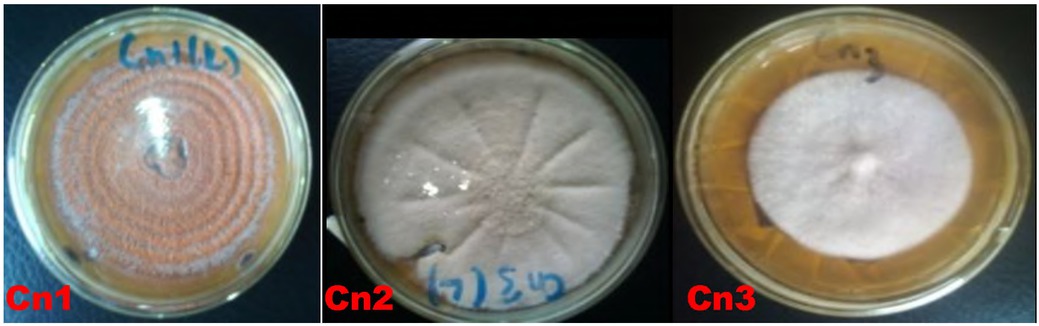
Figure 1
Macroscopic morphologies of the pure endophytic isolates.
(Cn1 - Acremonium sp., Cn2 - Aspergillus sp., Cn3 - Trichophyton sp.)
Table 1
Cultural morphology and microscopic features of the endophytic fungi isolates from C. nitida
| Isolates | Form | Elevation | Margin | Colour | Reverse | Growth Rate | Texture | Hyphae | Spores | Diameter (mm) | Suspected Organism |
|---|---|---|---|---|---|---|---|---|---|---|---|
| Cn1 | Circular | Flat | Curled | Orange | Light orange | Slow/moderate | Slimy and moist | Septed | Micro conidia | 75 | Acremonium (15) |
| Cn2 | Circular | Raised | lobate | White | Colourless with stripes | Moderate | Thick cottony and Dry | Septed | Micro conidia | 88 | Aspergillus II (16) |
| Cn3 | Circular | Nmbonate/Flat | Entire | white | Absent or pale brown-ish-yellow with age | Moderate | Cottony Smooth | Septed | Micro conidia | 60 | Trichophyton (17) |
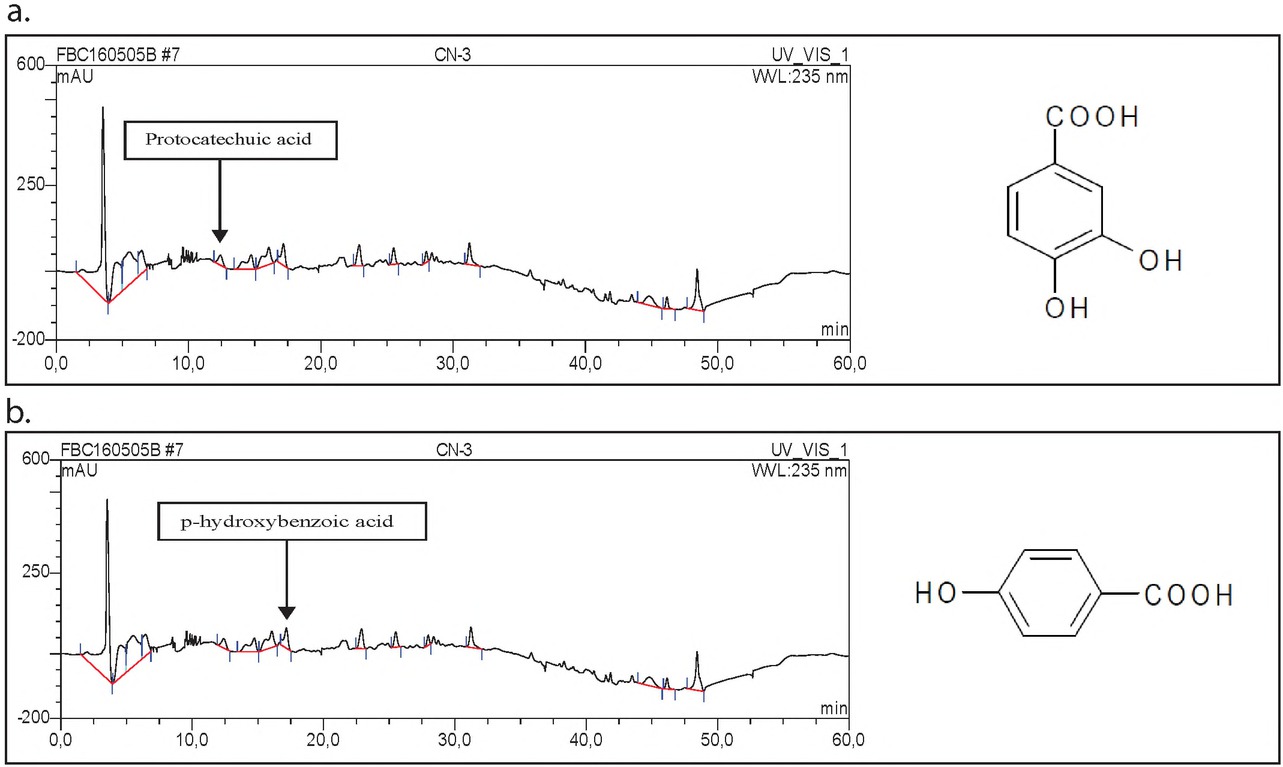
Figure 2
a: HPLC chromatogram of Cn3 extract showing protocatechuic acid; its UV spectrum and structure.
b: HPLC chromatogram of Cn3 extract showing p-hydroxybenzoic acid; its U V spectrum and structure.
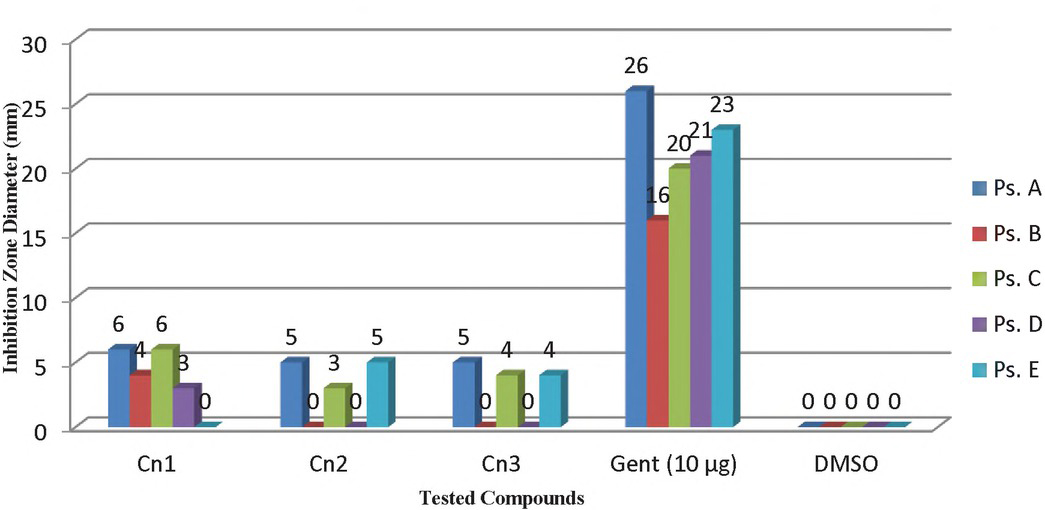
Figure 3
Antipseudomonal zones of inhibition of the fungal extracts against various clinical isolates (IZD in mm). Values represent the mean of experiments in triplicates.
Ps.a A = Laboratory isolate, Ps.a B=Orthopedic wound infection, Ps.a C= Urine, Ps.a D=Sputum isolate, Ps.a E = Vaginal swab Isolate.