
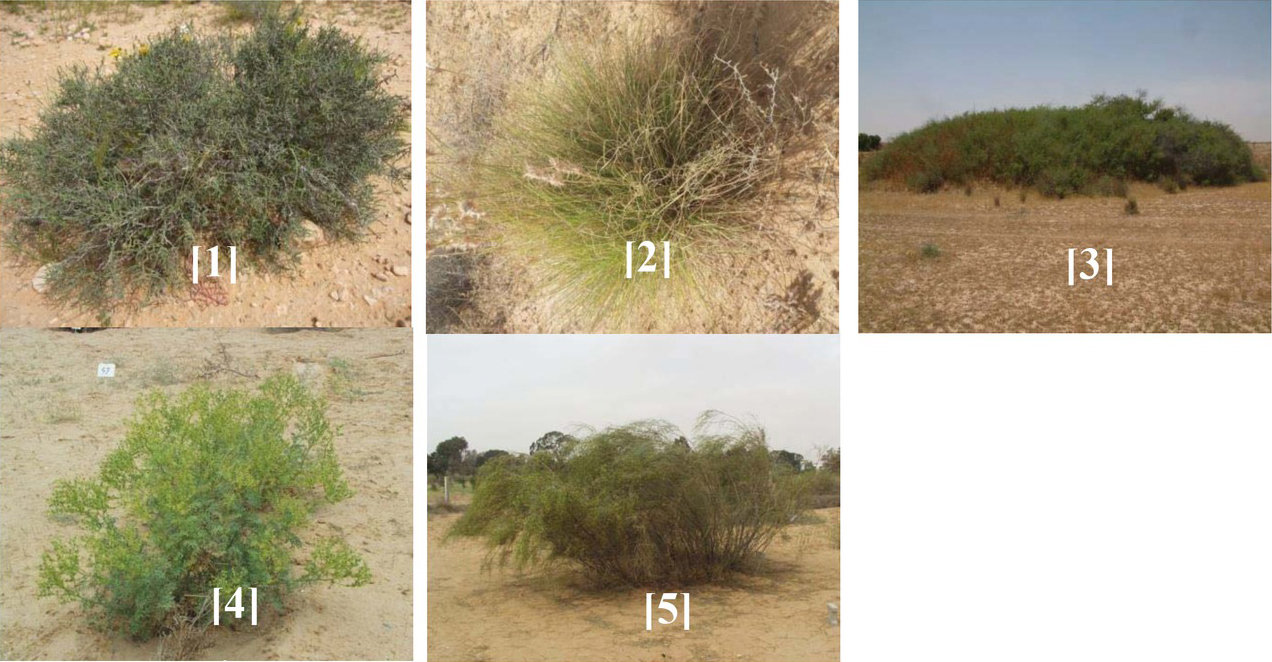
Figure 1
Aromatic and Medicinal species: [1]Hamada scoparia = Arthrophytum scoparium, [2]Cymbopogon schoenanthus, [3]Ziziphus lotus, [4]Crithmum maritimum, [5]Retama raetam.
Table 1
Medicinal properties of the plant species investigated
| Family and scientific name | Medicinal used parts | Use(s) | Major active compounds | Reference(s) |
|---|---|---|---|---|
| Poaceae Cymbopogon schoenanthus L. Spreng | Arial parts | Indicated for the treatment of rheumatism and fever. Diuretic, insecticide | Essential oil: limonene (10.5–27.3%), β-phellandrene (8.2–16.3%), α-ter- pinene (4.3–21.2%) and α –terpineol | (11) |
| Apiaceae Crithmum maritimum L. | Leaves, Seeds | Appetizers and condiments. Antiscorbutic, tonic, carminative , diuretic, depurative and vermifuge | vitamin C, carotenoids, flavonoids, essential oil (γ-terpinene, β-phellandrene , and sabinene) | (12) (13) |
| Chenopodiaceae Hammada scoparia Pomel. Iljin (Arthrophytum scoparium) | Shoots | Indicated for the treatment of eye disorders, a poultice for mould, diarrhea, bites of snakes and against rheumatisms Snuff powder | Alkaloids, flavonol triglycoside, isorhamnetin (3-O-beta-D-xy lopyranosyl-(1-3)-alpha-L rham nopyranosyl-(1’’’-6 »)-beta-D-ga lactopyranoside, Isorhamnetin 3-O-beta-D-apiofuranosyl-(1-2) (al- pha-L-rhamnopyranosyl-(1-6))-be ta-D-galactopyranoside, Isorhamnetin3-O-alpha-L-rhamnopy ranosyl-(1’-2 »)) | (14) (15) |
| Fabaceae Retama raetam Forssk. | Leaves | Used for the treatment of some renal deseases wounds, bites of snakes, sheep scabies, hyperten- sion and for making eye wash for eye troubles. Diuretic, febrifuge, purga- tive and vermifuge. | Alkaloids and flavonoids (daidzein, vicenin-2, naringenin, apigenin, kaempferol, quercetin and kaemp- ferol-7-O-glucoside, daidzein 7, 4′-di- methyl ether, chrysoeriol 7-O-gluco side and orientin) | (16) (17) |
| Rhamnaceae Zizyphus lotus L. | Fruits, leaves, seeds, roots bark | Treatment of digestive disorders, weakness, liver complaints, obesity, urinary troubles, diabetes, skin infections, fever, diarrhea, fatigue, distress, eyes inflammation, vitamin B deficiencies, emollient, sedative, spleen tonic, aphrodisiac, cleans blood, appetizing, facilitate digestion. | Cyclopeptide alkaloids, (lotusines B, C, E and F dammarane saponins) Flavonoids and phenolic acids (cat echin, caffeic acid, p-coumaric acid, ferulicacid, rutin, apigenin-7-gluco- side, eriodictyol, quercetin, p-hy droxybenzoic acid, chlorogenic acid andsyringic acid) | (18) (19) |
Table 2
Total polyphenolics, flavonoid and condensed tannin content in the five investigated plant extracts. Data are expressed in mg g-1 of dry matter
| Extracts | Cymbopogon schoenanthus | Crithmum maritimum | Hammada scoparia | Retama raetam | Zizyphus lotus | |
|---|---|---|---|---|---|---|
| Total phenolic (mg GAE g DW-1) | Ethanolic | 63.86±0.01d | 62.47±0.05e | 93.87±0.03c | 112.12±0.11b | 139.08±0.17a |
| Aqueous | 128.63±0.12a | 116.13±0.2b | 41.90±0.15d | 97.27±0.03c | 35.17±0.21e | |
| Total flavonoid (mg CE g DW-1) | Ethanolic | 7.09±0.07d | 6.05±0.13e | 70.00±0.10b | 15.93±0.23c | 70.71±0.09a |
| Aqueous | 16.00±0.09c | 21.26±0.08b | 14.11±0.20d | 14.50±0.12d | 29.17±0.03a | |
| Total condensed tannins (mg CE g DW-1) | Ethanolic | 22.84±0.09d | 16.62±0.07e | 82.44±0.20b | 28.15±0.16c | 129.17±0.12a |
| Aqueous | 59.97±0.16a | 58.31±0.19b | 35.22±0.11d | 40.83±0.08c | 22.22±0.06e |
Table 3
Antioxidant activity of the aqueous and ethanolic extracts of the five studied plants
| Extracts | Cymbopogon schoenanthus | Crithmum maritimum | Hammada scoparia | Retama raetam | Zizyphus lotus | |
|---|---|---|---|---|---|---|
| TAA (mg GAE g DW-1) | Ethanolic | 87.91±0.06e | 89.35±0.08d | 236.00±0.19b | 248.89±0.31a | 179.44±0.21c |
| Aqueous | 69.02±0.09e | 82.35±0.05b | 80.90±0.11c | 139.00±0.04a | 73.47±0.05d | |
| Antiradical activity (IC50 mg mL-1) | Ethanolic | 0.6.00±0.02a | 0.80±0.01b | 0.60±0.08b | 0.80±0.01a | 0.19±0.08c |
| Aqueous | 0.30±0.01c | 0.60±0.01a | 0.45±0.08b | - | 0.24±0.07d | |
| Iron reducing power (ECmg mL-1) 50 | Ethanolic | 0.38±0.01c | 0.46±0.02b | 0.10±0.01e | 0.90±0.01a | 0.30±0.02d |
| Aqueous | 0.11±0.01d | 0.40±0.01a | 0.33±0.01c | 0.36±0.01b | 0.40±0.11a | |
| Chelating effect (EC50 mg mL-1) | Ethanolic | 68.00±0.08b | 84.00±0.09a | 85.11±0.13a | 8.40±0.02c | 0.11±0.01d |
| Aqueous | - | - | - | 5.37±0.01a | 0.16±0.01b |
Table 4
Identification and quantification by reversed-phase high performance liquid chromatography of the main phenolic compounds extracted with ethanol 70% from the five examined plants.
| Phenolic compounds | Quantity (%) | ||||
|---|---|---|---|---|---|
| Cymbopogon schoenanthus | Hammada scoparia | Retama raetam | Ziziphus lotus | Crithmum maritimum | |
| Resorcinol | 5.08 | - | - | - | - |
| Caffeic acid | 3.18 | - | - | - | - |
| 2.5-Dihydroxybenzoic acid | 2.01 | - | - | - | - |
| Quercetine-3-o-rhamnoside | 32.82 | 3.64 | - | - | - |
| Trans-cinnamic acid | 9.72 | - | - | - | - |
| Gallic acid | 8,80 | 2.93 | - | 6.56 | - |
| Ferulic acid | 9.83 | - | - | - | - |
| Vanillic acid | - | 8.02 | - | 37.04 | 10.37 |
| Apigenin-8-C-glucoside | - | 31.17 | - | - | - |
| Coumaric acid | - | 3.84 | - | - | - |
| Rosmarinic acid | - | 1.93 | - | 4.17 | - |
| Chlorogenic acid | - | 7.05 | - | - | 5.39 |
| Syringic acid | - | - | 0.2 | - | - |
| Kaempferol | - | - | 2.58 | - | - |
| 3.5-dimethoxy-4- hydroxybenzoic acid | - | - | - | 5.16 | - |
| Quercetine-3-galactoside | - | - | - | 10.46 | - |
| Epigallocatechin | - | - | - | 35.89 | |
| Total phenolics | 71.44 | 58.58 | 4.36 | 63.39 | 52.82 |
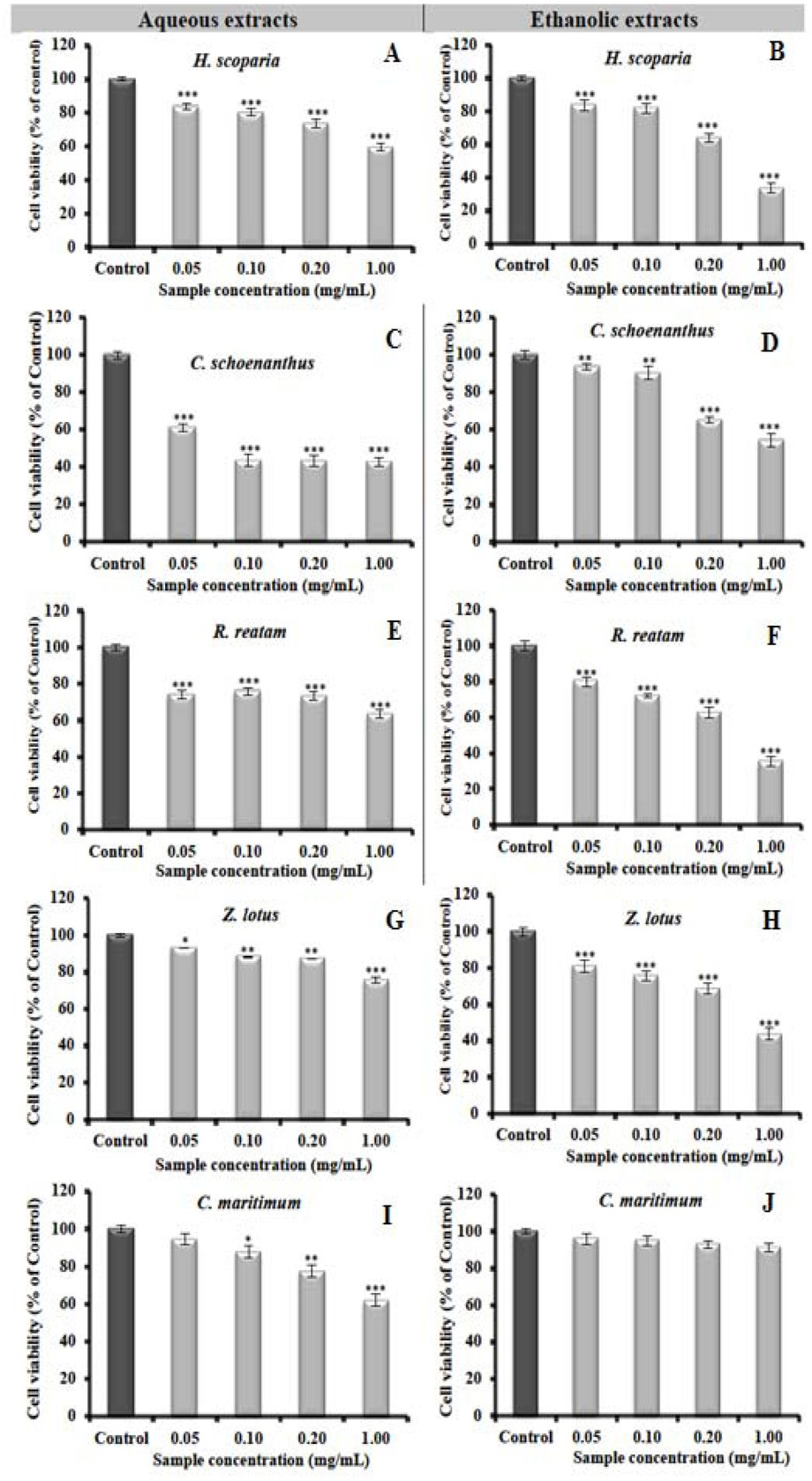
Figure 2
Anti-proliferative activity of the five selected Tunisian medicinal plants against the human breast cancer cell line MCF-7. According to T-student test *<0.05, **<0.01, ***<0.001