
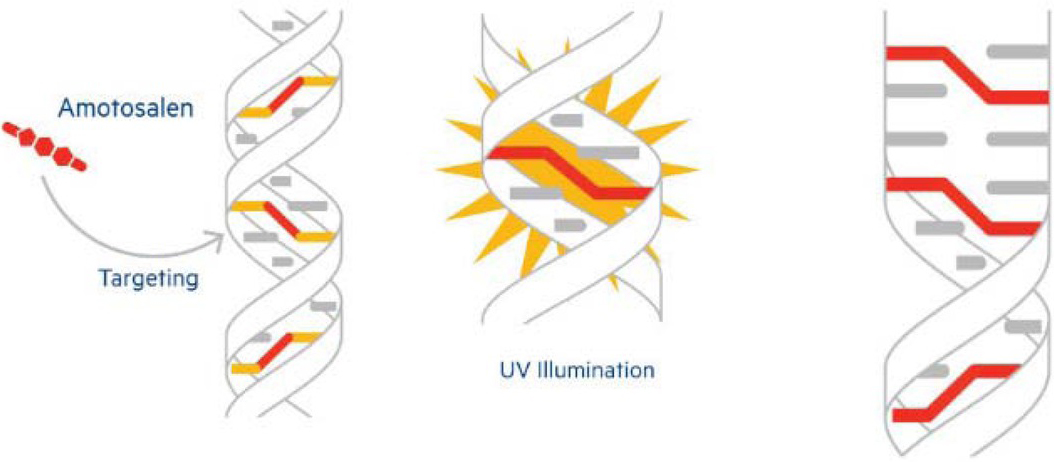
Figure 1
Amotosalen/UVA technology mechanism of action. Photoactive compound targets nucleic acids; UVA illumination activates photoactive compuond causing permanent cross-links between the double-stranded chains and blocks the replication of DNA and RNA. From: http://www.intercept-usa.com.
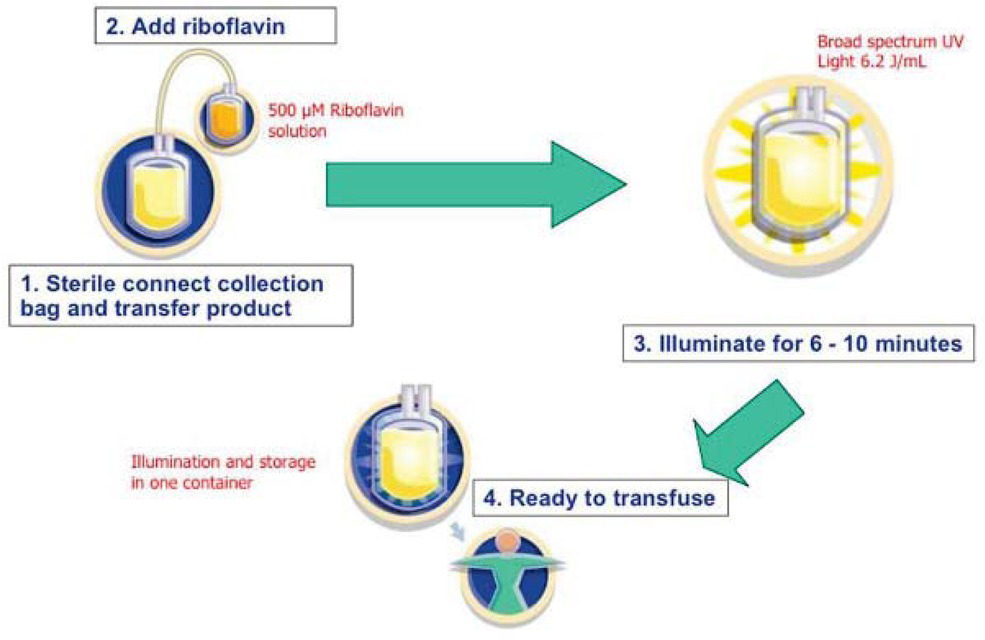
Figure 2
Mirasol mechanism of action. From Ref. (77), with permission.
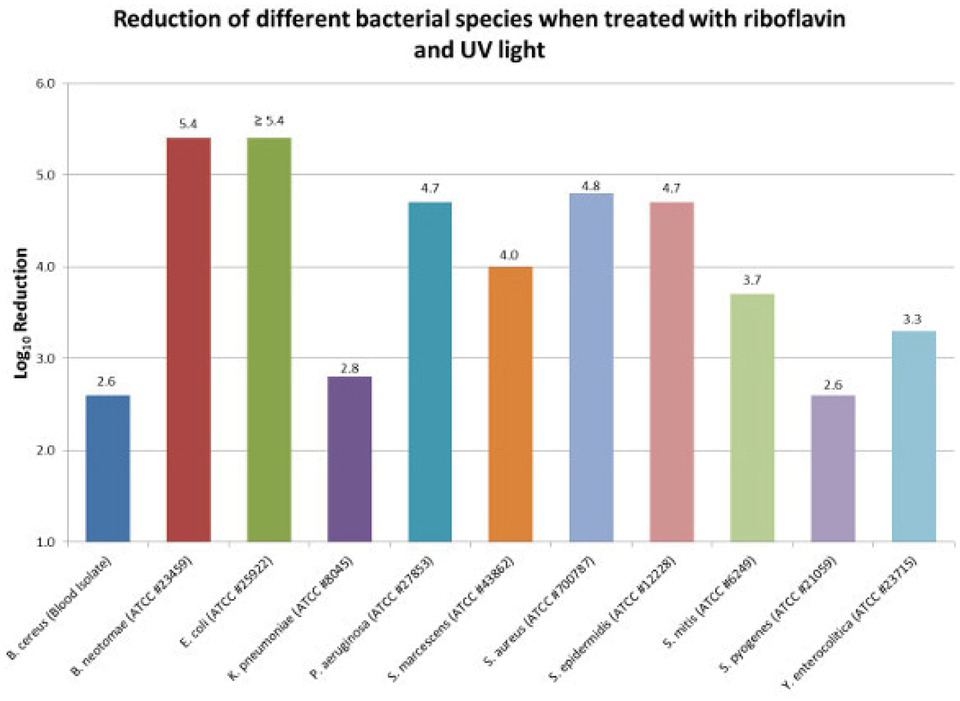
Figure 3
Reduction of various bacterial species when treated with Mirasol PRT System. From Ref (77), with permission.
Table 1
Reduction of infectious disease agent logs induced by different PI technologies*
| Pathogen | Amotosalen/UVA | Riboflavin/UV | UVC | Amustaline-GSH | |
|---|---|---|---|---|---|
| HBV | Enveloped virus | >5.5 (66) | 2.5 (76) | na** | >5.1 (105) |
| HCV | Enveloped virus | >4.5 (66) | 3.2 (76) | >4.9 (103) | na** |
| HIV (cell free) latent | Enveloped virus | >6.2 (66) | >4.5 (76) | 1.4 (90) | >6.5 (92) |
| HIV (cell-associated) active | Enveloped virus | >6.1 (66) | >5.9 (76) | na** | >5.9 (91) |
| CMV | Enveloped virus | >5.9 (66) | 2.1 (76) | na** | >6 (105) |
| WNV | Enveloped virus | >6.0 (66) | >5.1 (76) | 3.4 - 4 (85) | > 6.0 (93) |
| CHIKV | Enveloped virus | >6.9 (31) | 2.1 - 4 (83) | 6.34 (86) | > 6.78 (31) |
| Influenza A virus | Enveloped virus | >5.9 (66) | >5 (76) | na** | na** |
| HAV | Nonenveloped virus | 0.6 (98) | 1.8 (76) | 4.2 (87) | na** |
| Parvovirus B19 | Nonenveloped virus | 3.5-5.0 (99) | >5 (76) | 5.4 (31) | na** |
| Zika Virus | Enveloped virus | > 6 (68) | na** | 5.7 (104) | 5.99 (94) |
| Dengue Virus | Enveloped virus | > 4.3 (100) | 1.8 (101) | >4.6 (86) | 6.61 (106) |
| Staphylococcus aureus | Bacteria (Gram positive) | >6.6 (67) | 4.8 (6) | >4.4 (88) | 5.1 (91) |
| Staphylococus epidermidis | Bacteria (Gram positive) | >6.6 (67) | 4.2 (102) | 4.6 (88) | > 6.9 (92) |
| Pseudomonas aeruginosa | Bacteria (Gram negative) | 4.5 (67) | 4.5 (6) | 4.9 (84) | 4.5 (92) |
| Escherichia coli | Bacteria negative) (Gram | >6.4 (67) | 4.4 (102) | 7.3 (88) | >6.7 (91) |
| Serratia marcescens | Bacteria (Gram negative) | > 6.7 (67) | 4 (6) | > 5 (88) | 5.1 (91) |
| Yersinia enterocolitica | Bacteria (Gram negative) | > 5.9 (66) | 3.3 (6) | na** | >6.8 (93) |
| Trypanosoma cruzi | Protozoa | >5.3 (66) | >5 (76) | na** | > 5.4 (93) |
| Plasmodium spp | Protozoa | >6 (66) | >3.2 (76) | na** | > 6.8 (93) |
| Babesia spp | Protozoa | > 5.3 (66) | >4 (76) | > 5 (89) | >5.5 (93) |