Have a personal or library account? Click to login
Corrosion inhibition of iron surfaces with phosphatidic acid Cover

Corrosion inhibition of iron surfaces with phosphatidic acid

Open Access
|Jul 2019

Figures & Tables

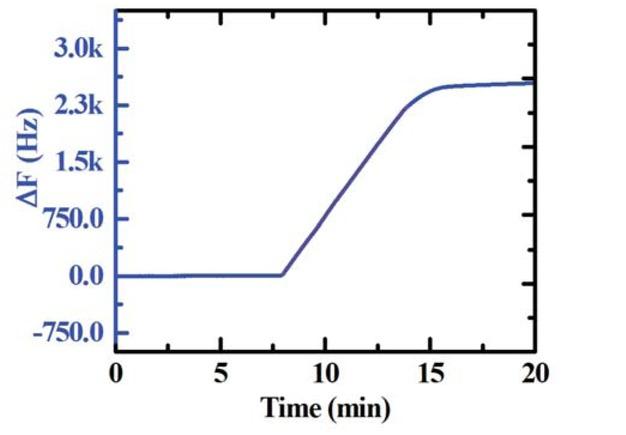
Figure 1

Representative QCM frequency sensogram of the corrosion experiment showing dissolution of iron at 25 °C using 0.01 M acetic acid solution. Ultrapure water was flushed through the chamber at 13 min to stop corrosion.

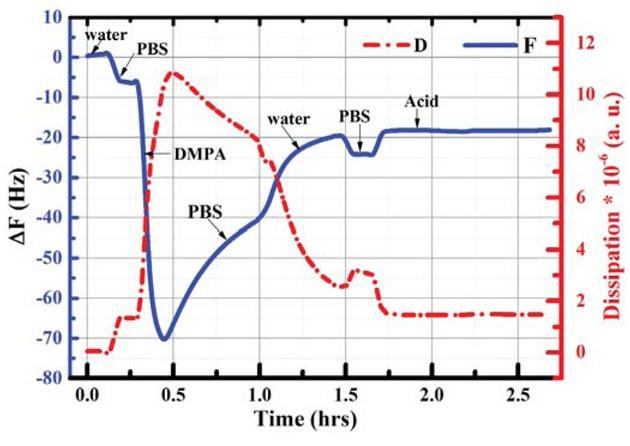
Figure 2

A typical QCM sensogram of a DMPA deposition and corrosion inhibitory test as changes of frequency (Δf; solid blue line) and energy dissipation (ΔD; dash red line multiplied by 10-6) against the time.

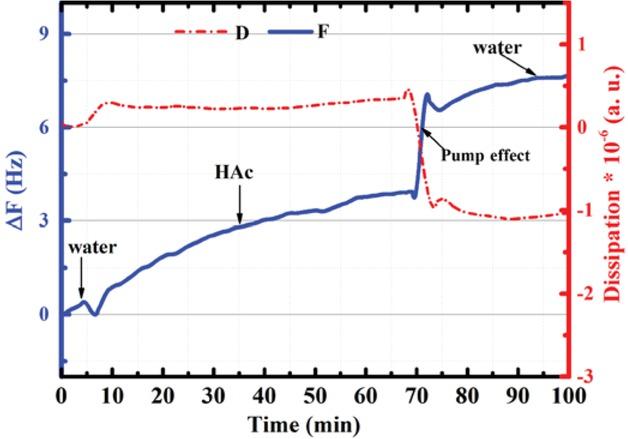
Figure 3

Representative QCM sensogram showing the removal of the top membrane leaflet by acetic acid on the DMPA coated iron chip.

Figure 4

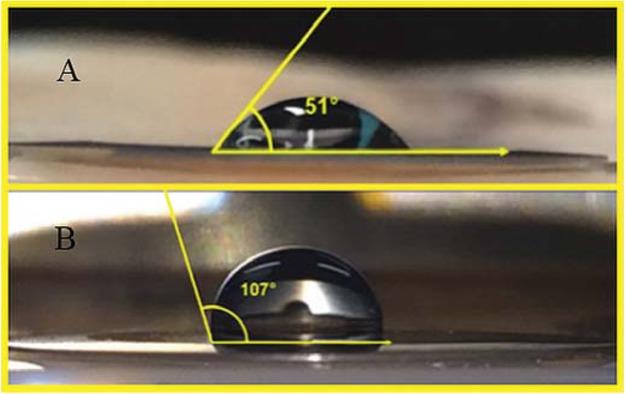
Contact angles of a water droplet on (A) uncoated iron oxide and (B) lipid coated iron oxide surface.

Figure 5

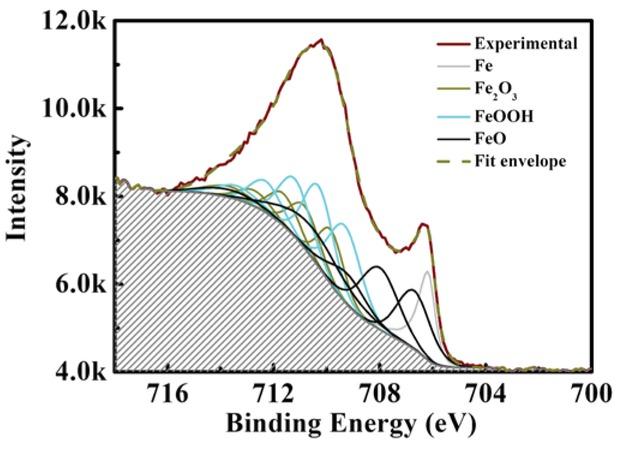
Fitted XPS spectrum of Fe 2p3/2 for the mixed iron oxide surface layer of the iron coated QCM chip using CasaXPS software (plotted in OriginPro). For fitting the method by by Biesinger et al (33) was used where the peak positions, FWHM and relative peak intensities were maintained constant for each series of peaks representing the specific oxidation states of iron; only the peak heights of the entire series were varied in the fitting.

Figure 6

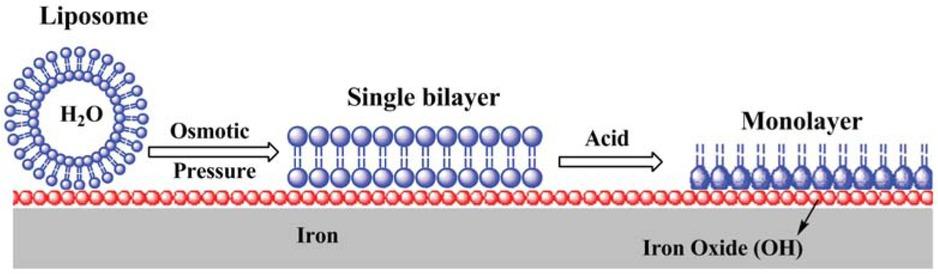
The mechanism of surface coating by liposome deposition. Bilayer coating forms spontaneously upon contact. The top leaflet of the bilayer may be removed upon acid treatment, however the bottom leaflet remains stable on the surface.

Figure 7

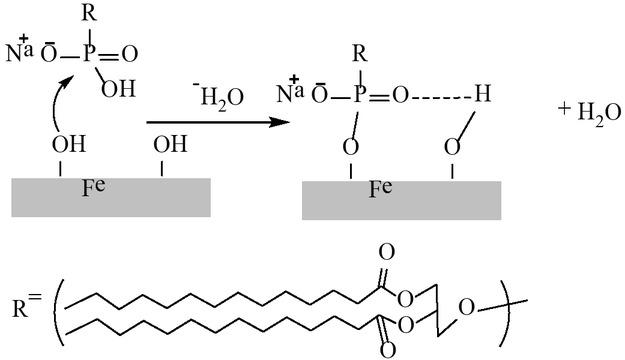
The condensation reaction mechanism of the lipid on the iron oxide surface. The hydroxyl group of the iron attaches to the phosphoryl group and the consequence of this step is chemical binding of the lipid to the metal oxide.

The XPS parameters: peak position (eV), FWHM, and the intensities for fitting the Fe 2p3/2; data from (33)_ Ave is the average value of the respective α and γ components of Fe2O3 and FeOOH_

CompoundPeak (eV)FWHM%
Fe706.60.88100.0
FeO(1)708.41.424.2
FeO(2)709.71.630.1
FeO(3)710.91.614.5
FeO(4)712.12.925.6
FeO(5)715.42.55.6
Ave. Fe2O3 (1)709.81.126.8
Ave. Fe2O3 (2)710.81.324.7
Ave. Fe2O3 (3)711.61.318.9
Ave. Fe2O3 (4)712.71.410.1
Ave. Fe2O3 (5)713.72.010.0
Ave. FeOOH(1)710.31.427.0
Ave. FeOOH(2)711.31.326.5
Ave. FeOOH(3)712.21.420.6
Ave. FeOOH(4)713.31.411.3
Ave. FeOOH(5)714.11.96.3
Language: English
Page range: 128 - 134
Published on: Jul 25, 2019
Published by: European Biotechnology Thematic Network Association
In partnership with: Paradigm Publishing Services
Publication frequency: 4 issues per year

© 2019 Ahmed Sameer Al-Badran, Adam Mechler, published by European Biotechnology Thematic Network Association
This work is licensed under the Creative Commons Attribution-NonCommercial-NoDerivatives 4.0 License.