
Introduction
The main cause of poor growth of plants in oil-polluted soils is the low availability of nutrients caused by inappropriate water regime, the increase of soil toxicity, the deterioration of soil structure due to the presence of oil hydrocarbons and salts.
Bioremediation plays an important part in solving these problems by the capacity of various microorganisms to degrade hydrocarbons by their enzymatic equipment and to utilize them as source of carbon and energy. Literature cites the utilization of inorganic or organic fertilizers for stimulating biodegradative activity of microbiota and creating conditions for plants growth (1), as well as the advantages and disadvantages of various methods of application of microorganisms in bioremediation (2).
The purpose of the present research was to improve the bean plants growth and microbial activity in rhizosphere using various natural stimulators and fertilizers in greenhouse experiments on oil-polluted soil from Icoana farm, Olt county.
Materials and Methods
Soil in greenhouse experiment: Surface soil (0-20cm) from Icoana farm, Olt County, polluted with total petroleum concentration (TPH previously determined by gravimetric method) of 72.87 g total petroleum hydrocarbon x kg-1 dry soil.
Test plants: Bean plants (Phaseolus vulgaris L. cultivar UNIDOR)
Natural stimulators and fertilizers: AMALGEROL, VERMIPLANT, POCO, IGUANA and FORMULEX (Table 1).
Table 1
Main characteristics of natural products utilized in experiment and their origin
| No. | Products | Characteristics/Source |
|---|---|---|
| 1 | AMALGEROL | Natural product with vegetal oils and hormones that stimulates plant growth, mycorrhizal symbiosis, N2-fixing, microbial activity, vegetal debris decomposition, improves soil structure and fertility |
| 2 | VERMIPLANT | Natural nutrients enriched product (biofertilizer) from earthworms containing microelements (barium, iron, zinc, manganese) and amino acids that stimulate microbial activity and plant growth |
| 3 | POCO | Natural product of herbs and plant extracts (utilized for pollution control), stimulating and accelerating the growth and metabolic activity of microorganisms by micro-nutrients and trace elements |
| 4 | IGUANA | Natural product of algae with macro and microelements for improving soil conditions and plant growth stimulating |
| 5 | FORMULEX | Natural organic complete, balanced and stabilized product of macro and microelements for optimum plant growth and rooting in horticulture |
Total plant biomass (grams) accumulated was determined by weighing fresh plants (shoots and roots) cultivated in polluted soil (non-treated control) and variants treated with natural stimulators and fertilizers (2%).
Microbiological analysis of soil samples was performed by plating soil decimal dilutions on specific solid culture media (Topping for heterotrophic bacteria, potato dextrose agar-PDA for fungi and Stapp with filter paper for cellulolytic microorganisms).
After incubation at dark, microbial colonies were counted and their density was reported to gram of dry soil.
Taxonomic identification of bacteria was done according to Bergey’s manual of determinative bacteriology (3).
Fungi identified according to Domsch and Gams (4) and Watanabe (5) determinative manuals.
The global physiological activities of microflora were determined by substrate induced respiration method (SIR) and expressed as mg CO2 x 100 g-1 soil (6).
All assays were carried out in triplicate.
Statistical analysis
Results were interpreted by one-way analysis of variance (ANOVA). The value p<0.05 was considered statistic significant (Student test).
Results
Total plant biomass accumulated significantly increased in variants with natural stimulators and fertilizers (excepting IGUANA) when compared to untreated control, the best results being of 176.25 g, recorded for the variant with VERMIPLANT (Fig. 1 and Fig. 2).
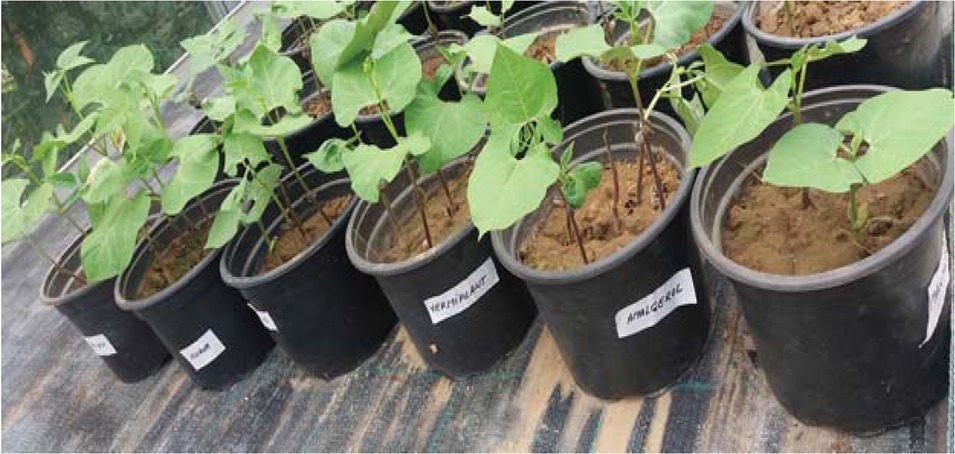
Figure 1
The aspect of bean plantlets in experimental variants.
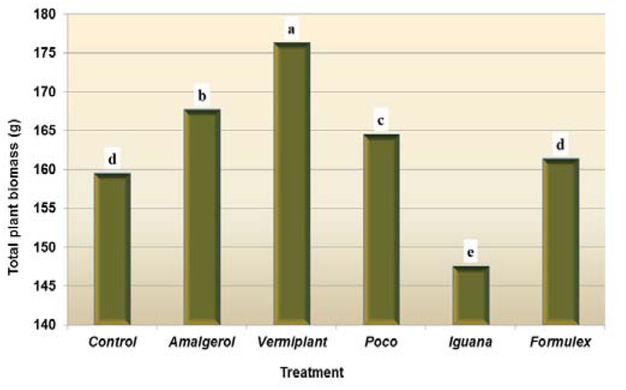
Figure 2
Influence of natural stimulators and fertilizers on plant biomass. Values followed by the same letter are not significantly different for p<0.05 (Student test).
Natural products improved physiological activities of microbiota reflected in increased values of CO2 released by respiration (Fig. 3), increased number of bacteria, especially of Pseudomonas fluorescens and actinomycetes (Fig. 4 and Table 2), lower levels of colonization with fungi and with potential plant pathogenic species of Fusarium, the domination of cellulolytic fungi (Fig. 5 and Table 2).
Table 2
Taxonomic composition of bacterial and fungal microflora
| Experimental variants | Bacterial species (Topping) | Fungal species/cellulolytic microflora (Czapek/Stapp) |
|---|---|---|
| Control | Pseudomonas fluorescens, Bacillus polymixa, Bacillus circulans, Bacillus cereus Actinomycetes Series Albus, Fuscus | Fusarium verticillioides, Aspergillus ochraceus, Fusarium avenaceus, Aspergillus flavus, Aspergillus terreus, Fusarium sp White sterile mycelia, Rhizopus stolonifer, Eurotium herbariorum, Fusarium sporotrichioides |
| Amalgerol | Pseudomonas fluorescens, Bacillus subtilis, Bacillus polymixa, Bacillus megaterium, Bacillus circulans Actinomycetes Series Albus, Ruber | Cunninghamella elegans, Rhizopus stolnifer, Emericella nidulans, Fusarium sporotrichioides, Fusarium sp., Aspergillus versicolor |
| Vermiplant | Pseudomonas fluorescens, Bacillus circulans, Pseudomonas sp Actinomycetes Series Griseus, Albus, Ruber | Fusarium sp., Fusarium oxysporum, Fusarium sporotrichioides, Paecilomyces marquandii, Mucor racemosus |
| Poco | Pseudomonas fluorescens, Pseudomonas sp., Bacillus circulans | Cunninghamella elegans, Fusarium oxysporum, Fusarium sp., Aspergillus niger, Rhizopus stolnifer, Myrothecium roridum |
| Iguana | Pseudomonas fluorescens, Bacillus subtilis, Bacillus megaterium, Pseudomonas aeruginosa, Bacillus polymixa, Alcaligenes sp., Serratia marcescens, Arthrobacter globiformis, Bacillus sp. Actinomycetes Series Albus, Luteus, Ruber | Cunninghamella elegans, Fusarium culmorum var. roseum, Paecilomyces marquandii, Aspergillus versicolor, Aspergillus flavus, Penicillium sp., Trichocladium sp., Aspergillus terreus |
| Formulex | Pseudomonas fluorescens, Bacillus megaterium, Bacillus mesentericus, Bacillus circulans, Pseudomonas aeruginosa Actinomycetes Series Albus, Luteus, Fuscus, Ruber | Cunninghamella elegans, Rhizopus stolnifer, Aspergillus fumigatus, Fusarium sp., Fusarium culmorum, Trichocladium sp., Paecilomyces Aspergillus marquandii, flavus, Penicillium sp |
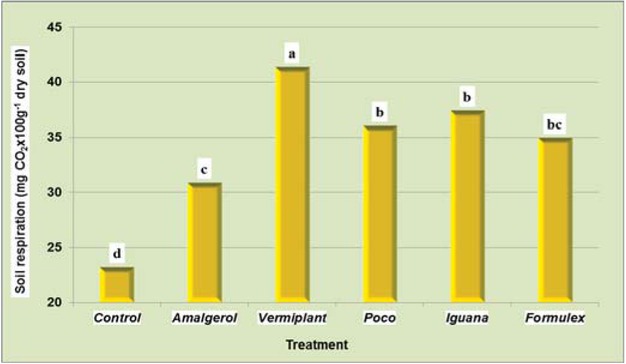
Figure 3
Influence of natural stimulators and fertilizers on soil respiration. Values followed by the same letter are not significantly different for p<0.05 (Student test).
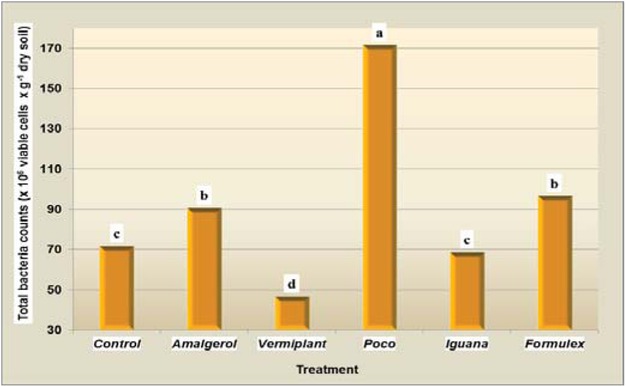
Figure 4
Influence of natural stimulators and fertilizers on soil bacteria. Values followed by the same letter are not significantly different for p<0.05 (Student test).
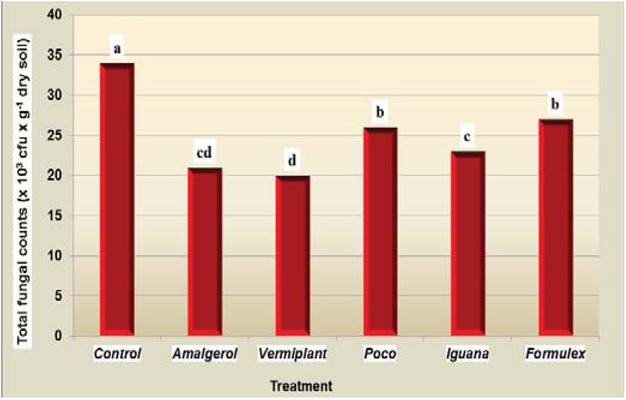
Figure 5
Influence of natural stimulators and fertilizers on soil fungi. Values followed by the same letter are not significantly different for p<0.05 (Student test).
Effect of natural stimulators and fertilizers was evidenced by creating conditions for development of microbial species characteristic for the non-polluted soil in the area (e.g. bacteria Bacillus cereus var. mycoides, fungal species Paecilomyces marquandii, Aspergillus niger, Trichoderma viride, Penicillium sp.) previously investigated (7), especially under the influence of Vermiplant, Iguana and Poco.
Excepting for the variant with Vermiplant, all fungal communities from the variants with natural stimulators and fertilizers were dominated by Cunninghamella elegans
The qualitative differences between rhizosphere soils determined by the treatments with natural stimulators and fertilizers were evidenced on the particular aspect of paper circular chromatograms (Fig. 6).
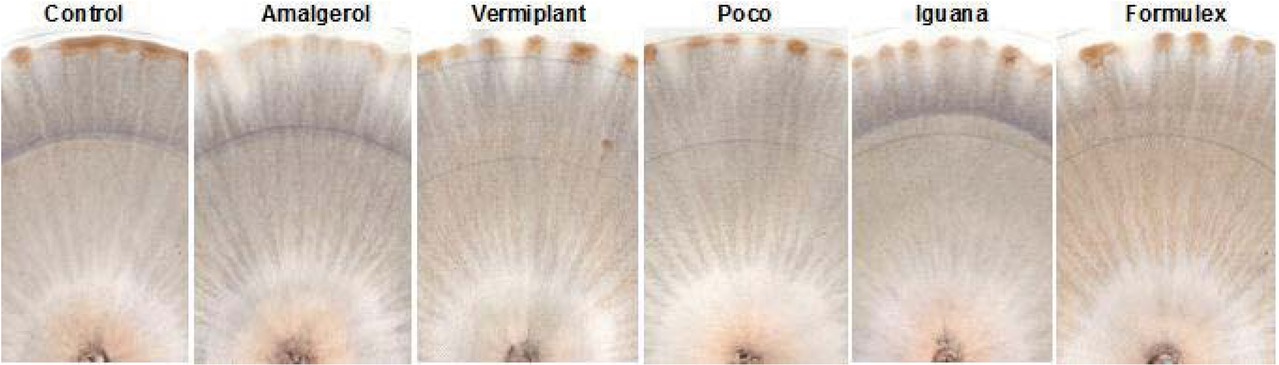
Figure 6
Paper circular chromatograms of soil from experimental variants.
Specific radiation, number, color and shape of pike-like edge of the outer zone, textures indicate different degrees of soil formations, differentiation in inner, middle and outer zones, vitality, health, intensity of biotic activity, complexity of organic ring formations between the middle and outer zone and at the matter or mineralization degree.
Discussions
The results of the greenhouse experiments carried out demonstrated that natural fertilizers and biostimulators coupled with improved aeration conditions in the soil by dilluting oil-polluted soil with perlite stimulated microbial activity plant growth, yields and resistence to pathogens.
Our results are in concordance with data from literature (8) that reported growth and yields stimulation of cucumber plants, as well as higher protein contents and increased peroxidase activity with beneficial effects on plant resistance to pathogens when organic fertilizers were combined with biological gels in environment friendly technologies.
The use of digestate and composts stimulated soil microbial activity, proved to be beneficial for lettuce crops and avoided environmental problems caused by agrochemicals (9).
Results obtained from previous field experiments on soil polluted with petroleum residues and salts evidenced the favorable influence of using perlite in proportion of 50%to 75% in phytoremediation processes involving potato cultures by stimulating biodegradative activity of microbiota, including halo tolerant species (10)
There are research showing that microbial strains or consortia of microorganisms from oil-polluted soils are able to degrade various hydrocarbons by efficient metabolic processes, with positive effect on improving soil conditions and making it less restrictive for plants growth (11).
Similar results were reported for biosurfactant-producing strains of microorganism such as Pseudomonas putida (12), Bacillus subtilis (13), Micrococcus sp., Streptomyces griseus (14), that contributed to soil bioremediation by increased capacity to degrade oil hydrocarbons.
Other research showed that metabolites from culture filtrates of Pseudomonas aeruginosa strain PG1 presented hydrocarbon-degrading capacity and antagonistic properties against plant pathogenic bacteria and fungi (15).
Recent research (16) showed that fungal isolates of Trichoderma, Polyporus, Aspergillus, Fusarium were able to metabolize certain water pollutants with polycyclic structure, process mediated by enzyme laccase, known also as responsible for antimicrobial properties of microorganisms able to produce it.
Research on various species from genus Trichoderma evidenced the role of certain metabolites in plant protection and plant growth promoting, stimulating of soil microbiota and improving soil aeration (“biological tillage”) (17, 18, 19, 20, 21).
Other research (22) reported that biodynamic paper circular chromatography and scanning electron microscopy proved to be very useful in evaluating comparatively the quality of various variants of biofertilizers produced by earthworms and microorganisms.
Present work evidenced that the natural products were stimulators for rhizosphere microbiota and its metabolic activity and ensured an adequate nutrition of plants, recommending them for utilization in bioremediation of oil-polluted soils under the cultures of horticultural plants.
Conclusions
Total plant biomass accumulation significantly increased in variants with natural stimulators and fertilizers (excepting IGUANA) when compared to untreated control, the best results being recorded for VERMIPLANT.
Natural products also improved physiological activities of microbiota reflected in increased values of CO2 released by respiration, lower levels of colonization with potential plant pathogenic species of Fusarium, the domination of cellulolytic fungi, Pseudomonas fluorescens and actinomycetes.
The qualitative differences between rhizosphere soils determined by the treatments with natural stimulators and fertilizers were evidenced on the particular aspect of paper circular chromatograms.
Acknowledgements
This work was supported by a grant of the Romanian National Authority for Scientific Research, CNDI-UEFISCDI, project number PN-III-P2-2.1_PTE-2016-0084, (40-PTE), acronym ECOREMTEH.