
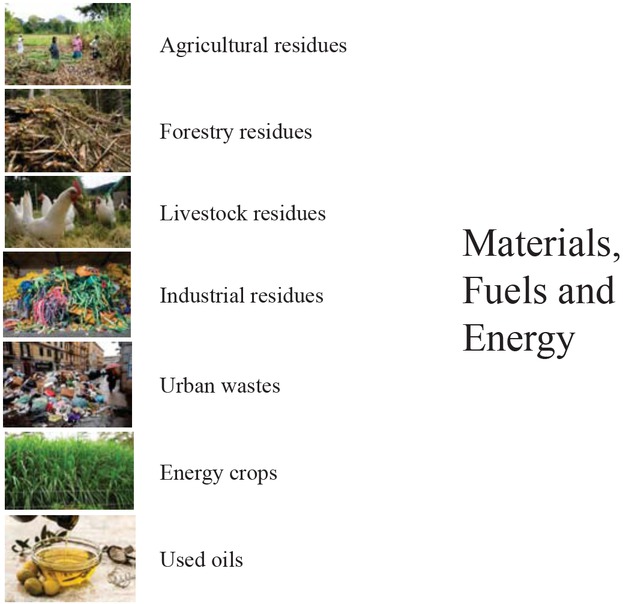
Figure 1
Waste-based resources with added value within the Bio-economy concept.
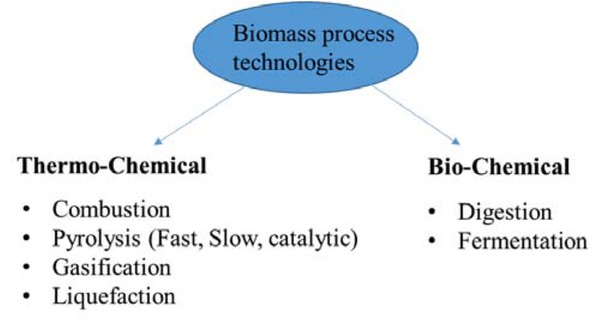
Figure 2
Two major technological means to process biomass: traditional themochemical and bio-chemical.
Table 1
A compilation of currently active institutions in Bio-economy and Bio-economy related issues
| 1. The Rural Development Programme (2014-2020) | |
| Relevant | 2. National Climate Change Adaptation Strategy (NCCAS) |
| 3. National RIS for Smart Specialisation | |
| national | • Part 5.4 on Energy |
| strategies | • Part 5.5 on Environment and Sustainable Development |
| 4. National Strategic Framework for Research and Innovation | |
| Key national | 1. General Secretariat of Research and Innovation (Under the auspices of the Ministry of Education) |
| 2. Ministry of Rural Development and Food | |
| stakeholders | 3. Ministry of Environment and Energy |
| 1. Hellenic Center for Marine Research | |
| 2. Center for Renewable Energy | |
| Research | 3. Hellenic Agricultural Organization (HAO) DIMITER |
| Institutions | 4. Centre for Research and Technology-Hellas (CERTH) |
| 5. The Agricultural University of Athens | |
| 6. The Center for Renewable Sources and Efficiency (CRES) | |
| Academic | 1. MSc in Bio-economics Pireaus and Athens University |
| programmes | 2. The International Hellenic University’s MSc in Bio-economy: Biotechnology and Law |
| ThinkTanks/ | 1. The Greek Bio-economy FORUM |
| Clusters | 2. The Cluster of Bioenergy and Environment of Western Macedonia (CluBE) |
| Other | 1. The Bio-economy and Sustainable Growth Laboratory of the Department of Economics of the University of Piraeus |
| Labs/ Institutes | 2. The Institute of Bio-Economy and Agri-Technology (iBO) of the Center for Research and Technology – Hellas (CERTH) |
Table 2
| Source | Units | Capacity | Waste (t/y) | Power (MW) |
|---|---|---|---|---|
| Cow farms | 26 295 | 755 665 (cattle) | 13 601 970 | 233 |
| Pig farms | 3 299 | 147 920 (sows) | 2 277 072 | 36 |
| Poultry farms | 1 972 | 33 875 054 | 813 001 | 86 |
| Processing of milk units | 696 | 1 175 319 | 822 723 | 14 |
| Total | 17 514 766 | 369 |
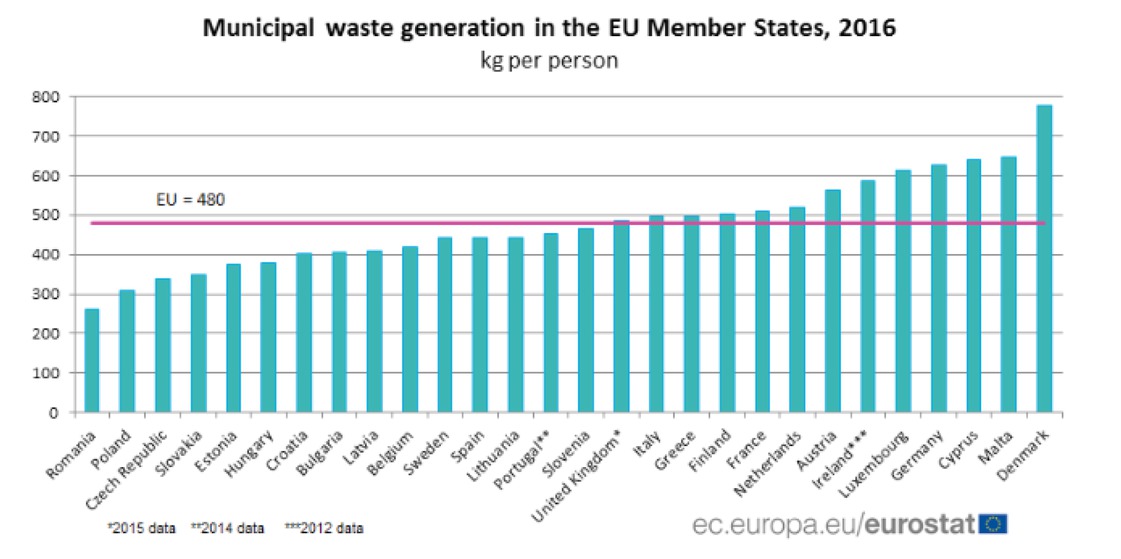
Figure 3
Generation of municipal waste in the EU member states (kg/person) in 2016.
Table 3
Synopsis of the barriers to the efficient exploitation of biomass and the promotion of Bio-economy in Greece
| Fragmentation of agricultural land in many small properties (lot size ~ 4.8 ha against 14,3 in EU-27 and average | |
| 1 | economic size of farm 9.266,8 € against 25.450,2 € in EU-27) that creates lack of reliable transportation network |
| and long-term supply of materials. | |
| 2 | The high price of raw materials (which initiates biodiesel imports and works inhibitory in the development of business for their further processing). |
| 3 | Disorganized and costly supply chain of raw materials |
| 4 | Low technical training of farmers (32% have no education) |
| 5 | Difficulty in introducing new technologies because of the age of rural population (60% of farmers over 45y old) |
| 6 | Reduction of employment in the primary sector. The family employment covers 85.5% of total employment in agriculture sector. |
| 7 | Lack of control mechanisms for the implementation of existing environmental legislation and penalties on offenders |
| 8 | Bureaucratic licensing difficulties |
| 9 | Instability of institutional and taxation environment |
| 10 | Unstable and inefficient policy, which affects the final price of bioproducts and biofuels/energy. |
| 11 | Environmental licensing |
| 12 | Lack of appropriate financial mechanisms |
| 13 | Lack of public awareness (especially regarding the environmental benefits of energy recovery resulting in strong local resistance to projects) |
| 14 | Lack of substantial efforts to create a framework for the marketability of ‘green’ innovations (69, 70 CRES 2016, 71, 72) |