
INTRODUCTION
Periodontitis is a chronic inflammatory disease caused by dysbiosis of the dental biofilm and is characterized by the progressive destruction of tooth-supporting structures (1). The disease results from a complex interaction between periodontal pathogens, host immune-inflammatory response, and various environmental and systemic risk factors (2).
It is among the most prevalent chronic infections globally and has a substantial impact on patients’ quality of life (3). Recent review and meta-analysis of epidemiological studies conducted between 2011 and 2020 indicate that periodontitis affects 62% of adults, while severe forms occur in 23.6% (4). These findings suggest a notably higher prevalence than that reported in previous decades, with current estimates indicating that severe periodontitis affects approximately 1.1 billion people worldwide (5).
Despite its high prevalence and significant impact, periodontitis has historically been viewed as a localized inflammatory condition with limited systemic implications. However, contemporary evidence now strongly supports its understanding as a systemic disease, given its extensive impact on general health and its strong association with numerous chronic non-communicable diseases (6). Over the past decades, significant links between periodontal disease and cardiovascular disorders, diabetes mellitus, preterm birth and low birth weight, chronic obstructive pulmonary disease, and various autoimmune conditions have been demonstrated (7,8,9). Periodontal pathogens and their endotoxins are thought to enter the systemic circulation through damaged periodontal tissues, potentially affecting distant organs and contributing to systemic inflammation (10). Components of periodontal pathogens have been identified in various sites, including atherosclerotic plaques, placental tissue, the respiratory tract, pancreas, and colon (9,11).
Oral health has long been neglected in the broader context of global health. However, recognizing its significance, recent global health initiatives have increasingly emphasized the importance of oral health in overall disease prevention and health promotion. The 2021 WHO Oral Health Resolution highlights the urgent need for a preventive, risk-factororiented approach, timely and comprehensive care, strengthening of oral health systems, and improvement of public awareness of the oral health maintenance benefits (12).
Awareness of periodontitis has been reported to be insufficient among the general population (13). Studies have demonstrated that knowledge of periodontitis is highest among individuals aged 40–60 years. However, even in this group, understanding its etiology, signs, symptoms, and risk factors remains inadequate (14). Furthermore, recent evidence demonstrated that awareness and knowledge of periodontitis remain insufficient, not only among the general population but also among medical students and doctors (15).
Given the notably high and growing global burden of periodontitis, strengthening preventive strategies, particularly those centered on health education, has become imperative. In this context, understanding the level of knowledge among future healthcare professionals is essential for shaping effective preventive and educational approaches. Therefore, this study aimed to assess the awareness of periodontitis among undergraduate students at a faculty of Medicine in Bosnia and Herzegovina, with particular emphasis on risk factors, associations with systemic diseases, and students’ attitudes toward preferred sources of information on this condition.
MATERIAL AND METHODS
This cross-sectional study was conducted at the Faculty of Medicine Foca, in Bosnia and Herzegovina, between March and July of 2025. The study included undergraduate students enrolled in three study programs of the faculty: Medicine (M) (from 1st to 6th year), Nursing (N) (from 1st to 4th year), and Special Education and Rehabilitation (SER) (from 1st to 4th year).
Before enrolment, the aim and purpose of the study were clearly explained to all respondents, after which written informed consent was obtained from all respondents. The Ethics Committee of the Faculty of Medicine approved the study protocol (approval no. 01-2-19/2025). The study was conducted in accordance with the principles of the Declaration of Helsinki.
Insights into participants’ knowledge of periodontitis, its risk factors, and its consequences were assessed using a structured questionnaire adapted from Kattel et al. (16). The questionnaire is developed based on a literature review of similar studies conducted globally and modified to suit our aims and study population. The questionnaire in this study comprised 10 questions. The first four questions covered demographic data: age (years), gender (male/female), study program (M, N, SER), and year of the study (1–6). The second part of the questionnaire included 6 questions: knowledge of the term periodontitis (yes/no), its signs and symptoms (Bad Breath, Oral Candidiasis, Gum Recession, Tooth Fracture, Tooth Decay, Bleeding Gums, Tooth Loss, Loose Tooth; multiple responses allowed), the most common periodontitis risk factors (Oral Candidiasis, Socioeconomic Status, Ehlers Danlos Syndrome, Papillon LeFevre Syndrome, Smoking, Sedentary Lifestyle, Pregnancy, Tooth Decay; multiple responses allowed), and the association between systemic diseases and periodontitis (Alzheimer’s Disease, Rheumatoid Arthritis, Systemic Lupus Erythematosus, Sarcoidosis, Adverse Pregnancy Outcome, Osteoarthritis, Ectodermal Dysplasia, Chronic Kidney Disease, Diabetes Mellitus, Cardiovascular Disease Hospital-Acquired Pneumonia; multiple responses allowed), self-assessment of knowledge (poor/fair/neutral/good/excellent) and preferred sources of information to improve awareness of periodontal health (Lectures, Information pack, Video, Web site; multiple responses allowed) (16).
The sample size was determined based on a previous study, which indicated that at least 215 subjects were required to achieve 95% power at a significance level of 0.05 (16).
Data were analyzed using SPSS 20.0 (IBM SPSS Statistics for Windows, Armonk, NY: IBM Corp, USA). Data are reported as means and frequencies for each group. ANOVA with LSD post-hoc and chi-square test with post hoc Z-test with Bonferroni correction were used to determine the significance of differences between groups. Statistical significance was set at p < 0.05 in all analyses.
RESULTS
A total of 333 students from the Faculty of Medicine Foca, representing three study programs, participated in the study: 214 of M students, 53 of N students, and 66 of SER students (Figure 1). The mean age of all participants was 21.71 ± 1.77 years, ranging from 19 to 29 years. The majority of respondents were female (78.7%) (p <0.001) (Table 1).
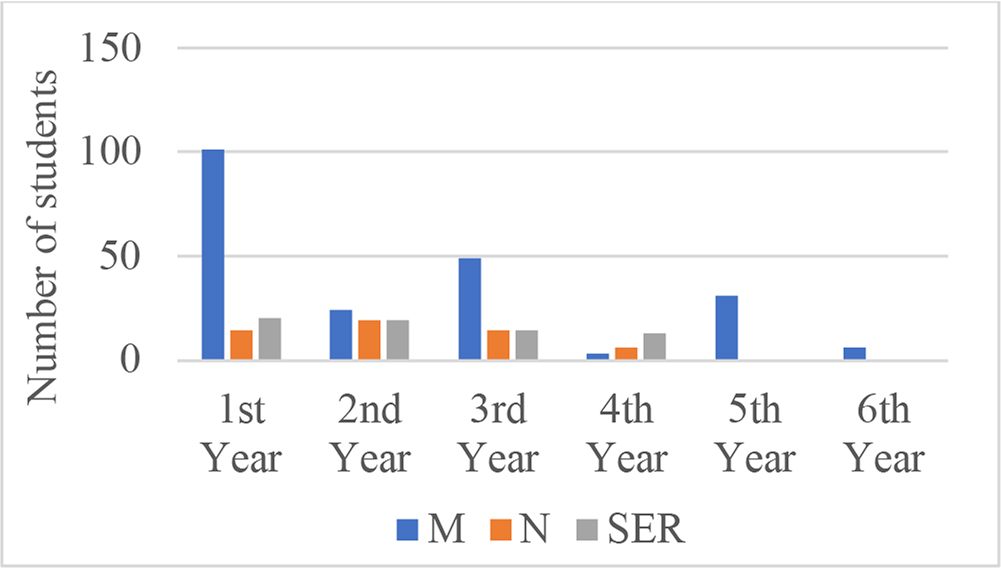
Figure 1.
Number of students by study year
Legend: M-Medicine students; N-Nursing students; SER- Special education and rehabilitation students
Table 1.
Distribution of undergraduate students by age and gender
| Variable | M (n=214) | N (n=53) | SER (n=66) | TOTAL (n=333) | P |
|---|---|---|---|---|---|
| Age (mean ±SD) | 21.70±1.90 | 21.87±1.42 | 21.64±1.59 | 21.71±1.77 | 0.765 |
| Gender n (%) | |||||
| Male | 60 (28.0%) | 7 (13.2%) | 4 (6.1%) | 71 (21.3%) | 0.064 |
| Female | 154 (72.0%) | 46 (86.8%) | 62 (93.9%) | 262 (78.7%) |
Of the total number of respondents, 42% reported that they were unfamiliar with the term periodontitis. The highest proportion of students who were familiar with the term periodontitis was recorded among N students (67.9%) (Table 2).
Table 2.
Knowledge of the term periodontitis among undergraduate students
| Question | Response | M (n=214) | N (n=53) | SER (n=66) | TOTAL (n=333) | P |
|---|---|---|---|---|---|---|
| Have you heard of the term Periodontitis? | Yes | 126 (58.9%) | 36 (67.9%) | 31 (47.0%) | 193 (58.0%) | 0.064 |
| No | 88 (41.1%) | 17 (32.1%) | 35 (53.0%) | 140 (42.0%) |
The highest number of students answered that Gum Recession (36.0%), Bleeding Gums (36.3%), Tooth Loss (20.7%) and Loose Tooth (25.2%) are common symptoms of periodontitis. Intergroup analyses showed that higher percentage of M and N students identified Gum Recession, Bleeding Gums, Tooth Loss and Loose Tooth compared to SER students, with significant differences for Gum Recession (M vs SER), Bleeding Gum (M and N vs SER), and Loose Tooth (M vs N vs SER). Oral Candidiasis was significantly more frequently recognized as a symptom of periodontitis by N students compared to SER students (Table 3).
Table 3.
Knowledge of the most common periodontitis signs and symptoms among undergraduate students
| Sign/Symptom | M (n=214) | N (n=53) | SER (n=66) | TOTAL (n=333) | P |
|---|---|---|---|---|---|
| Bad Breath | 41 (19.2%) | 12 (22.6%) | 5 (7.6%) | 58 (17.4%) | 0.052 |
| Oral Candidiasis | 10 (4.7%)a,b | 7 (13.2%)a | 0 (0.0%)b | 17 (5.1%) | 0.004 |
| Gum Recession | 86 (40.2%)a | 19 (35.8%)a,b | 15 (22.7%)b | 120 (36.0%) | 0.036 |
| Tooth Fracture | 13 (6.1%) | 4 (7.5%) | 1 (1.5%) | 18 (5.4%) | 0.270 |
| Tooth Decay | 23 (10.7%) | 5 (9.4%) | 3 (4.5%) | 31 (9.3%) | 0.317 |
| Bleeding Gums | 84 (39.3%)a | 23 (43.4%)a | 14 (21.2%)b | 121 (36.3%) | 0.015 |
| Tooth Loss | 50 (23.4%) | 11 (20.8%) | 8 (12.1%) | 69 (20.7%) | 0.144 |
| Loose Tooth | 55 (25.7%)a | 23 (43.4%)b | 6 (9.1%)c | 84 (25.2%) | <0.001 |
More than one-quarter of the students reported that Smoking (33.9%) and Tood Decay (25.8%) are the most common periodontitis risk factors, followed by Oral Candidiasis (12.6%) and Pregnancy (11.1%). Intergroup analyses showed that significantly more N students answered that Papillon LeFevre Syndrome and Smoking are periodontitis risk factors in comparison to SER, and Sedentary Lifestyle and Pregnancy in comparison to M and SER students. Tooth decay is recognized significantly more often as the most common periodontitis risk factor among M and N students compared to SER students (Table 4).
Table 4.
Knowledge of the most common periodontitis risk factors among undergraduate students
| Risk factors | M (n=214) | N (n=53) | SER (n=66) | TOTAL (n=333) | P |
|---|---|---|---|---|---|
| Oral Candidiasis | 29 (13.6%) | 8 (15.1%) | 5 (7.6%) | 42 (12.6%) | 0.370 |
| Socioeconomic Status | 19 (8.9%) | 8 (15.1%) | 4 (6.1%) | 31 (9.3%) | 0.226 |
| Ehlers Danlos Syndrome | 14 (6.5%) | 3 (5.7%) | 2 (3.0%) | 19 (5.7%) | 0.561 |
| Papillon LeFevre Syndrome | 9 (4.2%)a,b | 5 (9.4%)a | 0 (0.0%)b | 14 (4.2%) | 0.039 |
| Smoking | 74 (34.6%)a,b | 24 (45.3%)a | 15 (22.7%)b | 113 (33.9%) | 0.034 |
| Sedentary Lifestyle | 1 (0.5%)a | 6 (11.3%)b | 0 (0.0%)a | 7 (2.1%) | <0.001 |
| Pregnancy | 21 (9.8%)a | 12 (22.6%)b | 4 (6.1%)a | 37 (11.1%) | 0.010 |
| Tooth Decay | 61 (28.5%)a | 17 (32.1%)a | 8 (12.1%)b | 86 (25.8%) | 0.015 |
About one third of students answered that Diabetes Mellitus is related to periodontitis (32.4%) followed by Cardiovascular Disease (12.6%). Integroup comparisons showed significant differences between N and SER, M and N, M and SER students in linking periodontitis with Rheumatoid Arthritis, Chronic Kidney Disease, and Cardiovascular disease, respectively (Table 5).
Table 5.
Knowledge of the association between systemic diseases and periodontitis among undergraduate students
| Condition/Disease | M (n=214) | N (n=53) | SER (n=66) | TOTAL (n=333) | P |
|---|---|---|---|---|---|
| Alzheimer’s Disease | 9 (4.2%) | 2 (3.8%) | 0 (0.0%) | 11 (3.3%) | 0.242 |
| Rheumatoid Arthritis | 17 (7.9%)a,b | 10 (18.9%)a | 3 (4.5%)b | 30 (9.0%) | 0.017 |
| Systemic Lupus Erythematosus | 17 (7.9%)a | 10 (18.9%)a | 5 (7.6%)a | 32 (9.6%) | 0.044 |
| Sarcoidosis | 10 (4.7%) | 5 (9.4%) | 3 (4.5%) | 18 (5.4%) | 0.367 |
| Adverse Pregnancy Outcome | 8 (3.7%) | 2 (3.8%) | 2 (3.0%) | 12 (3.6%) | 0.962 |
| Osteoarthritis | 20 (9.3%) | 6 (11.3%) | 1 (1.5%) | 27 (8.1%) | 0.081 |
| Ectodermal Dysplasia | 11 (5.1%) | 3 (5.7%) | 0 (0.0%) | 14 (4.2%) | 0.162 |
| Chronic Kidney Disease | 10 (4.7%)a | 8 (15.1%)b | 3 (4.5%)a,b | 21 (6.3%) | 0.016 |
| Diabetes Mellitus | 73 (34.1%) | 21 (39.6%) | 14 (21.2%) | 108 (32.4%) | 0.070 |
| Cardiovascular Disease | 34 (15.9%)a | 6 (11.3%)a,b | 2 (3.0%)b | 42 (12.6%) | 0.022 |
| Hospital-Acquired Pneumonia | 6 (2.8%) | 1 (1.9%) | 1 (1.5%) | 8 (2.4%) | 0.807 |
A significantly lower percentage of N students (22.6%) assessed their knowledge of periodontitis as poor compared to M (41.6%) and SER (53.0%) students (Table 6).
Table 6.
Self-evaluation of knowledge about periodontitis among undergraduate students
| Knowledge Rating | M (n=214) | N (n=53) | SER (n=66) | TOTAL (n=333) | P |
|---|---|---|---|---|---|
| Poor | 89 (41.6%)a | 12 (22.6%)b | 35 (53.0%)a | 136 (40.8%) | 0.002 |
| Fair | 65 (30.4%)a | 17 (32.1%)a | 18 (27.3%)a | 100 (30.0%) | |
| Neutral | 51 (23.8%)a | 15 (28.3%)a | 11 (16.7%)a | 77 (23.1%) | |
| Good | 8 (3.7%)a | 6 (11.3%)a | 2 (3.0%)a | 16 (4.8%) | |
| Excellent | 1 (0.5%)a | 3 (5.7%)b | 0 (0.0%)a | 4 (1.2%) |
While assessing the preferred sources for obtaining additional information about periodontitis, a similar number of respondents considered each of the offered options suitable, but a significantly higher number of N think that the information pack is better than SER students (Table 7).
Table 7.
Preferred sources of information about periodontitis among undergraduate students
| Source of information | M (n=214) | N (n=53) | SER (n=66) | TOTAL (n=333) | P |
|---|---|---|---|---|---|
| Lectures | 67 (31.3%) | 20 (37.7%) | 14 (21.2%) | 101 (30.3%) | 0.131 |
| Information pack | 52 (24.3%)a,b | 19 (35.8%)a | 9 (13.6%)b | 80 (24.0%) | 0.019 |
| Video | 67 (31.3%) | 20 (37.7%) | 29 (43.9%) | 116 (34.8%) | 0.151 |
| Web site | 74 (34.6%) | 19 (35.8%) | 16 (24.2%) | 109 (32.7%) | 0.256 |
DISCUSSION
The present study assessed the awareness and knowledge of periodontitis among students from three programs at the Faculty of Medicine Foca in Bosnia and Herzegovina. Our findings indicate that the overall knowledge of periodontitis, including its risk factors and association with systemic diseases, was suboptimal across all programs. Notably, 42% of students reported being unfamiliar with the term periodontitis, which contrasts with the findings of Kattel et al., where only 4.1% of medical students were unaware of the term. However, the study by Kattel et al. included not only finalyear medical students (3rd to final year) but also interns, which may explain their higher overall knowledge of oral diseases (16). This observation is further supported by Márquez- Arrico et al., who reported that students with higher levels of education demonstrate greater awareness and knowledge of oral health (17).
Beyond general awareness, our findings regarding specific knowledge of periodontitis signs and symptoms offer further insights. M and N students, for instance, more frequently recognized Gum Recession, Bleeding Gums, and Loose Tooth as common symptoms than did SER students. Notably, a higher proportion of N students incorrectly identified oral candidiasis as a common symptom of periodontitis compared to M and SER students. These findings are consistent with a 2019 study involving 906 students from multiple faculties, which found a higher percentage of medical students correctly recognized bleeding gums as a symptom of periodontitis compared to students from other faculties (18). Early recognition of periodontitis signs and symptoms is crucial for preserving the supporting structures of the teeth and preventing tooth loss, as periodontitis is often a “silent” disease in its initial stages, with few or no symptoms (19). Patients frequently seek professional care only after significant impairment of the supporting structures, making treatment more complex and costly.
Our study results indicate that students demonstrated limited knowledge about risk factors for periodontitis onset. Interestingly, significantly more N students related Sedentary Lifestyle and Pregnancy with periodontitis than M and SER students. However, more M and N than SER students incorrectly recognized Oral Candidiasis as a risk factor for periodontitis. A finding that N students are much more likely to recognize common risk factors for periodontitis, but also to misrecognize them, probably can be related to the fact that many N students had completed secondary medical education, with respect to M and SER students. Our findings are in line with those of Yao et al., who suggested that insufficient understanding of the etiology of periodontitis may contribute to the high prevalence of bleeding gums among medical students (20).
This study shows insufficient knowledge among students regarding the association between periodontitis and systemic diseases. Only a relatively small proportion of students were aware of the systemic implications of periodontitis. The highest recognition was observed for the link between diabetes mellitus and periodontitis; however, this proportion remained low (approximately 30%), with no statistically significant differences between the groups. In comparison, Kattel et al. reported that 76.6% of medical students correctly recognized this association (16). Considering the systemic impact of periodontitis, particularly its bidirectional relationship with diabetes mellitus, it is essential to improve our knowledge of the underlying mechanisms and clinical consequences of this interaction. Similarly, Parveen et al. found that more than half of the examined medical doctors (54.5%) had limited knowledge of the link between periodontitis and systemic diseases (15). Obulareddy et al. also reported a lack of clinician understanding regarding this association, highlighting a notable gap between scientific evidence and clinical practice (21). In a study among physicians in France, 75% of respondents were aware of the connection between periodontitis and diabetes, while approximately half recognized its association with cardiovascular, inflammatory bowel, and respiratory diseases (53–59%). However, 74.31% of these physicians rarely or never inquired about their patients’ periodontal health (22). Consistent with our findings, Pisani et al. observed that medical students had limited knowledge regarding the oral-systemic health relationship; although approximately 60% were aware that diabetes is a risk factor for periodontitis, only 29.9% understood the bidirectional nature of this relationship (23).
The findings indicate that periodontal health is not given sufficient priority within the current educational framework, which may be due to the curriculum structure, limited clinical exposure, and the lack of formal interprofessional oral health education. Differences observed between study programs further highlight these educational gaps. Although medical and nursing students are expected to possess broader knowledge, their limited understanding of periodontitis may reflect insufficient coverage of oral health in their curricula. Additionally, the low level of awareness about the connection between periodontitis and systemic diseases emphasizes the need for preventive and educational strategies. Recognizing the relationship between periodontitis and systemic health can help develop integrated prevention and treatment approaches.
Analysis of the respondents' self-perceived knowledge of periodontitis revealed that approximately 71% rated their knowledge as poor or fair. A recent study demonstrated a significant improvement in knowledge and attitudes among clinicians following targeted training (15). As expected, studies including dental students reported that they exhibited superior knowledge and attitudes across all examined aspects compared with non-dental students (20,24).
Since knowledge of periodontitis, its complications, and associated risk factors is essential for prevention and effective management, it is crucial to educate the wider population, particularly health professionals and medical students, as timely recognition of periodontitis, appropriate patient counseling regarding possible complications, and referral for further diagnosis and treatment are key steps in preserving oral and general health. Although M and N students demonstrated better knowledge in certain aspects than SER students, our findings emphasize the need for continuous improvement in periodontal health education across all three study programs at the Faculty of Medicine Foca. One potential approach is to incorporate dental health into the curricula of the observed programs, with particular emphasis on the relationship between periodontitis and systemic diseases. Such an approach not only promotes the improvement of patients’ oral health but also supports the maintenance of oral health among future healthcare providers.
Since this study used a cross-sectional design, several limitations should be considered. It was conducted at a single center, limiting the extent to which the findings can be applied. Conducting research across multiple centers and including follow-up focus groups after educational interventions could produce more comprehensive data and support wider relevance. Additionally, the self-administered questionnaire was not validated, and the oral health status was not clinically assessed. In a self-administered questionnaire, design might have led to response bias, with participants possibly guessing or giving socially acceptable answers (25). However, the present results obtained from statistical analysis appear theoretically valid and offer a useful foundation for improving education curricula, aiming to boost clinicians’ awareness and understanding of oral health and foster interprofessional collaboration.
CONCLUSION
The findings of this study revealed a lack of adequate knowledge of periodontitis across all the observed study programs. Strengthening periodontal education within undergraduate curricula is essential, particularly considering the established links between periodontal and systemic diseases.
ACKNOWLEDGMENTS
The Faculty of Medicine Foca, University East Sarajevo provided administrative and logistical support for the study.