
INTRODUCTION
Mediastinal teratomas are the second most common extragonadal teratomas in children(1). Some cases are detected prenatally via ultrasound(2). Rapid tumor growth during the fetal period exerts compression on the lungs, heart, and major blood vessels, leading to lung hypoplasia and heart dysplasia. If a fetus with a mediastinal teratoma survives until birth, respiratory distress syndrome develops at birth.
Respiratory distress at birth results from tumor compression on mediastinal structures. Early surgical intervention is crucial; however, the outcome depends on multiple factors, such as the development of mediastinal organs (lung hypoplasia, heart hypoplasia, and tracheomalacia may occur) and perioperative and postoperative complications(3). This case report presents a newborn with a mass in the anterior mediastinum who survived the neonatal period.
CASE REPORT
A 29-year-old pregnant woman gave birth via cesarean section at GAK Narodni Front (gynecology obstetrics clinic). The term newborn, a female, had an Apgar score of 3/5 and a birth weight of 3300 g. The baby was intubated immediately after birth. Initial blood gas analysis indicated respiratory acidosis (pH = 6.91, pCO2 = 13.9 kPa, pO2 = 6.6 kPa). Prenatal suspicion of a diaphragmatic hernia led to the newborn being transferred to our clinic within two hours of birth. Upon admission, a chest X-ray revealed a soft tissue mass occupying the upper and middle thirds of the left lung (Figure 1A). The heart ultrasound shows a tumor mass pushing the heart completely to the right, compressing the left ventricle and both atria. CT imaging demonstrated a massive tumor in the left hemithorax with visible calcifications and prominent vascularization, exerting significant compressive effects on the heart, lungs, and major blood vessels (Figure 1B). The trachea and right main bronchus were shifted to the right (Figure 1D). Upon returning to the neonatal intensive care unit, the newborn was respiratory and hemodynamically unstable and cyanotic. Blood gas analysis confirmed respiratory and metabolic acidosis. The newborn baby was placed in a left lateral position, and a thoracic drain was inserted on the right side. This resulted in minimal hemodynamic and respiratory improvement but further compression of the inferior vena cava, leading to edema in the lower half of the body. High-frequency mechanical ventilation was attempted but did not yield satisfactory results, so the newborn was placed back on pressure-controlled mechanical ventilation. Hypotension developed, necessitating vasoactive support with dobutamine and later adrenaline. Due to signs of pulmonary hypertension, fentanyl was introduced into therapy. This led to relative stabilization of hemodynamic and respiratory conditions, maintained through continuous inotropic stimulation and aggressive pressure-controlled mechanical ventilation settings.
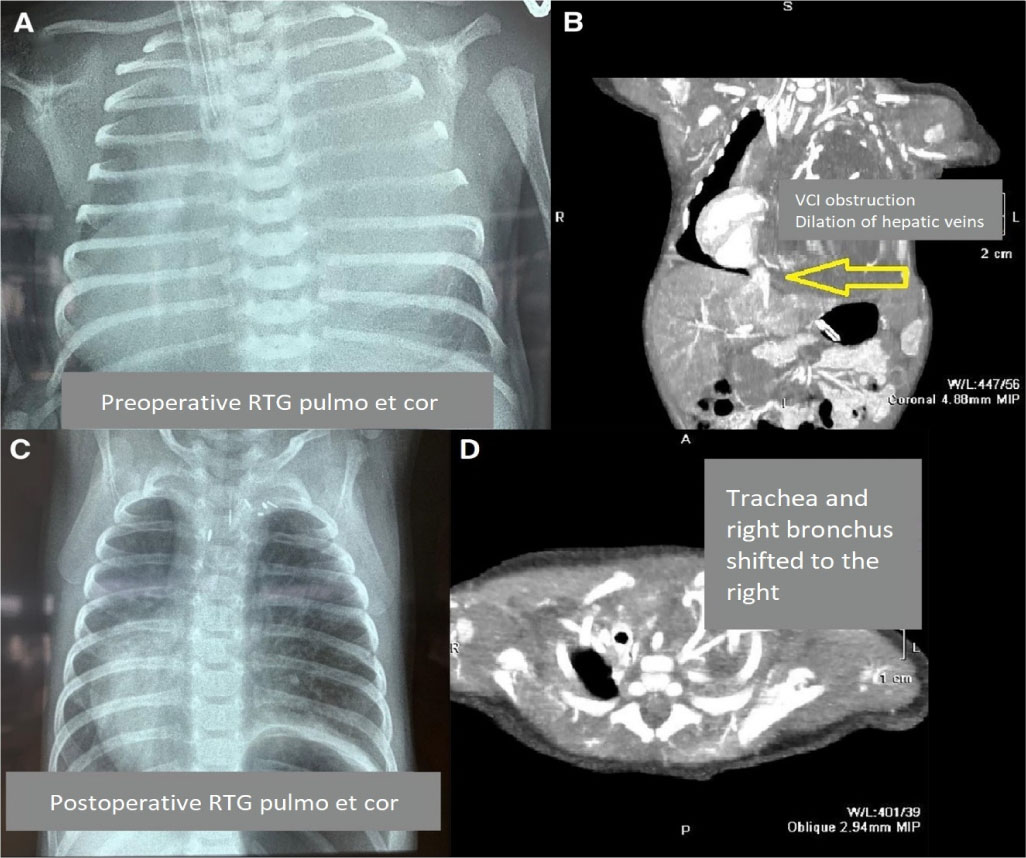
Figure 1:
(A) Preoperative chest X-ray, (B) Chest CT showing obstruction of the inferior vena cava (IVC), (C) Postoperative chest X-ray, (D) Chest CT showing displacement of the trachea and right bronchus to the right.
On the first day of life, a surgical intervention was performed via median sternotomy. The tumor was completely excised. The left lung was hypoplastic and expanded manually through ventilation. The right lung was normally developed, and the heart was located in the right hemithorax within an intact pericardium. The tumor weighed 230 g and was histologically classified as an immature teratoma, grade III. Postoperatively, the newborn remained on controlled mechanical ventilation, showing respiratory and hemodynamic stability under inotropic support. In the following days, mechanical ventilation parameters and inotropic drug doses were gradually reduced, with inotropes discontinued six days after surgery. The newborn was extubated on the twelfth postoperative day and placed on nasal CPAP, but due to respiratory deterioration, reintubation was required. Chylothorax developed, but after somatostatin therapy was introduced, drainage gradually decreased. Fiberoptic bronchoscopy revealed tracheomalacia and left bronchomalacia. The heart gradually returned to its central position over four weeks (Figure 1C). In the following days, an extubation attempt was unsuccessful. A chest X-ray showed left hemidiaphragm elevation. After plication of the left diaphragm, performed 28 days after the initial surgery, the newborn was successfully extubated and placed on nasal CPAP. The baby was transitioned to an oxygen mask 35 days postoperatively and was transferred to the regular ward 39 days after surgery.
DISCUSSION
A teratoma is a tumor originating from a germ cell with the potential to differentiate into tissues from all three embryonic germ layers, with the tissues and structures being more or less mature. Its histological structure is heterogeneous, consisting of both cystic and solid components. The incidence of neonatal tumors is estimated at 7.2 per 100,000 live births, although many benign tumors go undiagnosed, leading to imprecise incidence estimates. The most common neonatal tumors are teratomas (approximately 25%), with thoracic teratomas accounting for about 8–16%(4).
Radiological diagnostics, both prenatal and postnatal, play a key role in disease evaluation. Mediastinal tumors can be detected prenatally through routine fetal echocardiography in the second and third trimesters of pregnancy. Fetal MRI provides more precise information about the tumor itself and its relationship with adjacent structures. In our patient, the mediastinal teratoma was not diagnosed prenatally; instead, there was a suspicion of a diaphragmatic hernia. After birth, a chest CT scan revealed a massive tumor occupying the left hemithorax. The pathophysiological effect of a mediastinal tumor results from its compression of mediastinal structures, lungs, heart, esophagus, aorta, and systemic veins. Clinically, this manifests as edema, ascites, pleural effusion, and hepatomegaly.
The presence of a tumor mass in utero within the thoracic cavity can lead to cardiac dysplasia and pulmonary hypoplasia. Cardiac dysplasia may present in various ways, depending on the tumor's growth rate and the stage of cardiac development. This can include myocardial wall hypertrophy with atrial and ventricular dilation, abnormal positioning of the pulmonary artery leading to pulmonary hypertension. Additionally, polyhydramnios develops due to esophageal compression and reduced swallowing of amniotic fluid(5). In our patient, the presence of a mediastinal mass led to respiratory distress, cardiogenic and obstructive shock due to compression of the myocardium, pulmonary systemic veins, and aorta. The echocardiogram showed that the tumor had displaced the heart to the right, compressing the left ventricle and both atria, with minimal systemic venous return. No structural abnormalities of the heart were observed.
The outcome of treatment depends on the tumor's size, location, and the timing of prenatal or postnatal intervention. The presence of a tumor mass in such a small space, like the neonatal thorax where vital structures are located, represents a malignant localization of the lesion, accompanied by a severe clinical manifestations. The effects of the tumor are proportional to its size and pressure on vital structures. Literature reports describe four cases diagnosed prenatally as non-immune hydrops fetalis caused by a mediastinal teratoma, and who survived the neonatal period after surgery, i.e. tumor extraction(Table 1).
Table 1.
Clinical neonatal successful outcomes of fetal mediastinal teratomas.
| Author | Sex | Imaging | Prenatal Procedure | Outcome |
|---|---|---|---|---|
| Takayasu(6) | M |
|
|
|
| Giancotti(8) | M |
| No |
|
| Merchant(7) | ND |
| In utero resection of the tumor |
|
| M. Simoncic(3) | M | US (33WG): NIHF, polyhydramnion | No |
|
| Present case | F |
| No |
|
Different treatment approaches have resulted in survival, depending on the tumor's characteristics. These approaches can be classified as prenatal and postnatal interventions. Prenatal interventions include aspiration of the tumor cyst(6), resection of the tumor in utero before the 30th week of gestation to allow lung and airway development(7), while postnatal intervention involves tumor resection on the first day of life(8). In our case, a sternotomy with complete tumor resection was successfully performed on the first day of life. Postoperatively, expected complications include sepsis, tracheomalacia, bronchopulmonary dysplasia, diaphragmatic and vocal cord paralysis, chronic respiratory insufficiency, and cardiac dysplasia. In our patient, chylothorax and left diaphragm paralysis developed, leading to diaphragmatic plication surgery, after which the newborn was successfully extubated.
CONCLUSION
Mediastinal teratoma in a neonate is a life-threatening condition.
Patients with mediastinal teratoma and similar pathology are in a state of respiratory and vascular insufficiency which worsens if not treated, and leads to respiratory distress, cardiogenic and obstructive shock.
Prenatal diagnostics, size and localization of the tumor, appropriate intensive care measures and emergency surgical intervention greatly determine the disease outcome.
This case represents an extreme example of a newborn with an anterior mediastinal mass that survived.