
INTRODUCTION
In the up to date reviewed literature, less than 50 case reports of patients with ectopic intravesical prostate tissue have been published [1]. Ectopic prostate tissue is frequently found in the urinary bladder close to the ureteral orifice or at the bladder trigone. It is important to mention that ectopic prostate tissue is clearly separated from the orthotopic prostate tissue. It can also be localised in the urethra, retroperitoneum or infrequently in the gastrointestinal tract [2,3]. The most common cause of ectopic prostate tissue is the migration of undifferentiated prostate tissue during embryogenesis, but some data suggest that metaplasia of transitional cell epithelium and hyperplasia of Mullerian remnants tissues are possible mechanisms [3].
CASE REPORT
During an ultrasound examination in a 48-year-old male patient without urological difficulties, a lesion was seen close to left orifice in the bladder. It was approximately 27 mm in diameter defined as a urinary bladder tumor by the radiologists with a normal ultrasound report of the other urogenital organs. The patient denied macroscopic hematuria and urine analysis did not show microscopic hematuria, neither. PSA value was 1,1 ng/ml and free/total ratio of PSA was 24%. MSCT confirmed the presence of a solid lesion in the bladder in the proximity of the left ureteral orifice 27x24x27mm in diameter (Figure 1a, 1b). Cystoscopy described this urinary bladder tumor as a solid, smooth, nonpapillary tumor with a narrow base with epithelium similar to the normal surrounding bladder epithelium. The position of the tumor caused that the left orifice could not be visualized. The patient underwent transurethral resection of the tumor. Following the resection, the intact left ureteral orifice was identified next to the base of the tumor. The pathohistological report confirmed that it was ectopic prostate tissue in the urinary bladder (Figure 2). There were no signs of inflammation, cellular atypia or adenocarcinoma in the analyzed resected tissue (Figure 3,4). Six months following transurethral resection the patient was without complaints. The urological ultrasound examination and cystoscopy confirmed no residual of ectopic prostate tissue.
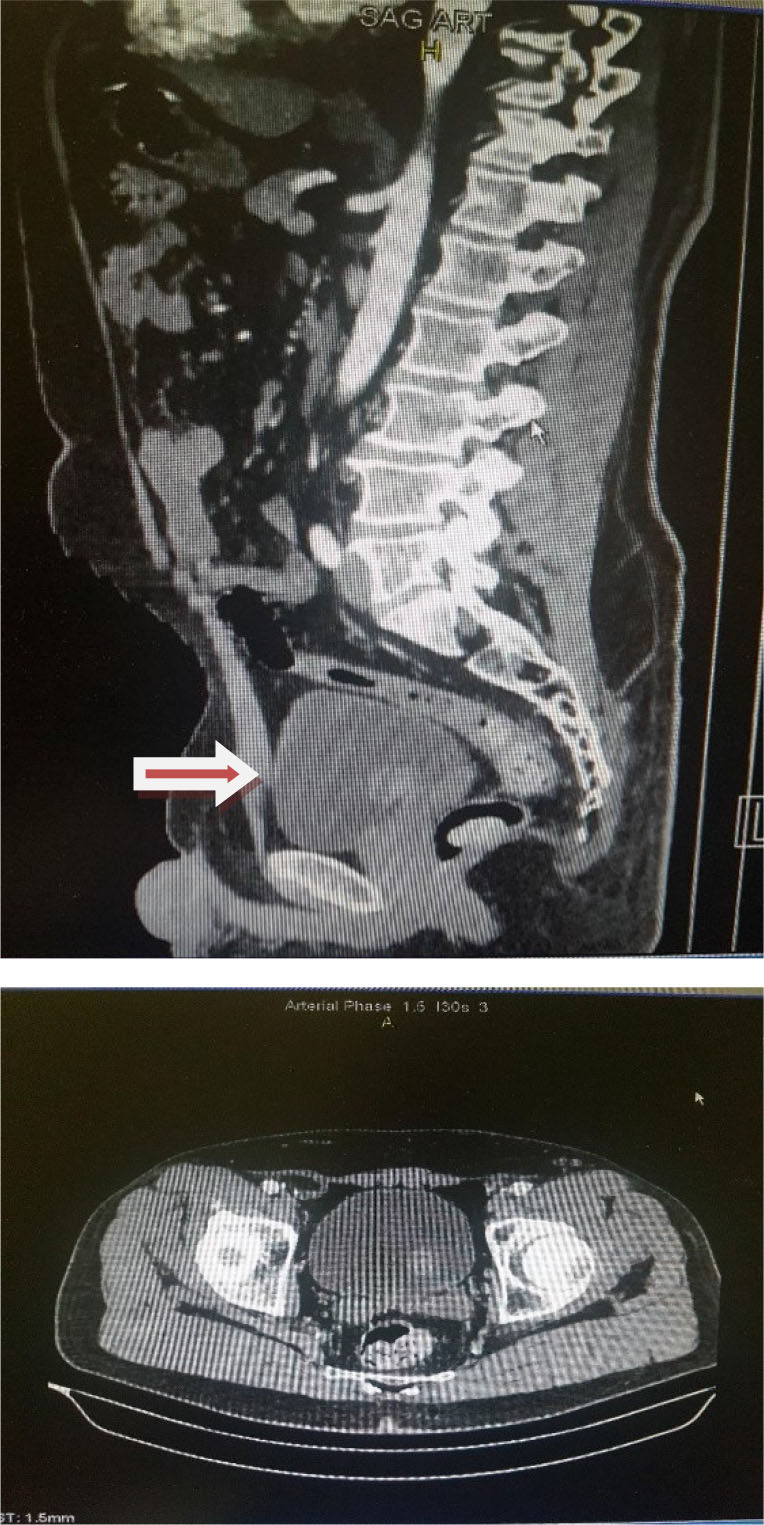
Fig. 1a and 1b -
MSCT of abdomen and pelvis minoris shows intravesical mass (arrows).
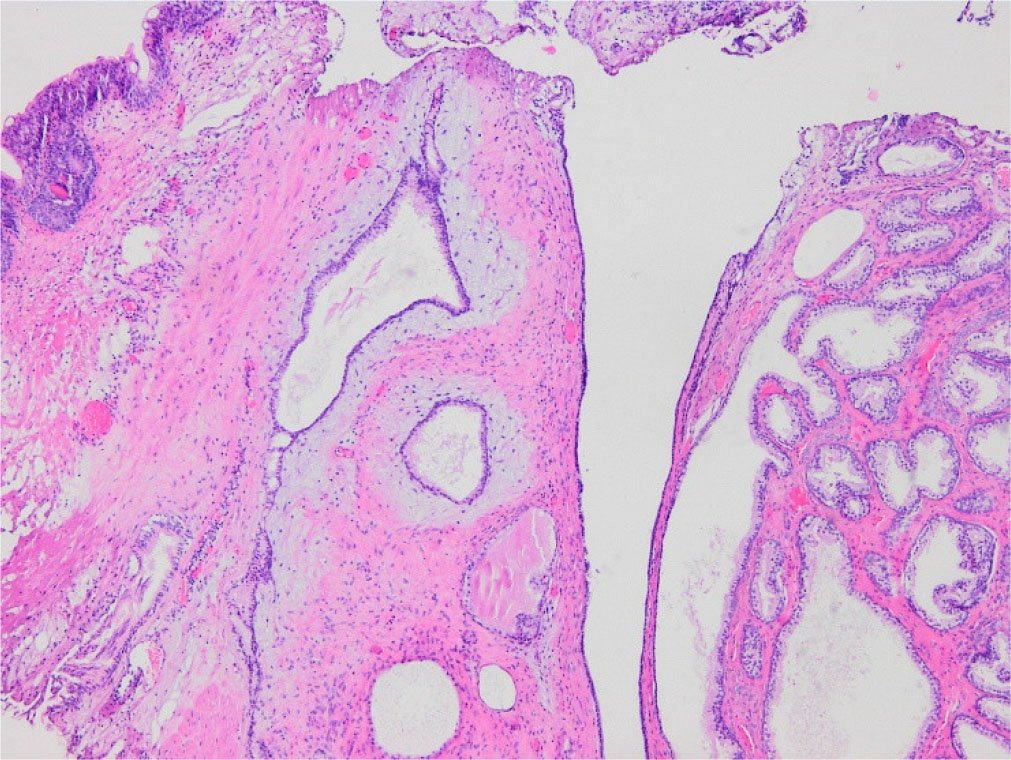
Fig. 2-
Ectopic prostate tissue in the subepithelial tissue of the urinary bladder. The bladder mucosa seems to moderately proliferative and intact (arrow). Prostate glands showing irregular dilated lumens with flattened epithelial cells (H&E, ×40).
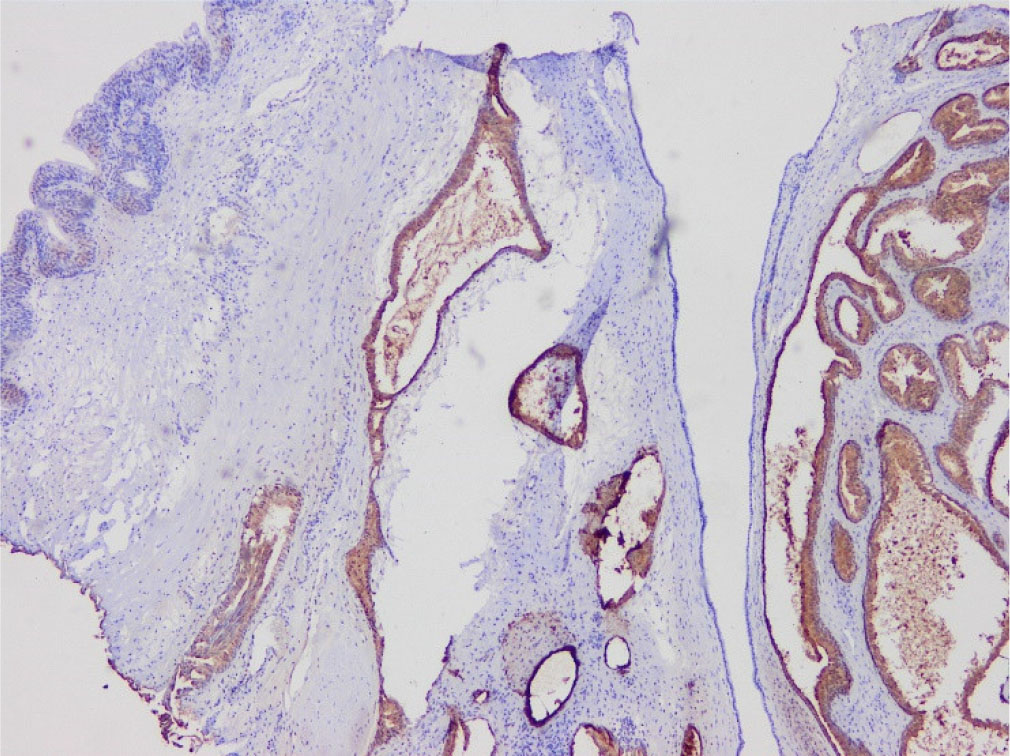
Fig. 3-
Immunopositive staining of ectopic prostate tissue for prostate-specific antigen (original magnification ×40).
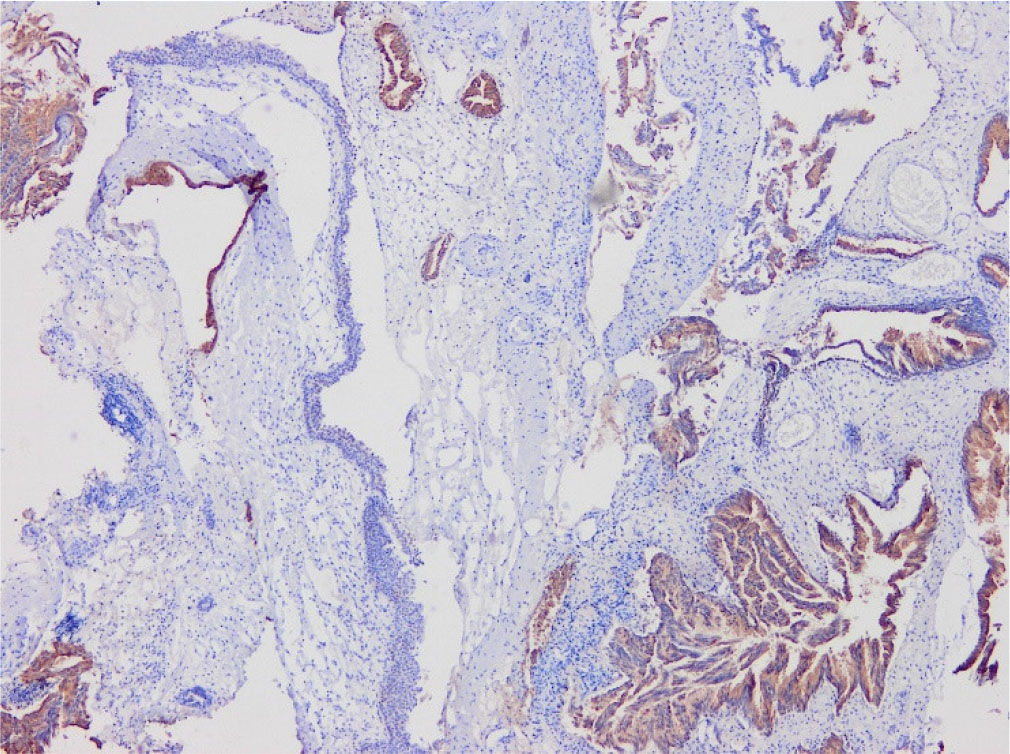
Fig. 4-
Microscopic sections showed a dilated glandular structures surrounded by a dense fibrovascular stroma. Immunoperoxidase stain shows strong and diffuse mmunopositivity of the glandular epithelium with antibody to prostate-specific antigen (original magnification ×40).
DISCUSSION
Ectopic prostate tissue is most commonly incidentally detected during diagnostic procedures for hematuria or dysuria [3,4]. In this case, the patient underwent an ultrasound examination without complains on some urological difficulties, so it was incidentally detected. Diagnostic differentiation based on images obtained by imaging techniques (ultrasonography, intravenous urography and MSCT) most frequently indicate the possible bladder tumor. Due to its location near the ureteral orifice, it may cause obstruction and ureterohydronephrosis. Preoperative imaging of whole urological tract is therefore needed, not only in this case, but in any case of bladder intraluminal proliferation. This is due to not only possibility of ureteral obstruction caused by ectopic prostate tissue in urinary bladder (as in this case), but also because of possibility of multifocal localization of urothelial carcinomas. On the other hand, cases of malignant alteration of the ectopic prostate tissue towards the appearance of adenocarcinoma have been reported [5,6]. Therefore, a preoperative PSA assessment is needed and also a postoperative analysis of CD 10 markers (as indicators of possible mesonephric origin), p63, 34βE12 and α-methylacyl-CoA-racemase for revealing possible presence of adenocarcinoma [2,7]. Most commonly two different types of lesions can be present: polypoid or “flat” [8]. In our case, the lesion was presented as polypoid. Patients in whom the ectopic prostate tissue is surgically removed have an excellent prognosis if the tissue was without the presence of malignancy [2]. If prostate adenocarcinoma is found in the resected specimen, the further diagnostic pattern should include rigorous postoperative follow up that includes more frequent check-up of serum PSA levels and cystoscopy, as well as imaging diagnostic such as PSMA PET scan. Incompletely removed ectopic prostatic tissue can continue to grow and can cause dysuria, hydronephrosis and malignant transformation of ectopic prostatic tissue is a possibility. Therefore, in any case of resection of prostatic tissue from urinary bladder postoperative assessment that includes ultrasound and cystoscopy is essential and represents a diagnostic minimum.
CONCLUSION
Benign lesions of the bladder as ectopic intravesical prostatic tissue are extremely rare. In preoperative diagnostic differentiation, these lesions most commonly resemble transitional cell carcinoma of the bladder. Transurethral resection with a pathohistological report is the method of choice for definitive diagnosis and treatment of these cases. Following complete removal of the ectopic intravesical prostate tissue patients have excellent prognosis.