
INTRODUCTION
Lumbar spine pain is becoming more widespread as a health problem and is one of the main reasons for short-term incapacity for work. The term “low back pain” (LBP) refers to a number of often overlapping categories of pain, such as nociceptive, neuropathic, nociplastic, and non-specific pain (NSLBP). Each of the components that make up the lumbar spine – soft tissue, vertebrae, sacroiliac and zygapophyseal joints, intervertebral discs, and neurovascular systems, for example – is subject to different stresses. These stressors can act alone or together to cause low back pain (1).
NSLBP, without recognizable pathogenesis, has been reported as the main type of LBP with a high proportion of 90–95% (2). Weak hip abductor, extensor, and lumbo-abdominal corset muscles cause overactivity of the hamstrings, iliopsoas, piriformis, and tensor fasciae latae muscles in patients with nonspecific low back pain. Stability of the trunk muscles is necessary to maintain adequate load balance within the pelvis, spine, and kinetic chain (3).
The core of the muscle functions like a corset around the abdomen and lower back, acting as a single unit for support and stabilization. This is critical for maintaining proper posture and alignment during static positions and dynamic movements (4). All body movements originate from the “core” muscle structure due to the internal stabilizing effect of these muscle boundaries on the torso and spine, which resemble the corset. Throughout the human kinetic system, maintaining proper muscular balance requires a strong and efficient core. This is why the core is called the “powerhouse” or “the engine of all limb movements” in the field of alternative medicine (5).
Deep trunk muscles, or local stabilizing muscles, play a key role in stabilizing the spine (6). These muscles are responsible for providing precise motor control and maintaining spine stability during various movements and activities, namely the erector spinae, multifidus, rectus and transversus abdominis, external and internal oblique, and quadratus lumborum (7). These muscles work in sync to provide spinal stability and support movement efficiency. Their role is crucial in maintaining balance and reducing the risk of injury during daily activities (8).
The goal of this research was to evaluate the muscle strength of the students using tests for examining the muscles of the lumbo-abdominal corset and determine whether the reduced strength of the mentioned muscle groups may represent an increased risk for the occurrence of lumbar syndrome in the near future. Also, by comparing two groups – rehabilitation students and sports and physical education students – we tried to determine if there is a difference in the power of muscle strength and the frequency of lumbar pain between these groups.
MATERIALS AND METHODS
The research was conducted from April to July 2024 on a sample of 100 students of the State University in Novi Pazar, Serbia, of which 50 students were from the rehabilitation study program and 50 from the sport and physical education study program. Of the total number of students, 54 were male, while 46 were female. The required sample size was calculated using the Sample Size Calculator (available online: https://www.calculator.net/sample-size-calculator.html?type=1&cl=95&ci=8&pp=50&ps=&x=Calculate; accessed on 1 April 2024), taking into account the assumption of a margin of error of 8% and a confidence level of 95%.
The criteria for inclusion in the study were: students aged between 18 and 30 years; respondents must have a signed written informed consent for inclusion in the study before the actual inclusion; absence of back pain on the day of examination; food: there is no limit; prohibition of alcohol consumption; respondents should be non-smokers. Only students who, at the time of the research, did not have any health problems or contraindications for performing the tests were included in the research, which is important to ensure the safety and reliability of the results.
The criteria for exclusion from the research were all those students who do not meet the inclusion criteria; pregnancy; the decision of the respondent or the decision of the examiner. Students who had recent injuries or other health problems that could affect their ability to perform the tests were not included in the study.
It is important to emphasize that voluntary withdrawal from the study was guaranteed, but none of the students who were involved in the research left the study.
The tests we conducted are often used in the assessment of muscle strength, endurance, and stability, especially in the context of trunk and lumbar region assessment (9,10,11,12,13).
The Biering-Sorensen test determines the endurance of the trunk extensor muscles, assessing how long the subject can hold the upper body without support (from the iliac crests) in a horizontal pronated position with the legs attached to the table and the arms crossed over the chest until the subject loses control of holding. For men, normal values are ≥161 sec, while for women, these values are ≥185 sec (11,12,13,14).
The 60-degree flexion test determines the endurance of the trunk flexor muscles, assessing how long the subject can sustain in a 60-degree trunk position relative to the floor while tending to maintain physiological lumbar lordosis. The feet are fixed on the base, and the angle in the hips and knees is 90 degrees. For men, normal values are ≥136 sec, and for women ≥134 sec (11,12,13,14).
The side bridge (plank) test determines the endurance of the muscles of the lateral flexors and rotators of the trunk. The examinee takes a side plank with support on the forearm and feet, keeping the body in a straight line from head to heel; the opposite hand is supported down the body or on the chest. For men, normal values are ≥99 sec, and for women ≥78 sec (11,12,13,14).
The mentioned tests were explained to the respondents in detail, verbally and practically, and in case of wrong positions, they were corrected. Respondents were suggested to maintain the test position for as long as possible. The data that was collected was recorded in seconds.
Also, the students filled out a questionnaire for the analysis of musculoskeletal problems, where based on the questions we obtained data on students who once had problems in the form of NSLBP in the past.
All collected data were processed using SPSS, version 21.0 (SPSS Inc., Chicago, II, USA).
Ethical considerations
The study was conducted in accordance with the ethical standards of the committee responsible for human experimentation (institutional and national) and the Helsinki Declaration of 1975, as revised in 2013 (15). Voluntary written and informed consent was obtained from each participant prior to enrollment in the study. The protocol of the study was approved by the local ethics committee of the State University of Novi Pazar, Novi Pazar, Serbia (approval number: 1004/24; date of approval: April 3, 2024).
RESULTS
We considered that sports and physical education students, due to their greater physical activity, could have better results in terms of muscle strength and lower incidence of lumbar pain compared to rehabilitation students. In the rehabilitation students, there was marked weakness of the extensor muscles, with 44 (88%) students showing weakness compared to 6 (12%) who had normal muscle strength. This indicates potential differences in muscle strength in this group, which could be related to the specifics of the study program or physical activities performed by the students. Among sport and physical education students, 30 (60%) students showed weakness of extensor muscles, while 20 (40%) students had satisfactory muscle strength, which in turn shows a significant difference in the strength of this muscle group among students of the compared groups (Graph 1). In rehabilitation students, only 2 (4%) students had satisfactory abdominal flexor muscle strength, while 48 (96%) students had not. In sports and physical education, 16 (32%) students showed satisfactory abdominal flexor muscle strength, while 34 (68%) showed unsatisfactory results. Although this is better compared to rehabilitation students, there was still a significant number of students (34) not achieving satisfactory results (Graph 1). Similar results were obtained when testing the muscles of the sides of the trunk; in rehabilitation students, only 2 (4%) had satisfactory muscle strength on the right side of the trunk, while 48 (96%) students had unsatisfactory results, which indicates a possible problem in this group. For the same group, all 50 (100%) students had unsatisfactory results for the muscles of the left side of the trunk. In sports and physical education students, 25 (50%) had satisfactory muscle strength on the right side of the trunk and 25 (50%) had unsatisfactory results, which was a significantly better result compared to rehabilitation students (Graph 2). On the left side of the trunk, 20 (40%) students from this group had satisfactory strength, while 30 (60%) had unsatisfactory results, which is another indicator that their physical fitness is generally better.
Table 1.
Characteristics and values of the examined students
| Tested Characteristics | Sample size (n=100) | |
|---|---|---|
| Age (year) Mean ± SD | 21.20±0.79 | |
| Sex | Male | 54 (54%) |
| Female | 46 (46%) | |
| Study program | Rehabilitation 50 (50) | |
| Sports and physical education 50 (50) | ||
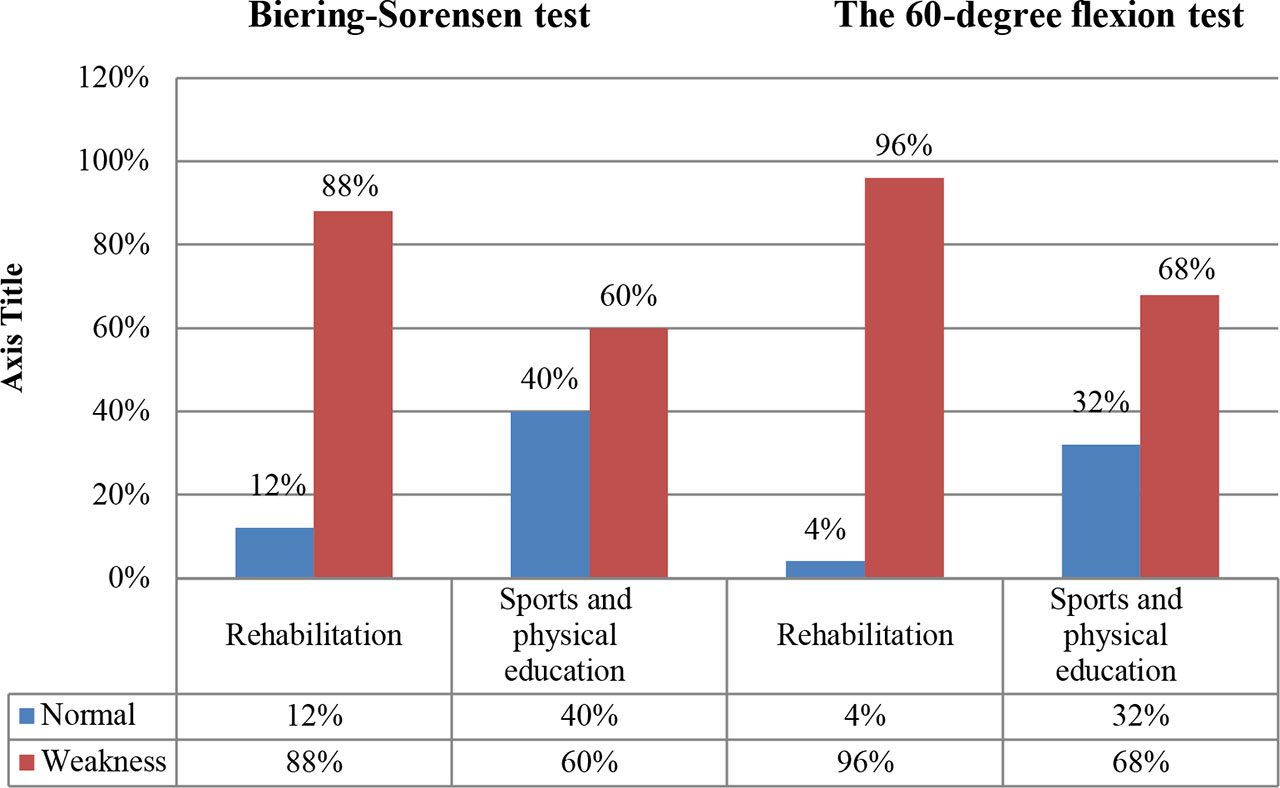
Graph 1.
Representation of the Biering-Sorensen and the 60-degree flexion test for both groups: rehabilitation and sports and physical education
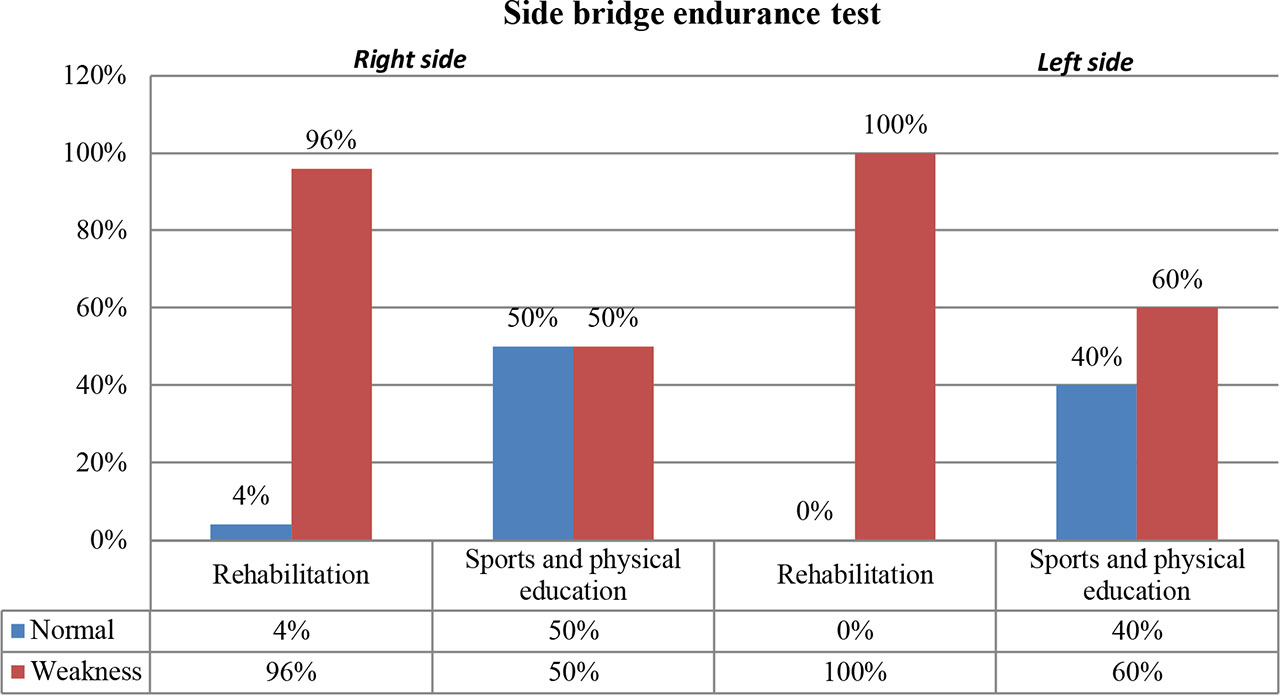
Graph 2.
Representation of Side bridge endurance test – right and left side
Using the Chi-square test (Table 3), we performed a comparison of qualitative variables; in this case, it was about the presence of NSLBP. 36 (80.0%) rehabilitation students declared that they had complaints in the lumbar part of the back in the previous period of life, while of sports and physical education students, back problems were present in 9 of them (20.0%), which gives us a statistically significant difference between these two groups (p=0.000; p<0.001). Based on the obtained results, we can conclude that a significantly higher number of students from Rehabilitation compared to students from Sports and Physical Education had at some point the appearance of NSLBP.
Table 3.
Significance of the differences in students between the qualitative variables of the questionnaire they filled out
| Tested variables | Rehabilitation n (%) | Sports and physical education n (%) | p* | ||
|---|---|---|---|---|---|
| The presence of complaints | Yes | 36 (80.0%) | Yes | 9 (20.0%) | <0.001 |
| No | 14 (25.5%) | No | 41 (74.5%) | ||
| Reporting complaints | No complaints | 14 (25.5%) | No complaints | 41 (74.5%) | <0.001 |
| Occasional | 36 (76.9%) | Occasional | 9 (23.1%) | ||
| The time of occurrence of complaints | Without pain | 14 (25.5%) | Without pain | 41 (74.5%) | <0.001 |
| In the morning | 4 (100.0%) | In the morning | / (0.0%) | ||
| In the afternoon | 11 (73.3%) | In the afternoon | 4 (26.7%) | ||
| In the evening | 21 (80.8%) | In the evening | 5 (19.2%) | ||
| Disturbance due to ailments | No disturbance | 19 (30.6%) | No disturbance | 43 (69.4%) | <0.001 |
| Nervousness 16 (80.0%) | Nervousness 4 (20.0%) | ||||
| Low frustration tolerance 2 (100.0%) | Low frustration tolerance / (0.0%) | ||||
| Bad sleep 2 (40.0%) | Bad sleep 3 (60.0%) | ||||
| Disturbances in daily activities 11 (100.0%) | Disturbances in daily activities / (0.0%) | ||||
In the binary logistic regression (Table 4), we had a dichotomous dependent variable coded with 0—no complaints, and 1—have complaints. What we are interested in is coded with 1; our main task was to predict the probability that the level of the dependent variable we are interested in is a function of the independent one, that is, a change in which variable can significantly affect the dependent variable. The values of the extensor endurance test, trunk flexion test, and side plank tests on the left and right sides are associated with an increase in the probability that complaints will occur.
Table 4.
Logistic regression
| Exp(B) | 95% CI for EXP(B) | Sig. | ||
|---|---|---|---|---|
| Lower | Upper | |||
| Study program | 1.246 | .198 | 7.844 | .815 |
| Sex | 1.240 | .260 | 5.912 | .788 |
| Biering-Sorensen test | .941 | .911 | .972 | .000 |
| Flexion test - 60 degrees | 1.000 | .968 | 1.034 | .977 |
| Side bridge endurance test-R | 1.029 | .937 | 1.129 | .555 |
| Side bridge endurance test-L | .942 | .843 | 1.052 | .289 |
| Constant | 5452.720 | .000 | ||
Logistic regression with control of the influence of all analyzed features, as the one that is significantly related to the presence of complaints, significantly singles out the Biering-Sorensen extensor endurance test, which means that any increase in the value of the Biering-Sorensen extensor endurance test by one measurement unit is associated with a decrease in the probability of occurrence of NSLBPs coded for 1 in the lower back (Exp(B)=0.941; 95% CI: 0.911 to 0.972; p=0.000). When it comes to the group, there is a higher probability that complaints will occur in the group of rehabilitation students, but it is not statistically significant (p=0.815); there is also a higher probability of the occurrence of the problem in women, but it is not statistically significant (p=0.788).
Multivariate linear regression analysis (Table 5) with control of the influence of all analyzed features singles out only the Biering-Sorensen test of extensor endurance as the one that is significantly related to the value of the Visual Analogue Scale. That is, each increase in the value of this test by one measurement unit is associated with a decrease in the value of the Visual Analogue Scale (VAS) by 0.028 from 0.040 to 0.016. The p value is 0.000 or p<0.001.
Table 5.
Linear regression
| Unstandardized Coefficients | 95.0% Confidence Interval for B | Sig. | |||
|---|---|---|---|---|---|
| B | Lower Bound | Upper Bound | |||
| Constant | 6.260 | 4.749 | 7.771 | .000 | |
| Study program | −.849 | −1.871 | .174 | .103 | |
| Sex | .064 | −.791 | .919 | .883 | |
| Biering-Sorensen test | −.028 | −.040 | −.016 | .000 | |
| Flexion test - 60 degrees | −.001 | −.018 | .016 | .901 | |
| Side bridge endurance test-R | .035 | −.013 | .083 | .152 | |
| Side bridge endurance test-L | −.045 | −.104 | .014 | .130 | |
DISCUSSION
Non-specific low back pain syndrome (NSLBP) is highly prevalent and represents a significant cause of medical costs, pain, and dysfunction in many people (16). NSLBP accounts for over 85% of LBP cases and has no apparent cause or pathophysiology; in patients with NSLBP, postural control, which is necessary for performing functional activities, is reduced (6).
According to studies, 84% of people will experience low back pain (LBP) at least once in their lifetime, with 23% of cases becoming chronic and 12% causing significant difficulty in daily activities (17).
Recently, the incidence of non-specific low back pain (NSLBP) is becoming more common among young people, who are increasingly suffering from this problem. The frequency of episodes in them is similar to that in adults. This pain can limit professional, social, and family activities, which negatively affects the quality of life of sufferers (18).
Numerous studies have proven that the increasingly frequent occurrence of NSLPB is present precisely in students, due to prolonged sitting and reduced physical activity. The highest prevalence of NSLBP was recorded in students who sit for more than 3 hours a day, which is 79% (19). According to a study conducted by Alwashmi et al. (20), 82.0% of medical students reported having lower back pain at some point in their lives. Such results agree with previous studies from different parts of the world. For example, the study among 629 Brazilian medical students showed that 81.7% of them reported suffering from NSLBP (21).
These findings are consistent with the results of our research, where we note that a significant number of students suffer from non-specific pain in the lower back. This problem is particularly pronounced among rehabilitation students, where risk factors, such as a sedentary lifestyle and lack of physical activity, are very present. A sedentary lifestyle, which includes prolonged sitting and lack of regular physical activity, can significantly contribute to the development and worsening of low back pain (22). Rehabilitation students often spend a lot of time in lectures or studying, which further increases the risk of these problems. On the other hand, among students of sports and physical education, we notice a significantly lower number of those who suffer from non-specific pain in the lower back. This difference suggests that regular physical activity and training may have a protective role in pain prevention. Physical activity not only strengthens back muscles and improves flexibility but also contributes to general health, which can reduce the risk of developing spinal problems (23).
Decreased muscle activity, lack of spinal flexibility, and poor muscle recruitment patterns are significant factors that may adversely affect normal spinal stability in patients with LBP. These problems often result in the weakening of the intrinsic postural muscles, which are crucial for maintaining the correct position of the spine and stability during movement. When the intrinsic activity of the muscles is not adequate, there is an overuse of the superficial muscles, which can create an imbalance and additionally burden the spine (6).
Koumantakis et al. (24) emphasized the importance of strong and durable muscles in the paravertebral musculature (muscles along the spine) and hip musculature. These muscles play a key role in stabilizing the spine and maintaining proper posture, which can significantly affect the prevention of back pain. Research has shown that there is a significant relationship between the level of physical activity in free time and isometric endurance, measured by the Sorensen test. This indicates that increased physical activity can improve trunk muscle endurance and reduce the risk of back problems and highlights the importance of strengthening specific muscle groups to prevent back pain (24).
This is consistent with our research, which showed that there is a close connection between weakness in the muscles of the lumbo-abdominal corset and the occurrence of NSLBP in students. Our study showed that rehabilitation students (80%) are more susceptible to NSLBP than sports and physical education students (20%). Also, based on the assessment of the muscle strength of the lumbo-abdominal corset with appropriate tests, a significantly reduced strength of these muscle groups is present in rehabilitation students.
Loss of muscle mass and strength is often the result of a sedentary lifestyle and lack of physical activity, which can also be a predictor of future episodes of lower back pain. The posterior lumbar structures are weakened due to the constant pressure on the intervertebral disc, which leads to a decrease in the metabolic exchange and nutrition of the disc. Weakness of the superficial and deep muscles of the trunk and abdomen is one of the risk factors for the development of low back pain (LBP). Strengthening these muscles can significantly reduce functional disability and pain (25).
Also, when it comes to gender, in our study we concluded that there is a greater probability for the occurrence of problems in the form of NSLBP in women. These findings are consistent with the results of a study conducted by Rakholiya et al. (11), which showed that women aged 18 to 25 years have significant trunk muscle weakness, which indicates the need for additional work on strengthening core muscles in this demographic category (11).
A study conducted by Banthia et al. investigated trunk muscle endurance in a sample of 80 nurses aged 20 to 30 years. Trunk muscle endurance was assessed through the lumbar functional test, and the results showed that nurses had reduced trunk muscle endurance compared to published normative data (26).
A similar study was recently conducted by Kadiervel et al. (27) and showed that the weakness of the muscles of the lateral sides of the trunk was the most prevalent in the respondents. These muscles are important for stabilizing the trunk and maintaining proper posture. Also, weakness of the muscles responsible for back extension was observed; this weakness may affect the ability to maintain proper posture and may contribute to the development of pain in the lower back. The results suggest that a large number of students do not pay enough attention to physical activity that could help strengthen the muscles of the lumbo-abdominal corset. Kadiervel et al.'s research, along with ours, highlights the importance of addressing lumbo-abdominal corset muscle weakness in college students (27).
Training the muscles of the lumbo-abdominal corset is increasingly recognized as a key strategy for the prevention of NSLBP. This approach includes various exercises aimed at strengthening and stabilizing the trunk muscles, which is especially important for problems with the lumbar spine as well as for various diseases of the musculoskeletal system. A strong muscular corset helps maintain proper posture, reduce strain on the spine, and prevent injuries during daily activities (11).
A study conducted by Behennah et al. (28), which aimed to examine the relationship between the strength, balance, and endurance of the lumbar extensors in people with pain in the lumbar part of the back and people without pain in this region, showed that pain occurs in the case of impaired motor muscle control in the lumbar region, i.e., that strengthening of the muscles of this region reduces dysfunction and relieves pain (28).
As in our study, students who had significantly reduced muscle strength complained of pain in the lumbar region, which means that one of the causes of lower back pain can certainly be muscle weakness and a sedentary lifestyle. Based on the results of statistical analyses, including logistic and linear regression, our study reached a significant conclusion. It was found that the Biering-Sorensen extensor endurance test significantly affects the presence of lower back pain. In particular, an increase in the score in this test by one measurement unit is associated with a decrease in the probability of the occurrence of complaints. This suggests that strengthening the back extensor muscles can significantly contribute to reducing lower back problems. In addition, linear regression analysis shows that the Biering-Sorensen extensor endurance test is also significantly related to the values of the Visual Analogue Scale used to assess pain. Each increase in the value of this test by one measurement unit leads to a decrease in the pain rating on the Visual Analogue Scale. This means that strengthening the endurance of the back extensor muscles results in a decrease in the perception of pain in the subjects. Our findings suggest that improving back extensor muscle strength may be crucial in the prevention and management of low back pain.
One study provided evidence that various exercise approaches are effective and should be included in the routine care of patients with NSLBP because of their potential to improve pain, physical function, muscle strength, and mental health. Resistance exercises for muscle strengthening, stabilization exercises, and pilates have been shown to be the most effective treatments, pending the outcome of interest, for patients with NSLBP (29).
LIMITATIONS OF THE STUDY AND FUTURE DIRECTIONS
Despite its strengths, this study also has some limitations. Namely, the sample in our study included students from one university in Serbia, which may limit the possibility of generalizing the results to a broader population. To improve the external validity of the research, future studies could include participants from different age groups, professions, and geographic regions. In addition, other factors, such as lifestyle, psychological factors, or previous diseases, may influence the results, and a more detailed examination and control of such potential confounding variables in future studies could improve the robustness of the findings. Also, another limitation of our study is that it did not use a longitudinal design that could provide stronger evidence of the long-term benefits of strengthening the lumbar abdominal muscles in preventing low back pain. Monitoring the participants over a longer period would allow a better understanding of how muscle strength affects the frequency and severity of pain over time.
In addition to its limitations, our study also has important practical implications. It highlights the importance of incorporating exercises that enhance trunk muscle endurance and strength as a key component of strategies aimed at reducing discomfort and improving quality of life. This claim is supported by a number of previous studies that have shown that strengthening the muscles of the trunk can significantly contribute to the reduction of lower back pain, improved posture and functional ability, as well as general health. In addition to the aforementioned, incorporating physical exercise programs into the prevention of lower back pain may be important for everyday clinical practice among physiatrists, orthopedic surgeons, and neurologists.
CONCLUSIONS
Based on the findings obtained in our research, we can conclude that 80% of rehabilitation students had occasional complaints, while only 20% of sports and physical education students reported the same problems, which indicates a significantly higher risk of developing complaints in the first group. The Biering-Sorensen test of extensor endurance shows a significant association with the probability of occurrence of complaints, whereby an increase in the result of this test reduces the risk of pain in the lumbar region. Also, in the analysis of the Visual Analogue Scale, each increase in the result of this test reduces the feeling of pain by 0.028, which further confirms its role in the prevention of ailments. Based on these results, we can conclude that rehabilitation students are more susceptible to NSLBP, and strengthening the endurance of the muscles of the lumbo-abdominal corset can significantly contribute to reducing the prevalence, incidence, and prevention of these problems.
ACKNOWLEDGMENTS
PhD candidate Zerina Salihagić would like to thank all co-authors for their valuable contributions, dedication, and collaborative effort in carrying out this research.