
INTRODUCTION
Pertussis, which literally means “a whooping cough”, also known as “the 100-day cough”, was for the first time described in the 1578 Paris epidemic. The disease agent, Bordetella Pertussis, was discovered in 1906, and the vaccine was developed in 1940s (1). Pertussis was a dreaded disease, especially for the very young, having a high risk of death for infants under the age of less than a year. It is characterized by paroxysms of cough, inspiratory whoop, and posttussive vomiting, with more severe forms leading to apnea in infants. Before the vaccine development, Pertussis was the major cause of the morbidity and mortality of newborns (2). Bordetella Pertussis is a Gram-negative coccobacillus which gets in touch with ciliated respitory epithelial cells. Local inflammatory changes occur in the respiratory tract mucous membrane. Toxins (Pertussis toxin, dermonecrotic toxin, adenylate cyclase toxin and tracheal cytotoxin), which have a local and systemic effect, are released even though the agent itself does not penetrate the respiratory tract completely and is almost never found in the hemoculture (3). Furthermore, the disease was highly contagious, leading to strict quarantining of the affected child. Lack of availability of treatment for pertussis resulted in clinical and psychosocial burden for both patient and the community. Numerous drug experiments were tried to accelerate recovery and enhance survival; however, none of the experiments achieved a significant therapeutic utility. Even though the whooping cough disease has been reduced to sporadic cases by vaccination, it is evident that the cases of the disease are reoccurring nowadays. One of the key reasons for the reintroduction of complex whooping cough cases is the insufficient level of vaccination, especially in the high-risk population, displaying high vaccination skepticism. The lack of vaccination or untimely vaccination contribute to the growth of the pertussis cases in the population (4). The pertussis cases often present a challenge due to various differential diagnoses. The whooping cough symptoms are frequently similar to other respiratory infection symptoms, which makes the precise clinical-symptom diagnosis more difficult. Therefore, it is essential to have a reliable diagnostic tool which can provide the relevant information about the patient’s condition. X-ray diagnostics has been used as one of the key modalities in the chest/lung disease evaluation for decades. The availability, the low price and the possibility of the chest anatomic structure visualization make x-ray diagnostics one of the most common diagnostic methods in the respiratory disease evaluation. Chest xray images provide the data on the inflammation presence or other pathological changes which could be the result of pertussis. Nevertheless, despite its wide application, x-ray diagnostics also demonstrates certain limitations. It can only provide a two-dimensional image of organs, which makes the precise localization and characterization of the lesions. Also, x-ray imaging does not procure a detailed overview of soft tissues surrounding the lungs, which can result in the negligence of certain pathological changes. This paper focuses on the advantages and disadvantages of x-ray diagnostics employed in the diagnosis of whooping cough patients, including the possible errors during the interpretation process and the need for additional diagnostic modalities. The analysis includes the factors which can affect the preciseness and reliability of x-ray findings as well as the need for the integration of other diagnostic methods aimed at providing an overall picture of the patient’s condition.
METHODS
In this overview paper, the electronic databases Google Scholar Advanced Search, Consortium of Serbian Libraries for Coordinated Purchase and and the PubMed platform are used. The search included the following key words: x-ray diagnostics, whooping cough, pertussis, interpretation errors. The 2014 to 2024 publications in Serbian and English have been used. The results of the studies related to x-ray diagnostics in cases of whooping cough are presented in a narrative form.
WHOOPING COUGH
The World Health Organization (WHO) describes pertussis as “an extremely contagious respiratory tract disease caused by Bordetella pertussis,” a microorganism specific to humans. Pertussis affects people of all ages, especially children, and is one of the leading causes of mortality in infants under the age of one year. The incubation period usually ranges from 7 to 10 days (from one to three weeks), and clinical characteristics are associated with age, duration of infection, immune status, and the applied antibiotic therapy (4). Whooping cough in children is characterized by paroxysmal cough accompanied by the typical inspiratory sound and post cough vomiting. Namely, as stated earlier, the clinical course can be susceptible to many factors, including the vaccination history and age. Adolescents and adults often show atypical symptoms and can only be faced with the persistent extended cough. The WHO estimates that a total of 151, 074 whooping cough cases worldwide were recorded in 2018, and in the previous years (2008) up to 89,000 mortalities were reported. Now, vaccination is the best available strategy to fighting the disease (1,2,3) (Figure 1).
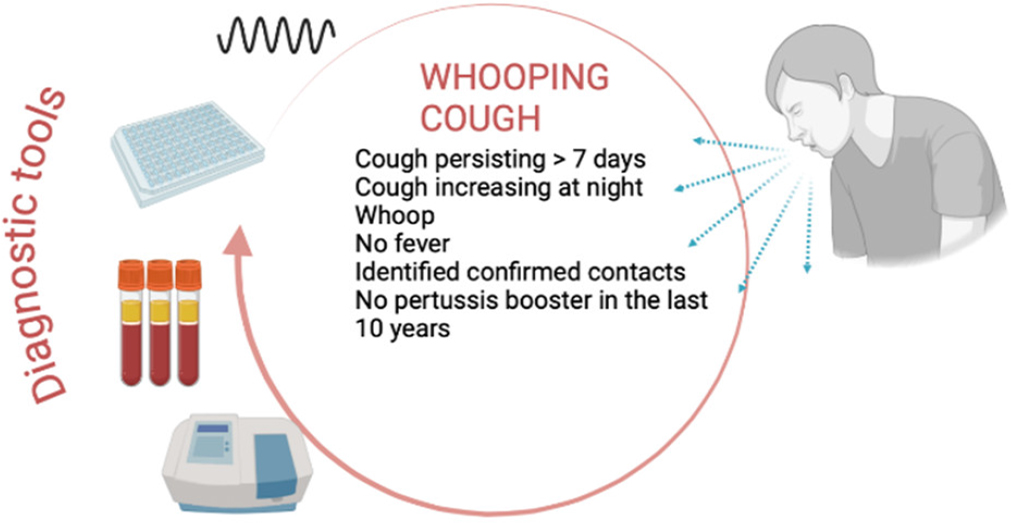
Figure 1
Clinical signs and diagnostic methods of whooping cough
Moreover, the severity of the disease is inversely proportional to the patient age (4, 5). Namely, pertussis has a predictable course in unvaccinated children and can result in grave symptoms and complications. The prognosis is particularly poor during the first and second year of age, when the hospitalization incidence and mortality are the highest (mortality rate: 0.2% in the developed and 4% in the developing countries) (6). The disease can have a mild and atypical course in vaccinated children, adolescents, and adults, which causes a rare disease detection. Namely, the abovementioned patients can pose a powerful infection source for little children, especially infants under the age of one, when the immune system is still maturing.
The pertussis infection has shown immunomodulatory effects, in the recent research focused on the role of adenylate cyclase toxins (CyaA) and the secretion system effector proteins type III (TTSS), which can affect the pathogenesis of the basic chronic conditions/diseases, especially the chronic inflammatory diseases (8, 9). The evidence suggests the Bordetella pertussis infection can impact the asthmatic response (10), respiratory diseases (8) and other atopic conditions (11).
Petrussis in patients with chronic diseases such asthma or chronic obstructive pulmonary disease can be related to the complications which can incurred additional treatment costs (12). Besides, pertussis can be an immediate causative agent of other diseases. A recent study indicates that 60% of elderly people in Europe suffer from at least two chronic diseases. The elderly are frequently susceptible to infectious diseases and the resulting complications for a few reasons, including the absence of previous immunization or incomplete vaccination or weakened immunity.
Petrussis testing is not always available as part of the primary healthcare, nor is it as part of certain medical emergency services. A nasopharyngeal swab and Polymerase Chain Reaction (PCR) can procure the laboratory confirmation, however, given the existing conditions, thses tests appear to be quite demanding. Also, slow-growing Bordetella organisms demand specialized means, and the cultures usually are not positive from 3 to 7 days. In adults, at the time around the suspected diagnosis, cultures are usually negative (96%), and the overall culture sensitivity is only 20% to 40% (13, 14). PCR is more sensitive and more specific than the culture, and the testing is not widely used.
From the differential diagnostics standpoint, whooping cough should be taken into account in patients with extended coughing period, especially if occurring in paroxysms or accompanied by the inhalation “sound” or vomiting following the cough. During the early paroxysmal stage, leukocytosis (often between 25, 000 and 60,000 per mL) with lymphocytosis can raise suspicion of pertussis (15,16,17). The chest radiography findins are not specific and can point out to peribronchial thickening, overemphasized reticular perihilar image, lung parenchyma consolidation, a different level lung atelectasis and lymphadenopathy.
THE ADVANTAGES OF X-RAY DIAGNOSTICS IN PATIENTS WITH WHOOPING COUGH
The Ministry of Health and the available whooping cough diagnostics protocols recommend that chest x-ray imaging should be done in patients under the age of four suspected of whooping cough to make the diagnosis process easier and detect potential complications. Nevertheless, despite all these recommendations, some 20% of the patients included in the investigation carried out by Lima et al. (2022) had not been chest x-rayed, which could have been a result of medical workers’ unawareness of this recommendation (18). Still, the abovementioned study identified changes in 57.5% of chest x-rayed patients, with peribronchial thickening and overemphasized reticular perihilar image being the most common findings. Namely, a small number of studies described the chest x-ray changes in patients suspected of whooping cough. Nonetheless, the most common chest x-ray image findings in patients with acute respiratory infections are: peribronchial thickening, overemphasized reticular perihilar image and lung parenchyma consolidation (19, 20).
Chest x-ray imaging is fairly significant for the whooping cough diagnostics, especially having in mind the rapid availability and the simplicity of the medical examination execution. The availability of x-ray imaging enables clinicians to be provided with the lung image immediately upon the examination indications. Additionally, it results in the rapid diagnosis and timely initiation of the adequate treatment (21).
In the case of whooping cough whoses symptoms may overlap with other diseases, an urgent condition evaluation is essential, and x-ray imaging can procure the key information concerning anatomic chest/lung changes. The simplicity of x-ray examination also contributes to its significance in the whooping cough diagnostics. Chest x-ray imaging is a noninvasive procedure using ionazing radiation aimed at providing the chest’s/lung’s internal image. This method is routinely used at many medical centers and hospitals, that is, this diagnostic tool is easily accessible. Due to its availability and execution simplicity, chest x-ray imaging is a vital step for the evaluation of the disease’s clinical course.
Peribronchial structure thickening is often found in the whooping cough patients. The x-ray image shows the thickened peribronchial space as a more conspicuous peripheral bronch due to the inflammation and swelling of the surrounding tissue (18, 22). These finding can be a consequence of the direct infection presence in the patient’s respiratory system, but also it can occur on account of an inflammation due to the mechanic brochial wall irritation caused by sudden pertussis cough attacks. Besides the peribronchial structure thickening, x-ray images are also likely to indicate other pertussis-specific changes.
Atelectasis (the collapse of lung alveoli) and alveolar shadowings (the accumulation of liquid or substances in the lung parenchima) can also be detected during the chest x-ray imaging in the pertissus-stricken patients. Atelectasis is a common disease complication occurring as a result of the increased pressure in the alveoli during the forceful and longlasting coughing attacts, which results in their collapse and the limited gas exchange inside the alveoli. An x-ray image manifests atelectasis as decreased parenchima transparency which, in fact, represents the lung segment without air (19, 23). Atelectasis may be localized or diffuse depending on the size of the stricken lung area (24). More severe cases can lead to the atelectasis of the whole lung. Such chest x-ray image findings point out to a severe lung function disorder in the pertussis-stricken patients (19). Consequently, atelectasis can lead to the lower organism airflow, which can cause symptoms such as shortness of breath, fatigue and weakness.
Alveolar opacification are also common findings related to chest x-ray imaging in pertussis patients (14, 25). They represent liquid or substance accumulation in the lung parechyma. Berdetella Pertussis itself, via its toxins and other metabolic products, may cause the lung inflammation and irritation, which causes increased mucous production. This thick mucous may be accumulated in the lung alveoli as well, which x-ray imaging presents as the occurrence of alveolar opacifications, which can be coupled with other disease manifestations such as peribranchial structure thickening and atelectasis (26). The combination of these changes shown in the x-ray images may indicate a severe lung function disorder in patients. Due to the limited airflow and inefficient gas exchange, alveolar infiltrations are clinically manifested by symptoms such as shortness of breath, coughing and dysfunctional breathing.
THE LIMITATIONS OF X-RAY DIAGNOSTICS IN PATIENTS WITH WHOOPING COUGH
One of the key problems of whoping cough patient x-ray imaging is coughing attacks during the imaging procedure. This may lead to artefacts which make the findings interpretation more difficult. Thereby, the poor image quality may require additional imaging, which can be an exhausting and unpleasant experience to patients who are in no control of the coughing attacks.
Another disadvantage of x-ray imaging of whooping cough patients is inefficiency of an early-stage detection of the disease, even though it may prove useful for the detection of later complications such as pneumonia or pneumothorax. Namely, in the early disease stage, cough may seem to be mild and bear resemblance to the cold-related cough. These initial stages can be vital for a timely diagnosis and the initiation of the adequate treatment aimed at the further prevention of disease spreading. However, x-ray imaging is usually not sufficiently sensitive to detect the mild changes occurring within this period (27,28,29).
Regarding x-ray imaging, another limitation is the patient’s exposure to ionizing radiation, which may potentially damage the body cells. Overexposure to this radiation may increase the risk of cancer and other disease development. In the event of whooping cough, with x-ray imaging not required for the early-stage diagnosis, the patient’s exposure to this type of radiation may be inefficient and unnecessary (30).
Regarding the chest x-ray interpretation in the whooping cough diagnostics, certain errors affecting the diagnosis precision are possible to take place. Some of the possible problems are:
- Insufficient sensitivity
- Non-specific aspects of the findings
- Diagnostic confusion,
- The findings variation during the disease.
Namely, chest/lung radiography may be less sensitive to mild changes detection occurring in the early-stage pertissus. This may lead to false negative findings with the image showing the lack of infection and may result in making an inaccurate diagnosis. Also, in patients with whooping cough, it may indicate non-specific changes such as peribronchovascular image thickening or slighter alveolar shadowing. These changes are not whooping cough specific and may be found in other respiratory infections or conditions (31, 32). Sometimes, the pertrussis symptoms may overlap with other respiratory infections or diseases making the similar demonstration such as bronchitis or asthma, thus may cause the socalled diagnostic confusion. In such cases, an x-ray image itself will not be sufficiently discerning in such overlapping cases, so additional evaluation and clinical assessment are needed. Additionally, whooping cough has different stages over the course of time, and x-ray findings may also vary depending on the disease stadium of the x-rayed patient. For instance, the early infection stages may have normal x-ray findins, whereas the latter stages may indicate consolidations as well. With a view to minimizing the chest radiography interpretation errors suspected of pertussis, it is important to have an overall approach including the patient’s clinical history (including the presence of whooping cough specific episodes), laboratory tests and the monitoring of symptoms over the course of time aimed at making the right diagnosis and initiating the adequate treatment (33,34,35).
With regard to overriding and diminishing the limitations of whooping cough x-ray diagnostics, it is significant that a few alternative methods as potential solutions should be considered provided there is a choice possibility: computerized tomography (CT), bronchoscopy and functional breathing tests.
CONCLUSION
In conclusion, several key concluding points regarding the possibilities and limitations of x-ray diagnostics in cases of whooping cough can be drawn. Chest radiography is frequently used as the first method for the evaluation of patients with whooping cough symptoms on account of its speed, simplicity and relative availability. With regard to this, the advantages of x-ray diagnostics are numerous. Firstly, chest xray imaging procures the visualization of the lung structure and detection of potential abnormalities such as peribronchial structure thickening, alveolar shadowings, pneumonia and atelectasis. Besides, it can be used for the tracking of the applied therapy effects. Nevertheless, it is important to underline certain x-ray diagnostics limitations in whooping cough patients as well. Firstly, an x-ray image is not always sufficient for making a proper diagnosis or detecting the severity of the patient’s condition Some cases may require additional diagnostic procedures such as computerized tomography (CT) or magnetic resonance imaging (MRI). Also, one must be aware of the fact that x-ray radiation poses a certain risk level to patients due to the ionizing radiation exposure. Therefore, it is important to make a benefit and risk assessment before applying this modality. Based on the advantage and disadvantage analysis of chest x-ray imaging in the whooping cough cases, a further investigation of the topics related to the technology improvement and x-ray diagnostic methods is suggested. Additional research may also be oriented towards the understanding of specific features of certain pathological conditions causing whooping cough aimed at improving the findings interpretation during the routine chest radiography. Given the fact that the majority of pertussis patients are made up of little children, it is important that x-ray diagnostics be applied in the case of grave necessity with benefits exceeding the potential risks. In cases of easier methods used for condition diagnostics, such as early-stage pertussis, alternative methods should be preferred in order to avoid the unnecessary ionizing radiation exposure, with x-ray methods used for the potential complication detection.