
INTRODUCTION
Trauma is the leading cause of death, disability and hospitalisation in the world (1). Globally, it is estimated that there are yearly approximately six million trauma-related deaths (2). About 40 million people experience permanent injuries annually, while 100 million experience temporary injuries (2,3). According to the EuReCa Serbia Trauma Register (ESTR), which collects emergency medical aid data, 45% of the population in Serbia had trauma in the last quarter of 2018 (4)]. The correct assessment of injury severity with limited resources in prehospital conditions significantly impacts triage and the outcome of trauma. This was why different scoring systems were developed based on various parameters. The first scoring systems appeared during the 1960s to aid triage in mass casualty situations. With further modifications, the scores took on a predictive role in addition to their primary role in triage. Trauma GAP (Glasgow coma score - GCS, Age, Arterial pressure) and MGAP (mechanism of injury, GCS, Age, Arterial pressure) are two predominantly physiologically based scoring systems whose value has been confirmed through research (5,6,7). The MGAP score includes the mechanism of injury, GCS, the patient’s age, and systolic blood pressure (SBP). French research confirmed its predictive value in assessing injury severity and 30-day mortality (5). Based on this score, patients are classified into low-risk (23–29 points), moderate-risk (18–22 points) and high-risk patients (<18 points). Unlike the MGAP, the GAP score does not look into the mechanism of injury and has been clinically validated as a predictor of injury severity and mortality in Japan [6]. GAP score points range from 3 to 24, where values of 3 to 10 indicate severe, 11 to 18 moderate, and 19 to 24 slight injury. These two systems are more straightforward than the Revised Trauma Score (RTS) as they do not include breath frequency or score adjustment for head injury. Clinical research showed that the GAP score has a better predictive value for injury severity classification and outcome than RTS and MGAP scores [6].
The RTS is a trauma management scoring tool based on physiology and is currently accepted worldwide. This scoring system relies on physiological variables, systolic blood pressure and respiratory rate (FD) and, during calculation, considers the value of the Glasgow Coma Scale (GCS) variable to be more important than the other variables (7, 10–11). The maximum score is 12, while anything less than that (a score of 11 or less) indicates severe injury and the need for immediate hospitalisation.
This study aimed to retrospectively calculate the RTS, MGAP and GAP scores and compare their efficacy in predicting mortality in prehospital conditions.
MATERIALS AND METHODS
The Institute for Emergency Medicine (IEM) Belgrade provides emergency medical assistance to more than 1.6 million residents living in 11 municipalities throughout the city of Belgrade, covering an area of approximately 1500 square kilometres. The Institute provides almost one million health services annually. A cross-sectional study was conducted at the IEM from October 1st to October 31st 2020, in Belgrade. The data were collected while working in prehospital conditions. The study included 286 trauma patients, who were examined in the field and treated by the ambulance service. The data collected included demographic data (gender and age of the patient), the cause of trauma, mechanism of injury (blunt or penetrating trauma), respiratory rate, systolic blood pressure, GCS score and outcome (resuscitation, emergency intervention, admission to the intensive care unit, operative treatment), and mortality after four weeks.
Statistical analysis
The collected data were presented using tables and graphs and analysed with SPSS. The Mann–Whitney U-test was used to compare the mean scores in the classified groups. The significance of the score as a predictor was determined by calculating the area under the AUROC curve. The values for individual scoring systems were compared using the Delong test. Statistical significance was set at p < 0.05.
RESULTS
In October 2020, the IEM medical teams provided emergency medical assistance to 286 trauma patients. Demographic data show that the mean age of the subjects was 40.3±17.54 years and that 65.7% of the patients were male, almost twice the number of female patients (34.3%). As to the cause of injury, the majority of the patients were injured in traffic accidents (n=132, 46.2%), as a result of a fall (n=90, 31.5%), as a result of other causes (n=49, 17.1%) and as a result of violence (n=15, 5.2%) (Table 1).
Table 1.
Clinical characteristics of the trauma patients
| Clinical parameters | Statistical values |
|---|---|
| Age | 40.3 ± 17.54 |
| Gender | |
| M | 188 (65,7%) |
| F | 98 (34,3%) |
| Systolic blood pressure | 115 ± 23,4 |
| Respiratory rate | 19,5 ± 8,5 |
| Cause of injury | |
| Motor vehicle accidents | 132 (46,2%) |
| Fall | 90 (31,5%) |
| Other | 49 (17,1%) |
| Violence | 15 (5,2%) |
| Mechanism of injury N (%) | |
| Blunt trauma | 191 (66,8%) |
| Penetrating trauma | 95 (33,2%) |
| GCS score | 13,54± 1,59 |
| GAP score | 21,55 ± 2,89 |
| MGAP score | 24,87± 3,22 |
| RTS score | 7,85± 2,22 |
| Resuscitation/Emergency | |
| Intervention N (%) | |
| Yes | 147 (51,6%) |
| No | 139 (48,4%) |
| Intensive Care Unit N (%) | |
| Yes | 79 (27,8%) |
| No | 207 (72,2%) |
| Operative Treatment | |
| Yes | 198 (69,2%) |
| No | 89 (30,8%) |
| Mortality at four weeks | |
| Yes | 56 (19,5%) |
| No | 230 (80,5%) |
The clinical data analysis shows that 191 (66.8%) patients suffered from blunt trauma, while only half of that (n=95, 33.2%) suffered from penetrating trauma. Vital signs were taken at the scene as the trauma patients were examined, and their mean values were for systolic blood pressure (SBP) 115±23.4 mmHg and for the respiratory rate (RR) 19.5±8.5 respirations per minute (Table 1).
The mean trauma score values calculated at the scene were for GAP 21.55±2.89, MGAP 24.87±3.22, and RTS 7.85±2.22. After processing, the Emergency Clinical Centre (ECC) treatment data showed that 51.6% of the patients included in the study had required resuscitation or emergency interventions, 69.2% had operative treatment, and 27.8% had been admitted to the intensive care unit. The total mortality rate was 19.5%. It turned out that the patients who survived the first four weeks after being injured had statistically significantly higher pre-hospital GAP scores (χ2 = 125.3, df = 2, p < 0.01), MGAP (χ2 = 125.3, df = 2, p < 0.01) and RTS (χ2 = 125.3, df = 2, p < 0.01) (Table 1).
There is a significant statistical difference in clinical signs and calculated trauma scores for trauma patients who were still alive after four weeks of treatment in the ECC (n=230; 80.5%) and those who died before that time (n=46; 19.5%). Patients with penetrating injuries had a fatal outcome in 84.8% of cases, while this percentage was significantly lower for blunt injuries (11.2%) (Table 2, Figure 1). All clinical signs (SBP and RR), except for the patient’s age, were also significantly different in the group that survived as opposed to the group of deceased patients (p<0.001).
Table 2.
Clinical signs and trauma scores in patients who survived versus those who died
| Clinical signs | Survived | Deceased | p |
|---|---|---|---|
| Age | 38,2 ± 17,22 | 41,5 ± 16.26 | 0,021 |
| SBP | 115,7 ± 18.28 | 88,4 ± 19.73 | <0,001 |
| RR | 19,04 ± 3,85 | 14,1 ± 6,67 | <0,001 |
| Mechanism of injury N (%) | |||
| Blunt trauma | 203 (88,2%) | 27 (11,2 %) | <0,001 |
| Penetrating trauma | 7 (15,2%) | 39 (84,8%) | <0,001 |
| GCS score | 13,54± 1,59 | 7,76± 3,87 | <0,001 |
| GAP score | 22,56 ± 2,93 | 16,21± 4,68 | <0,001 |
| MGAP score | 24,98± 3,45 | 18,54± 5,32 | <0,001 |
| RTS score | 7,95± 2,55 | 4,99± 2,58 | <0,001 |
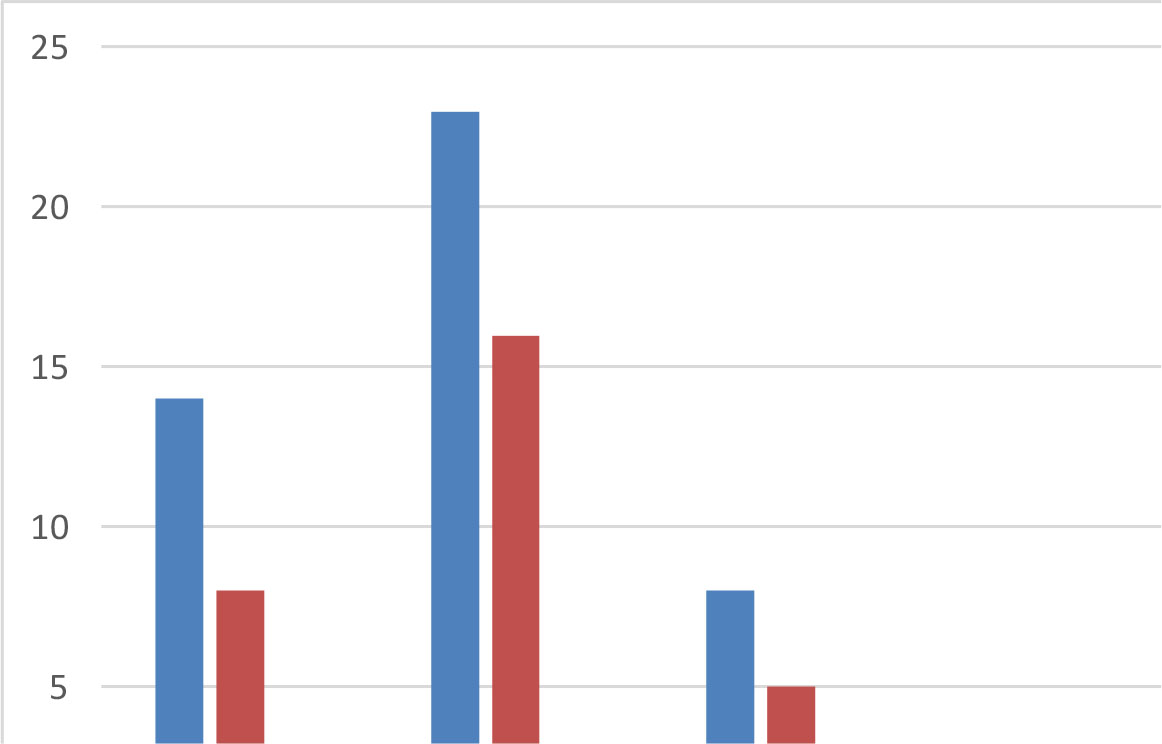
Figure 1.
Trauma scores mean values for the survivors and the deceased
By using the AUROC curve to analyse the ability of GAP, MGAP and RTS scores to predict in-hospital mortality (regardless of prevalence), comparable values with high statistical significance (p<0.001) were found at 0.890 (GAP), 0.869 (MGAP) and 0.871 (RTS). MGAP had the highest sensitivity (94), and RTS had the highest specificity (100) (Table 3, Figure 2).
Table 3.
Sensitivity and specificity for GAP, MGAP and RTS scores
| Scores | The cut-off value for predicting mortality | Sensitivity | Specificity | AUC (95% CI) | p |
|---|---|---|---|---|---|
| GAP | <11,5 | 86 | 100 | 0,890 (0,822–0,934) | <0,001 |
| MGAP | <18 | 94 | 98 | 0,869 (0,842–0,945) | <0,001 |
| RTS | <7,5 | 83 | 99 | 0,871 (0,854–0,969) | <0,001 |
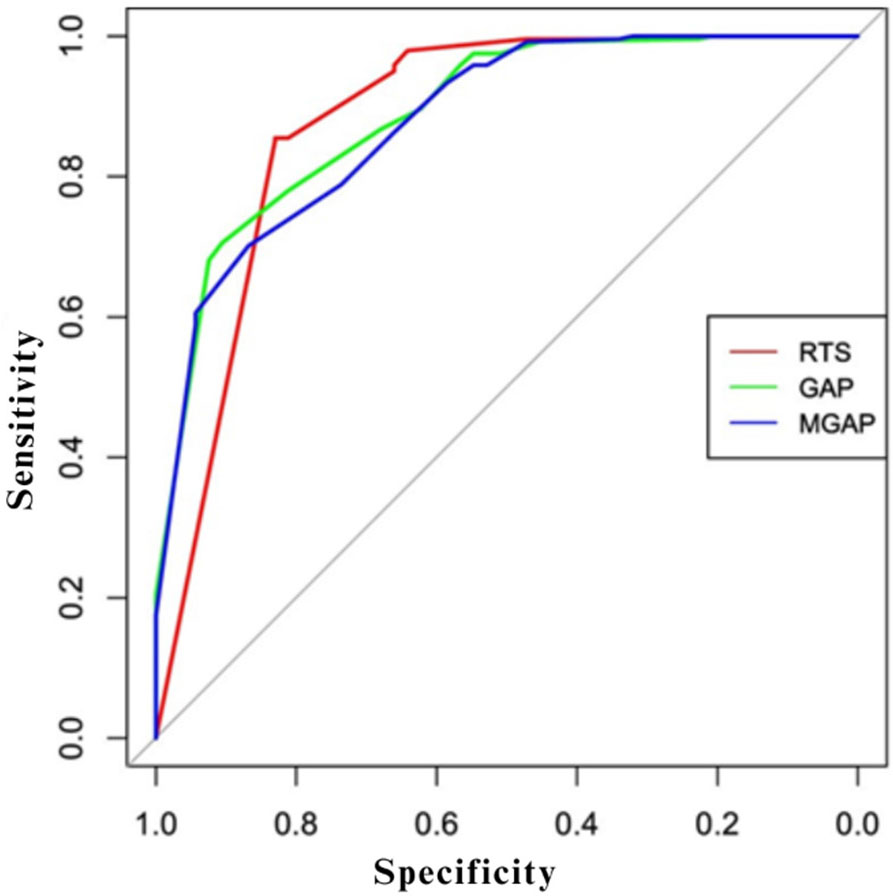
Figura 2.
AUROC values, sensitivity and specificity for GAP, MGAP and RTS scores
There was no statistically significant difference in values when using the Delong test to compare the AUROC results for GAP, MGAP and RTS scores (Table 4).
DISCUSSION
Prehospital trauma scores are valuable tools for triage in out-of-hospital settings with limited resources. The usefulness of various trauma scores for predicting the mortality of trauma patients has also been shown through clinical research (8–9). This study aimed to analyse the predictive values of GAP, MGAP and RTS scores and compare their efficacy in prehospital settings.
The results of analysing 286 trauma patients in our study revealed that the mean age of the injured was 40.3 ± 17.54 and that injuries occurred almost twice as often in men than in women (M:F 65.7%:34.3%). Literature data on this subject are not coherent. A study by Mohammed et al. (7) conducted in Egypt showed that, on average, slightly younger people were susceptible to trauma (37.12 ± 16.43), and men were four times more likely to have suffered from injuries than women. Chou et al. (12) found in a Taiwanese study that men injured themselves 1.4 times more often than women. The most common causes of injury in our study were traffic accidents (46.2%), followed by falls (31.5%), and violence as a cause was less prevalent (5.2%). These results vary significantly from indicators at the global level, where traffic accidents are represented as the cause of trauma in 23% of the cases and falls in 8% (1).
Regarding the trauma mechanism, blunt trauma was the most prevalent (66.8%) and twice as common as penetrating trauma. The calculated trauma scores in our sample have the following mean values: GAP 21.55 ± 2.89, MGAP 24.87 ± 3.22 and RTS 7.85 ± 2.22. Clinical outcome analysis revealed that 51.6% of the patients had resuscitation or emergency interventions, 69.2% required operative treatment, and 27.8% had to be admitted to the intensive care unit. The mortality rate as a result of trauma four weeks after the incident was 19.5%. The patients who had survived the first four weeks did have statistically significantly higher GAP, MGAP and RTS (p<0.001) scores initially in the pre-hospital setting. Clinical variables, such as vital signs and mechanisms of injury, were also significantly different in the survivor and deceased groups of trauma patients (p<0.001).
Previous studies have shown similar results regarding the role GAP, MGAP, and RTS scores have in preventing bad trauma outcomes. In our research, AUC values were for GAP 0.890 (CI 95% 0.822–0.934), MGAP 0.869 (CI 95% 0.842–0.945) and RTS 0.871 (CI 95% 0.854–0.969). The Delong test did not reveal a significant difference in the tested scores’ ability to predict a lethal outcome. An Egyptian study from 2022 (7) highlighted the importance of all three examined scores as predictors of poor trauma outcomes and mortality, which is particularly important in low-income countries that need more straightforward and effective trauma scores. Cassignol et al. (13) compared the values of MGAP and RTS as predictors of hospital mortality during three years in France. The AUC value for RTS was 0.84 (0.82–0.87), and for MGAP, 0.91 (0.89–0.92), which showed the advantages of MGAP as a predictor of mortality after trauma compared to RTS. Galvagno et al. (14) conducted a study which included 43.082 patients to compare the importance of RTS and MGAP scores during triage of trauma patients in prehospital settings. MGAP showed higher sensitivity and specificity than the RTS score but did not show overall superiority compared to the RTS. In our study, MGAP had the highest sensitivity, and the GAP score had the highest specificity. In a study by Bouzat et al. (15), the prehospital MGAP score had a significantly higher AUC compared to the RTS (0.93 [CI 95% 0.91–0.95] vs 0.86 [CI 95% 0.83–0.89], p<0.01). The MGAP score < 23 had a sensitivity of 88% for predicting mortality. The sensitivity for RTS < 12 was 79% (15). In a study by Jokšić et al. (16), which included 307 trauma patients, the MGAP score showed the highest sensitivity and specificity (93.4). The MGAP and GAP were highly correlated and proved statistically significant predictors of treatment outcomes in trauma patients (OR 2.23; 95% CI 1.06–4.70; p = 0.035). It was also discovered that with an increase in the value of the MGAP score by one, the probability of survival increases 2.2 times.
Research by Tirtayas and Philippi from Indonesia showed that all three scores (GAP, MGAP and RTS) have statistically the same predictive value in trauma (17). Ahun et al. found a statistically significant difference in the mean values for all three scores between the groups that survived and did not survive four weeks after injury. The sensitivity and specificity of the MGAP and GAP were significantly higher than the RTS score for predicting the 4-week survival after injury (18).
These results indicate that the MGAP and GAP scores should be used in prehospital settings and probably have an advantage over the RTS score. Their advantage lies in their simplicity and the inclusion of anatomical and physiological factors (mechanism of injury and age). Applying simple trauma scores, such as GAP, MGAP, and RTS, can assist medical emergency teams in triaging traumatised patients and determining the degree of injury severity quickly so patients can be treated and transported promptly to the Emergency Centre. Further research should aim to determine which score is the most useful predictor of poor trauma outcomes in the prehospital setting.
CONCLUSION
Trauma scores are valuable tools for triage and mortality prediction in trauma patients. The GAP, MGAP and RTS scores are significant predictors of poor trauma outcomes and mortality. It has been established that there is no difference in their predictive value. The MGAP score has anatomic-physiological characteristics and is simple, unlike the RTS score, so future research should be focused on further comparison of these scores in prehospital settings.