
Table 1.
Ointment base and H. italicum essential oil –based ointment formulations.
| Ingredient | Ointment Base (%) | Ointment HIEO (%) |
|---|---|---|
| HIEO | / | 0.50 |
| Cholesterol | 5.00 | 5.00 |
| Lanolin | 15.00 | 15.00 |
| Parafinum liquidum | 15.00 | 15.00 |
| Vaselinum album | 65.00 | ad 65.00 |
Table 2.
Organoleptic characteristics and spreadability of ointment with H. italicum essential oil after 3 and 180 days of preparation
| Parameters | 3 days | 180 days |
|---|---|---|
| Colour | Yellow | Yellow |
| Odour | Characteristic odor of the essential oil | Characteristic odor of the essential oil |
| Consistency | Semi-solid | Semi-solid |
| Homogenity | Homogeneous ointment | Homogeneous ointment |
| Spreadability | Easily | Easily |
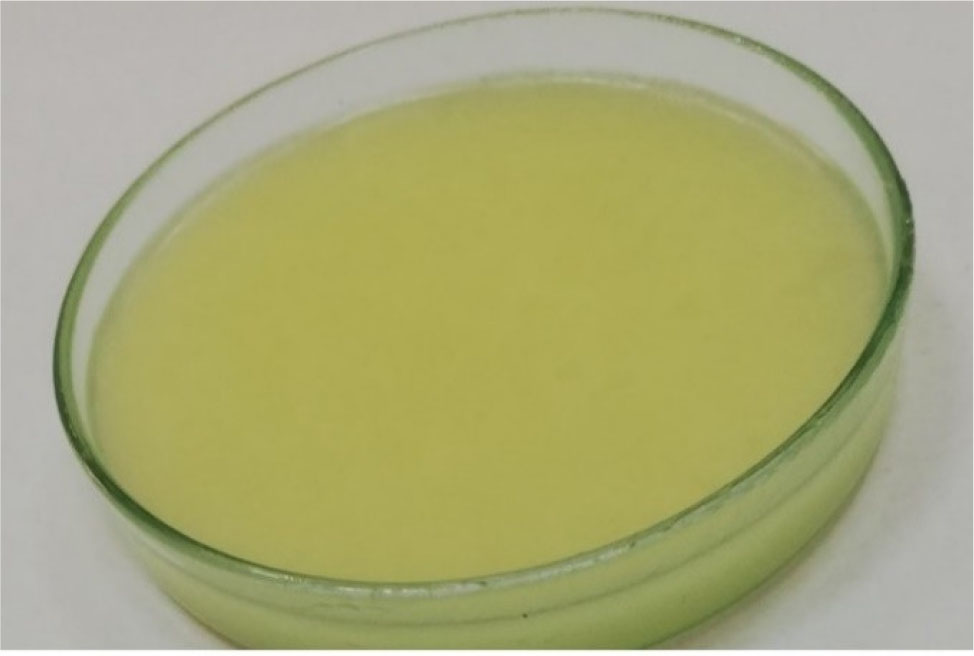
Figure 1.
Photograph of H. italicum essential oil – based ointment
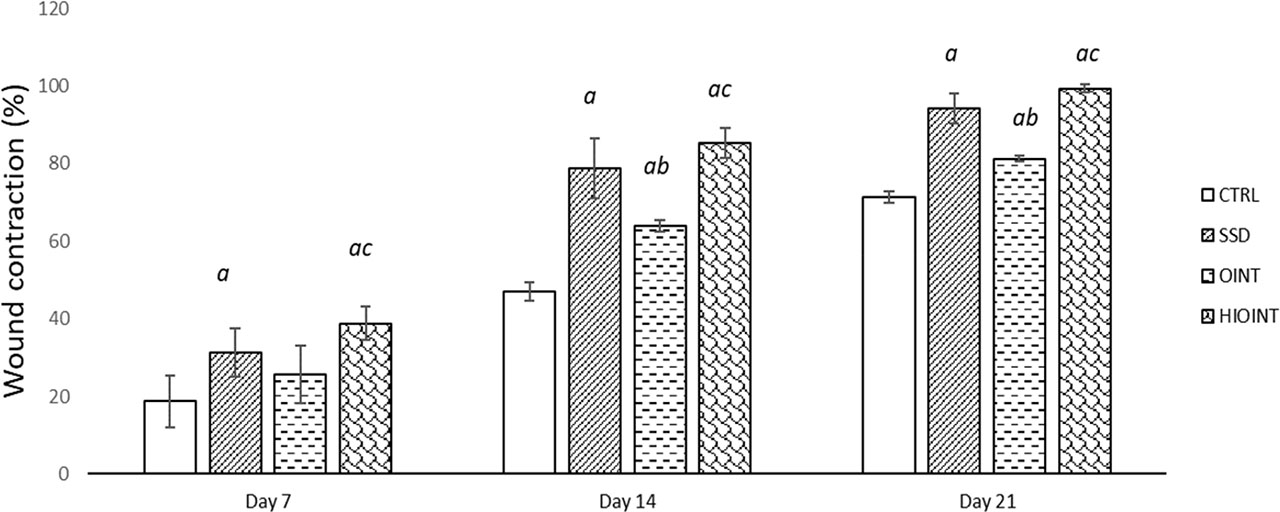
Figure 2.
Effects of applied ointments on the wound contraction.
Values are expressed as mean ± standard deviation (n = 8). a p < 0.05 compared to CTRL group; b p < 0.05 compared to SSD group; c p < 0.05 compared to OINT group; d p < 0.05 compared to HIOINT group. CTRL – control; SSD – silver sulfadiazine; OINT – ointment base; HIOINT – H. italicum ointment;
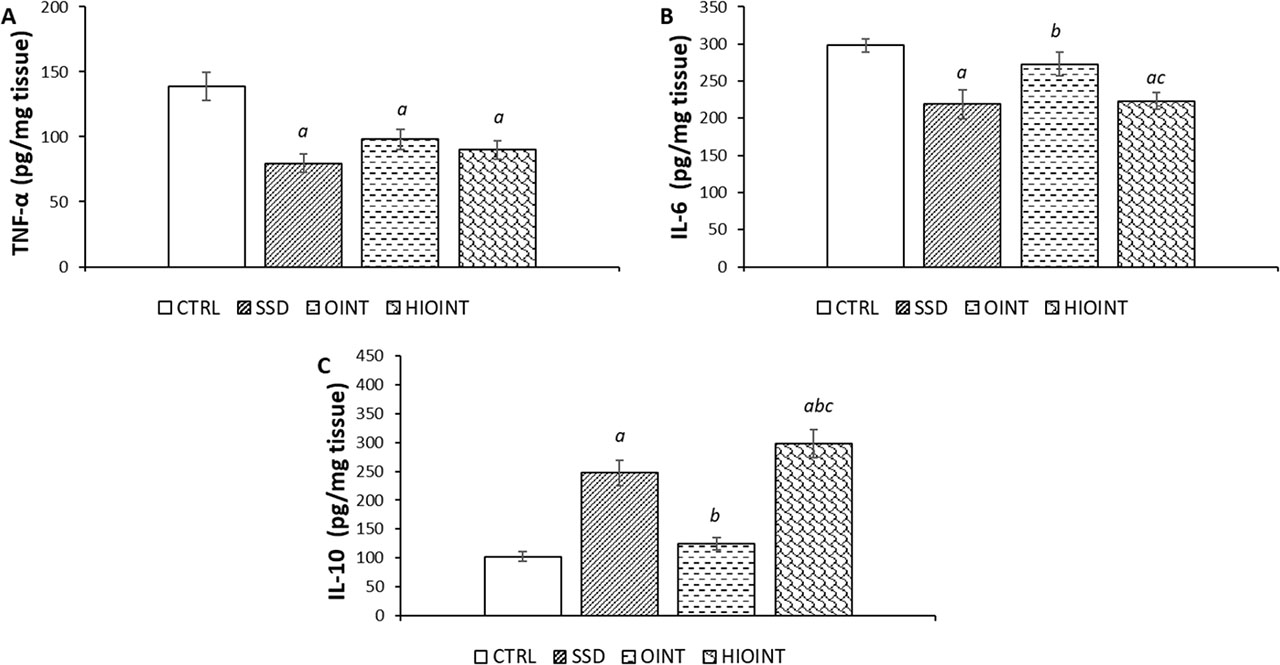
Figure 3.
Effects of applied ointments on the markers inflammation: A) TNF-α; B) IL-6; C) IL-10. Values are expressed as mean ± standard deviation (n = 8).
a p < 0.05 compared to CTRL group; b p < 0.05 compared to SSD group; c p < 0.05 compared to OINT group; d p < 0.05 compared to HIOINT group. CTRL – control; SSD – silver sulfadiazine; OINT – ointment base; HIOINT – H. italicum ointment;
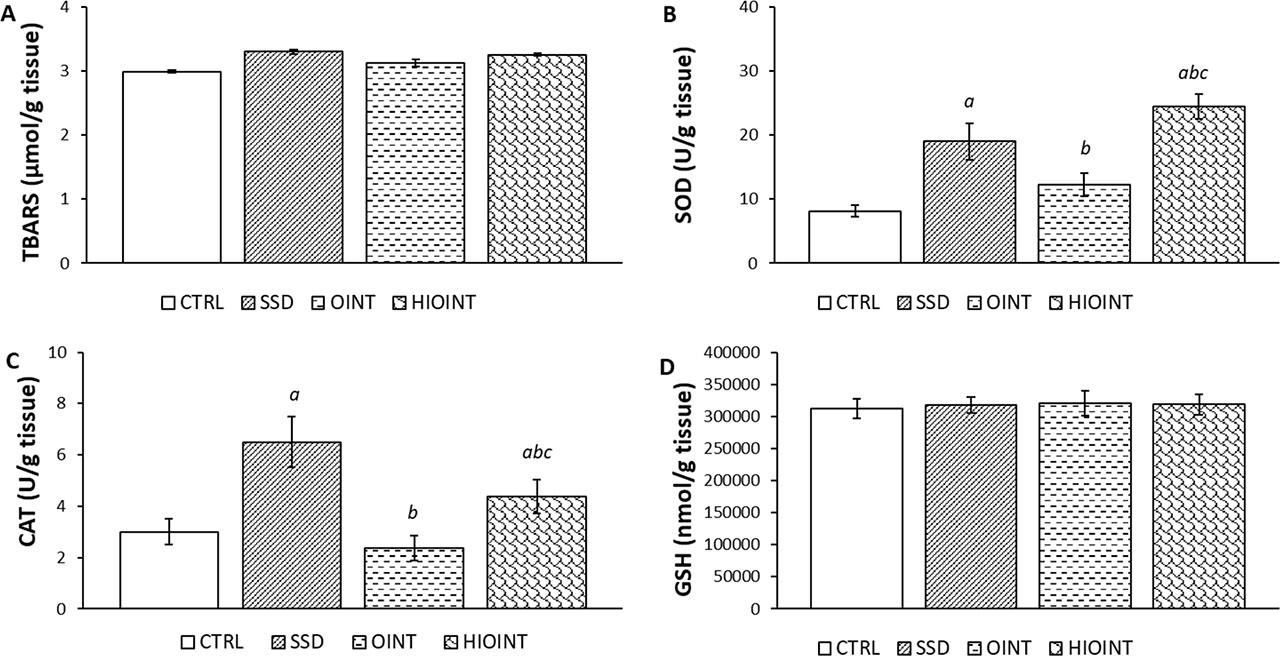
Figure 4.
Effects of applied ointments on the oxidative stress markers in wound tissue: A) TBARS; B) SOD; C) CAT; D) GSH. Values are expressed as mean ± standard deviation (n = 8).
a p < 0.05 compared to CTRL group; b p < 0.05 compared to SSD group; c p < 0.05 compared to OINT group; d p < 0.05 compared to HIOINT group. CTRL – control; SSD – silver sulfadiazine; OINT – ointment base; HIOINT – H. italicum ointment;