
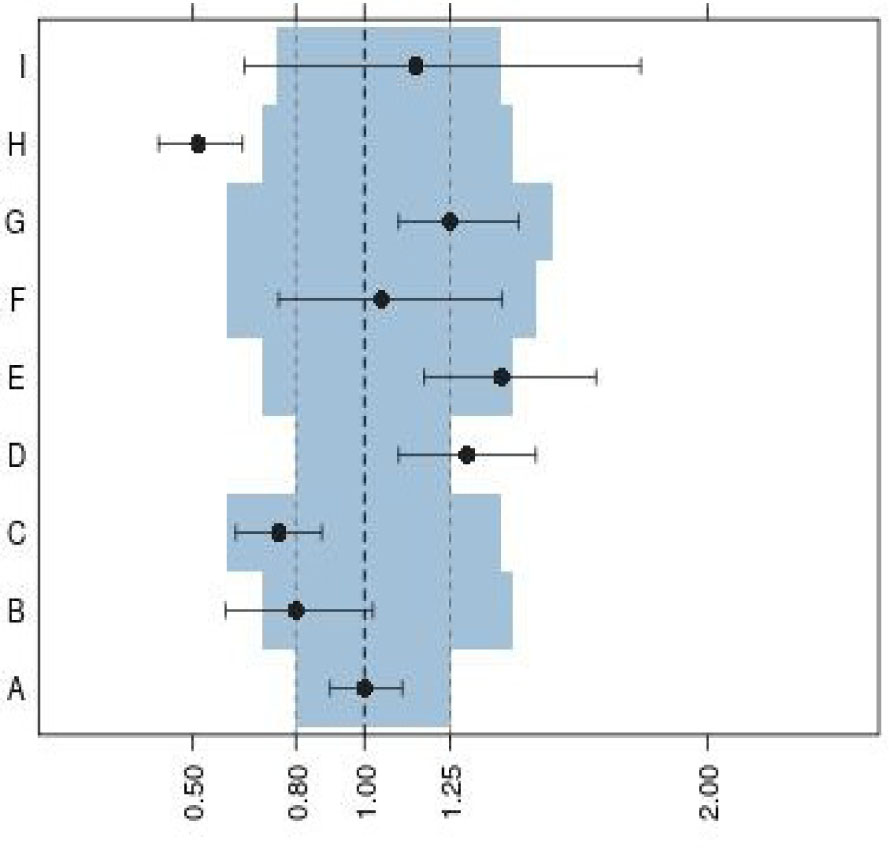
Figure 1.
Illustrated cases of the relative effect of a test item versus a reference item as provided by their geometric mean ratio (black circles) and associated 90% confidence intervals (black bars). The blue boxes show the variability of the reference item. Rows A to I illustrate different scenarios (explained further in the main text) for the value of the mean ratio and confidence interval and how they influence conclusions about the differences and equivalence of the two items.
Table 1.
Lower and upper equivalence range limits (δL and δU, respectively) for varying statistical design parameters: sample size by group (n), consumer’s risk (α), producer’s risk (β), and coefficient of variation (cv) with corresponding standard deviation (σR).
| n | α | β | cv | σR | δL | δU |
|---|---|---|---|---|---|---|
| 10 | 0.05 | 0.05 | 0.2 | 0.198 | 0.786 | 1.271 |
| 10 | 0.05 | 0.05 | 0.3 | 0.294 | 0.700 | 1.428 |
| 10 | 0.05 | 0.05 | 0.4 | 0.385 | 0.627 | 1.596 |
| 10 | 0.05 | 0.05 | 0.5 | 0.472 | 0.564 | 1.773 |
| 10 | 0.05 | 0.1 | 0.2 | 0.198 | 0.805 | 1.243 |
| 10 | 0.05 | 0.1 | 0.3 | 0.294 | 0.725 | 1.380 |
| 10 | 0.05 | 0.1 | 0.4 | 0.385 | 0.655 | 1.526 |
| 10 | 0.05 | 0.1 | 0.5 | 0.472 | 0.596 | 1.679 |
Table 2.
Lower and upper alternative equivalence range limits (δL* and δU*, respectively) for varying statistical design parameters: constant k and coefficient of variation (cv) with corresponding standard deviation (σR).
| k | cv | σR | δL* | δU* |
|---|---|---|---|---|
| 1 | 0.2 | 0.198 | 0.820 | 1.219 |
| 1 | 0.3 | 0.294 | 0.746 | 1.341 |
| 1 | 0.4 | 0.385 | 0.680 | 1.470 |
| 1 | 0.5 | 0.472 | 0.624 | 1.604 |
| 0.76 | 0.2 | 0.198 | 0.860 | 1.162 |
| 0.76 | 0.3 | 0.294 | 0.800 | 1.250 |
| 0.76 | 0.4 | 0.385 | 0.746 | 1.340 |
| 0.76 | 0.5 | 0.472 | 0.698 | 1.432 |
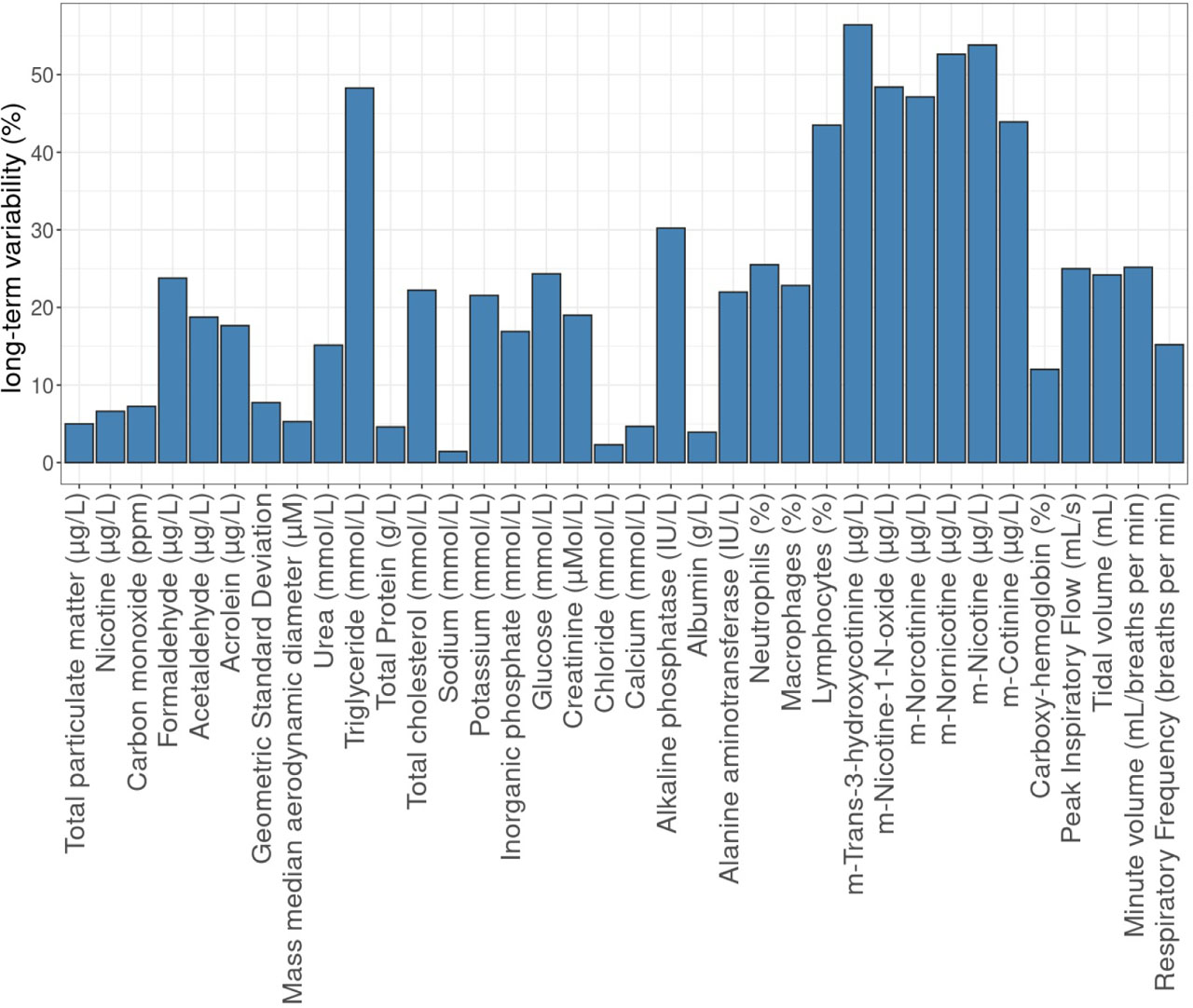
Figure 2.
Long-term variability estimates (σR) depicted in blue bars for all endpoints across the historical 3R4F data. Variability estimates are expressed in percentages.
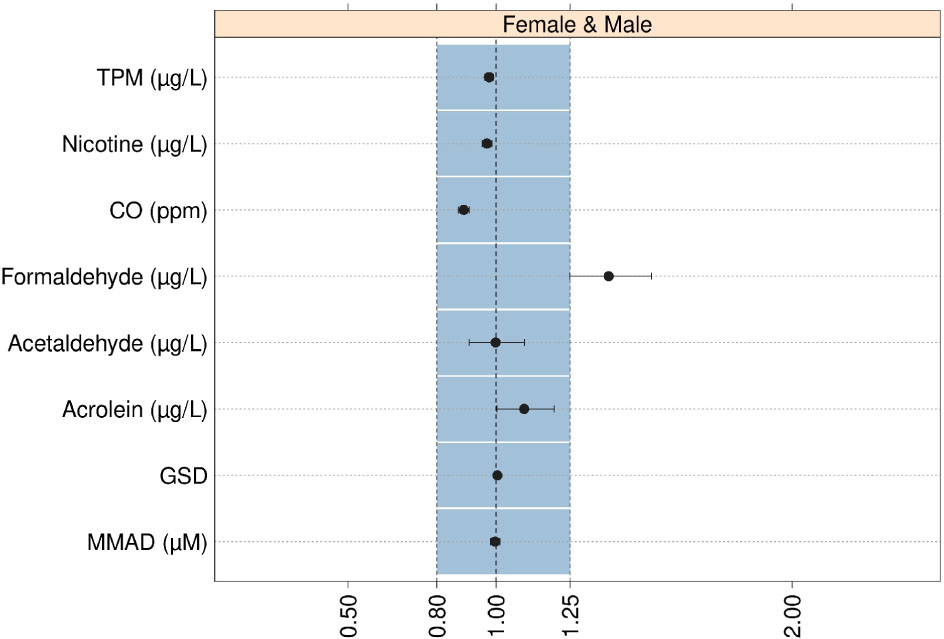
Figure 3.
Geometric mean ratio estimates (black circles) and their associated 90% confidence intervals for smoke emissions from the 1R6F reference cigarette over the 3R4F reference cigarette for test atmosphere endpoints. Blue boxes define equivalence ranges for the geometric mean ratio estimate based on the variability of 3R4F estimated using historical data. The standard equivalence limits of 0.8 and 1.25 and the reference value of 1 are shown (black dashed lines). TPM: Total Particulate Matter, CO: Carbon monoxide, GSD: Geometric Standard Deviation and MMAD: Mass Median Aerodynamic Diameter.
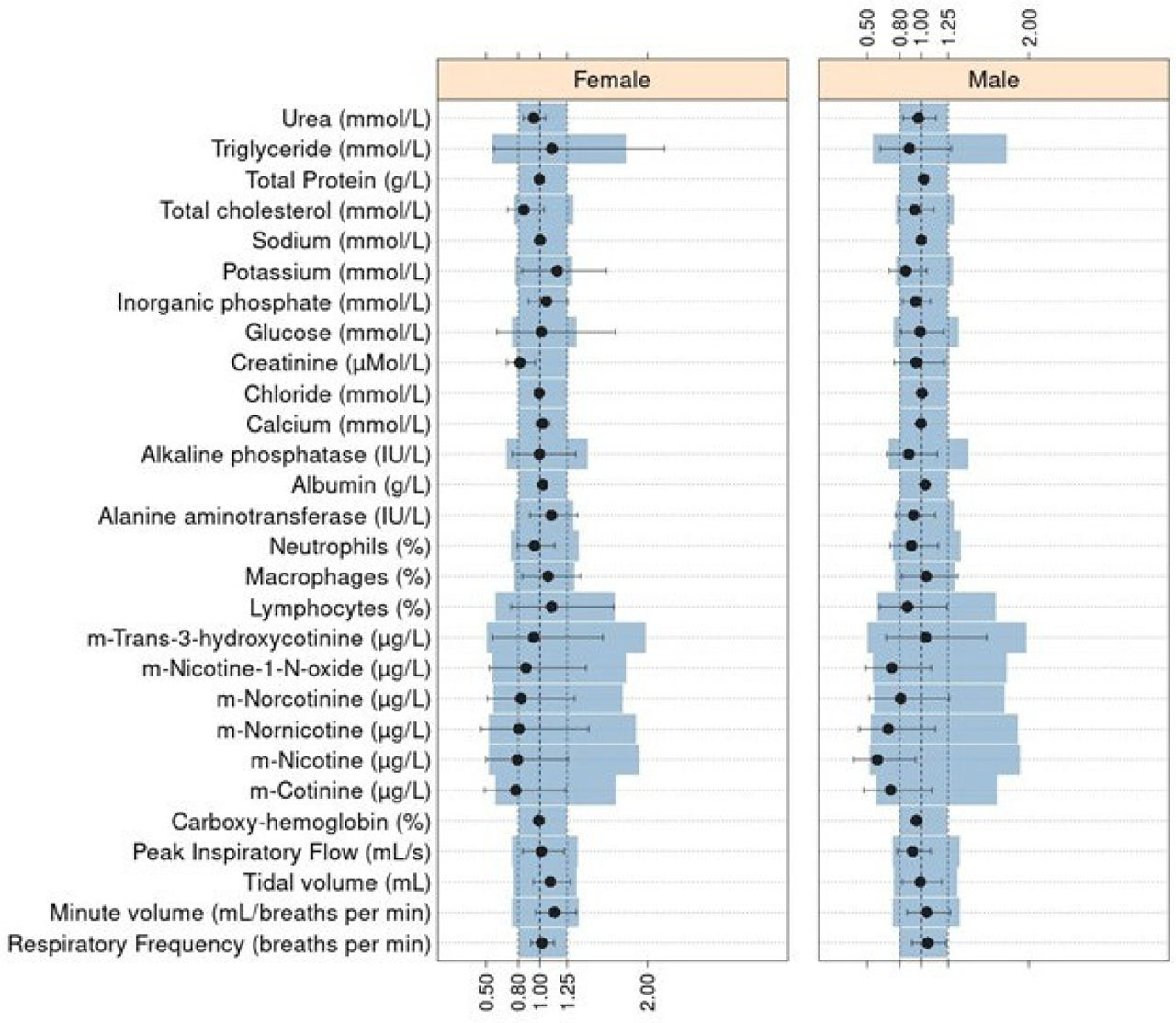
Figure 4.
Geometric mean ratio estimates (black circles) and their associated 90% confidence intervals for smoke from the 1R6F reference cigarette over the 3R4F reference cigarette for female (left panel) and male (right panel) rats across all endpoints related to (from bottom to top): respiratory physiology, exposure, urinary nicotine metabolites, and clinical chemistry. Blue boxes define equivalence ranges for the geometric mean ratio as estimated based on the variability of 3R4F estimated using historical data. The standard equivalence limits of 0.8 and 1.25 and the reference value of 1 are shown (black dashed lines).