
INTRODUCTION
The process of smoking a cigarette comprises many complex behaviors, with factors such as puff frequency, puff volume, and depth of inhalation displaying high variability between individuals (1). Together with many other parameters, such smoking characteristics are referred to as “smoking behaviors”. Thus, smoking behaviors are actions, that are taken by an individual and are associated with the burning of the tobacco rod and inhalation of the tobacco smoke generated. These behaviors have been researched and evaluated to complement the assessment of exposure to tobacco smoke under standardized machine smoking conditions.
In recent years, the tobacco and nicotine industry has significantly expanded its product offerings. In addition to traditional tobacco products such as cigarettes, the market now includes a variety of novel products, such as e-vapor products (commonly known as “e-cigarettes”), heated tobacco products (HTP), and nicotine pouches. Each one of these new product categories is associated with their own unique use behaviors that could differ from the behaviors measured and characterized in people who smoke.
Therefore, during the last decade, with the emergence of novel tobacco- and/or nicotine-containing products (TNPs), smoking behavior research has been broadened to cover these novel products and is referred to as “product use behavior” research. Numerous scientific papers have been published, describing/reporting the behavior of consumers using these products and assessing the potential health risks associated with their usage. Examples of these products and their associated descriptions are:
Heated tobacco product (HTP) (2,3,4,5):
Product containing a tobacco substrate that is designed to be heated with an electrical heating device or by a separate source (e.g., warmed aerosol, generated by drawing air through smoldering carbon) to produce an inhalable aerosol, rather than being combusted. This product category is currently marketed in a growing number of countries. Regulatory agencies, researchers, and manufacturers use a variety of terms and acronyms to describe the products, such as non-combusted cigarette (6), tobacco heating product (THP) (7), tobacco heating system (THS) (8), (novel) tobacco vapor product (NTV or TVP) (9), and heat-not-burn tobacco product (HnB) (10).
E-vapor product (2):
Product not containing tobacco that is designed to electrically heat a liquid (may also be called an e-liquid), which usually contains nicotine, propylene glycol, and/or glycerol, to produce an inhalable aerosol. Regulatory agencies, researchers, and manufacturers use a variety of terms and acronyms to describe this product category, such as electronic cigarette (e-cigarette or e-cig) (5,11,12,13), vape (14), vapor product (15), and electrical nicotine delivery system (ENDS) (16,17). Moreover, they come in many shapes, sizes, and open or closed device types (e.g., cig-a-like, pen, tank, mod) (14).
Nicotine pouch (18):
Pre-portioned, non-pharmaceutical product containing nicotine, but not tobacco. It is exclusively intended for oral use with nicotine uptake occurring across the oral mucosa. This innovative product category is popular in Sweden and the U.S. and is gaining acceptance in other countries. Regulatory agencies, researchers, and manufacturers use a variety of terms to describe this product category, such as oral tobacco derived nicotine product (OTDN) (2), nicotine-containing tobacco-free oral product (19), modern oral product (MOP) (20), and tobacco-free nicotine pouch (21).
In 2004, Baker et al. pointed out that terms related to smoking behavior were not used consistently in various papers and proposed terms and their definition for the first time (22). In 2013, Gregg et al. published a set of terms and definitions to describe both smoking behavior and tobacco smoke exposure in relation to conventional cigarettes (23). Over recent years, the expanded TNP portfolio, as described above (HTP, e-vapor product, and nicotine pouch), has led to challenges with respect to the diverse range of terminologies used to describe these products and their associated behaviors in the scientific literature. Researchers and regulatory agencies may use varying terms to refer to similar aspects, potentially leading to confusion and hindering communication within the field.
To address this issue, the purpose of this paper is to summarize a standard set of terms and methods for describing product use behavior and exposure related to these novel TNPs. By clarifying terminology including synonyms, scientists working in this field can communicate more effectively, share findings, and ensure consistency in research methodologies.
By providing clear and concise definitions of terms like “product use behavior” (which may encompass consumption, frequency, duration, and patterns of usage), “product exposure” (referring to the intake of constituents from the products and uptake into a human body), and other relevant concepts (e.g., the term ‘biomarkers’ is used to describe one of the major approaches to quantify uptake of constituents into the human body), this paper aims to promote a shared understanding among researchers and facilitate collaborative efforts in addressing the public health implications of these products.
Although other novel products, such as nicotine-free e-vapor products and cannabis containing products, have also been introduced to the market, this technical document focuses on TNPs as defined above.
TERMINOLOGY
A list of the terms included in this paper, along with common synonyms, definitions etc., is shown in Table 1 (updating the list from Gregg et al. (23)). The terms are divided into two categories: ‘Product use behavior’ and ‘Biomarkers’. The terms related to “Puffing topography” are listed as a subset of product use behavior. For each term, units of measurement are provided typically with an example of the term and a comment on the method of measurement or its application.
Table 1.
Definition of terms, units, and comments.
| No. | Term | Definition | Units and methods | Example and comment |
|---|---|---|---|---|
| Product use behavior | ||||
| 1 | Daily product consumption | The number or amount of consumables used per day |
| |
| 2 | Pack years (PY) | The number of packs smoked in a day multiplied by the number of years spent smoking |
|
|
| 3 | Exposure dose | The exposure dose is the amount of a specified constituent present in the external medium (such as air, water, tobacco smoke, aerosol, extraction, food) that is deposited or absorbed in the body of an exposed individual over a specific duration. |
|
|
| 4 | Puffing topography / Puffing pattern | The profile of puff characteristics including puff frequency, duration, volume, interval, and regularity of these parameters for an inhalable TNP |
|
(see Figure 1) |
| 13 | Puff flow rate / Flow rate | The volumetric flow rate of puff from an inhalable TNP |
|
|
| 14 | Draw pressure / Puff pressure / Puff draw pressure | The mouth-end pressure (vacuum) recorded per individual puff from an inhalable TNP |
|
|
| 15 | Draw resistance | The ratio of draw pressure to puff flow rate per individual puff from an inhalable TNP |
|
|
| 16 | Duration of product use / Total session length | The total time elapsed from the start of the first puff to the end of the last puff of an inhalable TNP |
| |
| 17 | Total puff duration | The cumulative time for all puffs from an inhalable TNP |
| |
| 18 | Smolder time / Total puff interval |
|
| |
| 19 | Product use topography | The complete pattern using an inhalable TNP, including puffing, mouth hold, inhalation, and exhalation |
| (See Figure 2) |
| 20 | Mouth hold time | The time over which a puff is held in the oral cavity before inhalation or exhalation for an inhalable TNP The time placed between the gum and the lip (upper lip or cheek/jaw) for an oral TNP |
| |
| 21 | Mouth spill (MSp) | The amount or fraction of smoke, aerosol, or constituent that is spilt from the mouth after puffing and not inhaled by an inhalable TNP user |
| |
| 22 | Inhalation | The act of moving puffed smoke/aerosol from the mouth into the trachea and respiratory space of an inhalable TNP user | See ‘Inhalation duration’ and ‘Inhalation volume’ | |
| 23 | Inhalation duration | The time from start of inhalation until start of exhalation phase of the breathing cycle | ||
| 24 | Inhalation volume / Inhalation depth | The volume of inspiration into trachea and respiratory space | ||
| 25 | Exhalation | The act of expelling inhaled and puffed smoke/aerosol from the respiratory space and mouth or nasal passages of an inhalable TNP user | See ‘Exhalation duration’ and ‘Exhalation volume’ | |
| 26 | Exhalation duration | The time from end of inhalation until the end of the exhalation phase of the breathing cycle |
| |
| 27 | Exhalation volume | The volume of exhaled breath from the respiratory space after a puff and inhalation of an inhalable TNP | ||
| 28 | Machine-derived yield / Machine yield | The amount of delivered smoke or aerosol constituents from the inhalable TNP under machine smoking/vaping conditions at a specified regime, e.g., ISO, Health Canada (2,15,102,103,104) |
|
|
| 29 | Mouth level exposure (MLE) / Yield in-use (YIU) / Intake |
|
| |
| 30 | Retention / Pulmonary retention | The difference between the amount of smoke or aerosol constituent inhaled and the amount of exhaled constituent over subsequent breathing cycles |
| |
| 31 | Uptake / Amount absorbed | The amount of smoke, aerosol or extracted constituent which is absorbed into a human body through the mucosa of the mouth, respiratory tract, and lung |
|
|
| Biomarker | ||||
| 32 | Biomarker of exposure (BOE) |
|
|
|
| 33 | Biologically effective dose (BED) |
|
| |
| 34 | Biomarker of risk / Biomarker of potential harm (BOPH) | The measurement of a biological impact/effect due to exposure; these include early biological effects, such as oxidative stress, platelet activation, and inflammation |
|
|
In Table 1, most examples are given in relation to inhalable products because they are the most widely researched and form the vast majority of scientific publications on product use behavior and exposure.
DISCUSSION
Product use status
Based on consensus within the research community (24,25,26), throughout the report, we adopt the use of person-first language (e.g., “people who smoke”) rather than commonly used labels (e.g., “smokers”) to promote greater respect and convey dignity for people. It has been suggested that the use of precise and bias-free language to describe people who use TNPs has the potential to reduce tobacco-related stigma and may enhance the precision of scientific communication (26).
The conventional cigarette smoking status of research participants is commonly described by three categories: Participants who currently smoke (CS; previously termed current smokers), participants who have formerly smoked (FS; previously termed former smokers), and participants who have never smoked (NS; previously termed never smokers). There are several ways to question or survey participants about smoking status, based on lifetime, past, and current use. Therefore, the operational definitions of “CS”, “FS”, and “NS” may vary depending on the objective of a given questionnaire. Although the definitions of active smoking status have not been fully standardized, the definition of people who are established smoking can be based on the total number of cigarettes smoked in the respondent's lifetime (e.g., “Have you smoked 100 cigarettes in your lifetime”) and in a question about status in a specified time period (e.g., “currently”, “past 12 months”, or “past 30 days”) and/or frequency of smoking (e.g., “some days” or “every day”) (27,28,29,30,31). In addition, some different definitions of FS can be found based on the amount of time that has passed since a person has quit smoking (27,28,29,30,31).
In contrast, lifetime use criteria to describe other TNP categories are less definitive (32,33,34,35,36). Several definitions can be found in the literature. For example, in the Population Assessment of Tobacco and Health (PATH) Study (31), e-vapor product use status among the adult population is assessed by asking the following questions (Q1: Have you ever used e-cigarettes, even one or two puffs? (Yes / No), Q2: Have you used e-cigarettes fairly regularly? (Yes / No), and Q3: Do you now use e-cigarettes? (Every day / Some days / Not at all)), without a lifetime threshold question (31). Moreover, currently, there are no established definitions for use status concerning HTP and nicotine pouches. Consequently, researchers often resort to using definitions based on cigarette smoking or e-vapor product use as proxies when studying the use status of these novel products.
The number of different types of TNPs on the market is increasing, and concurrent use of two or more products is now found in a subgroup of people (37, 38). Most evidence-based literature commonly refers to those who use both novel TNPs and conventional cigarettes as “dual users”; whereas those who use more than three products are referred to as “poly users” (39,40,41,42,43). These terms refer to individuals who engage in a wide range of hybrid use patterns of novel TNPs and conventional cigarettes. For example, Borland et al. published a categorization of “dual use” as four types of concurrent use: 1) predominant smokers (daily smokers with non-daily vaping); 2) dual users (daily use of both products); 3) predominant vapers (daily vapers and non-daily smokers); and 4) non-daily concurrent users (non-daily use of both) based on the frequency of use of both conventional cigarettes and e-vapor products (44).
This variability in definition makes it difficult both to compare results across studies and to understand what the patterns mean, but considering the frequency of use of both novel TNPs and conventional cigarettes is important in understanding the implications of different patterns of concurrent use. Those who use only one of the novel TNPs or who use only conventional cigarettes are referred to as exclusive or single users (39,40,41,42,43,44). We advocate that these terms should also be modified to accommodate people's first language.
As the popularity and availability of HTP, e-vapor products, and nicotine pouches continues to grow among adults who smoke, the need for specific definitions and measurement methods for their use prevalence becomes increasingly critical. Developing tailored and precise definitions will enable researchers and policymakers to gain a more accurate understanding of the impact of novel TNPs on public health, identify potential risks, and implement targeted interventions and bring consistency to the evidence generations.
Inhalable products
Use behavior
During a single usage of inhalable products, use behavior primarily consists of three repeating steps (45,46,47):
drawing out the smoke or aerosol from the product to the mouth (called “puffing”),
inhaling the smoke or aerosol from the mouth into the trachea and respiratory space with air dilution (called “inhalation”), and
expelling inhaled and puffed constituents from the respiratory space and mouth or nasal passages (called “exhalation”).
In addition, there may be mouth-hold and breath-hold involved, depending on the individual.
Portable puff recording instruments
A number of researchers have reported use of portable instruments (e.g., CReSS, SPA-M) to record puffing topography measurements of inhalable products (47,48,49,50). Typically, these devices measure parameters of puffing topography such as puff number, puff duration, puff volume, and puff interval.
Measurement of puffing topography of inhalable products has been widely researched; however, these studies are technically difficult and product use parameters are less well defined for e-vapor products compared to conventional cigarettes. For instance, when smoking a conventional cigarette, certain factors like the number of puffs and the puff interval are relatively straightforward to define and measure. The conventional cigarette is consumed in a short time frame with a well-defined start (lighting-up and taking the first puff) and end (burning down to a certain length). Many HTPs are also consumed in a short time frame, with certain limits on the number of puffs and/or duration of heater activation after the HTP device's heating system is turned on. For e-vapor products, however, the usage pattern in particular “session length” is not as easily defined. People who use e-vapor products have the flexibility to use and puff on a single consumable component, such as a cartridge filled with e-liquid, intermittently throughout the day (51, 52). This means that the number of puffs taken in a single use session might vary widely among people and circumstance. The variability in use behavior and the lack of precise definitions for parameters like the number of puffs with highly variable session lengths, present challenges for researchers attempting to compare e-vapor product use behavior with conventional cigarette smoking behavior. Beyond understanding the single use behavior of e-vapor product, recent studies have begun to explore e-vapor product use behaviors in real-world settings with new instruments or technologies (e.g., video monitoring, product with built-in topography measurement capability) that collect puffing topography data over time, including number of puffs per day, number of sessions per day, and distribution of puffs in the day (50, 52,53,54,55).
Puffing topography instruments are not capable of measuring behavior parameters such as mouth hold, mouth spill or any parameters associated with inhalation. Therefore, puffing topography parameters only give an estimate of human smoking/vaping yield, but do not elucidate an entire product use behavior cycle. As noted above, there is no direct relationship between puffing parameters and subsequent inhalation, and therefore, measurements of inhalation and exhalation are also required to complete the product use behavior cycle (56,57,58). Despite these limitations, portable puffing topography instruments are extremely useful in field studies (i.e., away from a laboratory environment) and can be used easily in cross-sectional studies. Portable topography instruments measure several parameters of human smoking/vaping and produce data more rapidly than those obtained with more-labor intensive, laboratory-based, puffing duplication techniques (59). In addition, product use behavior is affected by the setting of the investigation (59) and the use of a portable instrument in an ambulatory setting may allow a product user to interact with a consumable in a more ‘real world’ rather than laboratory environment.
Annotated graphics showing how some of the terms described above relate to a typical puffing topography profile and a typical product use topography profile are shown in Figures 1 and 2.
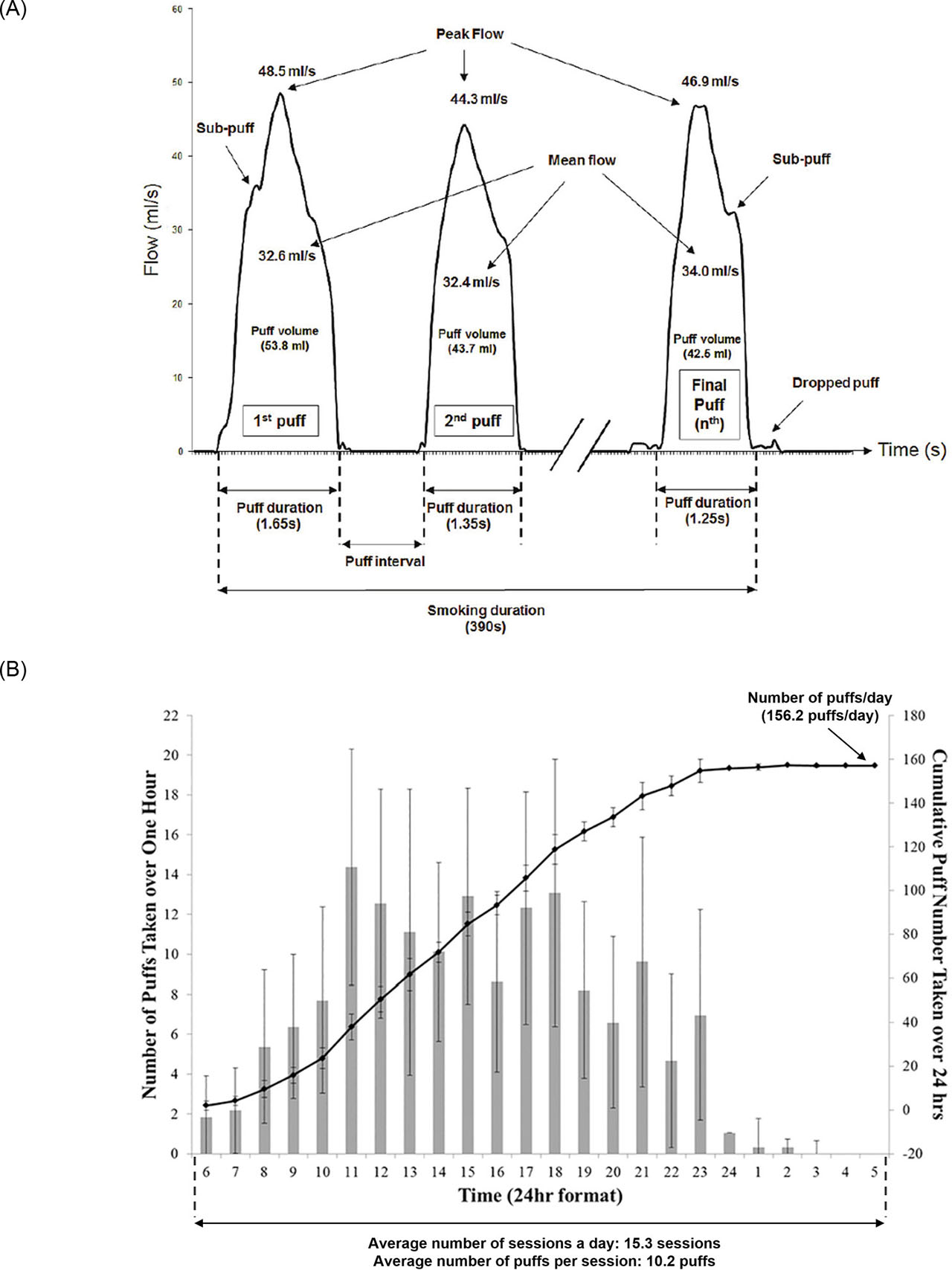
Figure 1.
Examples of (A) topography trace of single use of TNP (reprinted from Gregg et al. 2013 (23)), and (B) puff number trace of TNP use throughout the course of a day (modified from Kosmider et al. 2018 (115)).
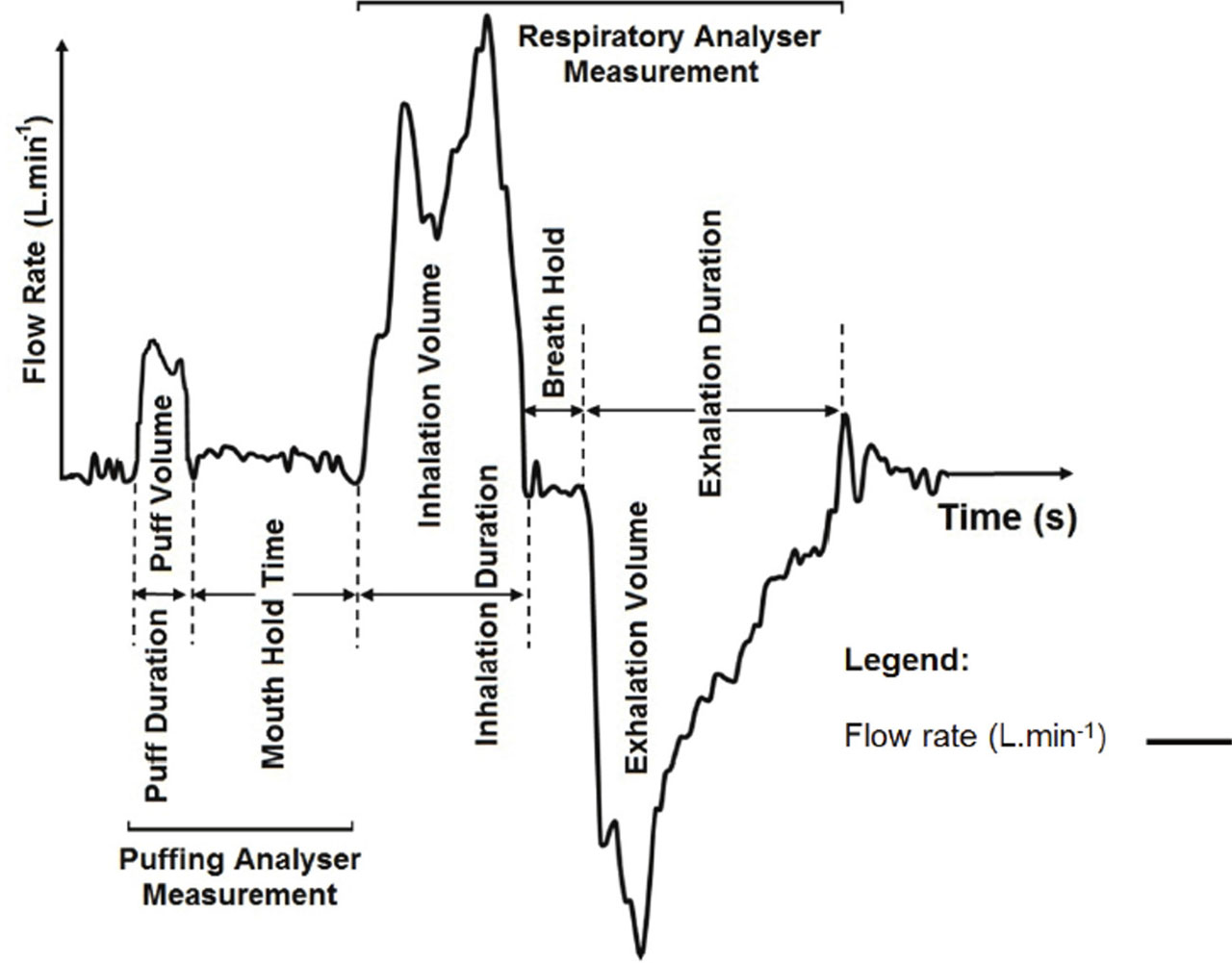
Figure 2.
An example of product use topography trace (Source: Vas et al. 2015 (109)). This profile was captured with a Smoking Behaviour System (SBS). A SBS is a novel system with regard to its capability to measure flow and duration characteristics of typical smoking cycles, which may provide a real-time profile of the flow and duration of puffing, post-puff inhalation and exhalation topography, thereby capturing the complete smoking cycle behavior at a resolution of 25 Hz.
Intake, uptake, and retention
Regarding inhalable products, the terms intake, uptake, and retention and their definitions cover subtly different aspects of exposure to smoke or aerosol. For intake, the definition refers to the amount of smoke or aerosol constituent that is delivered into the mouth and enters the body through the respiratory tract. The approach of other research disciplines, such as risk assessment (60,61,62), defines intake as the maximum exposure prior to an absorption step, which is consistent with the definition used in this report. Even if the smoke or aerosol is expelled from the mouth immediately after puffing, a portion of the amount of any smoke or aerosol constituent may be retained in the oral cavity. In a similar manner, if there is an inhalation step followed by exhalation, a large portion of any smoke or aerosol constituent may be retained in the respiratory tract. Such constituent retention may occur by several processes: for example, particle deposition onto a mucosal surface or by absorption into the tissue or the bloodstream (47). Uptake is used to define the absorption of smoke or aerosol constituents into the human body, which is distinct from retention. For some smoke or aerosol constituents, such as nicotine, retention and uptake can be practically identical (62, 63). The topic of retention has been considered in more detal in a review by Baker and Dixon (46).
Oral Products
Use behavior
The use of nicotine pouches does not involve inhalation. These products are generally placed between the gum and the lip (upper lip or cheek/jaw) for a flexible period of time (referred to as mouth-hold time), e.g., 30–60 min as guided by the product use instructions (64).
Intake, uptake, and retention
Regarding nicotine pouches, uptake has been assessed by measuring the difference in the amount of nicotine that can be extracted from the product before and after use. Several studies have indicated that the extraction yields of nicotine from nicotine pouches appears to be greater than the extraction of nicotine from traditional tobacco containing oral products; 50–60% on average over 60 min compared with 33% on average from snus (65,66,67).
Biomarkers
Biomarkers play an important role in assessing product use behavior and exposure including an assessment of exposure to smoke constituents (called “biomarkers of exposure”) and investigation of their potential health risk (called “biomarkers of effect” or “biomarkers of potential harm”) (23, 68,69,70). A biomarker of exposure is defined as a “chemical, or its metabolite, or the product of an interaction between a chemical and some target molecule or cell, that is measured in a compartment in an organism” (69, 71). The measurement of biomarkers of exposure has become one of the major approaches to quantify human exposure to constituents in smoke, aerosol, or product within clinical studies for the evaluation of novel TNPs (72,73,74,75).
The use of biomarkers for constituent exposure assessment is not straightforward for several reasons. First, the biomarker chosen should be either the constituent of interest itself or, preferably, a well-characterized metabolite. If such a biomarker is available, the degree of polymorphism within the metabolic pathway should also be understood, as fast- and slow-metabolizers of the constituent could give different biomarker measurements in body fluids due to the differences in ADME (absorption, distribution, metabolism, and excretion) following similar exposure or due to the differences in product use behavior when using the same TNPs. Genetic polymorphisms are known to cause inter-individual differences in nicotine metabolism. Therefore, in the case of estimating nicotine uptake, the parent molecule plus five (or in certain cases up to nine) metabolites are typically measured (76, 77), to take into account the polymorphism within the metabolic pathway. Second, the assays used for biomarker measurement should be fully validated in line with recognized international guidelines on bioanalytical method validation. As of May 2022, the International Council for Harmonization (ICH) finalized Guideline M10 on bioanalytical method validation and study sample analysis. Guideline M10 harmonizes existing guidelines used in many ICH affiliated countries (78) and is currently being implemented (e.g., implemented in the U.S. (79) and Europe (80)). Well-characterized reference standard materials are crucial to ensure valid bioanalytical assay measurements. The characterization of the reference standard will be documented in a certificate of analysis providing information about the identity and the purity of the substance (81). In addition, to monitor the accuracy of assays over time, inter-laboratory comparisons and participation in ring trials are encouraged. Thirdly, the availability of a biomarker and an associated assay does not automatically qualify this biomarker for all uses.
Another aspect of biomarker measurement is the method used to collect the sample. Biomarkers of exposure are often measured either by determining urinary excretion of constituents or metabolites (68–69, 71). For those biomarkers measured in the urine, 24-h urine collection is considered the “gold standard” sample collection technique for assessing exposure, because it estimates the “total daily exposure” or area under the concentration-time curve, which is particularly important since the time of product use throughout the day is not fixed and can be highly variable. However, the 24-h urine collection method has its limitations, especially in ambulatory clinical studies and observational studies (e.g., incomplete collection of 24-h urine samples due to procedural errors). It has been reported that spot urine collection, especially early morning spot urine (first void in the morning) adjusted for creatinine, has good potential to serve as a satisfactory substitute for 24-h urine collection for investigating relative differences in exposure to different products (82, 83). Spot urine concentrations are usually normalized to account for varying dilutions of the urine. Adjustment for urinary creatinine is commonly applied, albeit other methods like specific gravity or conductivity may be applicable as well (84). A biomarker of exposure should be specific for assessing the use of one TNP type compared to smoking and/or non-use. This issue was discussed in detail in Gregg et al. for conventional cigarettes (23). In recent clinical studies for novel TNPs, a similar selection of biomarkers of exposure to selected smoke constituents, listed as HPHCs (harmful or potentially harmful components), has been widely assessed (85,86,87). In order to demonstrate that novel TNPs reduce exposure to smoke constituents, biomarker assessment may focus on measuring changes in the levels of biomarkers of exposure when switching from conventional cigarette to the novel TNPs (72). Additionally, the identification and measurement of biomarkers specific to exposure to one product/category, such as the biomarker of exposure to propylene glycol in adults who use e-vapor product (88), allows for a more robust risk assessment of these products.
In this technical document, we have deliberately limited our description of biomarkers to those concerned with human exposure to constituents in smoke, aerosol, or product. Biomarkers of risk or potential harm have been defined as “biomarkers that indicate a risk factor for a disease” (89). The World Health Organization has recommended the use of the biomarkers to assess potential long-term harmful effects that are otherwise difficult to observe in short-term controlled trials or prospective studies (90). Although clinical outcomes such as cancer, cardiovascular disease (CVD), and chronic obstructive pulmonary disease (COPD) are smoking-related diseases (91,92,93), they take decades to develop and thus are not practical to assess in the short term. The 2010 Surgeon General's Report has reported that cigarette smoking is associated with a chronic inflammatory state and elevates levels of biomarkers of inflammation, well known powerful predictors of cardiovascular events (94). Therefore, assessing biomarkers related to inflammation, oxidative stress, and other conditions, has become one of the major approaches to investigate the biological changes that may indicate a change in long-term disease risk within clinical studies for the evaluation of novel TNPs relative to conventional cigarettes (70, 95).
ACKNOWLEDGMENTS
This publication is the work product of a cross-industry work item commissioned by the Cooperation Centre for Scientific Research Relative to Tobacco (CORESTA) Product Use Behaviour and Biomarkers Sub-Groups. The authors express their thanks to all participants at the CORESTA Product Use Behaviour and Biomarkers Sub-Group meetings for discussion of this manuscript.