
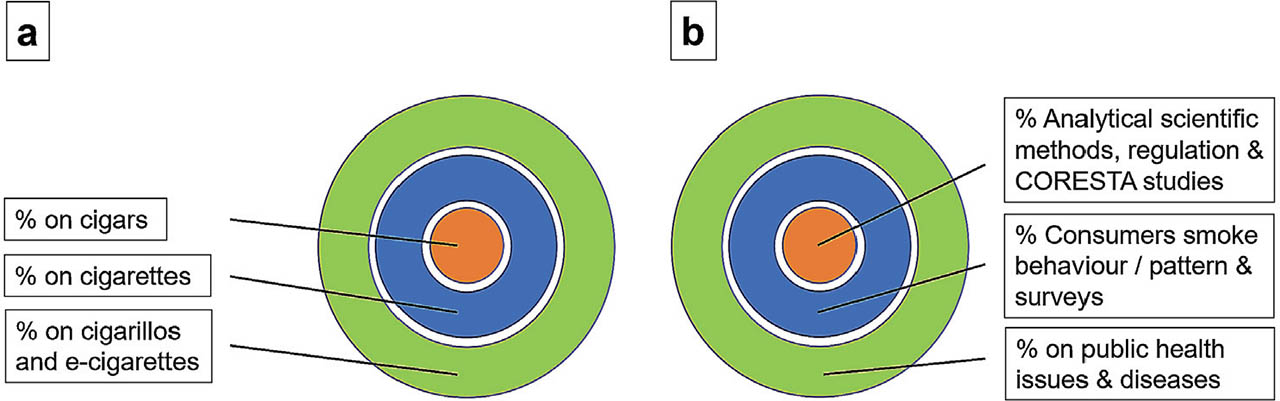
Figure 1
Statistical hierarchy of review method findings based on (a) general tobacco literature search and (b) cigar science literature search for about 1100 peer reviewed publications.
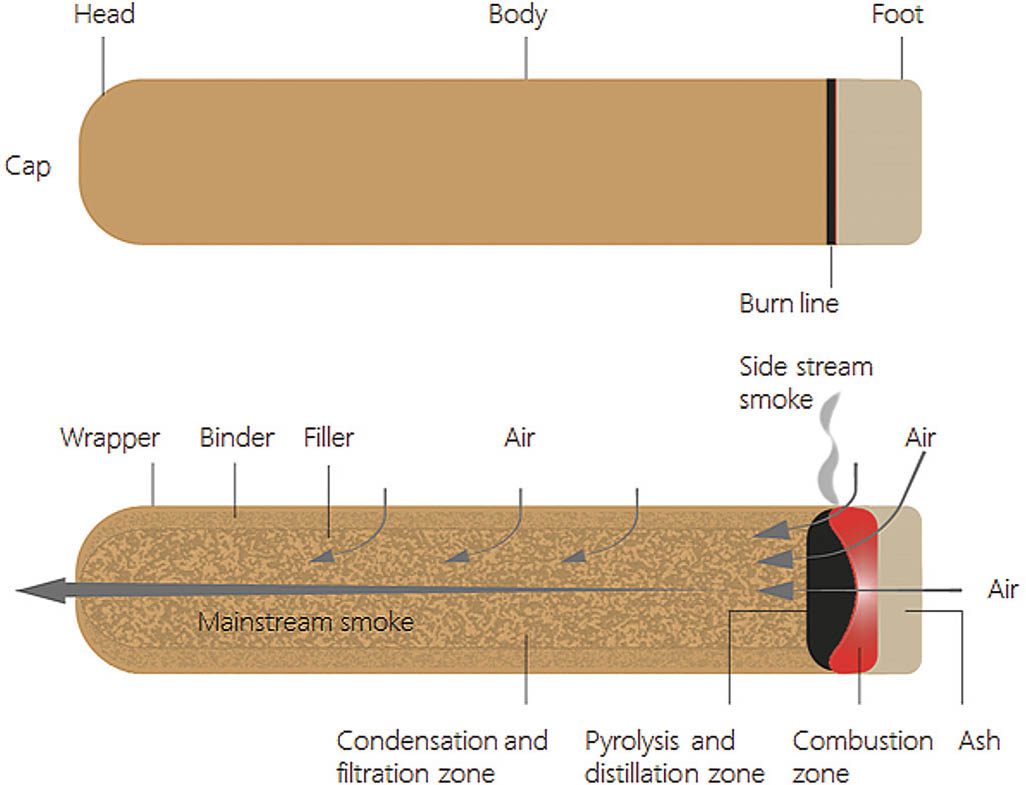
Figure 2
Construction of a typical premium cigar product (17).
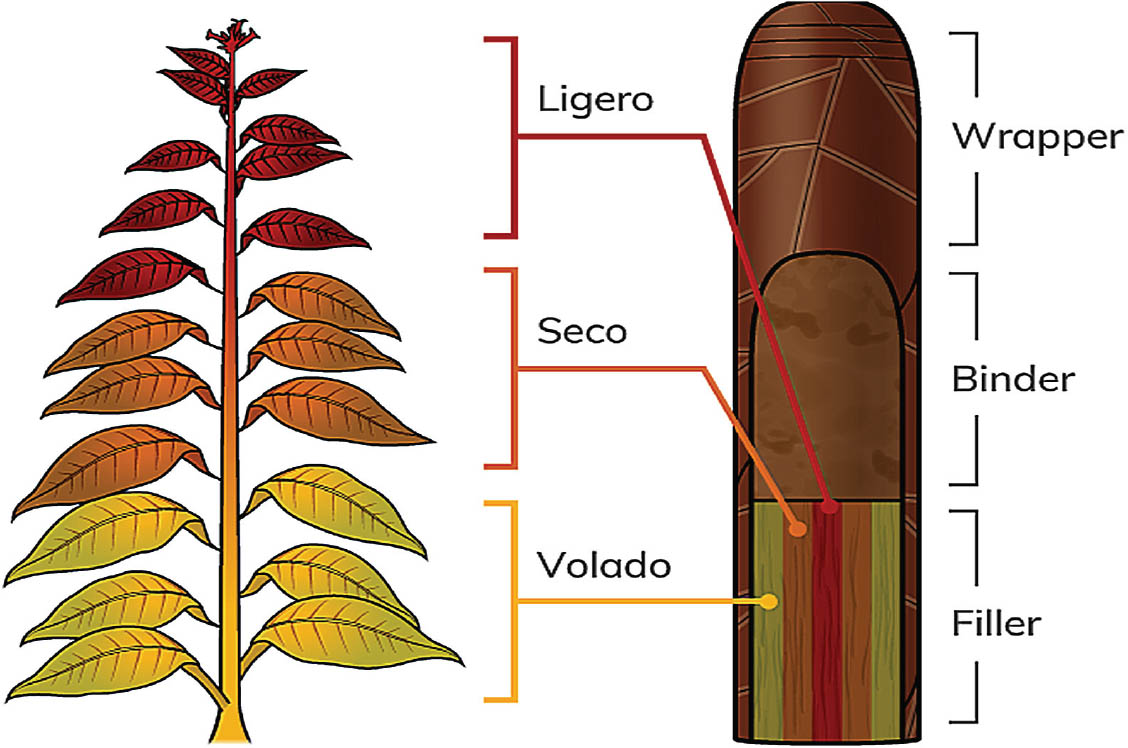
Figure 3
Strata, morphology and parts of tobacco leaves used for cigar construction. Colored “stripes” in the diagram represent concentric/rolled layers of tobacco (18).
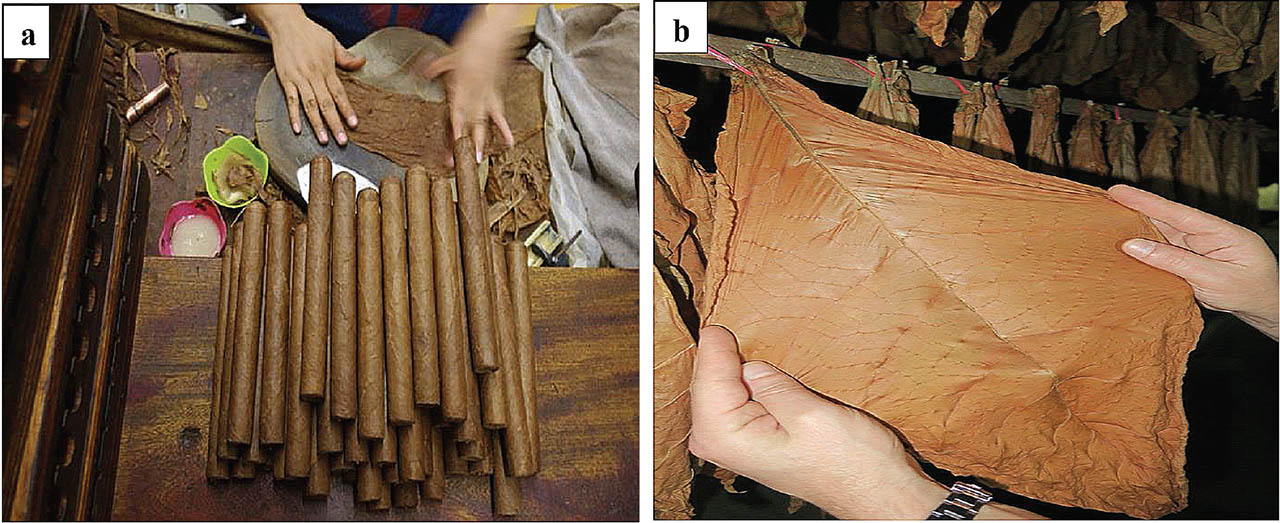
Figure 4
The art of hand-making premium cigars (a). The ideal cigar wrapper after curing in a barn (b) (15).
Table 1
Comparison of some selected components in the tobacco of cigars and four cigarette tobacco types (% of dry weight of tobacco) adapted from Hoffmann and Hoffman (25).
| Component | Cigar | Tobacco type used for cigarette | |||
|---|---|---|---|---|---|
| Burley | Maryland | Bright | Oriental | ||
| Nitrate | 1.4–2.1 | 1.4–1.7 | 0.9 | <0.15 | < 0.1 |
| pH | 6.9–7.8 | 5.2–7.5 | 5.3–7.0 | 4.4–5.7 | 4.9–5.3 |
| Reducing sugars | 0.9–2.7 | 1.5–3.0 | 1.2 | 7.0–25.0 | 5.5 |
| Total polyphenols | < 0.1 | 2.0 | 1.6 | 5.1 | 4.5 |
| Nicotine | 0.6–1.7 | 2.0–2.9 | 1.1–1.4 | 1.2–1.9 | 1.1 |
| Paraffins | 0.3–0.32 | 0.34–0.39 | 0.34–0.41 | 0.24–0.28 | 0.37 |
| Neophytadiene | 0.4–0.8 | 0.4 | 0.4 | 0.3 | 0.2 |
| Phytosterols | 0.14–0.16 | 0.3–0.39 | 0.38 | 0.3–0.45 | 0.26 |
| Citric acid | 5.5–6.0 | 8.22 | 2.98 | 0.78 | 1.03 |
| Oxalic acid | 3.3–3.6 | 3.04 | 2.79 | 0.81 | 3.16 |
| Maleic acid | 1.5–1.8 | 6.75 | 2.43 | 2.83 | 3.87 |
Table 2
Components in the gas phase of mainstream smoke of cigars and cigarettes, values are given for 1.0 g tobacco smoked adapted from Hoffmann and Hoffmann (25).
| Component | Cigars | Non-filter cigarettes | Little cigars | Filter cigarettes |
|---|---|---|---|---|
| Carbon monoxide (mg) | 39.1–64.5 | 16.3 | 22.5–44.9 | 19.1 |
| Carbon dioxide (mg) | 121–144 | 61.9 | 47.9–97.9 | 67.8 |
| Nitrogen oxides (NOx) (μg) | 159, 300 | 160 | 45, 150 | 90–145 |
| Ammonia (μg) | 30.5 | 95.3 | 200, 322 | 98 |
| Hydrogen cyanide (μg) | 1,035 | 595 | 510, 780 | 448 |
| Vinyl chloride (ng) | n.a. | 17.3, 23.5 | 19.7, 37.4 | 7.7–19.3 |
| Isoprene (ng) | 2750–3950 | 420, 460 | 210, 510 | 132–990 |
| Benzene (μg) | 92–246 | 45, 60 | n.a. | 8.4–97 |
| Toluene (μg) | n.a. | 56, 73 | n.a. | 7.5–112 |
| Pyridine (μg) | 49–153 | 40.5 | 61.3 | 27.6, 37.0 |
| 2-Picoline, μg | 7.9–44.6 | 15.4 | 17 | 14.8, 15.6 |
| 3- + 4-Picoline (μg) | 17.9–100 | 36.1 | 32.9 | 12.6, 20.2 |
| 3-Vinylpyridine (μg) | 7.0–42.5 | 29.1 | 21.2 | 102, 192 |
| Acetaldehyde (μg) | 1020 | 960 | 850, 1390 | 94.6 |
| Acrolein (μg) | 57 | 130 | 55, 60 | 87.6 |
| N ’-Nitrosodimethylamine (ng) | n.a. | 16.3–96.1 | 555 | 7.4 |
| N ’-Nitrosopyrrolidine (μg) | n.a. | 13.8–50.7 | 24.5 | 6.6 |
[i] n.a.: data not available
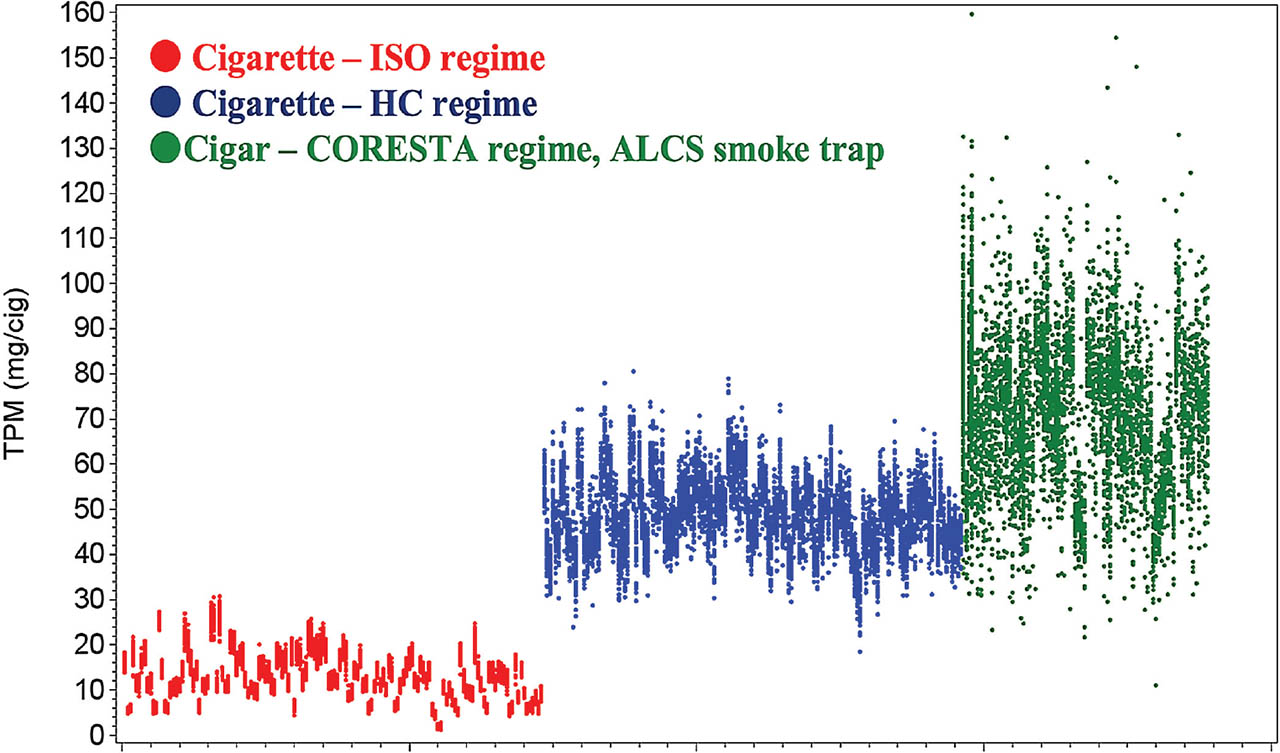
Figure 5
TPM variability comparison for 146 commercial cigarette products and 86 commercial cigar products under different smoking regimes, n = 55 (39).
Table 3
Carbonyl yields in cigarillo and leaf-wrapped cigar products tested in 2016 and 2017 under CRM 64 smoking regimen (n = 7) adapted from Young et al. (46).
| Tobacco Product Brand Name | 2016-Carbonyl yields, mean (RSD) | 2017-Carbonyl yields, mean (RSD) | ||||||
|---|---|---|---|---|---|---|---|---|
| Tobacco product weight (mg/unit) | Form-aldehyde (μg/unit) | Acet-aldehyde (μg/unit) | Acrolein (μg/unit) | Tobacco product weight (mg/unit) | Form-aldehyde (μg/unit) | Acet-aldehyde (μg/unit) | Acrolein (μg/unit) | |
| Cheyenne Cigarillo Dark & Mellow (SM) | 2462 (6) | 11.6 (16) | 1015 (8) | 20.2 (22) | 2688 (4) | 8.9 (12) a | 1246 (16) a | 14.2 (54) |
| Cheyenne Cigarillo Dark & Sweet (SM) | 2354 (8) | 10.2 (14) | 1258 (12) | 21.8 (21) | 2806 (3) | 9.8 (20) | 1333 (13) | 16.2 (25) a |
| Dutch Masters Cigarillo (SM) | 2484 (9) | 16.7 (34) | 2232 (9) | 46.2 (30) | 2879 (9) | 9.8 (16) a | 2259 (23) | 23.1 (32) a |
| Game - Black (SM) | 2161 (8) | 16.3 (25) | 1681 (10) | 33 (22) | 2363 (6) | 12.1 (22) a | 1817 (14) | 30.8 (30) |
| Swisher Sweet Cigarillos - Sticky Sweet (SM) | 2277 (5) | 13.1 (11) | 1551 (11) | 33.6 (18) | 2794 (2) | 10.7 (17) a | 1571 (19) | 22.5 (41) a |
| Swisher Sweet Cigarillos (SM) | 3048 (14) | 16.1 (19) | 1926 (10) | 15 (43) | 2682 (3) | 12.9 (22) | 1889 (15) | 36.2 (31) a |
| Swisher Sweet Cigarillos - Black (SW) | 2457 (3) | 9.8 (24) | 1548 (9) | 25.7 (36) | 2676 (3) | 9.3 (18) | 1799 (31) | 20.7 (55) |
| Dutch Masters President (LG) | 7538 (3) | 11.8 (12) | 4855 (7) | 49 (16) | 7603 (5) | 16.3 (9) a | 3913 (17) a | 34.5 (22) a |
| Phillies Blunt (LG) | 6611 (6) | 9.6 (15) | 3152 (4) | 35.8 (25) | 6931 (4) | 19.8 (18) a | 4145 (20) a | 64.6 (33) a |
Table 4
Selected analytical methods previously applied to testing of cigar leaf and cigar smoke constituents.
| Sample analyzed | Constituent and method of determination | Method feasibility with existing equipment | Detection limit |
|---|---|---|---|
| Tobacco (1.0 g) from cigarettes was placed into a 20-mL head-space vial. Internal standard solution (2 μL of 1 μg/μL 2,6-dichlorotoluene) and flavor spike mixture (1 μL of 1 μg/μL each benzaldehyde, tetra-methylpyrazine, methanol, and anethole in ethanol) were added. The samples were sealed and allowed to equilibrate for 2 h at room temperature before analysis (59) | Flavor additives to tobacco (e.g., menthol, anethole, benzaldehyde, and tetramethylpyrazine) Headspace solid-phase microextraction-gas chromatographymass spectroscopy (HS-SPME-GCMS) for both qualitative and quantitative analysis) | Feasible but could be very tedious, time consuming & unproductive | Benzaldehyde = 66 ng/g methanol = 120 ng/g anethole = 16 ng/g tetramethylpyrazine = 163 ng/g acetophenone = 41 ng/g |
| 10.0 g tobacco sample was added to 40 ml dichloromethane. Then the mixture was shaken overnight and steam distillated for 3 h to obtain 800 mL aqueous solution of volatile components using a simple apparatus (60) | Lactones, benzaldehyde, 6-methyl-2-heptanone, 2,4-dimethyl-1-penten-3-one, etc. Steam distillation (SD), simultaneous distillation and extraction (SDE) and headspace co-distillation (HCD)-GC-MS utilized for all volatiles | Feasible but could be very tedious, time consuming & unproductive | Total detected 315.72–445.48 μg/g |
| Evaluation of volatiles from flue-cured tobacco varieties, smoke organoleptic (61) | Lactones, benzaldehyde, 6-methyl-5-hepten-2-one, etc. Steam distillation of 10 g tobacco, capillary GC/GC-MS | Distillation system must be available | 200–600 μg/g |
| Smokeless tobacco products including snuff, plug tobacco, chewing tobacco, pellets, and snus (62) | α- and β-angelica lactones Headspace gas chromatography mass spectrometry (HS-GC-MS) | Feasible. However, reference standards for β-angelica lactone unavailable or difficult to obtain | The limit of detection was 30 ng/g and limit of quantitation 65 ng/g with a variability of 9–44% (RSD) |
| Tobacco samples used for analysis were Brazilian flue-cured, Kentucky Burley, N. rustica, and Greek and a sample of commercially available roasted peanuts (63) | Benzaldehyde, 6-methyl-5-hepten-2-one, acetone, hexenal Chromatography-mass selective detection-flame ionization detection (PT-GC-MSD-FID) hyphenated technique with purge-and-trap-gas | Feasible with little modification | Semiquantitative and qualitative analysis |
| Qualitative and quantitative analysis was developed and validated for volatile flavour components in flue-cured tobacco (64) | Flavour components in flue-cured tobacco (e.g., pyridine, 6-methyl-5-hepten-2-one, benzene acetaldehyde, benzaldehyde, furfural) HS-SPME followed by GC × GC-TOF-MS | Feasible but must have TOF-MS on scope | 5.7–147.6 ng/g |
| Determination of selective phenolic compounds in cigarette and MMC cigar smoke (65) | Phenolics (e.g. hydroquinone, resorcinol, phenol, catechol, and o-, m-, and p-cresol). Ultra-high pressure liquid chromatography (UHPLC) and fluorescence detector (FLD) with a sub-2 μm pentafluoro-phenylpropyl phase analytical column | Feasible high throughput method that is based on CRM 78, which has a run time of 10 minutes | Quantitative and qualitative analysis |
Table 5
Cigar reference products available through the University of Kentucky (72).
| Reference cigar | Product type | Cigar diameter (mm) | Cigar length (mm) |
|---|---|---|---|
| 1C1 | Large machine-made cigar | 15.9 | 136.5 |
| 1C2 | Machine-made filtered cigar | 7.8 | 99.0 |
| 1C3 | Small machine-made cigarillo | 11.0 | 109.5 |
| 1C4 | Large machine-made natural wrapper | 12.8 | 103.0 |