
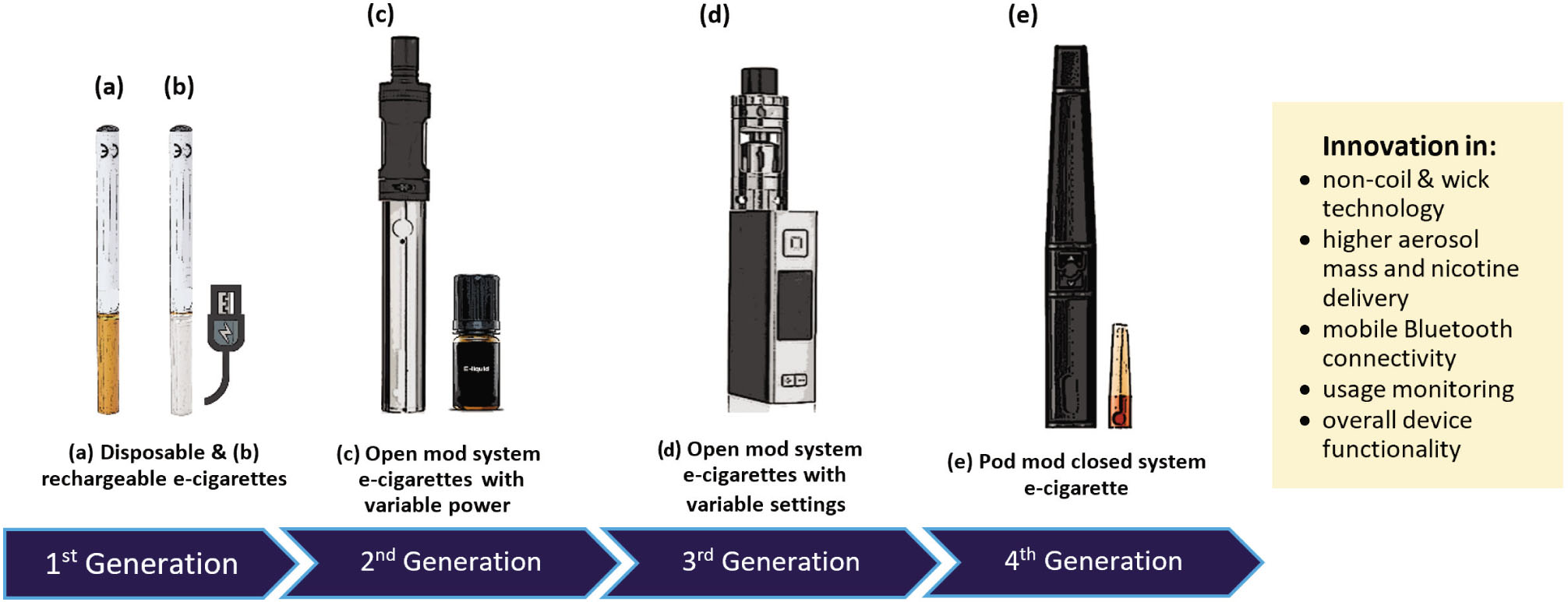
Figure 1
Schematic illustration of e-cigarette devices showing disposable 1st generation (cig-a-like) e-cigarettes, 2nd generation with refillable system, 3rd generation customizable ECs, and 4th generation e-cigarettes closed systems.
Table 1
Comparison of metal levels in e-cigarette vapour versus cigarette smoke from published studies analysed.
| Category | Device/Cigarette | Regime | No. of puffs | Metals | Units | Source | ||||||
|---|---|---|---|---|---|---|---|---|---|---|---|---|
| Mercury | Cadmium | Lead | Chromium | Nickel | Arsenic | Selenium | ||||||
| Cigarette | 1R6F | HCI | 4.68 | 76.1 | BLQ | BLD | BLD | BLQ | BLD | ng/cig | Jaccard et al. (342) | |
| Cigarette | 3R4F | HCI | 4.92 | 93.2 | BLQ | BLD | BLD | BLQ | BLD | ng/cig | Jaccard et al. (342) | |
| EC Gen 1 | Various | 70 / 1.8 / 10c | 150 | N/A | 0.01–0.22 | 0.03–0.57 | N/A | 0.11–0.29 | N/A | N/A | μg/150 puffs a | Goniewicz et al. (44) |
| Cig-a-like | 10 | N/A | N/A | 0.017 | 0.007 | 0.05 | N/A | N/A | μg/10 puffs a | Williams et al. (123) | ||
| EC Gen 2/3 | Open tank | N/A | 0.05–0.16 | 6.88–541 | 0.39–15.6 | 1.32–2148 | 0.1–1.59 | N/A | μg/kga | Zhao et al. (130) | ||
| EC Gen 3 | Liquids in reference | CRM81 | N/A | < 0.06 | < 0.05–0.12 | < 0.09–1.58 | < 1.08–1.54 | < 0.12–1.33 | N/A | ng/puffa | Belushkin et al. (116) | |
| EC Gen 4 | Closed system | N/A | 0.04–0.05 | 0.88–6.88 | 0.39–0.41 | 1.32–11.9 | 0.09–0.10 | N/A | μg/kga | Zhao et al. (130) | ||
| myblub | CRM81 | 150 | BLQ | BLD | BLD | BLD | BLQ | BLQ | 0.00024 | μg/puff | O'Connell et al. (343) | |
Abbreviations:
- BLD
below limit of detection
- BLQ
below limit of quantification
- CRM81
CORESTA recommended method number 81
- EC
electronic cigarette
- EC
Gen electronic cigarette generation
- HCI
Health Canada intense machine smoking regime
- N/A
not analyzed
Table 2
Comparison of carbonyl levels in e-cigarette vapour versus cigarette smoke from published studies.
| Category | Device/Cigarette | Regime | No. of puffs | Carbonyls | Units | Reference | |||||||
|---|---|---|---|---|---|---|---|---|---|---|---|---|---|
| Formaldehyde | Acetaldehyde | Acetone | Acrolein | Propionaldehyde Crotonald | ehyde | MEK | Butyraldehyde | ||||||
| Cigarette | 1R6F | HCI | 9.1 | 4.879 | 158.9 | 62.31 | 14.51 | 13.74 | 4.484 | 15.93 | 3.08 | μg/puff | (22) |
| Cigarette | Benson & Hedges Sky Blue | HCI | 8.1 | 5.235 | 177.4 | 65.68 | 15.93 | 15.43 | 5.321 | 17.41 | 4.469 | μg/puff | (22) |
| EC Gen1 | Various | 70 / 1.8 / 10* | 150 | 3.2–56.1 | 2.0–13.6 | N/A | 0–41.9 | N/A | N/A | N/A | N/A | μg/150 puffs | (44) |
| EC Gen 2 | Various open tank | 55 / 4 / 30* | 10 | 0.9–2.7 | 0.3–1.7 | N/A | 0.7–1.9 | N/A | N/A | N/A | N/A | μg/10 puffs | (344) |
| EC Gen 2/3 | Open tank/NHOSS “Lounge” model (no nic./16 mg/mL nic.) | CRM81 | 96 | 0.37–1.48 | 0.16–0.96 | N/A | 0.05–2.1 1 | N/A | N/A | N/A | N/A | ng/mL puff | (113) |
| EC Gen 3/4 | ePen | CRM81 | 122 | 106 | 73 | 70 | LOQ | N/A | N/A | 8 | ng/puff | (20) | |
| EC Gen 4 | JUUL rich tobacco (20 mg/mL) | CRM81 | 112 | 76 | 3 | 13 | N/A | N/A | N/A | N/A | ng/puff | (114) | |
| JUUL rich tobacco (18 mg/mL) | CRM81 | 11 | 12 | 36 | 7 | N/A | N/A | N/A | N/A | ng/puff | (114) | ||
| myblu (tobacco flavour, 1.6% nic.) | CRM81 | 150 | < 2.63 | < 17.5 | < 8.75 | < 4.38 | < 4.38 | < 4.38 | < 4.38 | < 4.38 | μg/150 puffs | (115) | |
| Vype ePen 2 (18 mg/mL nic.) | CRM81 | 268 | 230 | 135.8 | 346 | 96.2 | BLD | BLD | BLD | ng/puff | (22) | ||
| Vype ePen 3 (BAT 18 mg/mL nic.) | CRM81 | 52.8 | NQ | 111 | BLD | NQ | BLD | BDL | BLD | ng/puff | (22) | ||
Abbreviations:
- BLD
below limit of detection
- LOQ
Limit of quantitation
- CRM81
CORESTA Recommended Method No81
- EC
electronic cigarette
- EC Gen
electronic cigarette generation
- HCI
Health Canada intense machine smoking regime
- MEK
methyl ethyl ketone
- N/A
not analysed
- Nic.
nicotine
- NQ
not quantified
Table 3
Summary of pharmacokinetic, pharmacodynamic, vital signs profiles of combustible cigarettes, e-cigarettes (first to fourth generation), and nicotine-replacement therapy.
| Reference | Product type (nicotine concentration) | Pharmacokinetic parameters | Pharmacodynamic parameters | Vital signs | ||||||
|---|---|---|---|---|---|---|---|---|---|---|
| Cmax (ng/mL) | Tmax (min) | AUC (ng•min/mL) | Cravings | Urge to smoke | Sensory evaluation/satisfaction | Heart rate (bpm) | Systolic BP (mm Hg) | Diastolic BP (mm Hg) | ||
| Combustible cigarettes | ||||||||||
| Digard et al., 2013 (195) | Lucky Strike Red (14.6 mg) | 12.8 | 7.20 | 14.8 | N/A | N/A | N/A | N/A | N/A | N/A |
| Yan & D’Ruiz, 2015 (345) | Marlboro Gold King Size (0.8 mg) | 15.84S29.23 | N/A | N/A | N/A | N/A | N/A | 4.26 increase in heart rate | 5.74 change in systolic BP | 6.78 change in diastolic BP |
| Ebajemito et al., 2020 (139) | Benson & Hedges Sky | 14.5 (ad libitum) | 5.00 | 660.0 | N/A | N/A | Increased product satisfaction compared to e-cigarettes | Heart rate increased and decreased in similar trends to PK profiles | N/A | N/A |
| Blue (7 mg ISO tar) | 13.7 (fixed puff) | 7.00 | 631.0 | |||||||
| First-generation e-cigarettes (cig-a-like) | ||||||||||
| Hajek et al., 2017 (346) | Vuse (48 mg/mL); | 13.6 | 4.0 | 244.9 | N/A | N/A | N/A | N/A | N/A | N/A |
| Gamucci (16 mg/mL); | 9.7 | 6.0 | 169.9 | |||||||
| Blu (18 mg/mL); | 9.1 | 6.0 | 173.1 | |||||||
| Vype (16.8 mg/mL); | 8.5 | 6.0 | 161.0 | |||||||
| E-lites (24 mg/mL); | 7.8 | 6.0 | 157.6 | |||||||
| Puritane (20 mg/mL) | 7.5 | 4.0 | 144.4 | |||||||
| Bullen et al., 2010 (198) | Ruyan V8 (16 mg/mL) | 1.3 | 19.6 | N/A | No difference in withdrawal symptoms between the e-cigarette and inhalator | Greater decrease in desire to smoke compared to 0 mg placebo (not significant when adjusted for multiple comparisons) | N/A | N/A | N/A | N/A |
| Vansickel et al., 2010 (347) | NJOY NPRO (18 mg/mL); Hydro (16 mg/mL) | N/A | N/A | N/A | Some abstinence symptoms suppressed | Decrease in urge to smoke compared to sham condition | No effect on sensory evaluation | No significant change was reported between study products | N/A | N/A |
| Nides et al., 2014 (202) | NJOY King Bold (26 mg/mL) | 3.5–5.1 | 30 s–30 min | 0.67–0.57 | Reduction in craving with the highest decrease immediately after product use, followed by steady incremental increases in craving | N/A | N/A | Heart rate increased through the 10-min mark after the beginning first puffs, then gradually declined towards baseline. Mean increases in heart rate 5 and 10 min after the first series of puffs were 2.4 and 5.3 bpm | N/A | N/A |
| Yan & D’Ruiz, 2015 (345) | Blu (16 mg/mL, two formulations); Blu (24 mg/mL, three formulations) | 10–17 | N/A | N/A | N/A | N/A | N/A | 1.87–4.09 bpm increase in heart rate following product use | 1.13–3.78 change in systolic BP | 3.17–6.783 change in diastolic BP |
| Farsalinos et al., 2014 (201) | V2 (18 mg/mL) | 2.0 (fixed puff) and (ad libitum) | N/A | N/A | Similar levels to craving reduction observed compared to third-generation EC | N/A | Burning throat sensation was significantly lower compared to third-generation EC | N/A | N/A | N/A |
| Voos et al., 2019 (348) | V2 (11.7 mg/mL) Green smoke (19.4 mg/mL) | 4.07 | 13 | 88.60 | N/A | Low ratings on perceived smoking urge relief | Low satisfaction and sensory ratings | N/A | N/A | N/A |
| 4.16 | 10 | 121.9 | ||||||||
| Second-generation e-cigarettes | ||||||||||
| Voos et al., 2019 (348) | Mod iTazte (29.9 mg/mL) | 6.6 | 10 | 272.3 | N/A | Provided perceived smoking urge relief | High satisfactionrating, taste, pleasantness, harshness (“throat hit”), and speed of effect | N/A | N/A | N/A |
| Hajek et al., 2017 (346) | KangerTech EVOD (20 mg/mL) | 9.9 | 6.0 | 200.6 | N/A | N/A | N/A | N/A | N/A | N/A |
| Third-generation e-cigarettes | ||||||||||
| Farsalinos et al., 2014 (201) | EVIC device with EVOD cartomizer (18 mg/mL) | 4.00 (defined) 21.0 (ad libitum) | N/A | N/A | Similar levels of craving reduction observed compared to first-generation EC | N/A | Burning throat sensation was significantly higher compared to first-generation EC | N/A | N/A | N/A |
| Hajek et al., 2017 (346) | Innokin (20 mg/mL) | 11.9 | 6 | 232.1 | N/A | N/A | N/A | N/A | N/A | N/A |
| Voos et al., 2019 (348) | eGO V2 Pro (29.9 mg/mL) | 5.52 | 10 | 121.9 | N/A | Provided fastest perceived urge relief compared to first- and second-generation EC | High satisfaction rating, taste, pleasantness, harshness (“throat hit”), and speed of effect. | N/A | N/A | N/A |
| Ebajemito et al., 2020 (139) | Vype ePen (18 mg/mL) | 4.79 | 7.0 | 267.0 | N/A | N/A | Poor satisfaction compared to fourth-generation EC | Heart rate increased and decreased in similar trends to PK profiles | N/A | N/A |
| Fourth-generation e-cigarettes | ||||||||||
| O’Connell et al., 2019 (140) | myblu 25 mg/mL (free-base) | 5.05 | 8.03 | 99.99 | N/A | Higher Cmax was associated with greater relief on urge to smoke | Similar sensorial perception was reported across all products | N/A | N/A | N/A |
| myblu 16 mg/mL (salt); | 6.51 | 6.97 | 118.5 | |||||||
| myblu 25 mg/mL (salt); | 7.58 | 6.03 | 125.2 | |||||||
| myblu 40 mg/mL (salt); | 10.27 | 7.90 | 190.7 | |||||||
| blu PRO 48 mg/mL (salt) | 4.85 | 6.91 | 84.84 | |||||||
| Ebajemito et al., 2020 (139) | Vype ePen3 18 mg/mL (freebase; ad lib); | 6.38 | 7.0 | 325 | N/A | N/A | Higher Cmax was linked to increased satisfaction, except for the 30-mg/mL product | Heart rate increased and decreased in similar trends to pharmaco-kinetic profiles | N/A | N/A |
| Vype ePen3 18 mg/mL (med salt; ad lib); | 10.8 | 5.0 | 429 | |||||||
| Vype ePen3 30 mg/mL (high salt; ad lib); | 14.1 | 5.0 | 533 | |||||||
| Vype ePen3 18 mg/mL (med salt; fixed puff); | 5.64 | 5.0 | 326 | |||||||
| Vype ePen3 12 mg/mL (low salt; ad lib) | 5.97 | 7.0 | 284 | |||||||
| Nicotine-replacement therapy | ||||||||||
| Digard et al., 2013 (195) | Nicotine gum (4.2 mg) | 9.10 | 45.0 | 13.1* | N/A | N/A | All products had little effect on the sensory parameter assessed | N/A | N/A | N/A |
| Lunell & Curvall, 2011 (349) | Nicotine Polarilex gum (4 mg) | 12.8 | N/A | 3190 | Craving decreased similarly to snus | Urges to smoke decreased similarly with snus | Salivation and throat burn were rated higher for the 4 mg gum vs snus | Mean 20 min increase of heart rate 9.3 (± 9.6), 8.9 (± 6.4), and 9.9 (± 5.1) bpm for 9.9 mg snus, 8.7 mg snus, and nicotine gum, respectively | N/A | N/A |
| Dautzenberg et al., 2007 (350) | 1 mg Nicotinell lozenges | 2.30 | 66.0 | 8.30 * | N/A | N/A | N/A | N/A | N/A | N/A |
| 2 mg Nicotinell lozenges | 4.80 | 48.0 | 15.8 * | |||||||
| 2 mg Nicorette gum | 2.90 | 48.0 | 10.6 * | |||||||
| Choi et al., 2003 (351) | 4 mg nicotine lozenges | 10.8 | 66.0 | 44.0 * | N/A | N/A | N/A | N/A | N/A | N/A |
| 4 mg nicotine gum | 10.0 | 54.0 | 34.6 * | |||||||
| Hansson et al., 2017 (199) | 6 mg nicotine gum | 13.8 | 30.0 | 46.2 * | N/A | N/A | N/A | N/A | N/A | N/A |
| 4 mg nicotine gum | 10.1 | 30.0 | 30.2 * | |||||||
| 2 mg nicotine gum | 5.90 | 30.0 | 17.1 * | |||||||
| 4 mg nicotine lozenge | 9.30 | 45.0 | 35.3 * | |||||||
| Kraiczi et al., 2011 (352) | 1 mg nicotine mouth spray | 3.30 | 10.0 | 6.60 | N/A | N/A | N/A | N/A | N/A | N/A |
| 2 mg nicotine mouth spray | 5.30 | 12.5 | 12.2 | |||||||
| 4 mg nicotine mouth spray | 9.10 | 10.0 | 23.7 | |||||||
| 4 mg nicotine lozenge | 7.00 | 45.0 | 24.3 | |||||||
| 4 mg nicotine gum | 7.80 | 30.0 | 21.1 | |||||||
| Sukhija et al., 2018 (200) | 4 mg lozenges prototype I | 18.18 | 66.0 | 87.13 * | N/A | N/A | N/A | N/A | N/A | N/A |
| 4 mg lozenges prototype II | 18.11 | 66.0 | 85.69 * | |||||||
| 4 mg lozenges prototype III (I, II, III had different dissolutions) | 17.11 | 66.0 | 84.59 * | |||||||
| 4 mg Nicorette lozenges | 18.67 | 66.0 | 90.03 * | |||||||
| Molander & Lunell, 2001 (353) | 2 mg nicotine sublingual tablet | 13.2 | 20 | 12.4 * | N/A | N/A | N/A | N/A | N/A | N/A |
| 2 mg Nicorette gum | 14.4 | 20 | 13.5 | |||||||
| Lunell et al., 2020 (354) | 4 mg Nicorette gum | 12.8 | 46.0 | 52.1 | N/A | N/A | N/A | N/A | N/A | N/A |
| Bullen et al. (198) | Nicorette inhalator (10 mg) | 2.10 | 32.0 | N/A | No significant decrease in craving compared to placebo or first-generation EC | No significant decrease in craving compared to placebo or first-generation EC | N/A | N/A | N/A | N/A |
| Goldenson et al. (355) | Fixed puff | N/A | N/A | 59 mg/mL silica wick provided highest level of satisfaction followed by 18 mg/mL silica wick, 18 mg/mL coil wick and 9 mg/mL coil wick | N/A | N/A | N/A | |||
| JUUL 59 mg/mL with silica wick | 9.3 | 6.2 | 5.0 * | |||||||
| JUUL 18 mg/mL with silica wick | 3.2 | 6.3 | 1.7 * | |||||||
| JUUL 18 mg/mL with cotton wick | 3.3 | 5.8 | 1.8 * | |||||||
| JUUL 9 mg/mL with cotton wick | 2.1 | 6.6 | 1.2 * | |||||||
| Ad libitum puff | ||||||||||
| JUUL 59 mg/mL with silica wick | 8.3 | 6.4 | 4.6 * | |||||||
| JUUL 18 mg/mL with silica wick | 3.5 | 6.5 | 1.8 * | |||||||
| JUUL 18 mg/mL with cotton wick | 3.3 | 7.1 | 2.1 * | |||||||
| JUUL 9 mg/mL with cotton wick | 2.3 | 6.7 | 1.2 * | |||||||
Table 4
Clinical studies of e-cigarettes.
| Reference | Study design/product | Study arms (subgroups) | Conclusions |
|---|---|---|---|
| Shahab et al., 2017b (221) | Cross-sectional study, using unspecified EC or NRT products for ≥ 6 months | Smokers (n = 37) Dual use NRT (n = 36) Dual use EC (n = 36) NRT (n = 36) EC (n = 36) | NNAL, 3HPMA, AAMA, CYMA, MHBMA3, HEMA were expressed as proportions of levels in the smoker arm. Significantly lower levels of all biomarkers were observed for EC only users (2.9–43.5% decrease) that were similar to those in NRT only users. NRT and EC dual users presented similar biomarker levels to the smoking group |
| Lorkiewicz et al., 2019 (216) | Cross-sectional study, using unspecified ECs or smokeless products | No tobacco (n = 12) ECs (n = 12) smokers (n = 12) smokeless tobacco (n = 12) | The EC users showed higher levels of xylene, cyanide, styrene, ethylbenzene, and acrolein metabolites than non-tobacco users, but lower levels for toluene and acrolein metabolites. Levels of VOC metabolites in the smokeless tobacco group were similar to those in the non-tobacco group |
| Czoli et al., 2019 (214) | Three-period crossover design where dual users (smoked ≥ 5 cigarettes per day and used an EC at least once a day for the past 7 days) to either EC > smoking > no tobacco or smoking > EC > no tobacco, with each condition lasting for 7 days | Dual users (n = 48) | 1-HOP was significantly higher during the smoking period than during dual use but was lower during EC use. NNAL levels decreased significantly from dual use, by 30% during EC use and by 35% during cessation but did not change during smoking |
| Hecht et al., 2015 (226) | Cross-sectional study comparing biomarker levels in smoker to ECs switchers (≥ 2 months) with those in smokers from three previously published studies (Carmella et al. 2009; Hatsukami et al. 2010; Zarth et al. 2014) | EC users (n = 28) | All biomarkers (1-HOP, total NNAL, 3HPMA, 2HPMA, HMPMA, and SPMA) were significantly lower in EC users than in smokers |
| Mcrobbie et al., 2015 (217) | Switching study in which smokers switched to ECs or dual use | EC users (n = 16) Dual use (n = 18) | 3HPMA in urine showed significant reductions at 4 weeks after switching compared with baseline (ECs 79%, dual use 60%) |
| Goniewicz et al., 2017 (215) | Switching study in which smokers switched to ECs dual use for 2 weeks then ECs only for 2 weeks | Smokers switching to ECs (n = 20) | Significant reductions were seen after 2 weeks in urine biomarkers of exposure to NNAL and eight VOC metabolite levels (50–69%) and fluorene (42–82%), butnot in those for pyrene, phenanthrene, and naphthalene |
| Cravo et al. 2016 (225) | Parallel study in which smokers were randomly assigned in a ratio of 3:1 to switch to an EC (tobacco or menthol flavour) or continue smoking for 12 weeks | Switch to EC (n = 306) continue smoking (n = 102) | After 12 weeks, 3-HPMA, S-PMA and total NNAL in urine were reduced by around 30% compared with baseline in those who switched to ECs, whereas noreductions were among those who continued smoking |
| O’Connell et al., 2016 (245) D’Ruiz et al., 2017 (232) D’Ruiz et al., 2016 (356) | Parallel study of smokers switching to ECs or dual use during 6 days in clinic | Rechargeable EC tobacco flavour (n = 15) rechargeable EC cherry flavour (n = 15) disposable EC cherryflavour (n = 15) dual use with rechargeable EC tobacco flavour (n = 15) dual use with rechargeable EC cherry flavour (n = 15) dual use with disposable EC cherry flavour (n = 15) cessation (n = 15) | Biomarkers: all urine biomarker measures (total NNAL, 3-HPMA, HMPMA, CEMA, 1-OHP, NNN, MHBMA, S-PMA) were significantly reduced compared to baseline in all groups, except MHBMA in the cherry disposable dual use group; levels in dual users were significantly higher than those in the cessation group Spirometry: small changes seen in FVC from baseline to Day 5 (!0.5% to 3.1%) but were significant for tobacco and cherry rechargeable EC only users, while FEV1changes (!1.5% to 6.0%) were significant increases for the tobacco and cherry rechargeable EC only users and cherry rechargeable dual users Exhaled CO: reduced across all study groups, by around 89% in EC only and cessation groups and around 26% in dual user groups Exhaled FeNO: increased by 45.8–63.4% in EC only groups and 55%in the cessation group, but not in dual user groups (differences from the tobacco rechargeable and cherry disposable EC only groups were significant) Systolic blood pressure: changes varied across groups, but significant reductions in mornings seen for cherry flavour dual users, and in rechargeable tobaccoEC only users Diastolic blood pressure: reduced significantly in mornings forrechargeable tobacco dual users and cherry rechargeable EC only users Heart rate: reductions observed in the cessation group, rechargeable tobacco EC only group and rechargeable cherry product EC only and dual use groups |
| Sakamaki-Ching et al., 2020 (222) | Cross-sectional study of age and gender matched participants, assessing spot urine samples from EC users, smokers and non-smokers for metals (antimony, cadmium, copper, indium, lead, nickel, rubidium, selenium, silver, titanium, and zinc), metal exposure, and BOPH | EC users (n = 20) smokers (n = 13) non-smokers (n = 20) | Metals: biomarkers for seleniumwere significantly higher in ECusers than in non-smokers or smokers with means 54.0, 41.8, and 39.7 μg/g creatinine, respectively, and were significantly increased for zinc in EC userscompared to non-smokers (584.5 vs413.6 mg/g creatinine) but not compared to smokers (470.7 mg/g creatinine) Metal exposure: metallothionein was significantly greater in ECusers than in non-smokers (mean 3761 vs1129 pg/mg creatinine) but similar to that in smokers (4096 pg/mg creatinine) BOPH: concentrations were increased in EC users when compared to non-smokers but not smokers (8-OHdG 442.8 vs221.6 and 388 ng/mg creatinine; 8-isoprostane 750.8 vs411.2 and 784.2 ng/mg creatinine) |
| Campagna et al., 2016 (357) Cibella et al., 2016 (229) | Longitudinal study (52 weeks) of smokers switching to ECs with different concentrations of nicotine | 2.4% nicotine (n = 49) 1.8% nicotine (n = 50) 0% nicotine (n = 40) | 82 participants continued smoking, 34 significantly reduced thenumber of cigarettes smoked, and 18 quit smoking after switching Exhaled CO: decreased significantly in quitters and smokers whoreduced cigarette consumption from week 12 Exhaled FeNO: increased significantly in quitters from week 12 FEV1, FVC and FEV1/FVC ratio: not affected by smoking status (continued, reduced, or quit) FEF25–75%: significantly increased among quitters |
| Polosa et al., 2016 (220) | Retrospective chart review study of changes in respiratory outcomes over 2 years in patients with COPD who were daily EC users (without combustible cigarettes) or smokers, matched for age and sex | Baseline COPD GOLD stage 1 (smokers n = 3; EC users n = 2) stage 2 (smokers n = 5; EC users n = 6) stage 3 (smokers n = 11; EC users n = 10) stage 4 (smokers n = 5; EC users n = 6) | FEV1, FVC and ratio FEV1/FVC ratio did not change from baseline values in either EC users or smokers, whereas COPD exacerbations were reduced and 6-min walking test scores increased compared with baseline in the EC users group but not the smoking group |
| Pulvers et al., 2018 (358) | Switch study of smokers switching to an EC for 30 days with choice of seven flavours and two nicotine concentrations (12 or 24 mg/mL) | Smokers (n = 37) | Cigarette consumption: decreased significantly from mean 24.8 days to 14.0 days per month and mean 8.7 to 4.4 cigarettes per day, with six participants quitting, 21 becoming dual users and the remaining 10 sporadic EC only users Biomarkers: NNAL, PMA, CNEMA decreased significantly from baseline, whereas HEMA, MMA, 3-HPMA, 2-HPMA, AAMA and HPMMA did not Exhaled CO: decreased significantly Smoking dependence: decreased significantly from baseline |
| Aherrera et al., 2017 (218) | Cross sectional study of nickel and chromium concentrations in EC users | EC users (n = 59) | Concentrations in urine, saliva, and breath: were below the limit of detection for nickel in 4.7%, 3.2% and 3.1% of samples, respectively, and for chromium in 7.8%, 1.6% and 56.3% of samples Weekly consumption, time to first vape, voltage of device, number of coil changes per month, and levels in aerosol, dispenser, and tank had effects Nickel concentrations in urine were associated with time to first vape, coil changes, and concentrations in aerosol; in saliva were only associated with concentrations in aerosol and in tank, and in breath showed no associations Chromium in saliva was associated with cotinine in urine and concentrations in aerosol, tank, and dispenser |
| Wieslander et al., 2001 (231) | Symptoms study after experimental exposure of healthy non-asthmatic volunteers to propylene glycol mist for 1 min | Healthy volunteers (n = 27) | Symptom VAS ratings: showed significant increase of ocular irritation, throat irritation, and dyspnoea but no effects on solvent smell or other symptoms Lung function: FEV1, FVC, FEV1/FVC ratio, PEF did not change significantly from before to after exposure Tear film stability: break-up time decreased significantly after exposure from 38 to 28 s Dose response: throat dryness was 47% in the low exposure groupbut 100% in the high exposure group, where VAS ratings were also higher |
| Goniewicz et al., 2018 (219) | Cross-sectional analysis of population in longitudinal Population Assessment of Tobacco and Health (PATH) study for biomarker concentrations | Smokers (n = 2411) EC users (n = 247) dual users (n = 792) never tobacco users (n = 1655) | NNAL: concentrations were significantly lower in never-smokers than in EC users and in both groups compared with smokers (geometric mean 0.921 vs4.887 and 203.5 pg/mg creatinine), whereas dual users had higher levels than smokers (262.2 pg/mg creatinine) Other tobacco specific nitrosamines: NAT, NAB, and NNN in EC users were above the limit of quantification for 12%, 15% and 34%of samples, respectively and were all higher than those in never tobacco users but significantly lower than those in smokers Metal exposure: beryllium wasfound only in 3–9% of samples; cadmium was higher in EC users than in never tobacco users (0.193 vs 0.149 ng/mg creatinine) but lower than in smokers and dual users (0.277 and 0.280 ng/mg creatinine, respectively); lead was elevated in EC users compared to never users (0.432 vs 0.351 ng/mg creatinine) but was highest in smokers and dual users (0.500 and 0.479 ng/mg creatinine, respectively); strontium differed only between dual users and smokers (130.5 vs 113.7 ng/mg creatinine); and no differences in concentrations between groups were found for cobalt, manganese or thallium Tobacco alkaloids: anabasine and anatabine concentrations were significantly lower in EC users than in dual users or smokers but similar to those in never tobacco users Total inorganic arsenic: significantly higher in EC users than in smokers and dual users (0.053 vs 0.048 and 0.045 ug/mg creatinine) but not different to never tobacco users (0.054 ug/mg creatinine) PAHs: of seven biomarkers of PAHexposure only 1-hydroxypyrene was elevated in EC users compared to never tobacco users, while all were significantly higher in smokers and five were higher in dual users VOCs: of 20 biomarkers four were significantly elevated in EC users compared with never tobacco users (AMCA 1.5 times, BMA 1.1 times, CYHA 1.3 times, and CYMA 3.0 times*), although CYHA could only be detected in 3% of never tobacco users and 14% of EC users; 17 biomarkers were higher in smokers than in EC users by 1.4–31.0 times |
| Oliveri et al., 2020 (234) | Cross-sectional observational study comparing biomarkers of exposure and BOPH in ex-smoker (≥10 cigarettes per day for ≥10 years) EC users (≥6 months) with current smokers | Smokers (n = 62) ex-smoker EC users (n = 132) | Biomarkers of exposure: concentrations of total NNAL, nicotine equivalents, 3HPMA, and COHb were lower in EC users than smokers BOPH: of white blood cells, HDL cholesterol, 11-dehydrothromboxane B2, 8-epi-prostaglandin F2α, and sICAM-1, lower concentrations were found in EC users for 11-dehydrothromboxane B2 (471.4 vs 664.8 ng/g creatinine), 8-epi-prostaglandin F2α (288.6 vs374.1 ng/g creatinine), and sICAM-1 (224.5 vs266.4 ng/mL), although differences for the latter were observed only for cartridge based ECs and not tank-base ECs |
| Piper et al., 2019 (227) | Baseline assessments for longitudinal observational cohort study (2 years) of smokers versus EC dual users | Smokers (n = 166) dual users (n = 256) | In dual users, lower mean valueswere seen than in smokers for smoking duration (22.1 vs25.6 years), daily cigarette consumption (12.5 vs15.8), Fagerström nicotine dependence (4.15 vs 4.81), smoking within 30 min of waking (79.4% vs67.3%), and levels of NNAL (453.31 vs 340.99 pg/mL), whereas smoking starting age, motivation to quit, exhaled CO, the Wisconsin Inventory of Smoking Dependence Motives, and cotinine biomarkers did not differ significantly |
| Round et al., 2019 (223) | Randomized, controlled, open-label, forced switch parallel group study in smokers of menthol and non-menthol cigarettes who switched to an EC or nicotine gum, to measure biomarkers of exposure after 5 days | Smoker to EC (n = 38) smoker to nicotine gum (n = 39) menthol smoker to menthol EC (n = 40) menthol smoker to nicotine gum (n = 41) | In all switching groups, total nicotine equivalents in urine, cotinine in plasma, and all biomarkers of tobacco smoke exposure decreased except for 3-OH-B[a]P in the smoker to nicotine gum group (reductions were ECs 30.4–95.5%, menthol ECs 35.7–97.7%, and nicotine gum 20–99.2%) |
| Song et al., 2020 | Cross-sectional study of lung inflammation, measured by cell counts, cytokines, genome-wide gene expression and DNA methylation in bronchoalveolar lavage and brushings, in never smokers, EC users and smokers | Never-smokers (n = 42) EC users (n = 15) smokers (n = 16) | Most inflammatory cell counts and cytokine concentrations in EC users were intermediate between those of smokers and never-smokers, while most biomarkers were similar to those for never smokers, as were differential gene expression and DNA methylation |
Abbreviations:
- BOPH
biomarkers of potential harm
- COPD
chronic obstructive pulmonary disease
- EC
electronic cigarette
- FEF25–75%
mid-expiratory flow rate
- FEV1
forced expiratory volume in 1 s
- FVC
forced vital capacity
- GOLD
Global Initiative for Chronic Obstructive Lung Disease
- PAHs
polycyclic aromatic hydrocarbons
- PEF
peak expiratory flow rate
- VAS
visual analogue scale
- VOC
volatile organic compound
- 1-HOP
1-hydroxypyrene
- 2-HPMA
2-hydroxypropylmercapturic acid
- 3-HPMA
3-hydroxypropyl mercapturic acid
- AAMA
2-cyanoethylmercapturic acid
- AMCA
N-acetyl-S-(N-methylcarbamoyl)-L-cysteine
- BMA
S-benzylmercapturic acid
- CEMA
2-cyanoethylmercapturic acid
- CNEMA
2-cyanoethylmercapturic acid
- COHb
carboxyhemoglobin
- CYHA
N-acetyl-S-(1-cyano-2-hydroxyethyl)-L-cysteine
- CYMA
N-acetyl-S-(2-cyanoethyl)-L-cysteine
- HEMA
2-hydroxyethylmercapturic acid
- HMPMA
3-hydroxy-1-methylpropylmercapturic acid
- HPMMA
N-acetyl-S-(3-hydroxypropyl-1-methyl)-L-cysteine
- MHBMA
monohydroxy-3-butenyl mercapturic acid
- MMA
methylmercapturic acid
- NAB
N-nitrosoanabasine
- NAT
N-nitrosoanatabine
- NNAL
4-(methylnitrosamino)-1-(3-pyridyl)-1-butanol
- NNN
N-nitrosonornicotine
- NRT
nicotine replacement therapy
- PMA
phenylmercapturic acid
- S-PMA
S-phenylmercapturic acid
Table 5
Mouthpiece-based ad libitum topography measurement of various electronic cigarette types.
| Reference | Electronic cigarette type | Mode of activation | Topography device | Mean (± SD) puff characteristics | |||||||
|---|---|---|---|---|---|---|---|---|---|---|---|
| No. of pieces | Components | Rechargeable device | Refillable cartridge | Description | No. of puffs per session | Puff volume (mL) | Puff duration (s) | Puff interval (s) | |||
| Behar et al., 2015 (359) | 1 | All-in-one | No | No | Blu | Puff actuated | CReSSmicro | 33 (± 8) | 56 (± 22) | 2.75 (± 0.96) | 16.9 (± 8.2) |
| Cunningham et al., 2016 (320) | 1 | All-in-one | Yes | No | Cig-a-like | Puff actuated | Modified SA7 | 21.1 (± 14.9) | 52.2 (± 21.6) | 2.0 (± 0.7) | 23.2 (± 10.6) |
| Norton et al., 2014 (360) | 2 | Battery & cartomizer | Yes | No | Cig-a-like | Puff actuated | CReSSmicro | 8.7 (± 1.6) | 118.2 (± 13.3) | 3.0 (± 1.6) | 29.6 (± 11.7) |
| Lee et al., 2015 (361) | 2 | Battery & cartomizer | Yes | No | Cig-a-like | Puff actuated | CReSSmicro | 21.3 (± 2.4) | 63.3 (± 23.4) | 2.9 (± 0.9) | 22.1 (± 22.0) |
| Behar et al., 2015 (359) | 2 | Battery & cartomizer | Yes | No | V2 | Puff actuated | CReSSmicro | 31 (± 8) | 45 (± 22) | 2.54 (± 1.04) | 18.9 (± 7.3) |
| Cunningham et al., 2016 (320) | 2 | Battery & cartomizer | Yes | No | Vype ePen | Button activated | Modified SA7 | 16.1 (± 8.0) | 83.0 (± 44.3) | 2.2 (± 0.9) | 29.3 (± 19.2) |
| Jones et al., 2020 (322) | 2 | Battery & cartomizer | Yes | No | IS1.0(T) | Button activated | Modified SA7 | 63.6 (± 36.2) | 41.2 (± 17.0) | 1.5 (± 0.6) | 23.3 (± 17.3) |
Table 6
Connected e-cigarette-based ad libitum topography measurement of various e-cigarette types.
| Reference | Electronic cigarette type | Mode of activation | Topography device | Mean (± SD) puff characteristics | |||||||
|---|---|---|---|---|---|---|---|---|---|---|---|
| No. of pieces | Components | Rechargeable device | Refillable cartridge | Description | No. of puffs per session | Puff volume (mL) | Puff duration (s) | Puff interval (s) | |||
| Robinson et al., 2015 (362) | 2 | Battery & cartomizer | Yes | No | Closed | Puff actuated | Wireless personal use monitor | 225 ± 59 | 133 ± 90 | 3.5 ± 1.8 | 42.7 ± 12.1 |
| Robinson et al., 2016 (363) | 2 | Battery & cartomizer | Yes | No | Closed | Puff actuated | Wireless personal use monitor | 78 ± 162 | 65.4 ± 24.8 | 2.0 ± 0.6 | NR |
| Dawkins et al., 2016 (364) | 3 | Battery, cartridge & atomizer | Yes | Yes | Mod | Puff actuated | Connected e-cigarette | 70.7 ± 34.4 per session | NR | 5.2 ± 1.4 | NR |
| Farsalinos et al., 2018 (344) | 3 | Battery, cartridge & atomizer | Yes | Yes | Mod | Puff actuated | Connected e-cigarette | 57 ± 14.9 per session | NR | 4.6 ± 1.0 | NR |
| Lee et al., 2018 (365) | 2 | Battery & cartomizer | Yes | No | Closed | Puff actuated | Wireless personal use monitor | 13.7 per session | 110.3 | 13.7 | 38.1 |
Table 7
Population modelling studies.
| Reference | Focus and assumptions | Conclusions |
|---|---|---|
| Levy et al., 2018 (334) | Status quo scenario developed to project smoking rates and health outcomesin the absence of vaping, compared with substitution models in which combustible cigarette use is largely replaced by vaping over a 10-year period | Projections show that a strategy of replacing cigarette smokingwith vaping would yield substantial life-year gains, even under pessimistic assumptionsregarding cessation, initiation and relative harm |
| Levy et al., 2017 (366) | Alteration in smoking patterns caused by transitions from trialof e-cigarettes to established vaping (exclusive or dual use) and effects of cessation at later ages in a 1997 birth cohort; measured by estimated public health impact on deaths and life-years lost incorporating evidence-informed parameter estimates | Conservative assumptions indicated reductions of 21% in smoking-attributable deaths and of 20% in life-years lost with established vaping compared to no vaping. Health gains from vaping were especially sensitive to vaping risks and use rates among those who were otherwise likely to smoke cigarettes |
| Levy et al., 2019 (367) | Cohort-specific simulation model of the impact of e-cigarettes containing nicotine on smoking cessation by adult smokers and premature deaths and life-years lost, by gender in two US birth cohorts aged 30 or 50 years in 2012 | Vaping was projected to have a net positive impact on population health over a wide range of plausible levels of use (transitions to dual, exclusive, andno e-cigarette use) and vaping risks, although net impact wassensitive to parameter estimates |
| Warner & Mendez, 2019 (333) | Dynamic model that tracked smoking status in the US adult population and smoking-related deaths over time and the effects of vaping-induced smoking initiation and cessation on life-years saved or lost to the year 2070 | Health benefits were strongly suggested for e-cigarette use, interms of their potential to increase adult smoking cessation, that exceeded risks to healthresulting from increasing the number of youthful smoking initiators |
| Petrović-van der Deen et al., 2019 (368) | Multistate life-table model of 16 tobacco-related diseases thatsimulated lifetime quality-adjusted life-years and health-system costs at a 0% discount rate, incorporating transitions from never, former, and current smoker states to and fromregular vaping and based on literature estimates for relative risk of disease incidence for vaping vs. smoking | A regulatory environment permissive of vaping achieved net health-gain and cost savings, although uncertainty intervals were wide |
| Cherng et al., 2016 (336) | Agent-based model examining hypothetical scenarios of e-cigarette use by smoking status and e-cigarette effects on smoking initiation and smoking cessation | With current patterns of e-cigarette use by smoking status and the heavy concentration of e-cigarette use among current smokers, simulated effects of e-cigarettes on smoking cessation generated substantiallylarger changes to smoking prevalence than on smoking initiation |
| Soneji et al., 2018 (337) | Monte Carlo stochastic simulation model of expected years of life gained or lost due to effects of e-cigarette use on smoking cessation among current smokers and transition to long-term cigarette smoking among never smokers in 2014US population, with model parameters drawn from census counts, national healthand tobacco use surveys, and published literature | The existing evidence and optimistic assumptions about the relative harm of e-cigarette use compared to cigarette smoking, suggest that e-cigarette usecurrently represents more population-level harm than benefit |
| Kalkhoran & Glantz, 2015 (369) | A base case model using data on reported cigarette and e-cigarette use patterns in the US and UK to quantify transitionsfrom no cigarette or e-cigarette use to never use of either, cigarette use, e-cigarette use, dual use, or quit | If e-cigarette use increased only among smokers interested in quitting vsmore quit attempts and no increased initiation of e-cigarette use among non-smokers or e-cigarettes were taken up only by youth who would have smoked conventional cigarettes, population-level health benefits were estimated regardless of e-cigarette health costs. Conversely, scenarios in which e-cigarette promotion led to renormalisation of cigarette smoking or ECs were used primarily by youth who never would have smoked, net health harms were estimated across all e-cigarette health costs. In other scenarios, the net health effects varied by the health costs of e-cigarettes |
| Hill & Camacho, 2017 (338) | System Dynamics Model representing UK population. Assumes the risk of dual users is the same as smokers and any benefit obtained from quitting is lost if there is a relapse to smoking. Provide projections to 2050. | The results suggest that by 2050, smoking prevalence in adults could be as low as 12.4% in the core model and 9.7% (including dual users) in the counterfactual. Smoking-related mortality would be 8.4% and 8.1%, respectively. |