
Table 1
Categorization of the outcome with QCA.
| Value | Definition |
|---|---|
| 0 | Completely unsatisfied |
| 0.1 | Dissatisfied, critical, and without hope of improvement in the future |
| 0.2 | Dissatisfied and critical |
| 0.3 | Dissatisfied |
| 0.4 | Understands that has only a little amount of money, but is not dissatisfied |
| 0.5 | Indifferent |
| 0.6 | Knows that there are others in a worse situation |
| 0.7 | Satisfied |
| 0.8 | Satisfied and knows that he/she possesses more than others |
| 0.9 | Satisfied and knows that he/she earn more than others and can travel at any time |
| 1 | Very satisfied |
[i] QCA, qualitative comparative analysis.
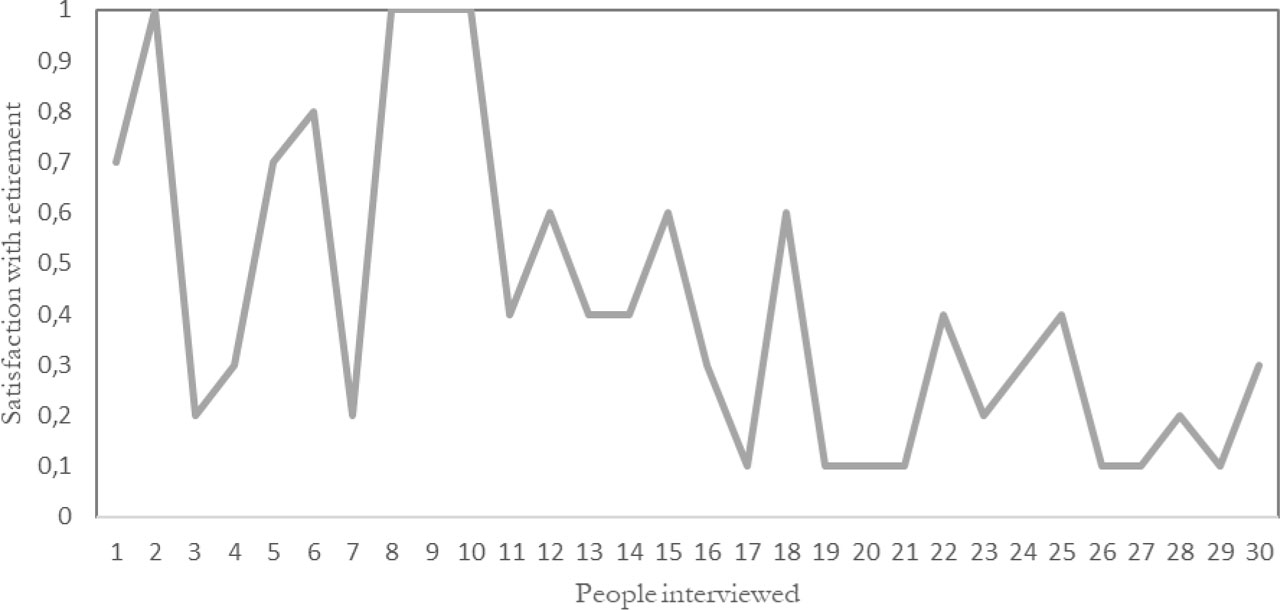
Figure 1
Level of satisfaction with retirement per person interviewed. Source: Fieldwork October 2019–January 2020 in Santiago, Chile.
Table 2
Sufficient pathways for satisfaction with retirement.
| No. | Variable name | Sufficient conditions Consistency |
|---|---|---|
| 1 | Amount of pension each month | 0.797 |
| 2 | Having a chronical disease (or not) | 0.767 |
| 5 | Working by choice (or not) | 0.660 |
| 7 | District in which they live during retirement | 0.676 |
| 29 | Size of SSN | 0.617 |
| 30 | Size of SSN with no kin | 0.624 |
| 34 | Efficiency of SSN | 0.669 |
| 35 | Reciprocity of material aid | 0.629 |
| 36 | Reciprocity of intimate interaction | 0.620 |
| 39 | Reciprocity of physical assistance | 0.736 |
[i] Note: For interpretation of a consistency: between 0.8–1.0 is high; 0.6–0.7 is modest; and the rest are low.
Table 3
Sufficient paths to being satisfied with retirement.
| D*E | A*~B*~C*~D | ~A*B*C*~D | ~A*B*~D*~E | |
|---|---|---|---|---|
| Consistency | 0.930 | 0.995 | 0.916 | 0.955 |
| Covered cases* | 4, 11, 16 | 9, 8, 10 | 30, 25, 22, 28, 21 | 3, 22 |
| Solution coverage | 0.460 | 0.396 | 0.501 | 0.501 |
| Solution consistency | 0.930 | 0.995 | 0.920 | 0.920 |
Table 4
Necessary conditions for satisfaction with retirement I.
| No. | Variable name | Coverage | Consistency |
|---|---|---|---|
| 3 | Living with someone else | 0.408 | 0.835 |
| 4 | Someone helping with domestic tasks | 0.435 | 0.890 |
| 8 | Age | 0.558 | 0.756 |
[i] Note: For interpretation, a consistency between 0.8–1.0 is high; 0.6–0.7 is modest; and the rest are low. Bold values shown a high level of consistency.
Table 5
Necessary conditions for satisfaction with retirement II.
| No. | Variable name | Coverage | Consistency |
|---|---|---|---|
| 11 | Completion of school education | 0.510 | 0.803 |
| 13 | Not having had children prior to 18 years of age | 0.474 | 0.858 |
| 14 | Having had both parents in childhood | 0.469 | 0.937 |
[i] Note: For interpretation, a consistency between 0.8–1.0 is high; 0.6–0.7 is modest; and the rest are low. Bold values shown a high level of consistency.
Table 6
Necessary conditions for satisfaction with retirement III.
| No. | Variable name | Coverage | Consistency |
|---|---|---|---|
| 16 | Ego received intimate interaction | 0.497 | 0.756 |
| 18 | Ego received feedback | 0.503 | 0.677 |
| 19 | Ego received physical assistance | 0.565 | 0.748 |
| 20 | Ego received positive interaction | 0.542 | 0.661 |
| 21 | Ego has not received negative interaction | 0.437 | 0.843 |
[i] Note: For interpretation, a consistency between 0.8–1.0 is high; 0.6–0.7 is modest; and the rest are low. Bold values shown a high level of consistency.
Table 7
Necessary conditions for satisfaction with retirement IV.
| No. | Variable name | Coverage | Consistency |
|---|---|---|---|
| 22 | Ego gives material aid | 0.568 | 0.724 |
| 23 | Ego gives intimate interaction | 0.429 | 0.638 |
| 25 | Ego gives feedback | 0.476 | 0.630 |
| 26 | Ego gives physical assistance | 0.556 | 0.622 |
| 27 | Ego gives positive interaction | 0.526 | 0.646 |
| 28 | Ego does not give negative interaction | 0.411 | 0.874 |
[i] Note: For interpretation, a consistency between 0.8–1.0 is high; 0.6–0.7 is modest; and the rest are low. Bold values shown a high level of consistency.
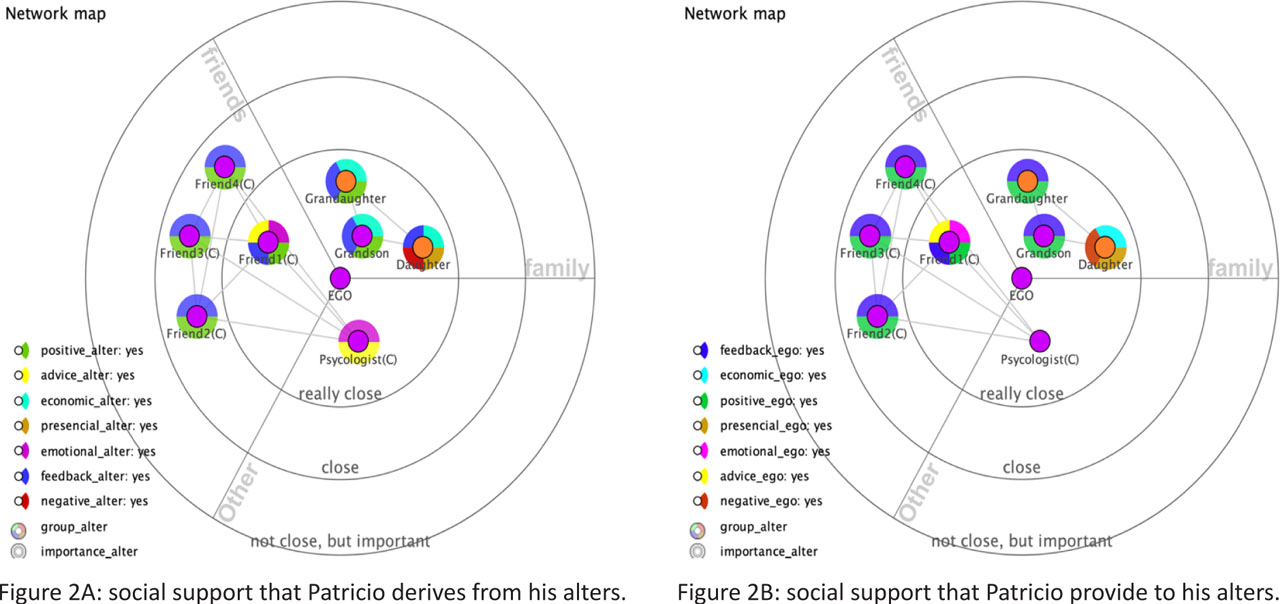
Figure 2
Patricio's SSN. SSN, social support network.
Table 8
Necessary conditions for satisfaction with retirement V.
| No. | Variable name | Coverage | Consistency |
|---|---|---|---|
| 31 | Density SSN | 0.518 | 0.740 |
| 32 | Density SSN no kin | 0.451 | 0.613 |
| 33 | IQV SSN | 0.493 | 0.803 |
| 42 | Constrain SSN | 0.533 | 0.786 |
[i] Note: For interpretation, a consistency between 0.8–1.0 is high; 0.6–0.7 is modest; and the rest are low. Bold values shown a high level of consistency.
[ii] IQV, Index of Qualitative Variation; SSNs, social support networks.
| AMOUNTMONTH (Fuzzy) | Amount of money (in Chilean peso) that EGO received each month | 0: Absence of money; 0.1: $0–$99,999; 0.2: $100,000–$199,999; 0.3: $200,000–$299,999; 0.4: $300,000–$399,999; 0.5: $400,000–$499,999; 0.6: $500,000–$599,999; 0.7: $600,000–$699,999; 0.8: $700,000–$799,999; 9: $800,000–$899,999; 10: >$900,000. |
| HEALTH (Crisp) | Whether the participant has a chronical disease now | 0: Have a chronical disease; 1: Does not have a chronical disease |
| HOUSE (Crisp) | Whether the participant lives with someone or not | 0: Living alone; 1: Not living alone |
| DOMESTIC (Crisp) | Whether the participant has at least one person who helps him/her with domestic tasks | 0: Nobody to do domestic work; 1: Have someone to do domestic work |
| WORKNOW (Fuzzy) | Whether the participant works or not | 0: Currently working, but not for choice; 0.6: Not working; 1: Currently working, but for choice |
| PARTNER (Crisp) | Whether the participant has his/her partner alive | 0: Partner not alive; 1: Partner alive |
| DISTRICT (Fuzzy) | Where the participant lives | 0.1: Quinta Normal (low class); 0.6: La Reina (middle class); 1: Vitacura (high class) |
| AGE (Fuzzy) | Age of the participant | 0: <60 years; 0.1: 60–63 years; 0.2: 64–67 years; 0.3: 68–71 years; 0.4: 72–75 years; 0.5: 76–79 years; 0.6: 80–83 years; 0.7: 84–87 years; 0.8: 88–91 years; 0.9: 92–95 years; 1: >95 years |
| GENDER (Crisp) | Gender of the participant | 0: Woman; 1: Man |
| BIRTH (Crisp) | Where the participant was born, whether in the capital or not | 0: Not born in the capital; 1: Born in the capital |
| SCHOOL (Crisp) | Whether the participant has completed schooling | 0: Not finished schooling; 1: Finished schooling |
| WORKCHILD (Crisp) | Whether the participant started working before attaining 18 years of age | 0: Started working before have 18 years old; 1: started working after have 18 years old |
| CHILDREN (Crisp) | Whether the participant had children prior to attaining 18 years of age | 0: Had children before 18 years of age; 1: Have not had children prior to 18 years of age |
| PARENTS (Fuzzy) | Whether the participant had both or one parent alive and in contact with him/her, during their childhood | 0: Did not have both parents; 0.6: Had only one parent alive in childhood; 1: Had both parents alive in childhood |
| SSEGO1 (Fuzzy) | Number of people who give material aids to ego | 0: No one; 0.3: One person; 0.7: Two people; 1: Three or more people |
| SSEGO2 (Fuzzy) | Number of people who give intimate interaction to ego | 0: No one; 0.3: One person; 0.7: Two people; 1: Three or more people |
| SSEGO3 (Fuzzy) | Number of people who give advice to ego | 0: No one; 0.3: One person; 0.7: Two people; 1: Three or more people |
| SSEGO4 (Fuzzy) | Number of people who give feedback to ego | 0: No one; 0.1: One person; 0.2: Two people; 0.3: Three people; 0.4: Four people; 0.5: Five people; 0.6: Six people; 0.7: Seven people; 0.8: Eight people; 0.9: Nine people; 1: ≥10 people |
| SSEGO5 (Fuzzy) | Number of people who give physical assistance to ego | 0: No one; 0.3: One person; 0.7: Two people; 1: Three or more people |
| SSEGO6 (Fuzzy) | Number of people who give positive interaction to ego | 0: No one; 0.1: One person; 0.2: Two people; 0.3: Three people; 0.4: Four people; 0.5: Five people; 0.6: Six people; 0.7: Seven people; 0.8: Eight people; 0.9: Nine people; 1: ≥10 people |
| SSEGO7 (Fuzzy) | Number of people who give negative interaction to ego | 0: Three or more people; 0.3: Two people; 0.7: One person; 1: No one |
| SSALTER1 (Fuzzy) | Number of people who give material aids to ego | 0: No one; 0.3: One person; 0.7: Two people; 1: Three or more people |
| SSALTER2 (Fuzzy) | Number of people who give intimate interaction to alter | 0: No one; 0.3: One person; 0.7: Two people; 1: Three or more people |
| SSALTER3 (Fuzzy) | Number of people who give advice to alter | 0: No one; 0.3: One person; 0.7: Two people; 1: Three or more people |
| SSALTER4 (Fuzzy) | Number of people who give feedback to alter | 0: No one; 0.1: One person; 0.2: Two people; 0.3: Three people; 0.4: Four people; 0.5: Five people; 0.6: Six people; 0.7: Seven people; 0.8: Eight people; 0.9: Nine people; 1: ≥10 people |
| SSALTER5 (Fuzzy) | Number of people who give physical assistance to alter | 0: No one; 0.3: One person; 0.7: Two people; 1: Three or more people |
| SSALTER6 (Fuzzy) | Number of people who give positive interaction to alter | 0: No one; 0.1: One person; 0.2: Two people; 0.3: Three people; 0.4: Four people; 0.5: Five people; 0.6: Six people; 0.7: Seven people; 0.8: Eight people; 0.9: Nine people; 1: ≥10 people |
| SSALTER7 (Fuzzy) | Number of people who give negative interaction to alter | 0: Three or more people; 0.3: Two people; 0.7: One person; 1: No one |
| SIZE | Number of alters in the network | 0: 0; 0.1: 1 or 2; 0.2: 3 or 4; 0.3: 5 or 6; 0.4: 7 or 8; 0.5: 9 or 10; 0.6: 11 or 12; 0.7: 13 or 14; 0.8; 15 or 16; 0.9: 17 or 18; 1: ≥19 |
| SIZENOKIN | Total number of alters having no kin in the network | 0: 0; 0.1: 1; 0.2: 2; 0.3: 3; 0.4: 4; 0.5: 5; 0.6: 6; 0.7: 7; 0.8; 8; 0.9: 9; 1: ≥10 |
| DENSITY | Social network measure of the density of the complete network | This measure takes values between 0 and 1. |
| DENSITYNOKIN | Social network measure of the density of the network without kin | This measure takes values between 0 and 1. |
| IQV (Fuzzy) | Social network measure of heterogeneity in the diversity of the types of support received by ego | This measure takes values between 0 and 1. |
| EFFICENCY | Social network measure of the efficiency of the network | This measure takes values between 0 and 1. |
| Mutuality1 | Social network measure of the reciprocity of the material aids network | This measure takes values between 0 and 1, by min–max normalization. The minimum value here was 0 and the maximum was 4. |
| Mutuality2 | Social network measure of the reciprocity of the intimate interaction network | This measure takes values between 0 and 1, by min–max normalization. The minimum value here was 0 and the maximum was 6. |
| Mutuality3 | Social network measure of the reciprocity of the advice network | This measure takes values between 0 and 1, by min–max normalization. The minimum value here was 0 and the maximum was 3. |
| Mutuality4 | Social network measure of the reciprocity of the feedback network | This measure takes values between 0 and 1, by min–max normalization. The minimum value here was 0 and the maximum was 12. |
| Mutuality5 | Social network measure of the reciprocity of the physical assistance network | This measure takes values between 0 and 1, by min–max normalization. The minimum value here was 0 and the maximum was 6. |
| Mutuality6 | Social network measure of the reciprocity of the positive interaction network | This measure takes values between 0 and 1, by min–max normalization. The minimum value here was 0 and the maximum was 11. |
| Mutuality7 | Social network measure of the reciprocity of the negative interaction network | This measure takes values between 0 and 1, by min–max normalization. The minimum value here was 0 and the maximum was 3. |
| Constrainnor | Social network measure of the aggregate constrains of the network | This measure takes values between 0 and 1. |
[i] IQV, index of qualitative variation; QCA, qualitative comparative analysis.
| Section | Conditions | Models | ||||
|---|---|---|---|---|---|---|
| 1 | 2 | 3 | 4 | 5 | ||
| Dependent variable | SATISFPENSION (Fuzzy) | X | X | X | X | X |
| Conditions from the present situation of the people interviewed | AMOUNTMONTH (Fuzzy) | X | X | |||
| HEALTH (Crip) | X | X | ||||
| HOUSE (Crisp) | X | X | ||||
| DOMESTIC (Crip) | X | X | ||||
| WORKNOW (Fuzzy) | X | X | ||||
| PARTNER (Crisp) | X | X | ||||
| DISTRICT (Fuzzy) | X | X | ||||
| AGE (Fuzzy) | X | X | ||||
| GENDER (Crisp) | X | X | ||||
| Conditions from the past of the people interviewed | BIRTH (Crisp) | X | X | |||
| SCHOOL (Crisp) | X | X | ||||
| WORKCHILD (Crisp) | X | X | ||||
| CHILDREN (Crisp) | X | X | ||||
| PARENTS (Fuzzy) | X | X | ||||
| Conditions from the SNA – relational approach | SSEGO1 (Fuzzy) | X | X | |||
| SSEGO2 (Fuzzy) | X | X | ||||
| SSEGO3 (Fuzzy) | X | X | ||||
| SSEGO4 (Fuzzy) | X | X | ||||
| SSEGO5 (Fuzzy) | X | X | ||||
| SSEGO6 (Fuzzy) | X | X | ||||
| SSEGO7 (Fuzzy) | X | X | ||||
| SSALTER1 (Fuzzy) | X | X | ||||
| SSALTER2 (Fuzzy) | X | X | ||||
| SSALTER3 (Fuzzy) | X | X | ||||
| SSALTER4 (Fuzzy) | X | X | ||||
| SSALTER5 (Fuzzy) | X | X | ||||
| SSALTER6 (Fuzzy) | X | X | ||||
| SSALTER7 (Fuzzy) | X | X | ||||
| DENSITY | X | X | ||||
| DENSITYNONKIN | X | X | ||||
| IQV (Fuzzy) | X | X | ||||
| EFFICENCY | X | X | ||||
| RECIPROCITY1 | X | X | ||||
| RECIPROCITY2 | X | X | ||||
| RECIPROCITY3 | X | X | ||||
| RECIPROCITY4 | X | X | ||||
| RECIPROCITY5 | X | X | ||||
| RECIPROCITY6 | X | X | ||||
| RECIPROCITY7 | X | X | ||||
| Constrainnor | X | X | ||||
[i] IQV, index of qualitative variation; QCA, qualitative comparative analysis; SNA, social network analysis.