
Table 1:
Comparison of Traditional and Modern Military Communication Platforms
| Feature | Conventional Frameworks | Proposed Secure Framework |
|---|---|---|
| Transmission Medium | Basic radio and satellite channels | Encrypted multi-layer digital networks with adaptive routing |
| Data Rate | Limited throughput | High-capacity, mission-optimized transfer speeds |
| Security | Susceptible to interception and disruption | Integrated end-to-end encryption with quantum-ready algorithms |
| Interoperability | Partial integration across services | Tailored joint and multinational compatibility |
| Adaptability | Static frequency and rigid protocols | Dynamic spectrum allocation with software-defined controls |
| Reliability in combat | Easily degraded by jamming and EW attacks | Maintains continuity under EW and cyber-contested environments |
Table 2:
Framework for Resilient Military Communication
| Layer | Process | Technology Applied | Impact on Military Operations |
|---|---|---|---|
| 1. Secure Initialization | Establishes multilayer encryption and optimized links | Quantum-resistant protocols, adaptive routing | Reliable and protected mission startup |
| 2. Signal Control & Monitoring | Detects jamming and reallocates spectrum securely | Distributed authentication, EW monitoring tools | Stronger defense against hostile interference |
| 3. Multi-Domain Data Exchange | Shares intelligence across all operational domains | IoBT sensors, encrypted voice-to-data conversion | Seamless cooperation between land, air, sea, space, and cyber units |
| 4. Adaptive Connectivity | Maintains links in contested environments | LEO satellite systems, SDR-based frequency agility | Sustained communications under electronic warfare |
| 5. Decision Support Layer | Analyzes live data and forecasts threats | Predictive analytics, cyber risk modeling | Faster and more accurate command decisions |
| 6. Network Reinforcement | Strengthens weak points and stores mission data securely | Self-healing networks, encrypted archival systems | Long-term resilience and secure mission continuity |
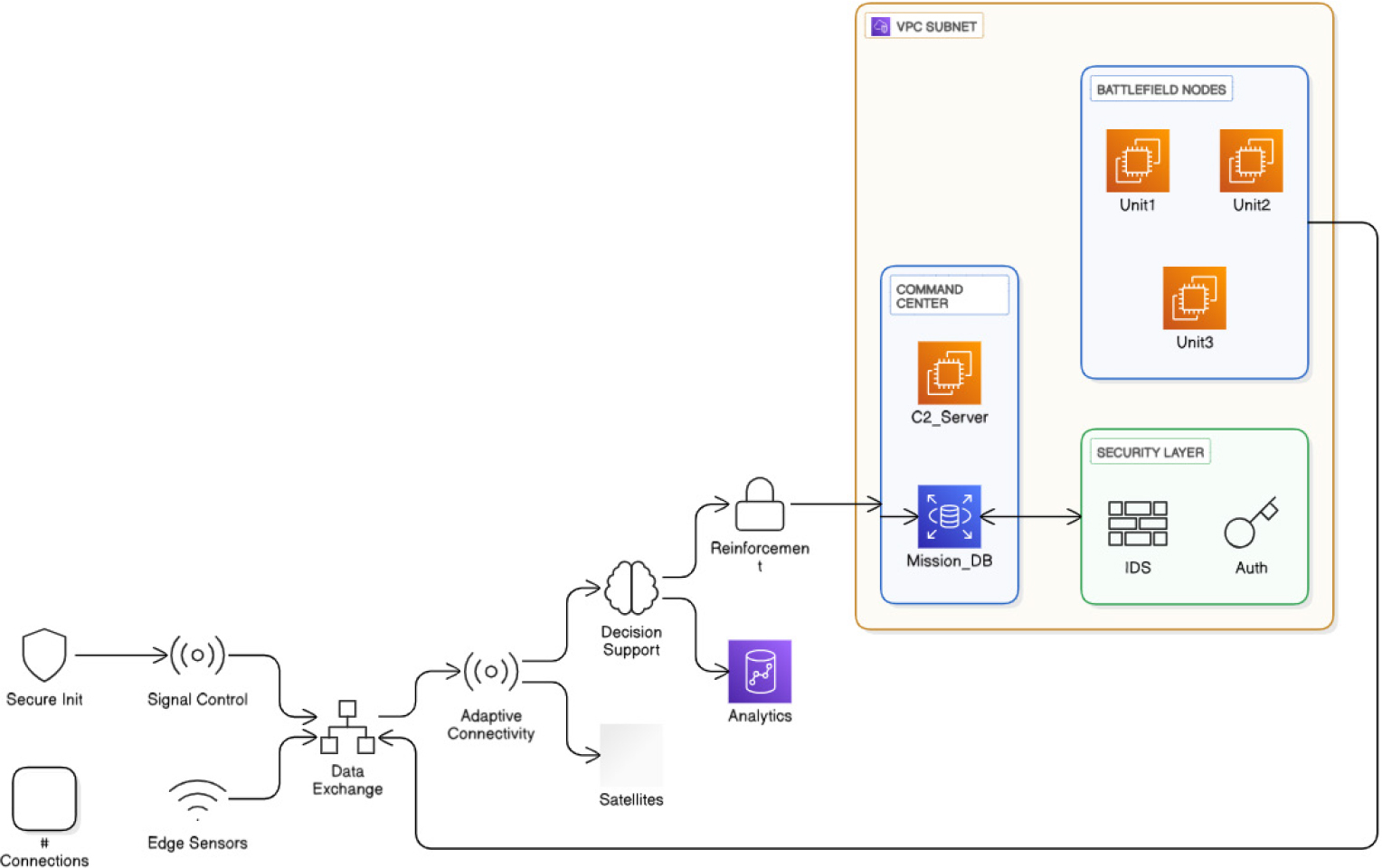
Figure 1:
Layered Framework for Resilient Military Communication
Table 3:
Impact of Resilient Communication Framework on Operational Effectiveness
| Key Advantage | Conventional communication | Resilient Framework | Impact on Operations |
|---|---|---|---|
| Speed of Deployment | Manual configuration and delayed setup | Automated initialization with secure protocols | Faster preparation and improved mission readiness |
| Reliability in Combat | Susceptible to disruption and jamming | LEO satellite coverage with SDR-based flexibility | Sustained connectivity in contested environments |
| Cybersecurity | Basic encryption with limited protection | Multi-layer security with quantum-safe methods | Stronger defense of classified data and networks |
| Interoperability | Restricted to branchspecific systems | Unified backbone for joint and coalition forces | Smooth coordination across Allied operations |
| Threat Response | Manual monitoring and delayed reaction | Predictive detection with automated countermeasures | Preemptive defense against cyber and EW threats |