
Tab. 1:
Filter settings on the Web of Science platform
| Search timeframe | 2005 to June 2025 |
|---|---|
| Document types | Journal articles, conference proceedings |
| Language | English |
| Fields | Topic (TS): titles, abstracts, author keywords, Keywords Plus |
| Thematic area | Sample keywords |
| Small and medium enterprise | TS=((“small business*” OR “small enterprise*” OR “medium business*” OR “medium enterprise*” OR SME OR SMEs OR “micro enterprise*” OR “micro business*” OR “micro, small and medium enterprise*” OR MSME OR MSMEs OR “small and medium-sized business*” OR “small and medium-sized enterprise*” OR “small-to-medium business*” OR “small-to-medium enterprise*” OR SMB OR SMBs) |
| NEAR/10 | |
| Cybersecurity |
|
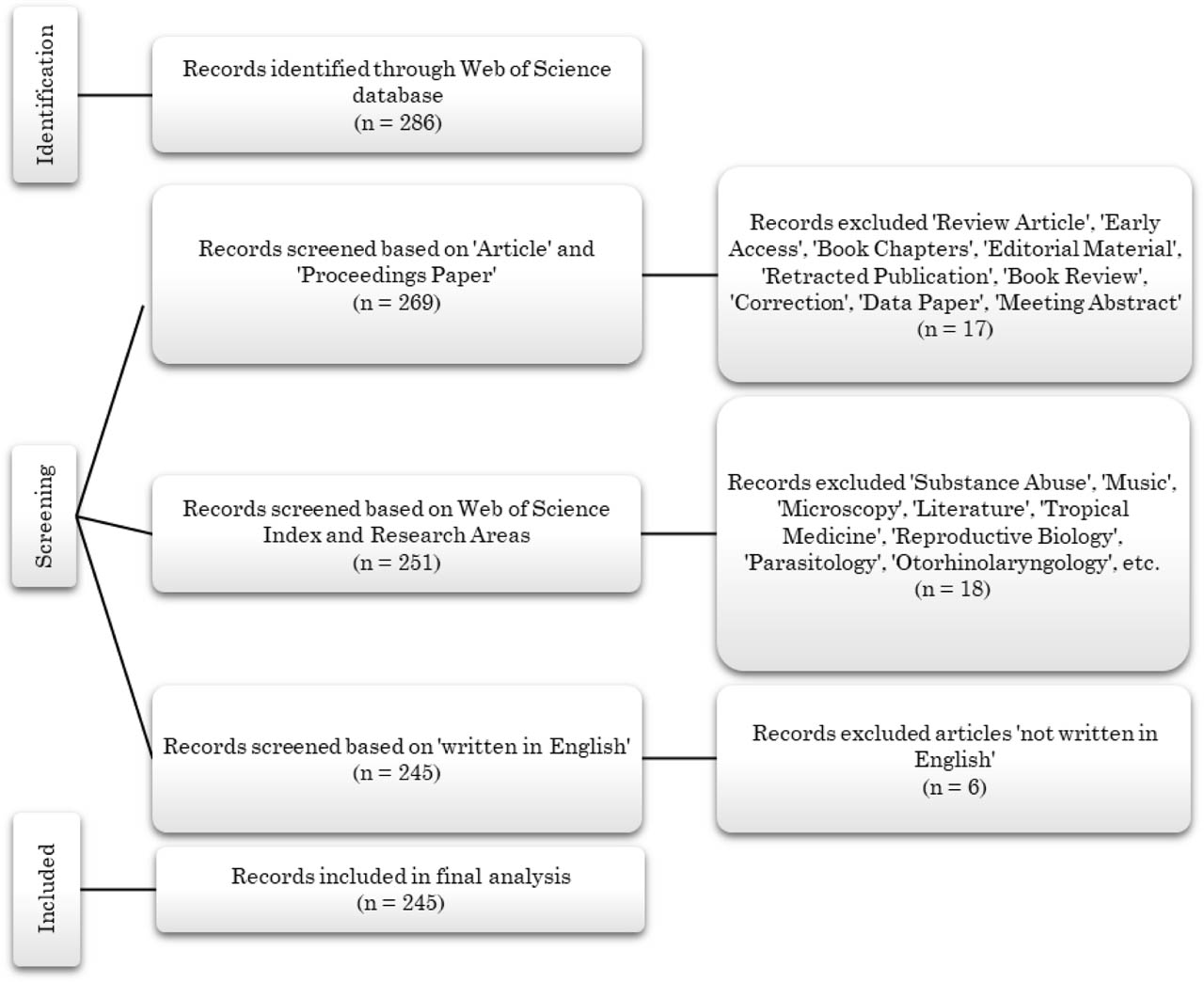
Fig. 1:
PRISMA flow diagram.
Source: Prepared by the authors.
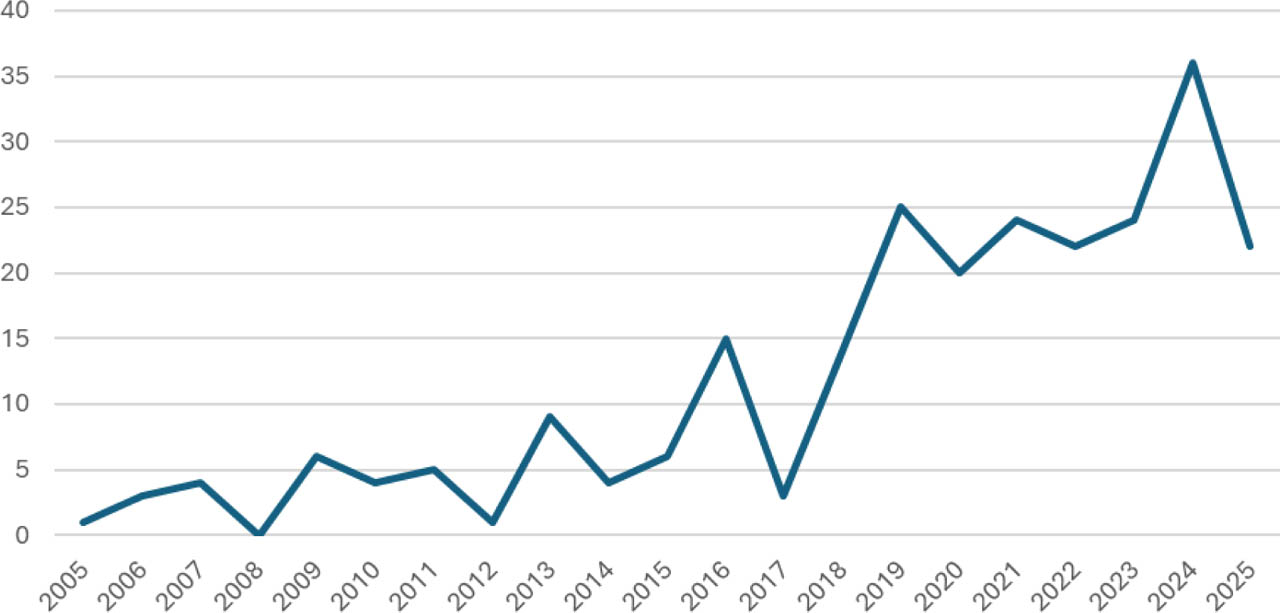
Fig. 2:
Publication trend.
Source: Prepared by the authors.
Tab. 2:
Bibliometric summary of the dataset
| Description | Results | Description | Results |
|---|---|---|---|
| Timespan | 2005–2025 | Authors | 787 |
| Sources (journals, books, etc.) | 194 | Authors of single-authored docs | 14 |
| Documents | 245 | Single-authored docs | 16 |
| Annual growth rate % | 16.71 | Co-authors per doc | 3.63 |
| Document average age | 5.47 | International co-authorships % | 20.41 |
| Average citations per doc | 7.837 | Article | 112 |
| References | 8219 | Article; proceedings paper | 1 |
| Keywords Plus (ID) | 221 | Proceedings paper | 132 |
| Author's keywords (DE) | 794 |
Tab. 3:
Top 20 most frequently occurring keywords
| KEYWORD | OCCURRENCES | KEYWORD | OCCURRENCES |
|---|---|---|---|
| CYBERSECURITY | 69 | RISK | 13 |
| INFORMATION SECURITY | 48 | CHALLENGES | 12 |
| SMES | 47 | ADOPTION | 11 |
| SME | 38 | TECHNOLOGY | 11 |
| MANAGEMENT | 27 | INDUSTRY 4 0 | 10 |
| SECURITY | 27 | MODEL | 10 |
| RISK MANAGEMENT | 15 | BUSINESS | 9 |
| AWARENESS | 14 | CYBERSECURITY AWARENESS | 9 |
| IMPACT | 14 | INFORMATION | 9 |
| CYBER SECURITY | 13 | INNOVATION | 9 |
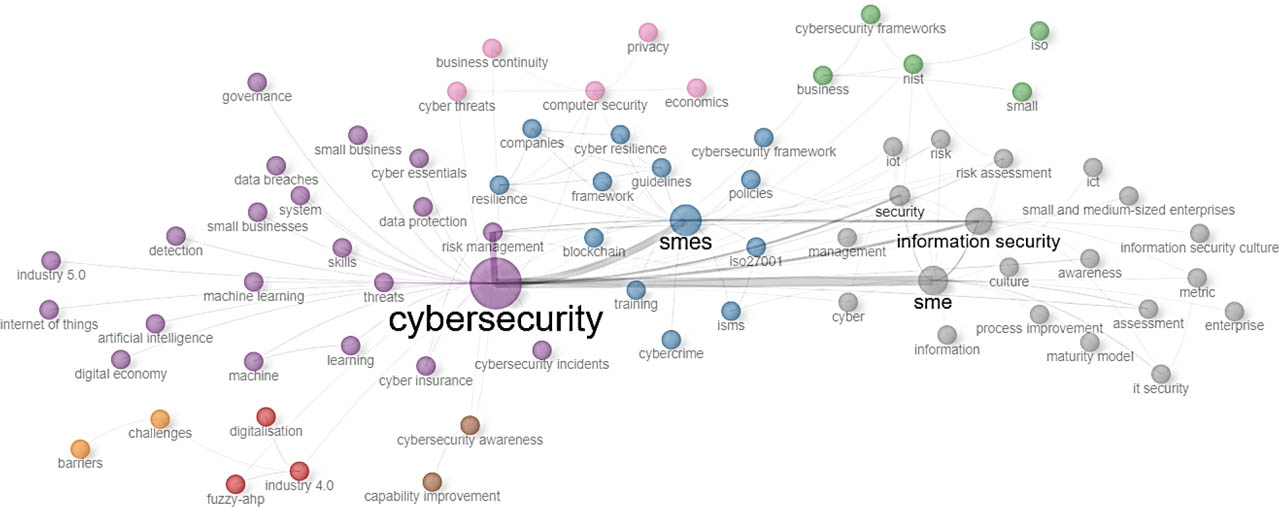
Fig. 3:
Co-occurrence network of keywords (2005–2025).
Source: Prepared by the authors.
Tab. 4:
Top 10 authors by number of citations and by number of documents
| Author | Articles | TC | h_index | g_index | m_index | PY_start | Articles fractionalized |
|---|---|---|---|---|---|---|---|
| ARRANZ CFA | 4 | 28 | 3 | 4 | 1.5 | 2024 | 0.8 |
| ARROYABE MF | 4 | 28 | 3 | 4 | 1.5 | 2024 | 0.8 |
| DE ARROYABE JCF | 5 | 47 | 4 | 5 | 1.3333 | 2023 | 1.30 |
| GRANDCLAUDON J | 4 | 17 | 3 | 4 | 0.375 | 2018 | 1.25 |
| JAYAL A | 4 | 46 | 3 | 4 | 0.6 | 2021 | 1.2 |
| LEVY Y | 4 | 6 | 2 | 2 | 0.25 | 2018 | 1.33 |
| NCUBUKEZI T | 4 | 8 | 2 | 2 | 0.3333 | 2020 | 2.67 |
| PONSARD C | 4 | 17 | 3 | 4 | 0.275 | 2018 | 1.25 |
| PRAKASH E | 4 | 46 | 3 | 4 | 0.6 | 2021 | 1.2 |
| SPRUIT M | 5 | 71 | 5 | 5 | 0.5 | 2016 | 1.31 |
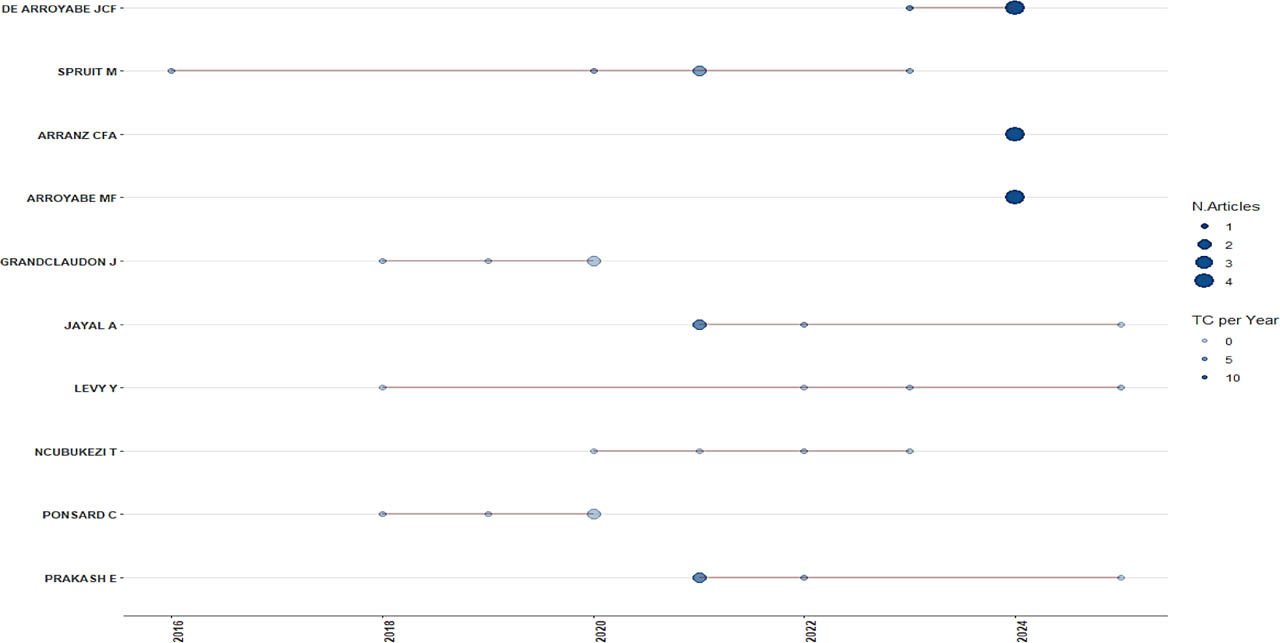
Fig. 4:
Top author productivity over time.
Source: Prepared by the authors.
Tab. 5:
Author productivity through Lotka's Law
| Documents written | No. of authors | Proportion of authors | Theoretical |
|---|---|---|---|
| 1 | 717 | 0.911 | 0.683 |
| 2 | 51 | 0.065 | 0.171 |
| 3 | 8 | 0.01 | 0.076 |
| 4 | 9 | 0.011 | 0.043 |
| 5 | 2 | 0.003 | 0.027 |
Tab. 6:
The number and share of individual countries involved in publication activities focused on cybersecurity in SMEs
| Country | Articles | Freq | Single-country publication | Multiple-country publication | MCP ratio |
|---|---|---|---|---|---|
| The United States | 28 | 0.11 | 26 | 2 | 0.071 |
| The United Kingdom | 27 | 0.11 | 21 | 6 | 0.222 |
| South Africa | 15 | 0.06 | 15 | 0 | 0 |
| China | 12 | 0.05 | 11 | 1 | 0.083 |
| Germany | 12 | 0.05 | 11 | 1 | 0.083 |
| Spain | 12 | 0.05 | 9 | 3 | 0.25 |
| Australia | 11 | 0.04 | 7 | 4 | 0.364 |
| France | 7 | 0.03 | 4 | 3 | 0.429 |
| Greece | 7 | 0.03 | 5 | 2 | 0.286 |
| India | 7 | 0.03 | 5 | 2 | 0.286 |
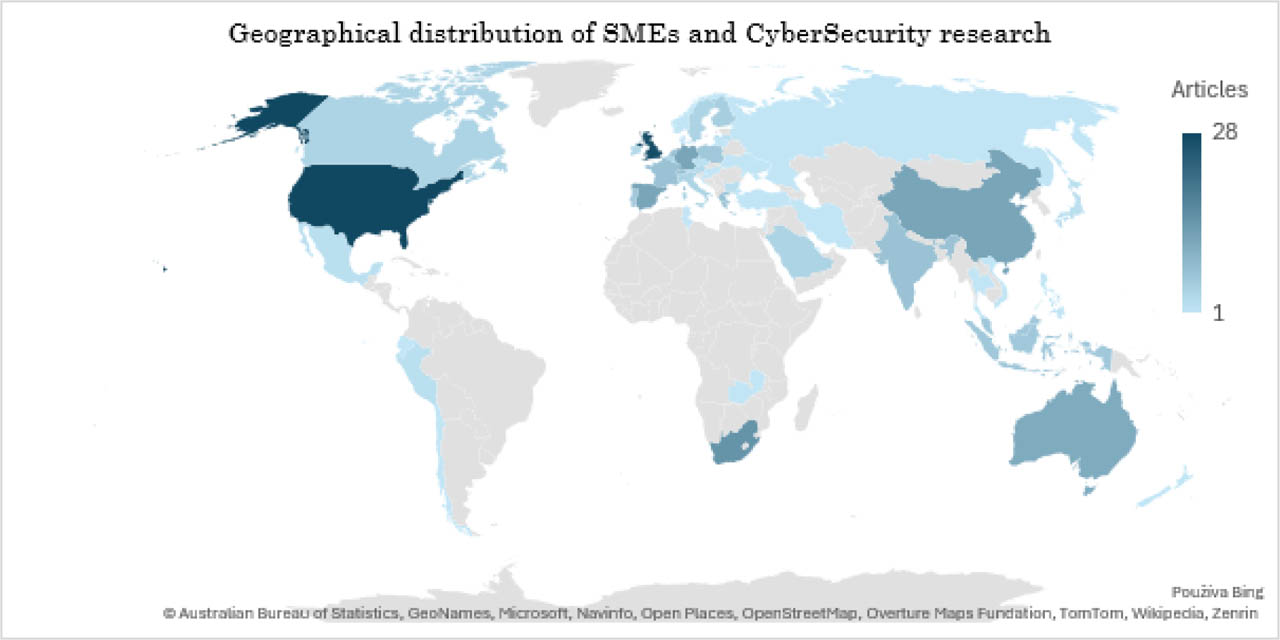
Fig. 5:
Geographical distribution of SME and cybersecurity research.
Source: Prepared by the authors.
Tab. 7:
Top 10 publications by number of citations
| Author and year | DOI | Total citations | TC per year | Normalized TC |
|---|---|---|---|---|
| FIELDER A, 2016 | 10.1016/j.dss.2016.02.012 | 152 | 15.20 | 8.98 |
| KABANDA S, 2018 | 10.1080/10919392.2018.1484598 | 64 | 8.00 | 4.87 |
| YILDIRIM EY, 2011 | 10.1016/j.ijinfomgt.2010.10.006 | 63 | 4.20 | 3.99 |
| BENZ M, 2020 | 10.1016/j.bushor.2020.03.010 | 61 | 10.17 | 5.73 |
| HEIDT M, 2019 | 10.1007/s10796-019-09959-1 | 59 | 8.43 | 5.27 |
| KLJUCNIKOV A, 2019 | 10.9770/jesi.2019.6.4(37) | 55 | 7.86 | 4.91 |
| TAMVADA JP, 2022 | 10.1016/j.techfore.2022.122088 | 55 | 13.75 | 4,25 |
| WONG LW, 2022 | 10.1016/j.ijinfomgt.2022.102520 | 53 | 13.25 | 4,09 |
| GUPTA S, 2018 | 10.1108/JOCM-06-2017-0230 | 51 | 6.38 | 3.88 |
| ARMENIA S, 2021 | 10.1016/j.dss.2021.113580 | 50 | 10.00 | 4.86 |
Tab. 8:
Top 10 journals
| Sources | Articles | TC | H-index | G-index | M-index | PY_start |
|---|---|---|---|---|---|---|
| Information and Computer Security | 10 | 94 | 5 | 9 | 0.5 | 2016 |
| Journal of Computer Information Systems | 4 | 52 | 4 | 4 | 0.4 | 2016 |
| Ares 2021: 16th International Conference on Availability, Reliability and Security | 4 | 18 | 3 | 4 | 0.6 | 2021 |
| Computers & Security | 5 | 43 | 3 | 5 | 0.75 | 2022 |
| IEEE Access | 4 | 77 | 3 | 4 | 0.5 | 2020 |
| Technological Forecasting and Social Change | 3 | 86 | 3 | 3 | 0.6 | 2021 |
| 2019 IEEE 24th International Workshop on Computer Aided Modeling and Design Of Communication Links and Networks (IEEE CAMAD) | 2 | 14 | 2 | 2 | 0.286 | 2019 |
| 2020 61st International Scientific Conference on Information Technology and Management Science of Riga Technical University (ITMS) | 2 | 12 | 2 | 2 | 0.333 | 2020 |
| Computers | 3 | 35 | 2 | 3 | 0.4 | 2021 |
| Decision Support Systems | 2 | 202 | 2 | 2 | 0.2 | 2016 |
Tab. 9:
PRISMA 2020 Checklist
| Section and topic | Item # | Checklist item | Location where item is reported |
|---|---|---|---|
| TITLE | |||
| Title | 1 | Identify the report as a systematic review. | Title page, abstract |
| ABSTRACT | |||
| Abstract | 2 | See the PRISMA 2020 for Abstract checklist. | Abstract section |
| INTRODUCTION | |||
| Rationale | 3 | Describe the rationale for the review in the context of existing knowledge. | Introduction section |
| Objectives | 4 | Provide an explicit statement of the objective(s) or question(s) the review addresses. | Introduction section |
| METHODS | |||
| Eligibility criteria | 5 | Specify the inclusion and exclusion criteria for the review and how studies were grouped for the syntheses. | Methods—eligibility criteria |
| Information sources | 6 | Specify all databases, registers, websites, organizations, reference lists, and other sources searched or consulted to identify studies. Specify the date when each source was last searched or consulted. | Methods—information sources (Web of Science, search completed June 2025) |
| Search strategy | 7 | Present the full search strategies for all databases, registers, and websites, including any filters and limits used. | Methods—search strategy (keywords, filters) |
| Selection process | 8 | Specify the methods used to decide whether a study met the inclusion criteria of the review, including how many reviewers screened each record and each report retrieved, whether they worked independently, and if applicable, details of automation tools used in the process. | Methods—selection process (screening by document type, language, subject area) |
| Data collection process | 9 | Specify the methods used to collect data from reports, including how many reviewers collected data from each report, whether they worked independently, any processes for obtaining or confirming data from study investigators, and if applicable, details of automation tools used in the process. | Methods—data collection (using Bibliometrix in RStudio) |
| Data items | 10a | List and define all outcomes for which data were sought. Specify whether all results that were compatible with each outcome domain in each study were sought (e.g., for all measures, time points, analyses), and if not, the methods used to decide which results to collect. | Methods—keyword analysis, citation metrics, co-authorship networks |
| 10b | List and define all other variables for which data were sought (e.g., participant and intervention characteristics, funding sources). Describe any assumptions made about any missing or unclear information. | Methods—additional metadata (publication year, country, document type) | |
| Study risk of bias assessment | 11 | Specify the methods used to assess risk of bias in the included studies, including details of the tool(s) used, how many reviewers assessed each study and whether they worked independently, and if applicable, details of automation tools used in the process. | Not applicable—no risk of bias assessment conducted |
| Effect measures | 12 | Specify for each outcome the effect measure(s) (e.g., risk ratio, mean difference) used in the synthesis or presentation of results. | Not applicable—no effect size or outcome comparison |
| Synthesis methods | 13a | Describe the processes used to decide which studies were eligible for each synthesis (e.g., tabulating the study intervention characteristics and comparing against the planned groups for each synthesis [item #5]). | Methods—descriptive bibliometric synthesis using Bibliometrix |
| 13b | Describe any methods required to prepare the data for presentation or synthesis, such as handling of missing summary statistics, or data conversions. | Methods—descriptive bibliometric synthesis using Bibliometrix | |
| 13c | Describe any methods used to tabulate or visually display results of individual studies and syntheses. | Methods—descriptive bibliometric synthesis using Bibliometrix | |
| 13d | Describe any methods used to synthesize results and provide a rationale for the choice(s). If meta-analysis was performed, describe the model(s) and method(s) to identify the presence and extent of statistical heterogeneity and software package(s) used. | Methods—descriptive bibliometric synthesis using Bibliometrix | |
| 13e | Describe any methods used to explore possible causes of heterogeneity among study results (e.g., subgroup analysis, meta-regression). | Methods—descriptive bibliometric synthesis using Bibliometrix | |
| 13f | Describe any sensitivity analyses conducted to assess robustness of the synthesized results. | Methods—descriptive bibliometric synthesis using Bibliometrix | |
| Reporting bias assessment | 14 | Describe any methods used to assess risk of bias due to missing results in a synthesis (arising from reporting biases). | Not applicable—bibliometric study |
| Certainty assessment | 15 | Describe any methods used to assess certainty (or confidence) in the body of evidence for an outcome. | Not applicable |
| RESULTS | |||
| Study selection | 16a | Describe the results of the search and selection process from the number of records identified in the search to the number of studies included in the review, ideally using a flow diagram. | Results—study selection, flow of inclusion (n = 286 → 245) |
| 16b | Cite studies that might appear to meet the inclusion criteria, but which were excluded, and explain why they were excluded. | Methods—list of exclusion criteria (e.g., language, document type, topic mismatch) | |
| Study characteristics | 17 | Cite each included study and present its characteristics. | Results—core publications, tables with citation data |
| Risk of bias in studies | 18 | Present assessments of risk of bias for each included study. | Not applicable |
| Results of individual studies | 19 | For all outcomes, present, for each study: (a) summary statistics for each group (where appropriate) and (b) an effect estimate and its precision (e.g., confidence/credible interval), ideally using structured tables or plots. | Not applicable—no meta-analysis or comparative statistics |
| Results of syntheses | 20a | For each synthesis, briefly summarize the characteristics and risk of bias among contributing studies. | Results—descriptive synthesis of themes, authors, journals |
| 20b | Present results of all statistical syntheses conducted. If meta-analysis was done, present for each the summary estimate and its precision (e.g., confidence/credible interval) and measures of statistical heterogeneity. If comparing groups, describe the direction of the effect. |
| |
| 20c | Present results of all investigations of possible causes of heterogeneity among study results. | Results—descriptive synthesis of themes, authors, journals | |
| 20d | Present results of all sensitivity analyses conducted to assess the robustness of the synthesized results. | Results—descriptive synthesis of themes, authors, journals | |
| Reporting biases | 21 | Present assessments of risk of bias due to missing results (arising from reporting biases) for each synthesis assessed. | Not applicable |
| Certainty of evidence | 22 | Present assessments of certainty (or confidence) in the body of evidence for each outcome assessed. | Not applicable |
| DISCUSSION | |||
| Discussion | 23a | Provide a general interpretation of the results in the context of other evidence. | Discussion—synthesis with prior literature |
| 23b | Discuss any limitations of the evidence included in the review. | Discussion—thematic and dataset limitations | |
| 23c | Discuss any limitations of the review processes used. | Discussion—limitations of bibliometric method (e.g., database dependence) | |
| 23d | Discuss implications of the results for practice, policy, and future research. | Discussion—recommendation section | |
| OTHER INFORMATION | |||
| Registration and protocol | 24a | Provide registration information for the review, including register name and registration number, or state that the review was not registered. | Review not registered |
| 24b | Indicate where the review protocol can be accessed, or state that a protocol was not prepared. | No protocol was prepared | |
| 24c | Describe and explain any amendments to information provided at registration or in the protocol. | Not applicable | |
| Support | 25 | Describe sources of financial or nonfinancial support for the review and the role of the funders or sponsors in the review. | Funding |
| Competing interests | 26 | Declare any competing interests of review authors. | Declarations—no conflict of interest |
| Availability of data, code, and other materials | 27 | Report which of the following are publicly available and where they can be found: template data collection forms, data extracted from included studies, data used for all analyses, analytic code, and any other materials used in the review. | Available upon request or documented in Methods |