
INTRODUCTION
Probably one of the most significant events of the 20th century, which brought changes in public management practices around Central Eastern Europe (CEE) and Western Asian regions, was the demise of socialism. This caused substantive changes to economic, political, and social landscapes (Gill, 1992) through reorientation toward free markets. Countries with similar traditions of public administration experienced substantial economic transformations and faced several dilemmas regarding the reconstruction of their public sector practices: “rebuilding on ruins” or “rebuilding with the ruins” (Stark, 1996, p. 995), following revolutionary or evolutionary changes (Feldmann, 2018). This was a difficult choice for the newly established states, which were unfamiliar with market rules and capitalism (Hogan, 1991).
The dynamics of the reforms were influenced by external—often interconnected—pressures, such as the effects of the financial crisis (Peters, 2011; Foster & Magdoff, 2009), diffusion of practices by international financial institutions (Neu, Silva, & Ocampo Gomez, 2008), and isomorphic mimicry (Krause, 2013). Such exogenous pressures promoted the implementation of similar packages of public sector reforms (Drechsler, 2005), focused on implementing business-like rules in the public sector, with the aim of maximizing public organizations’ efficiency and effectiveness regarding service delivery (Klijn, 2012). Nevertheless, “each country makes its own translation or adaptation” (Ferlie, Lynn Jr, & Pollitt, 2005, p. 721) of reform packages. This depends on local factors, such as historical background (Christensen, Lie, & Lægreid, 2008), commitment of ideologically driven political leaders (Abrams & Fish, 2015), unstable political context (Mele & Ongaro, 2014), local culture, status of public servants (Shpak, Podolchak, Karkovska, & Sroka, 2019; Kotrusová & Výborná, 2016), economic and/or political elites, and level of democracy.
After the dissolution of the Union of Soviet Socialist Republics (USSR), in the early 1990s, several reforms took place in Eastern European (EE) and former Soviet Union (FSU) countries, reflecting public sector transformations in response to substantial economic, societal, and political change events. While the dissolution caused economic turbulence in some FSU countries, growth patterns marked the EE countries, until a series of crises hit the region in 1997–1998 (Roaf, Atoyan, Joshi, Krogulski, & IMF Staff Team, 2014). The downturn of national economies made governments optimize public sector spending, which might have served as a new impetus toward public sector reforms. The new millennium brought a boost of economic activity and stable growth until the global financial crisis of 2008–2009, which caused a substantial drop in output, showed a greater negative impact than in any other region of the world (Roaf et al., 2014). Facing fiscal imbalances, some governments had to alter their policies under austerity (Jõgiste, Peda, & Grossi, 2012), which further affected the level of democracy in some of the countries (Pavlović, 2019). Simultaneously, a strong aspiration for European Union (EU) integration influenced public sector reforms in countries eager to join the Union, as those governments were required to harmonize their national legislation with the EU’s.
Despite these outstanding transformations spreading across the region, over the years, the academic discussion of adopting new policies and practices in the public sector was mostly focused on Western countries (e.g., Weiss, 2017; Anessi-Pessina & Steccolini, 2005; Christensen, Lie, & Lægreid, 2008). Even more surprisingly, the body of research on countries facing the demise of planned economy and introduction of public sector management (PSM) reforms in CEE still remains fragmented (Dan & Pollitt, 2015). At the same time, those studies, which actually do focus on PSM reform/(s) in transitional context, provide intriguing findings of one or couple country cases, yet giving little chance to grasp the macropicture of changes occurring within the whole region. This article is a genuine opportunity to contribute to the debate by tracing reforms’ trajectories in this region. Following developments since the 1990s in the public sector of CEE and FSU allows us to capture major transformations during the 25 years of the transition to market economy. Learning from the past brings valuable knowledge to both academics and practitioners in explaining social, economic, and/or institutional patterns observed at the present time among the countries-in-focus, to trace the range of reforms as well as to foresee what might be the future trends of PSM in the region. To achieve this, we frame our analysis within a generic policy process framework (De Boer et al., 2016) and demonstrate how the focus of the reforms (inspired by Pollitt & Bouckaert’s (2017) classification) has been changing.
This article aims to explore the dynamically changing public sector in the context of EE and FSU countries, to provide an in-depth understanding of trajectories of PSM reforms, which appeared unsystematically as the countries started introducing novel public sector practices, for example, performance measurement and management, new accounting and reporting principles, civil service reforms, privatization, and other initiatives (Savas, 1992; Mikesell and Mullins, 2001; Guess, 2007; Verheijen and Dobrolyubova, 2007), in the region after the quarter of century since the collapse of the USSR. Through a systematic literature review (SLR) approach, we answer the following research questions:
RQ1: What was the main focus of the research on PSM reforms in EE and FSU countries?
RQ2: Which PSM reforms and how they were developing in EE and FSU countries after the start of transition to the market economy?
In this way, this article seeks to contribute to the public administration research by identifying the exhaustiveness of the literature, analyzing it based on the policy process framework and mapping research gaps to encourage further scientific development (Schooler, 2014; Torraco, 2016).
This article is structured as follows. The next section discusses the methodological approach used to review the literature. Then, the analysis of SLR findings is presented and followed by a discussion of the changing trajectories of the PSM reforms in EE and FSU countries, outlining the complexity and layering of reforms in the region. This article ends with concluding remarks, suggestions of further research, limitations, and implications.
RESEARCH PROTOCOL
This article applied a systematic review of the literature, which ensures replicability of results, minimizes a potential bias during the review process, and thus increases the credibility of the SLR (Tranfield, Denyer, & Smart, 2003). Ensuring replicability and transparency of research is crucial (Mattei, Grossi, & Guthrie, 2021); thus, the research approach follows the “PRISMA Flow Diagram” (Moher, Liberati, Tetzlaff, & Altman, 2009), which is widely adopted when conducting public sector research (e.g., Polzer, Adhikari, Nguyen, & Gårseth-Nesbakk, 2021).
Review Boundaries
To provide an overview of PSM reforms in EE and FSU countries experiencing the transition from socialism to capitalism, first, a classification framed around politicoeconomic systems is used, as this allows for a more comprehensive overview of the changing PSM practices in the region. In the past, the sample of selected countries belonged to the Eastern Bloc, comprising the USSR and satellite states, built on the principles of planned economy. Importantly, in the following analytical sections, the distinction between EE and FSU countries is made, based on the contrasting speed of economic recovery during the first years of transition, the ease of state building and internal political influences on the process of reform (IMF, 2000). Second, the time span of 1991–2017 has been chosen, to provide a snapshot of developments of PSM reforms in EE and FSU countries during the quarter of the century after the dissolution of the USSR. The final boundary was limiting the papers written in English only (Mauro, Cinquini, & Grossi, 2017).
The Review Processes
We started with the identification of keywords. Given the broad focus of this SLR, the following keywords were used in the search: reform, public sector, and the name of one of 28 EE and FSU countries. The expression “public sector” rather than “public sector management” was used as a keyword because it yields a wider search result. To provide a holistic overview of the existing body of literature, the search was framed by Scopus, Web of Science (WoS), and JSTOR databases, which, as the major databases (Paoloni, Mattei, Dello Strogolo, & Celli, 2020), have often been used in previous literature reviews on similar topics (e.g., Mauro, Cinquini, & Grossi, 2017). The process of finding eligible papers is summarized in Figure 1.
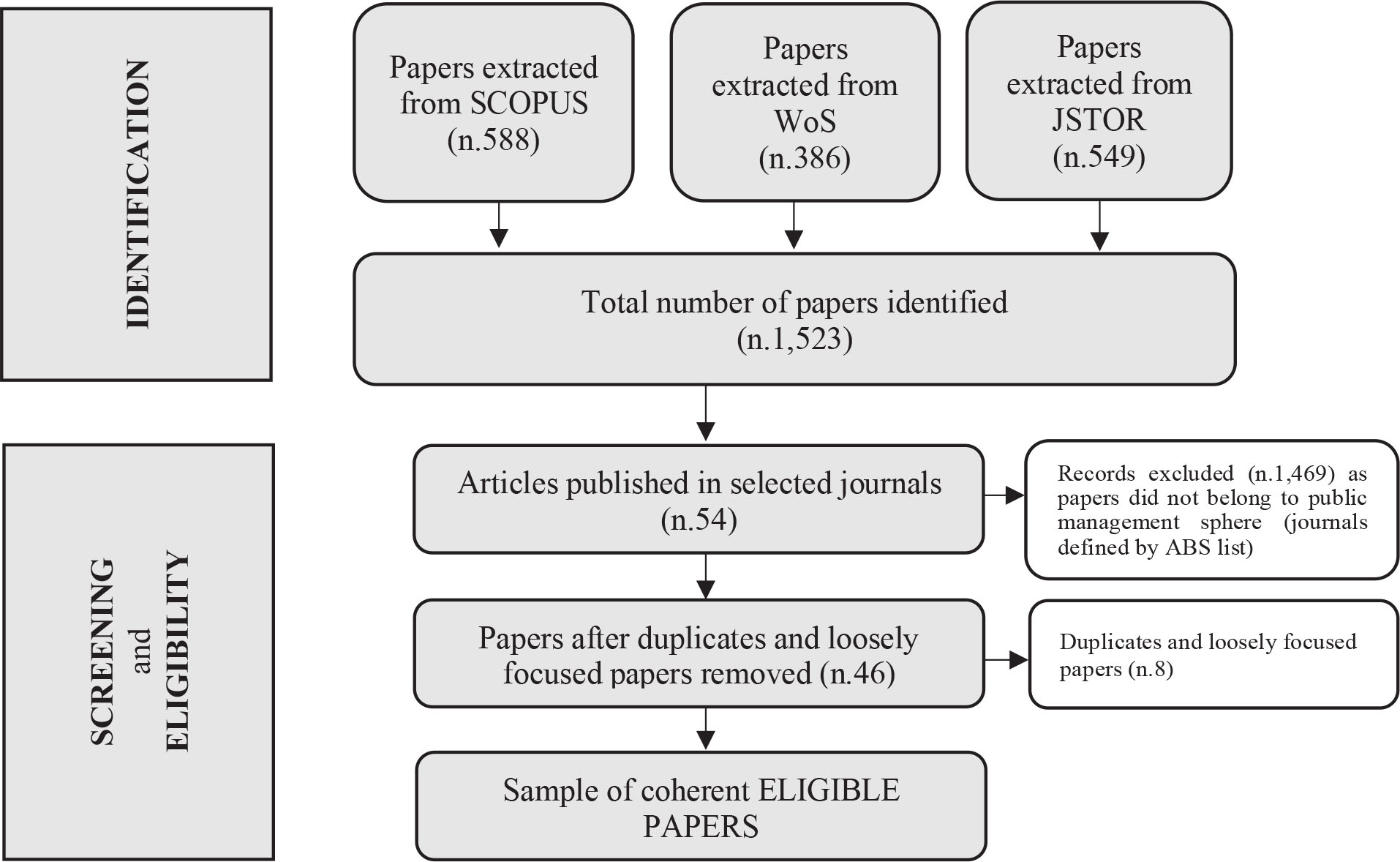
Fig. 1:
Search, identification, and selection of records for review (adopted from Moher, Liberati, Tetzlaff, & Altman, 2009)
To identify the studies (step 1) we conducted search rounds in each of three selected web-search engines, 28 search queries were framed. During searches, Boolean logic was applied to frame the search by combining selected keywords (e.g., “reform” AND “public sector” AND “the name of one of 28 EE and FSU countries”) for each search round. For Scopus and WoS databases, the queries were made by limiting the search to abstracts, keywords, and titles. In JSTOR, the query was limited to “articles, full-text, and 33 journals.”
A total of 1,523 papers was obtained from these searches.
In the next step (screening), each paper was manually assessed. First, we limited the papers based on the publication source. This review included papers published in international peer-reviewed journals ranked in the ABS (2015) Academic Journal Guide. This Guide was used to filter journals and include those in the sphere of public management (the subject area “Public Sector and Health Care”) to provide a universal overview of reform directions; therefore, other journals were excluded. Thus, 33 academic journals (Appendix 1) were used to limit papers (from 1,523 until 54).
In the end, the eligibility check was performed. Titles and abstracts of 54 papers were read. In some cases, a general search of keywords was applied within the paper, to ensure the relevance of the paper’s content. At this stage, duplicates and loosely focused papers (8 articles) were removed. This resulted in a sample of 46 coherent eligible papers used for the analysis.
The Framework for Analysis
The main dimensions for the framework selected for this study are extrapolated from previous literature reviews (van Helden & Uddin, 2016; Anessi-Pessina, Barbera, Rota, Sicilia, & Steccolini, 2016; Paoloni et al., 2020; Broadbent & Guthrie, 2008) focusing on the analysis of different public sector areas and in various contextual settings; these were slightly transformed, due to the features of the current dataset. As a result, the following dimensions were used to analyze papers on PSM reforms (Table 1):
Tab. 1:
Framework for descriptive analysis of eligible papers
| Dimension | Elements | |
|---|---|---|
| 1 | Types of paper | a. Research paper |
| b. Viewpoint | ||
| c. Conceptual paper | ||
| d. Literature review | ||
| e. General review | ||
| 2 | Research methods | a. Empirical qualitative research |
| 1) Exploratory | ||
| 2) Explanatory | ||
| 3) Descriptive | ||
| b. Empirical quantitative research | ||
| 1) Exploratory | ||
| 2) Explanatory | ||
| 3) Descriptive | ||
| c. Mixed methods | ||
| d. Papers with inexplicitly defined methodology | ||
| 3 | Theories and scientific paradigms | a. Single paradigm |
| 1) Positivistic tradition (economic theory and other objectivist and functionalist theories) | ||
| 2) Interpretive tradition (institutional or neo-institutional, stakeholder, behavioristic approach, or others) | ||
| b. Several paradigms | ||
| c. No explicit reference to the theory | ||
| 4 | Geographical location | a. Single country |
| b. Multiple countries | ||
| 1) Two countries | ||
| 2) Three or more countries | ||
| 5 | Focus of reform(s) | a. Financial management |
| b. Human resource management | ||
| c. Organization | ||
| d. Performance measurement and management | ||
| e. Transparency and open government | ||
| f. Mixed reforms |
Types of paper. For this SLR, the basis for classification was adjusted to Emerald Publishing’s (2020) article classification.
Research methods: To differentiate the papers according to “types of conclusions the researcher aims to draw” (Blanche, Durrheim, & Painter, 2007, p. 44). In addition to dividing the papers into empirical qualitative and quantitative, mixed methods, and papers with inexplicitly defined methodology, papers with quantitative or qualitative methodology were divided into exploratory (what?), descriptive (how?), and explanatory (why?) classifications (Flick, 2014).
Theories and scientific paradigms: To analyze the papers on PSM reforms in EE and FSU countries according to the theoretical framework(s) used. Furthermore, within a group of publications with a single paradigm, a distinction was made between papers that followed either a positivistic or an interpretive tradition.
Geographical location: Maps reform trajectories within the region by analyzing eligible papers according to their research sites.
Focus of reforms: To distinguish between various topics of PSM reforms in EE and FSU countries, Pollitt and Bouckaert’s (2017) classification was taken as a starting point. Considering the complexity of PSM reforms in the context of EE and FSU the group “mixed reforms” was added.
FINDINGS
In this section, we answer RQ1 by analyzing the selected papers according to the framework (Table 1) to map dominating methodologies, theoretical underpinnings, geographical, and reforms’ focus when doing research on PSM developments in the region.
Type of Papers
The analysis showed that two-thirds of the selected articles were research papers (see Table 2). Those categorized as research papers included records with a well-defined theoretical framework or reference to particular scientific paradigms, as well as studies that emphasized a more researched context and could either apply a theoretical approach or be context driven.
Tab. 2:
Categorization of papers according to their type
| Number of papers | Percentage of total | |
|---|---|---|
| Research paper | 30 | 66% |
| Viewpoint | 2 | 4% |
| Conceptual paper | — | — |
| Literature review | 1 | 2% |
| General review | 13 | 28% |
| Total | 46 | 100% |
Approaches used by research papers to investigate the directions of PSM reforms in EE and FSU countries varied significantly: for instance, qualitative evaluation of New Public Managemnt (NPM) effects on public administration reform (Vakulchuk, 2016); mapping of (de)agencification, along with analysis of the impact of the change of events on this process (Nakrošis & Budraitis, 2012); or democratization reform’s components (i.e., structural decentralization and institutional democratization) in the training of civil servants (Witesman & Wise, 2009).
Other papers consisted of general reviews, viewpoints, and a literature review. Placing the context of the study at the fore, general reviews (28% of publications) investigated developments in the public sector with the introduction of new techniques, for example social health insurance in Bulgaria (Atanasova et al., 2011), or provided normative recommendations for the overhaul of public administration (Rice, 1992). Although less represented, two viewpoints and a literature review depicted developments of PSM reforms in EE and FSU countries, providing more evidence of the reforms’ trajectories. For instance, Dan & Pollitt (2015) analyzed publications on NPM reforms in CEE to support the NPM reforms’ impact across the region, even though the success of these reforms varied. Watson (2000) shared the Bulgarian experience in establishing local participatory practices, and Vladetic (2013) analyzed the new legislature designed to reform Serbian communal services.
Research Methods
Most of the papers (46%) were qualitative, as indicated in Table 3, and used interviews and/or secondary data analysis as the main tools for data collection. The majority of qualitative papers were descriptive and exploratory in studying PSM reforms, which means that, in most cases, they did not refer to any theory. The purpose of these papers was, for example, to describe how civil service structures in a particular country were constructed (Condrey, Purvis, & Slava, 2001) and what factors hindered the human resource management (HRM)-based reforms (Common, 2011), or to illustrate a case of creating nonprofit organizations in line with health sector reform (Brinkerhoff, 2002).
Tab. 3:
Categorization of papers according to research method
| Number of papers | Percentage of total | |
|---|---|---|
| Qualitative | 21 | 46% |
| Exploratory | 9 | — |
| Descriptive | 9 | — |
| Explanatory | 3 | |
| Quantitative | 7 | 15% |
| Exploratory | — | — |
| Descriptive | 5 | — |
| Explanatory | 2 | — |
| Mixed | 4 | 9% |
| Not explicitly stated | 14 | 30% |
| Total | 46 | 100% |
There were fewer quantitative papers (15%): primarily descriptive, with several explanatory and no exploratory studies. Lastly, slightly less than one-third of publications had no explicitly stated methodology.
Theories and Scientific Paradigms
Most of the selected papers (76%) did not use any explicit theoretical approach or, in some cases, provided a fairly pragmatic form of theorization (Table 4). A rather low level of theorization in publications on PSM reforms was also observed in previous literature reviews (e.g., Broadbent & Guthrie, 2008; Goddard, 2010; Jacobs, 2012). The explanation is possibly embedded in the research topic itself, since most of the authors chose to describe the public management reform experience by revealing the new context. Identifying a scientific paradigm in those papers that studied the reform process was challenging, as the scholars provided extensive literature overviews on a topic with normative conclusions and little theoretical contribution. Such an approach might be a relevant conclusion for NPM ideas, which cannot be identified as an established paradigm (Gruening, 2001). However, it was often used by researchers as a way of theorizing.
Tab. 4:
Categorization of papers according to theories and scientific paradigms
| Number of papers | Percentage of total | |
|---|---|---|
| Single | 11 | 24% |
| Positivistic tradition | 8 | — |
| Interpretive tradition | 3 | — |
| Multiple | — | — |
| No explicit theory | 35 | 76% |
| Total | 46 | 100% |
Around 24% of the papers were based on a single scientific paradigm, while publications with multiple paradigms did not appear in the search. Interestingly, papers including a positivist paradigm were prevalent. Using a range of theories, these papers studied public sector developments by adopting the following approaches: political economy (Rinnert, 2015), new institutional economics (Raudla, 2013), market orientation in the public sector (Kowalik, 2011), fiscal decentralization (Guess, 2007) and initiatives for conducting public sector reform (Witesman & Wise, 2012). Surprisingly, few papers used interpretive paradigms; those that employed public choice theory (Nemec, Merickova, & Vitek, 2005), new institutional theory (Schnell, 2015), and theory on policy implementation (O’Toole, 1994).
Geographical Location
The majority of papers (63%) studied reforms in the context of a single country, while 37% studied multiple countries (Table 5). Ukraine and Kazakhstan, with four papers each, were the most studied single countries, while three papers were published on Polish reform experiences.
Tab. 5:
Categorization of papers according to geographical location
| Number of papers | Percentage of total | |
|---|---|---|
| Single country | 29 | 63% |
| Multiple countries | 17 | 37% |
| 2 countries | 6 | — |
| 3 or more countries | 11 | — |
| Total | 46 | 100% |
Almost a quarter of the papers studied three or more countries. Primarily, EE countries captured more research attention. Researchers referred to them as groups of countries, that is, Central and Eastern Europe (Dan & Pollitt, 2015), European countries (Tambor, Pavlova, Golinowska, Sowada, & Groot, 2013), Eastern Europe (Rice, 1992), or the Baltic countries (Jacobs, 2004), or as particularly selected countries, for example, the Czech Republic, Hungary, Romania, Serbia, Croatia, Slovenia, and Slovakia. However, several papers with an exclusive focus on FSU countries were also identified (Footman, Roberts, Mills, Richardson, & McKee, 2013; Mikesell & Mullins, 2001).
The overall picture of the geographic focus seems to favor EU neighboring countries in Central Europe, quick reformers—the Baltic countries (Estonia, Latvia, Lithuania) —as well as powerful nations with great potential for natural resource extraction in the Eurasian region (Russia and Kazakhstan). Smaller countries in Southern Europe, some of which also belong to the Balkans (Croatia, Bosnia and Herzegovina, Montenegro, Serbia), in Central Europe (Belarus, Moldova), and in Central Asia (Kyrgyzstan, Tajikistan, Turkmenistan, Uzbekistan) received less research attention. This might be due to lack of or unavailable data in some of these countries or an unstable political situation that prevented researchers from studying the context more closely (e.g., ethnic conflicts in former Yugoslavia). For more detailed information on the geography of public sector reforms, see Appendix 2.
Focus of Reform(s)
The final categorization focuses on PSM reforms (Table 6), reflecting the content of contributions. Organizational scope of reforms covered issues of organizational restructuring, such as specialization, coordination, scale, and (de)centralization (Pollitt & Bouckaert, 2017).
Tab. 6:
Categorization of papers according to the focus of reform(s)
| Number of papers | Percentage of total | |
|---|---|---|
| Financial management | 6 | 13% |
| Human resource management | 7 | 15% |
| Organization | 12 | 26% |
| Performance measurement and management | 5 | 11% |
| Transparency and open government | 4 | 9% |
| Mix | 12 | 26% |
| Total | 46 | 100% |
The topics discussed within “organization” were as follows: why problems might occur when introducing contracting out (Nemec et al., 2005), change of agency relationship in primary healthcare after the implementation of financial responsibility delegation (Kowalska, 2007), and transformation of road administrations from complex public organizations into lean networks during the road sector restructuring process (Robinson, 2006). Specific attention here was given to privatization features in EE and FSU countries (Savas, 1992; O’Toole, 1994).
Papers investigating transformations associated with public sector employees focused directly on civil service reform (Condrey et al., 2001; Neshkova & Kostadinova, 2012) or HRM reform (Common, 2011) or emphasized either the role of public administrators, their behavior, and readiness to implement reforms (Witesman & Wise, 2012) or the importance of “realignments of the mind sets and skill requisites” of civil servants (Saner & Yiu, 1966, p. 61).
Articles with a focus on performance measurement used the context of EE or FSU countries to argue for the introduction of performance measurement systems and to exemplify governments’ experiences after their implementation. Publications related to financial management studied such topics as social health insurance reform (Atanasova et al., 2011), public procurement procedures (Yakovlev, Tkachenko, Demidova, & Balaeva, 2015), or public sector budgeting reform (Mikesell & Mullins, 2001). Several papers on transparency and open government included democratization reform (Witesman & Wise, 2009), citizen participation (Watson, 2000), and the introduction of anticorruption policies (Schnell, 2015).
The last category included papers on mixed reforms. Publications referred to different aspects of PSM reform, for example, a literature review by Dan & Pollitt (2015). However, most studies described several reform components, with one of them dominating slightly.
DISCUSSION
While understanding the focus of reforms provides interesting evidence on practices, which the governments selected for rebuilding the public sector, the need to study the dynamics of their development is essential to reflect on the complexity of the directed action of change in EE and FSU (A’gh, 2001). Therefore, to trace the trajectories of PSM reforms, we elicit the focus of reforms and structure them based on a specific phase of their occurrence. We follow a processual approach and build the framework for reforms’ analysis depending on a particular reform phase (Pollitt & Bouckaert, 2017; De Boer et al., 2016) as visualized in Figure 2.
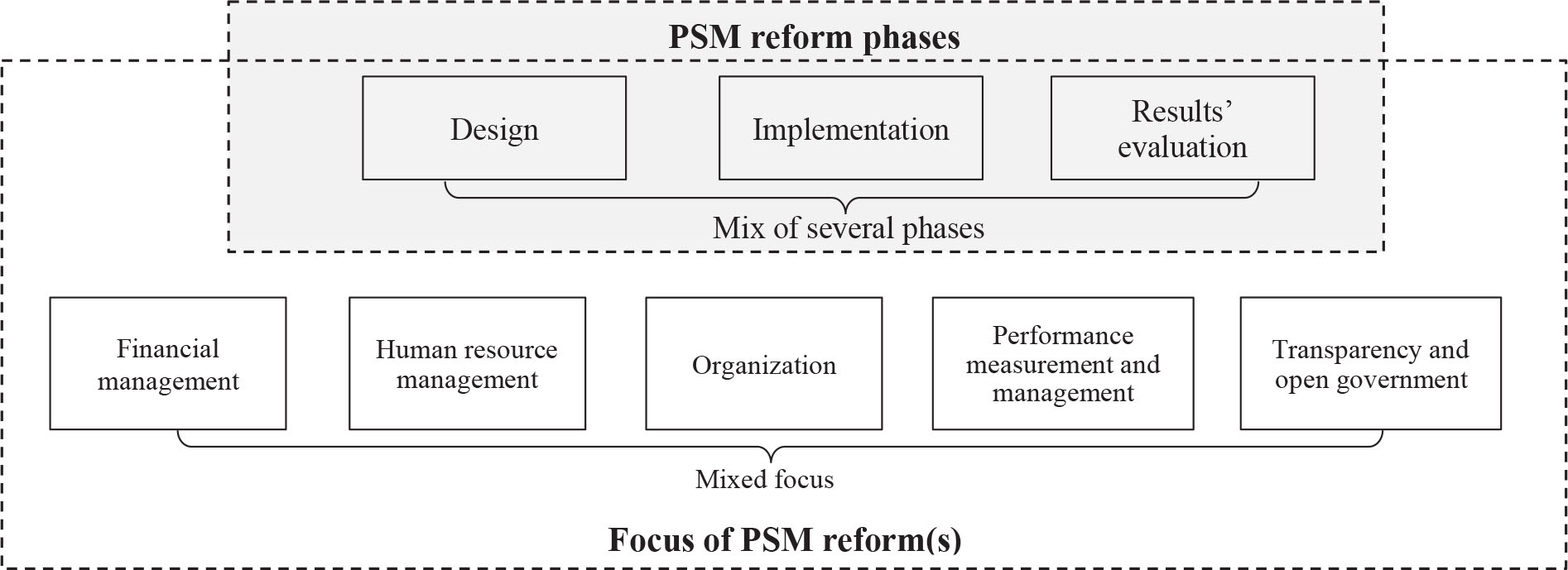
Fig. 2:
The framework for analysis of the PSM reforms trajectories in EE and FSU
A reform initiative starts with defining a problem to be solved, then continues with preparation and design, policy formulation and decision, proceeds with implementation, and concludes with evaluation and feedback (De Boer et al., 2016). The content of reforms emerges from both political agenda-setting (Cobb, Ross, & Ross, 1976) and signals coming from the society (Kingdon, 1984), and aims to identify discrepancies in public sector practices and ways of solving them. Depending on the driving forces, the second phase—implementation—is carried out in a top-down, bottom-up, or in more complex ways shaped by endogenous and/or exogenous factors. During implementation, reforms may take divergent paths from those initially planned, as unexpected challenges arise or because decision makers select other solutions than the default. The final phase focuses on achieved results, including evaluation of effects upon completion of PSM reforms through different criteria (Yeh, 2010; DeGroff & Cargo, 2009; Dunn, 2004). This final phase is crucial to understand the actual results of PSM reforms and helps to draw conclusions regarding their success.
Further discussion outlines these three phases of PSM reforms in the region and additionally reflects on multiple reform phases reflecting the layering and complexity of the transformations during the first years of transition.
Designing the Content of Reforms
Initially, the content of public sector changes in EE and FSU countries was primarily concerned with organizational issues and HRM, highlighting the importance of artful navigation of public service to successfully implement PSM reforms. As previous studies concluded (e.g., McGuinness & Cronin, 2016; Rho, Jung, & Nam, 2020), a change might be negatively perceived by public servants, since it often clashes with established values in an organization (Andrews, 2011). As a result, this potentially leads to resistance to change, thus compromising the reform result; therefore, starting with redesigning FSU and EE public organizations and public service delivery was crucial (Saner & Yiu, 1996). Besides a precise focus on changing the skills of public servants, the need for HRM reform was motivated by the optimization of the number of public sector employees, to reduce costs. At the same time, the studies highlighted challenges occurring when designing HRM reform to achieve devolution of personnel responsibility, due to the rather low maturation level of personnel and civil service systems in EE and FSU countries (Condrey et al., 2001).
At the same time, when moving to market-based practices, it was essential to focus not only on employees but also on changing organizational structures, rules, and routines. The lack of adequate rules in CEE and FSU for public service delivery systems could have served as a breeding ground for corruptive practices (Nemec et al., 2005). The experience of postsocialist EE and FSU countries starting reforms aimed to redesign organizational practices through the privatization of state-owned enterprises to address such problems in the public sector as: inconsistency in ownership of state property, appropriateness of methods of evaluation, the process of buying and selling state property (Savas, 1992), and, in some countries, chaotic division of public and private resources (Jakobson, 2001). Furthermore, studies focusing specifically on designing public services’ provision highlighted the multilevel character of PSM reforms. The decentralization of services was launched to increase the efficiency and reduce the costs of public services, while making them more responsive to citizen needs locally (Mayne & Vigoda-Gadot, 2018). Meanwhile, reforms focused on eliminating “obsolete” agencies, redesigning basic government systems (i.e., the public finance), as well as reforms of civil service systems, were conducted at the central government level, to transform the role of government (Rice, 1992). Therefore, after identifying specific shortcomings in the public sector, each country tailored the content of PSM reforms to address the limitations, given the peculiarities of their local context. For example, several countries selected the following tools under the reform of the public financial system: transition to accrual and cost-center accounting; improvement of public procurement legislation; training and retraining of experts in public finances; overhaul of public sector control/auditing procedures; revision of budget processes and procedures (Mikesell & Mullins, 2001).
Implementation of Reforms
The implementation of PSM reforms has been not only interlinked with HRM and organizational aspects but also placed greater attention on transparency and open government issues. Most of the papers that focused on implementation discussed the effects of various contexts (O’Toole, 1994) and exogenous and endogenous factors (Nakrošis & Budraitis, 2012) on the reforms. The endogenous factors affecting implementation were the influential interests of hospital management and staff during the restructuring of hospital care (e.g., Fidler, Haslinger, Hofmarcher, Jesse, & Palu, 2007) or political empowerment while implementing new practices related to increased transparency in the public sector (Schnell, 2015). The importance of exogenous factors was evident from tracing the role of consultants during public sector reform implementation (e.g., Condrey, 1998). As one of the studies showed, with the help of American experts, citizens became more engaged in the process during the development of the municipality’s strategic plan (Watson, 2000), thus increasing local democracy and government openness. Other cases of consultants’ contribution to the implementation of reforms related to the co-creation of new public sector practices (e.g., related to performance-based budgeting) together with the state authorities (Raudla, 2013).
Evaluation of Achieved Results
Being defined as “deliberate attempts to change the structure, processes, and/or cultures of public sector organizations with the objective of getting them (in some sense) to run better” (Pollitt & Bouckaert, 2017, p. 2), the results of many PSM reforms in the region marked an “elusiveness of change” (Pollitt & Bouckaert, 2003, p. 19) and ambiguous effects (Vakulchuk, 2016). Constraints for PSM reforms in achieving fundamental objectives (e.g., economic liberalization) in EE and FSU countries were caused by insufficient capacity for modernization and influential cultural legacies of the past (Neshkova & Kostadinova, 2012). Moreover, the necessary actions, such as countrywide legal adjustments, anticorruption measures and context variables, were not always in place to secure the success of reforms (Rinnert, 2015). Moreover, gaps in public managers’ training restricted implementation of major systemic changes in the public sector (Kowalik, 2011). Another important focus of PSM reforms was performance management and measurement, to evaluate public sector practices. Measurement of public sector performance, especially of socially important activities, has been in its infancy in several countries, as the case of community assessments of the satisfaction with healthcare systems showed (Footman et al., 2013). Thus, PSM improvements are hard to assess and often left in the shade (Klun, 2004).
While many studies suggested that reforms caused unintended effects and disappointing results (Hood & Dixon, 2016), in some EE and FSU countries the results of PSM reforms brought positive changes and improvements (Bouckaert, Nakrosis, & Nemec, 2011) regarding NPM tools (Dan & Pollitt, 2015). For example, reforms focused on public procurement led to flexible regulations that resulted in a decline in bid competition but improved contract execution (Yakovlev et al., 2015). Results of reforms in Bulgarian public healthcare showed that, although apparently, the expectations from this reform were met, doubts remain about the achieved overall social benefit, which is due to inefficiencies in the organization of the public health system and a lack of financial resources for healthcare in the country (Atanasova et al., 2011).
Mix of Several Phases
Given the complexity and overwhelming transformations that EE and FSU countries faced in reforming public sector practices (Tilcsik, 2010; Babajanian, 2008), the layering of several phases of different reforms was observed. It became clear that incorporating the practices originating from Western countries cannot always ensure the same result in EE and FSU countries (Nemec & Kolisnichenko, 2006), due to economic, governance, and cultural differences within the region (Tambor et al., 2013).
To achieve successful reform results, several barriers should be overcome on the implementation phase. Specifically for FSU and EE countries to enjoy successful PSM reform (Jacobs, 2004), it is important to implement: (1) strategic planning and policy improvement; (2) financial and budgetary management stability; and (3) motivated, qualified, and honest staff. In addition, a key role in the reforms’ success was attributed to the promotion of reforms through citizen participation (Knox, 2008), e-governance (Bhuiyan & Amagoh, 2011), and an optimal balance between responsibilities and administrative capacities (Guess, 2007).
PSM reforms implementation in these countries rely heavily on matching needs in the national context, the level of engagement of international institutions, and specific PSM practices to be implemented (i.e., their scope, content, and sequence); otherwise, the results of the reforms can be easily reversed and are difficult to sustain (Mussari & Cepiku, 2007). This trend resulted in a shift of the reform agenda in the region toward decentralization, clarification of responsibilities, pluralization in providing services, developing the provision of social services, and increased accessibility and efficiency for citizens. When facing the difficulty of finding sufficient resources to provide basic public sector services, for example, healthcare (Brinkerhoff, 2002), the governments tried to enhance structural processes, which could guarantee coordinated, continuous, and high-quality services for citizens (Kowalska, 2007). The case of the healthcare reform showed a change of legal form from a public body to a for-profit unit (Sagan & Sobczak, 2014), aiming to improve the financial performance of hospitals in particular and the healthcare sector in general. However, the evaluation of the reform results demonstrated that a simple change of the legal form does not ensure the achievement of intended goals (Sagan & Sobczak, 2014).
Performance management and measurement reforms were challenging for EE and FSU. On one hand, the introduction of performance measurement and management tools created problems in the “new democracies” transitory factors, compromising the outcome of the reform (Nõmm & Randma-Liiv, 2012). On the other hand, several countries showed that successful reforms of public management systems can occur if certain conditions are met, for example sufficient political support and level of maturity of performance management systems (Verheijen & Dobrolyubova, 2007). Moreover, the comparative analysis of different countries showed that reform results are not always similar under the same conditions (see the case of centralization of services in Estonia and Georgia (Puolokainen, 2017)), but implemented solutions can work by fitting to the national contextual specifics.
To summarize, applying the processual approach allowed interesting patterns of reform trajectories to be observed in EE and FSU countries. The main focus was on changing HRM practices and organizational structures, which first materialized in civil service reforms, privatization, and the changing structure of public entities. The debate on HRM reforms dominated, probably because the transition from socialism to market-led democracy required instant paramount changes in people’s mindsets, later affecting how they would guide the changes in public sector practices. Facing several issues, such as lack of transparency and control, as well as corruption, reforms with a focus on open government, financial management, and performance measurement followed after addressing the drawbacks of reforms launched at the beginning of the transition of EE and FSU countries to a market-based economy.
CONCLUDING REMARKS AND THE WAY FORWARD
The SLR highlights the necessity for theoretical and contextual considerations when studying PSM reforms in FSU and EE countries. Over the decades, theoretical contribution has been recognized as one of the most demanding research objectives, since it must not only explain and describe patterns but also explore phenomena (Whetten, 1989). However, the results of this SLR indicated that, when studying PSM reforms in EE and FSU countries, an imbalance between theoretical and normative research existed, in favor of the latter. Given substantial transformations in the public sector around the region, why did academia not use this opportunity of a new context as a laboratory to develop and test existing theoretical assumptions? Based on the findings of this SLR, we can state that the majority of studies on PSM reforms in EE and FSU countries observed extreme contextual complexity, which constrained cumulative theorization, resulting in the dominance of descriptive and prescriptive findings (Modell, 2009; van Helden, 2005). Especially at the beginning of the transition in FSU and EE countries, the emphasis of papers was on giving consultative advice and recommendations on how the reforms should be handled, rather than on conducting rich, in-depth theoretical studies. Furthermore, papers that applied theoretical frameworks seemed to favor a more positivistic rather that interpretive paradigm. Considering that positivistic approaches may sometimes fail to comprehend change in complex social, economic, and cultural matters (van Helden & Uddin, 2016), future research would significantly benefit from applying interpretive and constructivist approaches. For instance, recent streams of institutional theory (i.e., institutional logics, institutional entrepreneurship, and institutional work) could broaden explanations of how individual or collective actors react to changing institutional structures. New, interesting insights may also be developed via the lens of actor–network theory (e.g., Latour, 2005). Future studies might be directed at better understanding the role played by human and nonhuman actors involved in different phases of reform or how the translation of PSM reforms has changed from one country to another. Despite the criticism for not engaging in empirical settings, which was previously emphasized (e.g., Broadbent & Guthrie, 2008), being too focused on familiar surroundings (Whetten, 1989) might be the case for studies of EE and FSU countries, which seemingly fell out of sight of Western academia, due to contextual constraints. This may be caused by a lack of understanding of local culture, limited access to the data, or language barriers. This could be overcome by establishing links with local researchers with deep knowledge of the local context.
Moreover, the results of analysis showed the dominance of studies on a particular public management reform, usually from the central government perspective within a single EE or FSU country. This resulted in a lack of comparative research on reform experiences. First, there is a need for more comparative studies between the countries of the EE and FSU groups (e.g., Puolokainen, 2017; Verheijen & Dobrolyubova, 2007) and with more developed countries (e.g., Fidler et al., 2007). From a practical point of view, this would enrich the understanding of variations in PSM reforms across Europe, enable the sharing of experience in implementing certain reform tools and provide practical recommendations on the reform alternatives. From a theoretical point of view, these studies might contribute, for example, to understanding how historical background, culture, and other contextual factors influence the implementation of PSM reforms. Next, given the predominance of the central governments’ perspective in conducting reforms, studies on local responses to reforms are encouraged. Future studies should investigate such topics as regional variations in implementing particular tools of PSM reforms (e.g., performance-based budgeting, public procurement, e-governance, etc.), intergovernmental interactions during the reform process, and the level of local governments’ resistance to centrally formed pressures. Finally, the analysis indicated that some countries within the scope of this review were overlooked in the research. This research gap may be filled by focusing on the impact of reforms on macro-as well as microlevels.
We also find that several other promising directions can be developed further. For example, few studies (Mikesell & Mullins, 2001; Atanasova et al., 2011; Tambor et al., 2013) focused on the financial aspects of accounting, auditing, and tax reforms, especially in the early stage of transition. Although these studies have most likely appeared more in accounting literature, more interdisciplinary research is welcomed, to explore the role that public sector accounting standards played in redesigning public finances in EE and FSU countries, the changes in taxation and auditing rules and in the roles of the institutions performing these functions. Surprisingly, limited attention was paid to reform in the educational sector: both higher education and schools on all phases of reforms. Therefore, future research would benefit from studying how educational institutions operate, for instance in the introduction of performance measurement, changes in budgeting techniques, development of businesslike models for providing educational services, or increase in quality assurance within a competitive environment.
Finally, a deeper analysis of international financial institutions interaction with national governments in EE and FSU countries during the reform process is encouraged. As it may appear from previous studies, the work of international consultants was criticized for its poor understanding of local context (e.g., Huddleston, 1999). We believe that their contribution to public sector transformations in the region is underestimated and requires closer attention. Similarly, more analysis is needed on how the reform frames relations between central and local governments and on the role of intermediate-level (i.e., regional) governments during the reform process.
IMPLICATIONS AND LIMITATIONS
This article contributes by tracing dynamics of PSM reforms trajectories over more than 25 years by using a generic policy process framework (De Boer et al., 2016) to analyze how countries transformed their public administration practices. After synthetizing and critically analyzing the literature (Schooler, 2014; Torraco, 2016), we followed PSM reforms as a process, which enabled a better understanding of how reforms were designed and implemented. We found that while prominent discussion in the field (e.g., Dan & Pollitt, 2015) was mostly focused on achieved results of PSM reforms, studies on designing the content of reforms prevailed. We observed the layering of the reforms as multiple reforms initiatives were launched causing significant complexity for securing their successful implementation.
When it comes to the practical implications, the overall pattern of transformations showed that most of the reforms in the region were implemented through market-type mechanisms (e.g., Rice, 1992; Nemec & Kolisnichenko, 2006) and, in some countries, with positive results (Knox, 2008). However, growing concern among researchers (e.g., Condrey et al., 2001) raised questions about the relevance of these mechanisms and emphasized the importance of local context when adopting NPM ideas. Consequently, the Neo-Weberian State paradigm became recognized as a worthy alternative (Dunn & Miller, 2007). The failures of NPM have been keenly discussed by academics (Randma-Liiv, 2009), who have cautiously stated that, without thorough consideration, reforms under NPM may not work in the EE and FSU context (Dan & Pollitt, 2015). As we discuss in this SLR, politicians are still experimenting with the content of the reform programs inspired by NPM. It may appear that researchers, who study public sector transformations, and politicians, who design and implement reforms in practice, live in two separate universes. Based on the findings of this SLR, establishing a dialogue between research and practice could enrich and integrate the knowledge of researchers and politicians for finding new and better reform solutions.
The limitation of this article is connected to its exclusive focus on English-language articles in selective peer-reviewed international journals. Although this was used as a review boundary, we acknowledge that numerous papers, books, and conference proceedings in national languages, produced by local researchers, were outside the scope of this review. In addition, articles on public sector reforms can be published in other journals, which were not included in the ABS list. This SLR can also be criticized for its rather broad focus on public management reform developments in the region. However, since the study aimed at mapping PSM reforms trajectories after the quarter of century since the start of constructing or reconstructing the countries’ economic systems, it provided useful suggestions and gave impetus for future studies to follow different directions and further explore the complexity of PSM reforms.
ACKNOWLEDGEMENTS
The authors would like to thank the editor and reviewers for their valuable suggestions, which helped in improving the manuscript. Special gratitude is expressed to Herman Aksom for his encouragement, support, and inspiration on the final stage of preparing the paper.
Appendices
APPENDIX 1
The list of selected journals for the review, referred to as “Public Sector and Health Care” subject area in the ABS Academic Journal Guide (2015):
Administration and Society
Environment and Planning C Government and Policy
Evidence and Policy
Governance: An International Journal of Policy, Administration, and Institutions
Health Care Management Review
Health Policy
Health Services Management Research
Health Services Research
International Journal of Educational Management
International Journal of Health Care Quality Assurance
International Journal of Healthcare Technology and Management
International Journal of Public Administration
International Journal of Public Sector Management
International Public Management Journal
International Review of Administrative Sciences
Journal of European Public Policy
Journal of Health Services Research and Policy
Journal of Health, Organization, and Management
Journal of Policy Analysis and Management
Journal of Public Administration, Research, and Theory
Local Government Studies
Milbank Quarterly
Policing: An International Journal of Police Strategies and Management
Policy and Politics
Policy Studies
Public Administration and Development
Public Administration Review
Public Administration: An International Quarterly
Public Management Review
Public Performance and Management Review
Public Policy and Administration
Regulation and Governance
Social Policy and Administration
APPENDIX 2
Tab. A1:
Categorization of papers according to research setting
| Number of papers | ||
|---|---|---|
| Single country | 1 country | 29 |
| Ukraine | 4 | |
| Kazakhstan | 4 | |
| Poland | 3 | |
| Russia | 2 | |
| Estonia | 2 | |
| Georgia | 2 | |
| Romania | 2 | |
| Serbia | 2 | |
| Slovenia | 2 | |
| Bulgaria | 2 | |
| Lithuania | 1 | |
| Albania | 1 | |
| Bosnia and Herzegovina | 1 | |
| Hungary | 1 | |
| Multiple countries | 2 countries | 6 |
| Slovakia and Czech Republic | 2 | |
| Estonia and Georgia | 1 | |
| Kazakhstan and Kyrgyzstan | 1 | |
| Estonia and Austria | 1 | |
| Bulgaria and Romania | 1 | |
| 3 or more countries | 11 | |
| Postsocialist countries | 1 | |
| Eastern/Central and Eastern Europe/selected European countries | 3 | |
| FSU (all ex-members/part of them) | 2 | |
| Latvia, Lithuania, Russia | 1 | |
| Latvia and the Baltic countries | 1 | |
| Ukraine, Russia, Armenia, Czech Republic | 1 | |
| Croatia, Czech Republic, Hungary, Romania, Serbia, Slovakia, Slovenia | 1 | |
| Croatia, Czech Republic, Bulgaria, Romania, Macedonia, Slovakia | 1 | |
| Total | 46 |
APPENDIX 3
Tab. A2:
Categorization of eligible papers
| # | Author(s) | Journal (year) | Focus of reform | Reform phases | Main findings |
|---|---|---|---|---|---|
| 1 | Condrey, S. E. | International Journal of Public Sector Management (1998) | Organization | Mix of several phases | Research conducted by the Center for Public Management showed that the best way to address the issues faced by Eastern European countries may be the university-based public service model. The main idea of this model is a division of functions: consultation, policy research, technical assistance, and training activities are provided by the national university, and supportive activities are conducted by outside experts. As national universities are rooted in societal culture, they can play an important role in the process of reforming the public sector. |
| 2 | Condrey, S. E., Purvis, K., Slava, S. S. | Public Management Review (2001) | Human resource management | Implementation | The experience of Ukraine in conducting civil service reform is not completely synchronized with NPM ideas (the degree of a devolution of personnel authority considering rather low level of Ukrainian personnel and civil service systems’ maturation). It is important for Ukraine as well as other FSU countries to look selectively at western-type reforms; otherwise meaningful and substantive managerial reform may become delayed. |
| 3 | Nemec, J., Kolisnichenko, N. | International Review of Administrative Sciences (2006) | Financial management | Mix of several phases | The factors that contributed to failures connected with health reforms in the CEE countries: financial, i.e. start of reform during the decline of GDP per capita; healthcare “marketization” launched when potentially competitive markets in the CEE were still not well developed; reforms lacked conceptual understanding of existing problems, etc. The success of the reform depends on an effective combination of western and local expertise, as well as understanding of the specific local environment. |
| 4 | Yakovlev, A., Tkachenko, A., Demidova, O., Balaeva, O. | International Journal of Public Administration (2015) | Financial management | Results achieved | As the data from two Russian universities showed, a reduction in the level of competition at the auctions exists together with simultaneous improvement of the quality of contract execution (opposite effects). |
| 5 | Verheijen, T., Dobrolyubova, Y. | International Review of Administrative Sciences (2007) | Performance measurement and management | Mix of several phases | A combination of sufficient political support, a dedicated reform team, and a step-by-step introduction of performance management systems can bring a significant improvement in the effectiveness and efficiency of public management systems. |
| 6 | Jakobson, L. | International Public Management Journal (2001) | Mixed focus | Content | The problems in public sector management that Russia faces today have their roots in the past system. Administrative reform requires a set of shifts: (1) revision of written rules; (2) changes in public attitudes, which are affected by cultural and economic changes; (3) changes in institutional arrangements; and (4) changes in the functioning of the public sector (consistency of actions and written standards). |
| 7 | Puolokainen, T. | International Journal of Public Sector Management (2017) | Performance measurement and management | Mix of several phases | Estonia is more advanced than Georgia in applying performance indicators when managing the fire and rescue system. Despite European experience, both countries chose a centralized approach in reforming fire and rescue services. |
| 8 | Raudla, R. | Governance: An International Journal of Policy, Administration, and Institutions (2013) | Mixed focus | Implementation | The Estonian case showed that the contractualization of policymaking in the area of public sector reform can lead to inconsistent reform plans, hinder genuine deliberations on the content of the reform, and undermine its democratic legitimacy. |
| 9 | Jacobs, C. | Public Administration and Development (2004) | Mixed focus | Mix of several phases | Areas important for successful public administration reform: (1) strategic planning and policy improvement; (2) financial and budgetary management stability; (3) motivated, qualified, and honest staff. In the case of the Baltics, the reform process is at its beginning; progress has been made, though sometimes faltering. |
| 10 | Nakrošis, V., Budraitis, M. | International Journal of Public Administration (2012) | Organization | Implementation | The study of Lithuanian agencies in the period 1990–2010 showed that international pressures for change can be transformed by interacting state-specific factors related to the polity, politics, and policy in the process of organizational changes. Intensive organizational changes were experienced by Lithuanian agencies (i.e. establishment, reorganization, abolition of agencies). |
| 11 | Rinnert, D. | Public Administration and Development (2015) | Mixed focus | Results achieved | The Georgian case showed that a narrow focus on successful reform examples constrains effective countrywide implementation. Thus, legal adjustments, anticorruption measures, and context variables are necessary but insufficient conditions for successful reform, whereas political variables are crucial factors explaining within-country variance in reform outcomes. |
| 12 | Common, R. | International Journal of Public Sector Management (2011) | Human resource management | Implementation | In Georgia, human resource–based reforms were accepted and promoted. However, deep politicization of the administrative system constrained their implementation. |
| 13 | Kowalik, I. | International Journal of Public Sector Management (2011) | Organization | Results achieved | Polish local government units have a moderate (21%) level of market orientation. Factors that stimulate the development of market orientation are organization size, professional training of managers, and revenues in the medium-sized units. |
| 14 | Vakulchuk, R. | International Journal of Public Administration (2016) | Human resource management | Mix of several phases | Results of public administration reform in Kazakhstan are contradictory: some success was achieved in greater efficiency of public services, while weaknesses remained in spheres of public officials’ training, their rotation and promotion, and implementation of e-government. |
| 15 | Bhuiyan, S. H., Amagoh, F. | International Journal of Public Sector Management (2011) | Transparency and open government | Mix of several phases | Efforts of the Kazakhstani government to reform the public sector (decentralization, civil service reform, e-governance, and civil society) resulted in progress in public service delivery and enhancement of good governance. |
| 16 | Amagoh, F. | International Journal of Public Administration (2011) | Mixed focus | Mix of several phases | A history of Kazakhstan’s healthcare reform efforts showed that despite remaining problems in this sector, the government was trying to implement a comprehensive health reform highlighting the importance of long-term healthcare development. |
| 17 | Knox, C. | International Review of Administrative Sciences (2008) | Mixed focus | Mix of several phases | Despite a recognized argument that democratization in the sense of competitive politics promotes reforms though citizens’ participation, the results of a case study on the Kazakhstani experience showed that political stability through autocratic rule has actually enabled implementation of public management reforms. |
| 18 | Brinkerhoff, D.W. | Public Administration and Development (2002) | Organization | Mix of several phases | Review of the collaboration between the government and NGOs during health reform in Kazakhstan and Kyrgyzstan showed positive though preliminary results, including improved flexibility and performance of the health sector; more citizens’ participation in decision making, policy formulation and implementation through NGOs; and increased openness of government. |
| 19 | Österle, A. | Social Policy and Administration (2010) | Mixed focus | Mix of several phases | Several obstacles to development of long-term care exist: limited infrastructure, a lack of financial resources, an immature regulatory framework, and limited involvement of the private sector in care work. The reform agenda across the region should be focused on decentralization, clarification of responsibilities, pluralization in providing services, development of the provision of social services, and increased accessibility and efficiency. |
| 20 | Nemec, J., Merickova, B., Vitek, L. | Public Management Review (2005) | Organization | Content | Currently, the system of delivering local public services in Slovakia and the Czech Republic lacks systematic decisions and can potentially become corruptive. The following reforms are necessary to improve the situation: accrual and cost-center accounting in the public sector, creation of public–private mix; improvement of public procurement legislation, training and retraining of public servants, and overhaul of public sector control/auditing procedures. |
| 21 | Nemec, J., Sagat, V., Vitek, L. | Public Administration and Development (2004) | Organization | Mix of several phases | The comparative case study of telecommunications reform in the Czech and Slovak Republics showed (1) establishment of partnerships between political institutions and monopolistic providers of telecommunication services served private interests rather than the public interest; (2) foreign state ownership of monopolistic companies allowed did not reflect real privatization; (3) state regulatory bodies were unable to control pricing processes. |
| 22 | Schnell, S. | Public Administration and Development (2015) | Transparency and open government | Implementation | Implementation of transparency and anticorruption policies in Romania showed that with interplay of domestic and international factors throughout the policy cycle, pressures for mimicry facilitate rather than hinder domestic policy learning. |
| 23 | Robinson, R. | Public Administration and Development (2006) | Organization | Mix of several phases | Implementation of the evolutionary model of road sector reform on both central and local government levels in Romania showed a well-structured process on central level, yet local governments faced some problems during this process. |
| 24 | Vladetic, S. | International Journal of Public Sector Management (2013) | Organization | Content | Serbian communal services sector reform prescribed establishment of the Republic Directorate for Communal Services to improve the provision of these services, but unresolved questions of responsibility, legal status, and broad authorities were considered as the main drawbacks. |
| 25 | Klun, M. | International Review of Administrative Sciences (2004) | Performance measurement and management | Content | Focusing on performance measurement, the study demonstrated that the tax administration paid attention to improving the areas it assesses with its own indicators (number of appeals, number of inspections, discovered irregularities, etc.) and that it neglected its internal weaknesses. |
| 26 | Saner, R., Yiu, L. | International Journal of Public Sector Management (1996) | Human resource management | Content | Notwithstanding some issues in the public sector, Slovenia may be considered as one of the most successful states in transition. At the same time, efforts and investments are needed to develop internal change capacities within Slovenia’s administration on central level. |
| 27 | Footman, K., Roberts, B., Mills, A., Richardson, E., Mckee, M. | Health Policy (2013) | Performance measurement and management | Content | Population satisfaction measures may be one indicator of the success of health reforms. Satisfaction with the healthcare system is generally low across the FSU; some countries showed improvements, whereas the situation has deteriorated in others. |
| 28 | Dan, S., Pollitt, C. | Public Management Review (2015) | Mixed focus | Results achieved | Tracing the impact of NPM across Central and Eastern Europe, this review study demonstrated that NPM has worked. Even though reforms have not always been successful, the evidence showed that performance management, quality improvement, and the creation of agencies improved public services delivery across the region. |
| 29 | Nõmm, K., Randma-Liiv, T. | Public Management Review (2012) | Performance measurement and management | Mix of several phases | The Estonian case revealed that the presence of “transitional” factors (e.g., political and administrative instability, unsustainability of reforms, poor analytical skills in parliaments as well as in civil services, implementation gap, and foreign influence) may complicate the development of performance measurement in new democracies. |
| 30 | Fidler, A. H., Haslinger, R. R., Hofmarcher, M. M., Jesse, M., Palu, T. | Health Policy (2007) | Organization | Implementation | A decade of experience in Austria and Estonia in restructuring hospital care suggested that hospital incorporation and market incentives together with public ownership have the potential to introduce more cost-efficient and flexible management of hospitals and at the same time offer a politically acceptable solution to stakeholders. |
| 31 | Tambor, M., Pavlova, M., Golinowska, S., Sowada, C., Groot, W. | Health Policy (2013) | Financial management | Mix of several phases | Data from 35 European countries were used to analyze the formal–informal payment mix to outline factors associated with this mix. The authors concluded that obligatory cost sharing for healthcare services is driven from governance factors, while informal patient payments are a multicause phenomenon. |
| 32 | Atanasova, E., Pavlova, M., Velickovski, R., Nikov, B., Moutafova, E., Groot, W. | Health Policy (2011) | Financial management | Results achieved | Social health insurance in Bulgaria brought several improvements in the public healthcare sector; however, the overall social benefit of the reform is doubtful. The main triggers of the reform are ineffective organization of the healthcare sector and limited financial resources for healthcare. |
| 33 | Sagan, A., Sobczak, A. | Health Policy (2014) | Financial management | Mix of several phases | The change of the legal form of Polish public hospitals from public entity to for-profit company did not guarantee a better financial performance, unless internal changes in the hospitals’ operations were also made. |
| 34 | Kowalska, K. | Health Policy (2007) | Organization | Mix of several phases | The delegation of financial responsibility and risk management from the payer to Polish healthcare providers changed the nature of the agency relationship between primary care physicians and their patients. |
| 35 | Mussari, R., Cepiku, D. | Public Management Review (2007) | Mixed focus | Mix of several phases | The Albanian transition demonstrated how development achieved without paying attention to public administration and management (i.e., the scope, contents and sequence of reforms, and the role of international institution) might become hard to sustain. |
| 36 | Simic, S., Milicevic, M. S., Matejic, B., Marinkovic, J., Adams, O. | Health Policy (2010) | Mixed focus | Mix of several phases | The main goals of primary healthcare reform are to address expectations of citizens and to improve primary healthcare performance. The reform in Serbia is on the right path, yet the process demands additional time to demonstrate the real shift toward measurable improvements. |
| 37 | Savas, E. S. | Public Administration Review (1992) | Organization | Content | Privatization of state-owned enterprises in postsocialist countries encountered unique problems: current ownership, valuation and the process of transferring ownership. However, each country tried to advance at its own pace toward a market economy. |
| 38 | Witesman, E. M., Wise, C. R. | Public Administration Review (2012) | Human resource management | Mix of several phases | The article emphasizes that public administrators’ perceptions of the need for reform influence the success of the reform along with political and extranational factors. |
| 39 | Mikesell, J.L., Mullins, D.R. | Public Administration Review (2001) | Financial management | Content | Reforms of budget systems in FSU countries have mainly improved the budget processes, procedures, and institutions. Yet, much remains to be done to transform fiscal systems with persuasive and dynamic features. |
| 40 | Witesman, E. M., Wise, C. R. | Public Administration Review (2009) | Transparency and open government | Content | Conceptually, democratization and decentralization reform streams are contradictory, but in Ukraine they were launched simultaneously. The ordering of these two processes may affect the nature of the developing government (equilibrated). The best option is to implement democratization first and decentralization second. |
| 41 | Guess, G. M. | Public Administration Review (2007) | Mixed focus | Mix of several phases | Running fiscal decentralization programs in three social service programs in Romania and Bulgaria showed that a proper assignment of authority is required to match spending responsibilities with the policy and administrative capacity to carry them out. |
| 42 | Neshkova, M. I., Kostadinova, T., Gary J., Reid, G. J. | Public Administration Review (2012) | Human resource management | Mix of several phases | Administrative reform in Eastern European countries performed via depoliticization and professionalization creates more competent and predictable bureaucracies and thus encourages increase of foreign investments, and updated legislation on civil service increases the responsibility of civil servants. |
| 43 | Watson, D. J. | Public Administration Review (2000) | Transparency and open government | Implementation | Results of a “twinning” program between a Bulgarian city and an American city supported by USAID have made Bulgarian leaders committed to broaden efforts to involve citizens and groups in developing the strategic plan for the municipality, thus increasing the value of democracy on the local level of government. |
| 44 | Rice, E. M. | Public Administration Review (1992) | Mixed focus | Content | To transform government into a “servant” of the people, it is necessary to decentralize governmental functions, eliminate excessive agencies, redesign basic government systems, and conduct reforms of public finance and civil service. |
| 45 | Huddleston, M. H. | Public Administration Review (1999) | Human resource management | Implementation | The lessons learned during the consultancy practice in Bosnia and Herzegovina from the view of a foreign consultant showed that in attempting to implement a reform there is an apparent disconnect between the public administration consultant’s mission abroad and what this profession was thought to do. |
| 46 | O’Toole, L. J., Jr. | Journal of Public Administration Research and Theory (1994) | Organization | Implementation | In the Hungarian case neither creating the agency, restructuring its apparatus nor finetuning its policy instruments can solve the challenges of implementation (i.e., corruption; conflicting imperatives; and shift of sectors, levels, and the role of local governments). |