
Tab. 1
Description of variables used in the regression analysis
| Variables | Description of variables |
|---|---|
| Employed 1 year after | Follow-up 1 year after the end of support: coded 1 if employed in any job (also self-employed), otherwise as 0 |
| Employed 2 years after | Follow-up 2 years after the end of support: coded 1 if employed in any job (also self-employed), otherwise as 0 |
| Self-employed 1 year after | Follow-up 1 year after the end of support: coded 1 if self-employed, otherwise coded as 0 |
| Self-employed 2 years after | Follow-up 2 years after the end of support: coded 1 if self-employed, otherwise coded as 0 |
| Independent variables | |
| Gender (male) | Gender of the beneficiary: coded 1 if male, otherwise 0 |
| Age | Age of the beneficiary (years) |
| Age2 | Squared value of age (years) |
| Married | Marital status: coded 1 if married, otherwise 0 |
| Unemployment length | Total length of previous unemployment (days) |
| Education | Achieved education: ordinal variable from 0 to 8 (without formal education = 0, primary education = 1, lower vocational education = 2, secondary vocational education = 3, completed secondary education = 4, higher vocational education = 5, bachelor's degree = 6, master's degree = 7, PhD degree = 8) |
| Tertiary education | Coded 1 if achieved bachelor's, master's degree or PhD (6–8), otherwise 0 |
| Primary education or lower vocational education | Coded 1 if the highest achieved education is primary or lower vocational education (1–2), otherwise 0 (people without education excluded) |
| Primary sector (based on NACE 1 and 2) | The sector in which the beneficiary was active before unemployment. Based on the Statistical Classification of Economic Activities in the European Community, coded 1 if the Statistical classification of economic activities (NACE) code is 1 (agriculture, forestry and fishing) or 2 (mining and quarrying), otherwise 0 |
| Industry | The sector in which the beneficiary was active before unemployment. Based on the Statistical Classification of Economic Activities in the European Community, coded 1 if the NACE code is 3, otherwise 0 |
| Less-developed sub-regions | Less-developed sub-regions (according to the Slovak government) coded 1, otherwise coded as 0 (more developed sub-regions) |
| Same place | Same place of work and living. Coded 1 if the individual is living in the same city or village where his/her job is located, otherwise 0 |
| Amount of financial support | Total amount of financial support from the self-employment support allocated to the beneficiary (in EUR) |
| Length of support | The length of the period during which the beneficiary is supported and that is also mandatory to carry out self-employment business (in years) |
| Year of support | Order of the year when the support started to take place during the selected period (year 2012 = 1, year 2013 = 2, year 2014 = 3, …, year 2017 = 6) |
[i] Source: Authors.
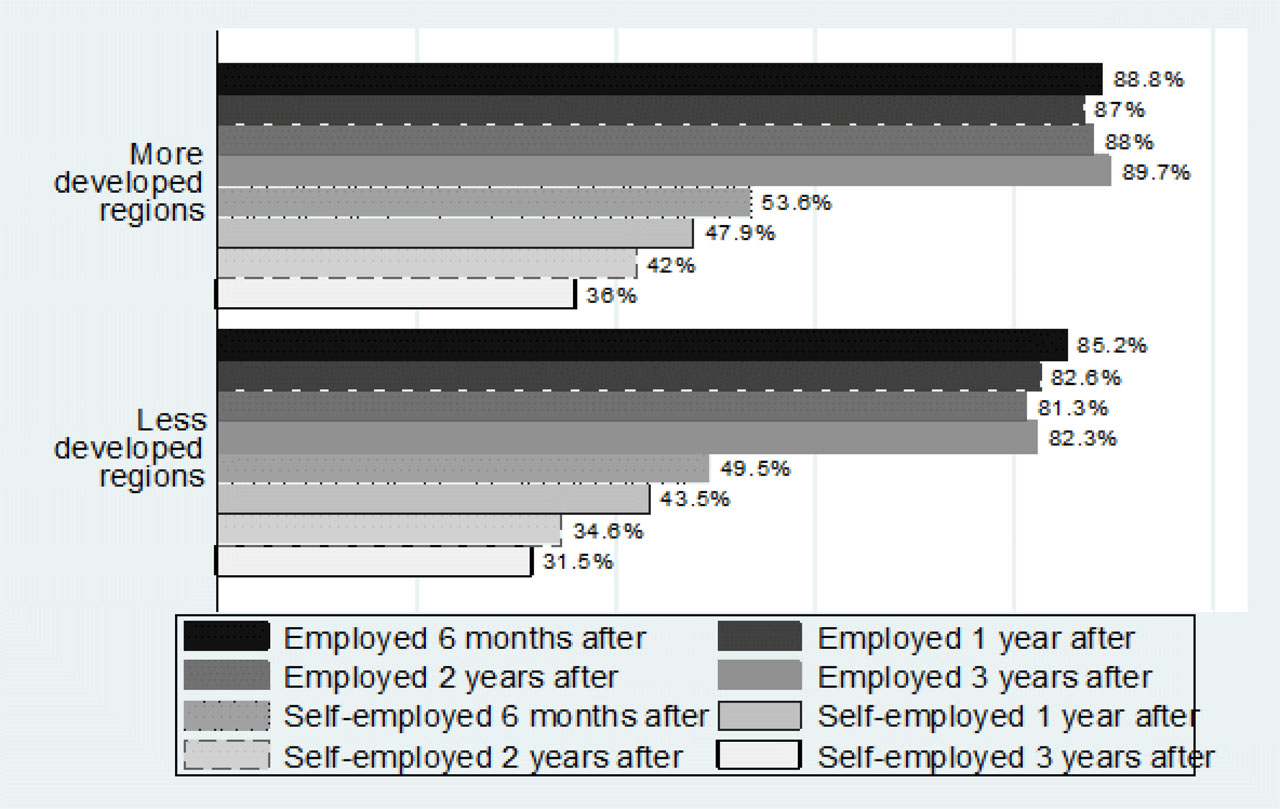
Fig. 1
The proportion of employed and self-employed in the more developed and less-developed sub-regions after the end of support
Tab. 2
The status of supported people classified by educational level 2 years after the end of support
| Educational level | |||||||||
|---|---|---|---|---|---|---|---|---|---|
| Sub-region type | Elementary | Secondary vocational | Secondary | Higher vocational | Bachelor's | Master's | PhD/doctoral | Together | |
| Employed | More developed | 85.2% | 82.5% | 89.5% | 57.1% | 71.4% | 93% | 85.7% | 88% |
| Less developed | 61.5% | 70.5% | 81.8% | 50% | 71.4% | 93.7% | 100% | 81.3% | |
| Self-employed | More developed | 40.7% | 47.4% | 44.3% | 14.3% | 14.3% | 36.2% | 14.3% | 41.9% |
| Less developed | 23.1% | 34.4% | 36.7% | 0% | 14.3% | 35% | 0% | 34.7% | |
Tab. 3
Status of supported people classified by selected characteristics 2 years after the end of support
| Sub-region type | Men (%) | Women (%) | Married men (%) | Married women (%) | Men with tertiary education (%) | Women with tertiary education (%) | Women with vocational education or lower (%) | |
|---|---|---|---|---|---|---|---|---|
| Employed | More developed | 89.8 | 85.3 | 87.9 | 85.5 | 95.3 | 86.7 | 77.8 |
| Less developed | 85.5 | 74.8 | 83.6 | 71.1 | 90.4 | 96.5 | 55.8 | |
| Self-employed | More developed | 46.5 | 35 | 48.3 | 37.2 | 36.7 | 31.1 | 34.9 |
| Less developed | 38.1 | 29.2 | 45.9 | 31.3 | 28.7 | 42.1 | 19.2 |
Tab. 4
Analysis of the selected factors affecting the employment and self-employment of supported people 1 and 2 years after the end of support (probit regression)
| Dependent variables | Employed (total) (yes = 1, no = 0) | Employed (without self-employed) | Self-employed (yes = 1, no = 0) | |||||||
|---|---|---|---|---|---|---|---|---|---|---|
| 1 year after the end of support | 1 year after the end of support | 2 years after the end of support | 1 year after the end of support | 2 years after the end of support | ||||||
| Coef. (z-stat.) | dy/dx | Coef. (z-stat.) | dy/dx | Coef. (z-stat.) | dy/dx | Coef. (z-stat.) | dy/dx | Coef. (z-stat.) | dy/dx | |
| Gender (male = 1) | 0.248*** (3.05) | 0.049 | 0.266*** (2.71) | 0.082 | 0.191* (1.91) | 0.054 | 0.116* (1.79) | 0.047 | 0.251*** (3.57) | 0.096 |
| Married | −0.224** (−2.48) | −0.044 | −0.309*** (−3.03) | −0.095 | −0.226** (−2.17) | −0.065 | 0.038 (0.55) | 0.085 (1.12) | ||
| Age | 0.067** (2.02) | 0.006 | −0.034 (−0.63) | −0.005 (−0.83) | 0.002 (0.46) | 0.107*** (3.74) | 0.041 | |||
| Age2 | −0.0009** (−2.08) | − | −0.001*** (−3.63) | |||||||
| Amount of support (in EUR) | −0.0005 (−0.69) | −0.0001 (−1.70) | −0.001 (−1.00) | 0.0002*** (−3.28) | 0.00007 | 0.0002*** (2.82) | 0.00006 | |||
| Unemployment length (in days) | −0.0002*** (−5.04) | −0.00004 | −0.0002*** (−4.51) | −0.00007 | −0.0002*** (−4.63) | −0.0001 | −0.0001* (−1.89) | −0.00003 | −0.0002*** (−3.83) | −0.0001 |
| Length of support (in years)t | 0.067*** (3.74) | 0.0002 | 0.001**** (3.01) | 0.0003 | 0.001*** (2.87) | 0.0003 | 0.001*** (4.32) | 0.0004 | 0.001*** (4.06) | 0.0004 |
| Year of support (start of the support) | 0.067 (1.27) | 0.111* (1.88) | 0.034 | 0.128* (1.86) | 0.036 | −0.034 (−0.91) | −0.092* (−1.72) | −0.036 | ||
| Education (coded from 1-lowest to 7-highest) | 0.132*** (4.40) | 0.025 | 0.207*** (6.00) | 0.0629 | 0.135*** (3.9) | 0.038 | −0.053** (−2.55) | −0.022 | −0.056** (−2.48) | −0.021 |
| Previously worked in primary sector (NACE 1 and 2) | −0.341 (−1.73) | −0.19 (−0.80) | 0.102 (0.39) | −0.272 (−1.46) | −0.167 (−0.89) | |||||
| Previously worked in industry (NACE 3) | 0.219 (1.63) | 0.369** (2.34) | 0.1 | 0.065 (0.42) | −0.029 (−0.31) | −0.021 (−0.21) | ||||
| Same place (work and home) | 0.113 (0.87) | 0.186 (1.20) | 0.049 (0.32) | 0.064 (0.60) | 0.135 (1.18) | |||||
| Less-developed sub-regions | −0.077 (−0.87) | −0.005 (−0.05) | −0.15** (−1.39) | −0.038 | −0.164** (−2.35) | −0.064 | −0.217*** (−2.84) | −0.082 | ||
| Cons. | −132.65 (−1.29) | −222.80* (−1.88) | −257.4** (−1.86) | 67.51 (0.90) | 181.5* (1.68) | |||||
| Observations | 1683 | 896 | 894 | 1683 | 1484 | |||||
| Wald chi2 | 140.5 | 131.62 | 97.5 | 61.73 | 73.60 | |||||
| Pseudo R2 | 0.106 | 0.143 | 0.11 | 0.026 | 0.043 | |||||
[i] Notes: Values in parentheses are the z-statistics and the marks */**/*** indicate the statistical significance at the 10%/5%/1% level.
[ii] All models used robust standards errors. The dy/dx data are estimated values of marginal effects calculated at the mean of independent variables. It is calculated as a partial derivative, with respect to x of the prediction function. The derivative is calculated as approximation of the derivative using the following formula: marginal effect of . If the independent variable x is a dummy variable, the marginal effect used is h = 1 and the slope of the line between f(0) and f(1) is calculated.
[iii] Source: Own processing.
Tab. 5
The results of bivariate probit regression (1 year after support)
| More developed sub-regions | Less-developed sub-regions | |||
|---|---|---|---|---|
| Dependent variables | Employed 1 year after the end of support | Self-employed 1 year after the end of support | Employed 1 year after the end of support | Self-employed 1 year after the end of support |
| Coef. | Coef. | Coef. | Coef. | |
| Gender (male = 1/female = 0) | 0.042 | 0.108 | 0.400** | 0.231* |
| Gender × tertiary education (interaction term) | 0.447* | 0.11 | 0.127 | −0.741*** |
| Tertiary education | 0.093 | −0.336*** | 0.438* | 0.439** |
| Married | −0.16 | −0.065 | −0.143 | 0.242** |
| Age | −0.002 | 0.002 | −0.003 | 0.002 |
| Amount of financial support (EUR) | −0.0001 | 0.0001** | −0.0003 | 0.0005*** |
| Unemployment length (days) | −0.0003** | −0.0001 | −0.0002*** | −0.0001 |
| Length of support (years) | 0.001*** | 0.001*** | 0.002*** | 0.0006 |
| Year of support | 0.098* | −0.0072* | −0.075 | 0.033 |
| Previously worked in primary sector (NACE 1 and 2) | −0.238 | −0.219 | −0.389 | −0.333 |
| Previously worked in industry (NACE 3) | 0.162 | −0.107 | 0.301 | 0.057 |
| Cons. | −196.3* | 143.09 | −151.90 | −69.57 |
| Number of observations | 1137 | 552 | ||
Tab. 6
Comparison of survival of supported business and maintenance of employment for selected groups
| Status | Sub-regions | Men in construction sector (%) | Men in whole sample (%) |
|---|---|---|---|
| Employed | More developed | 83.81 | 89.80 |
| Less developed | 73.81 | 85.51 | |
| Self-employed | More developed | 51.43 | 46.52 |
| Less developed | 59.52 | 38.07 |
Appendix 1
Characteristics of supported unemployed people – selected variables
| Unemployed people supported by the scheme | Full sample of unemployed people | Self-employed in sub-region (2015) | Inhabitants of sub-region (2015) | |
|---|---|---|---|---|
| Men | 59.13% | 51.96% | 69.2% | 48.40% |
| Women | 40.84% | 48.02% | 30.8% | 51.52% |
| Single | 46.26% | 52.78% | 44.03% | |
| Married | 44.02% | 34.31% | 37.27% | |
| Average age (years) | 34.8 | 35.73 | 43.8 | 40.82 |
[i] SOLSAF = Slovak Office of Labour, Social Affairs and the Family
[ii] Sources: Authors based on 1, 2- SOLSAF database, 3- SBA (2020), 4- Statistical Office SR.
Appendix 2
Characteristics of supported job seekers based on selected variables
| All sub-regions | Less developed | More developed | ||||
|---|---|---|---|---|---|---|
| Mean | Std. dev. | Min. | Max. | Mean | Mean | |
| Age (years) | 34.8 | 9.9 | 18 | 61 | 34.73 | 34.86 |
| Total length of unemployment (days) | 1036.4 | 973.5 | 103 | 7305 | 943.7 | 1216.7 |
| Sum of support (EUR) | 3971.1 | 606.8 | 1899 | 4645 | 3856.1 | 4186.9 |
[i] SOLSAF = Slovak Office of Labour, Social Affairs and the Family
[ii] Source: Authors based on SOLSAF database.