
Tab. 1
Overview of the observed skills crucial to perform the individual occupations
| Skill area | Skills | Skills description |
|---|---|---|
| Sensory perception | Sensory perception | Ability to respond to signals by movement, to see objects at a close range and at a distance, to see objects in low light, to recognize colours and their hues, to recognize distances, differences in sounds, differences in the direction of sound, to recognize sound in a disruptive environment. |
| Cognitive capabilities | Recognizing existing patterns and categories (supervised learning) | Ability to recognize a problem, derive a meaning from known categories of stimuli, to identify known patterns (object, sound, image) in a disruptive environment, to compare similarities and differences, to estimate the form of patterns (shapes, objects, …) when a part of them is rearranged. |
| Generating novel patterns/categories | Ability to develop new ideas (the number is of importance, not originality, quality, or correctness). | |
| Logical reasoning and problem solving | Ability to apply general rules to specific problems and to formulate answers that make sense, to combine information that gives rise to general rules or conclusions (it includes finding a relationship between seemingly unrelated events), to determine correct mathematical methods or formulas for solving a problem. | |
| Optimization and planning | Ability to create or to use different sets of rules for combining or grouping objects in various ways – add, subtract, multiply, or divide in a fast and a correct way. | |
| Creativity | Ability to develop unusual and clever ideas about a given topic or situation, or to develop creative ways to solve a problem. | |
| Information retrieval | Ability to organize objects or actions in a certain order or pattern based on a particular rule or on a set of rules (e.g., patterns of numbers, letters, words, images, mathematical operations), ability to remember information such as words, numbers, images, and processes. | |
| Coordination with multiple agents | Ability to focus on a certain task for a certain amount of time without distraction, to switch between two or more activities or sources of information (e.g., speech, sounds, touches, or other sources). | |
| Output articulation/presentation | Ability to deliver information and thoughts in writing. | |
| Natural language processing | Natural language generation | Ability to deliver information and thoughts in spoken word. |
| Natural language understanding | Ability to listen and to understand information and thoughts presented in spoken words and sentences, to read and to understand information and thoughts presented in written text. | |
| Social and emotional capabilities | Social and emotional sensing, understanding, and expression | Ability to identify and to understand the speech of other person and to speak clearly so others can understand emotional nuances |
| Physical capabilities | Fine motor skills | Ability to carry out coordinated finger movements of one or both hands to grab, to manipulate or to assemble tiny objects, to set quickly and repeatedly machine or vehicle controls to defined positions, to carry out quick and repetitive finger, hand, and wrist motions. |
| Gross motor skills | Ability to generate maximal muscle strength to lift, push, pull, or move objects, to bend, stretch, turn, or reach the body, arms, or legs, and to coordinate arm, body, and leg movement. | |
| Navigation | Ability to identify own location in the environment; determination of relative position of objects | |
| Mobility | Ability to physically move for a long time. |
[i] Source: TC CAS with the use of MGI (2017).
Tab. 2
Time horizon to achieve suitable skill levels by technology
| Up to 5 years | 6–15 years | 16–30 years | Over 30 years |
|---|---|---|---|
| – Optimization and planning | – Fine motor skills | – Mobility | – Logical thinking and problem solving |
| – Recognizing existing patterns | – Generating novel patterns | – Coordination with multiple agents | – Creativity |
| – Information retrieval | – Output presentation | ||
| – Navigation | – Sensory perception | – Natural language understanding | – Natural language understanding |
| – Gross motor skills | – Social and emotional skills |
[i] Source: TC CAS with the use of MGI (2017).

Fig. 1
Share of substitutable skills in a 5-year time frame
Note: The occupation categories are grouped according to the 2-digit CZ-ISCO codes.
Source: TC CAS.
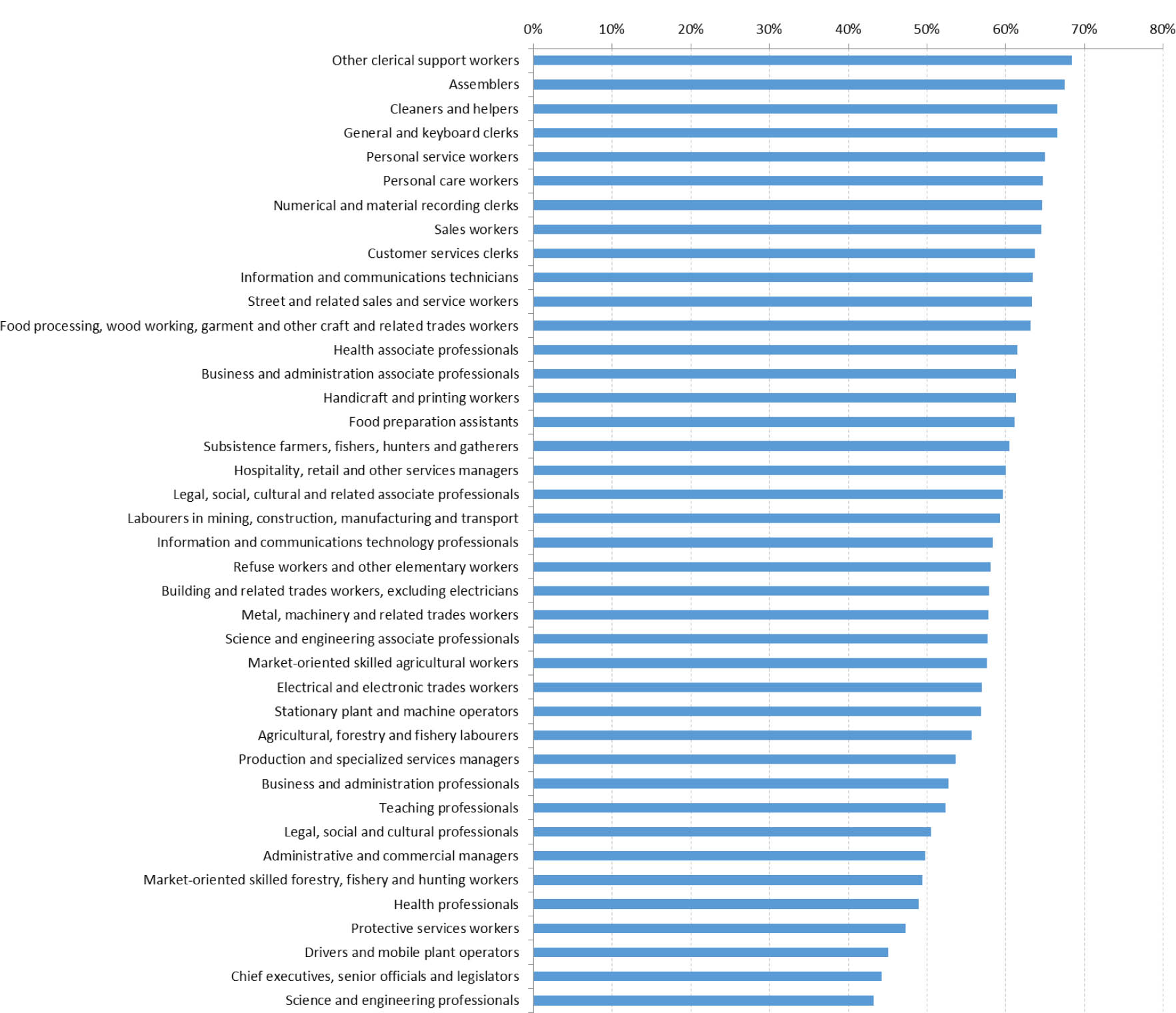
Fig. 2
Share of substitutable skills in time frame from 6 to 15 years
Note: The occupation categories are grouped according to the 2-digit CZ-ISCO codes.
Source: TC CAS.

Fig. 3
Share of substitutable skills in the time frame from 16 to 30 years
Note: The occupation categories are grouped according to the 2-digit CZ-ISCO codes.
Source: TC CAS.