
Tab. 1
Theoretical Lines of the Concept of Transparency
[i] Source: Own elaboration
Tab. 2
Summary of the Regulations on Transparency and Right of Access in the International Sphere and their influence in Spain
| TYPE OF LEGISLATION OR REGULATION | LAWS/REGULATIONS | CONTRIBUTION TO THE PROCESS OF TRANSPARENCY |
|---|---|---|
| At the end of the 20th century, only thirteen countries had a transparency law, now there are more than one hundred and twenty, and many more are in the process of being processed and approved. | ||
| International Laws and Standards |
| International organizations have anticipated the scope of public information in their statements and other manifestations, from which legislators in many States of the world have drawn inspiration. Since 1766, there has been an expanding international public interest and concern in developing regulations for transparency and access to public information in each of the branches of government. The right of the citizen to hold public officials accountable is defined. It also addresses freedom of expression and freedom to disseminate opinions. A new concept limiting all these rights also appears, which is having national security. And finally, the most recent one develops the principles with which corruption can be fought (legality, integrity, transparency and accountability). Each State gives priority to transparency, which often coincides with the quality of its legal system. Sometimes the right of access is framed in a fundamentalist or a politically correct category, ignoring the international premises to which it is subject. |
| Transparency Laws in Scandinavian Countries |
| Sweden is now known as the State of Transparency, because it was the first country to develop direct state regulation, the other countries saw that this was important and started to develop their own laws. |
| Transparency Law in United States | *The Freedom of Information Act (FOIA), 1966 | This law has undergone four reforms and the last one in 1996, to include access to electronic information (e-FOIA). |
| Transparency Law in Canada | *Access to Information Act, 1985 | The purpose of this Act is to enhance the accountability and transparency of federal institutions in order to promote an open and democratic society and to enable public debate on the conduct of those institutions. |
| Transparency Law in New Zealand | *Official Information Act, 1982 | This law helps New Zealand citizens, permanent residents and anyone in New Zealand to access information held by governments and government agencies. This promotes openness and transparency, and enables public participation in government. |
| Transparency Law in Austria | *Transparency Act 2013 | In Austria, on the other hand, transparency in politics and administration has no tradition. Official secrecy even has constitutional status. State information is in principle only classified as freely accessible and that official secrecy is only applied in exceptional cases to be justified. |
| Transparency in Western European Mediterranean Countries |
| All these countries surrounding Spain have greatly influenced the process and the elaboration of the Spanish transparency law, not only because of their proximity but also because of the Mediterranean cultural similarities they share. Furthermore, the Spanish law was the last to be approved and therefore this is another important reason for influence. |
| Rest of Western European States |
| The regulation in transparency that these European countries carry out, have great similarities since all of them are within the community legal environment of the European Union to which they all belong. |
| Normative Context of the European Union |
| Since the origin of the European Union, the founding treaties have contained statements on the transparency of the Community institutions. As it is consolidated, the Community regulations on transparency are being applied to other matters such as the environment, the press and equality. With the holding of successive European Councils, the foundations of transparency policy were laid, and the institutions gradually reached agreements in favor of transparency by approving codes of access to Council and Commission documents. These Codes of Good Conduct established the principles to be followed by Community officials in the process of applying for access to EU documents. This was a further major step forward with the advent of computer systems and the Internet, which made it easier to access European public information from any computer. The EU, through its official channels, has taken care to convey to the Member States the categorical maxims of transparency and the right of access to public information, defining a common supranational character committed to these values. |
| State Transparency Regulations in Spain |
| The first Spanish law, which contains a reference to transparency and the right of access to information of citizens, is the Spanish Constitution of 1978, in Article 105. There is a gradual difference between Spain and contemporary and adjacent regulations with regard to the scope granted to its standards. Recent Spanish legislation is still reluctant to consider the right of access as a fundamental right, despite the powerful legal and institutional apparatus it has had in other regulations. Spain has received considerable impetus in this area because it is part of the European Union. It has benefited from the Community regulations that have been adopted on numerous occasions in relation to transparency. |
[i] Source: Own elaboration based on the comparative study on transparency regulations carried out by Herrera (2017).
Tab. 3
Summary of the Regulations on Transparency and Right of Access in the Regulation of Spanish Transparency at Regional Level. Autonomous Communities in Spain
| TYPE OF LEGISLATION OR REGULATION | LAWS/REGULATIONS | CONTRIBUTION TO THE PROCESS OF TRANSPARENCY |
|---|---|---|
| Regulation of Spanish Transparency at Regional Level. Autonomous Communities with Transparency Laws prior to Law 19/2013 |
GALICIA
BALEARIC ISLANDS
FORAL COMMUNITY OF NAVARRE
EXTREMADURA
| |
| Regulation of Spanish Transparency at Regional Level. Autonomous Communities with Transparency Laws after Law 19/2013 |
ANDALUSIA
RIOJA
MADRID
REGION OF MURCIA
CATALONIA
VALENCIA
| |
| Regulation of Spanish Transparency at Regional Level. Autonomous Communities with Transparency Laws after Law 19/2013 |
ARAGÓN
CASTILLA Y LEÓN
ASTURIAS
CANTABRIA
AUTONOMOUS CITY OF MELILLA
| |
[i] **There are only two Spanish Autonomous Communities that do not have their own transparency regulations. On the one hand, there is the Basque Country, which, although it does not have its own law, does have a draft law on transparency. In the case of the Autonomous City of Ceuta, there is no law or project.
[ii] *** Many Spanish municipalities have developed their own transparency regulations, adapting national and regional (Autonomic) regulations, while others adhere to existing regulations.
[iii] Source: Own elaboration based on the comparative study on transparency regulations carried out by Herrera (2017).
Tab. 4
Total number of indicators of social services of the model MTSS (68)
| Nº | Indicator Description |
|---|---|
| ACTIVITY INDICATORS | |
| A1 | Index of people served in social services |
| A2 | Index of people attended to in the service of autonomy and care of dependence |
| A3 | Index of interventions per person served in social services |
| A4 | Index of interventions per person attended to in the autonomy and dependency care service |
| A5 | Percentage of home care for people under 64 years |
| A6 | Percentage of home care for people over 64 and under 80 years |
| A7 | Percentage of home care for the elderly |
| A8 | Index of home help service coverage |
| A9 | Index of hours per recipient of home help (agreed plan) |
| A10 | Index of hours per beneficiary of home help (dependency) |
| A11 | Percentage of attention with tele-assistance |
| A12 | Index of perceptions of emergency economic aid |
| A13 | Percentage of immigrants served by social services |
| A14 | Index of emergency occupations for women suffering from gender-violence |
| A15 | Index of occupations in shelters for the homeless |
| A16 | Average resolution time for home help in social services |
| A17 | Average time for effective start of home help in social services |
| A18 | Average total waiting time for the provision of home help in social services |
| A19 | Index of human resources (social workers) in social services |
| A20 | Index of human resources (social workers and other technicians) in social services |
| A21 | Index of human resources (administrative staff) in social services |
| A22 | Index of workload of the service of autonomy and attention to dependence (recognition) |
| A23 | Index of workload of the service of autonomy and care of dependence (PIA in spanish) |
| A24 | Index of the workload of the home help service (dependence) |
| Nº | Indicator Description |
| BUDGET INDICATORS | |
| P1 | Current expenditure on social services per habitant |
| P2 | Capital expenditure on social services per habitant |
| P3 | Percentage of current expenditure on social services |
| P4 | Percentage of capital expenditure on social services |
| P5 | Percentage coverage of current expenditure on social services, with current transfers received |
| P6 | Percentage coverage of current expenditure on social services, financed by users |
| P7 | Average amount of emergency financial aid |
| Nº | Indicator Description |
| COST INDICATORS | |
| CT1 | Cost of information and individual counselling in basic care |
| CT2 | Cost of home tele-assistance per assisted household |
| CT3 | Cost of home care service: help provided at home (agreed plan) |
| CT4 | Cost of home care service: help provided at home (dependency) |
| CT5 | Cost of foster care for children, per child cared for |
| CT6 | Cost per space in day centers for the elderly |
| CT7 | Cost of daily accommodation of the immigrant population |
| CT8 | Cost of an overnight stay in a homeless shelter |
| CT9 | Cost of emergency floor accommodation (gender-based violence) |
| CT10 | Cost of the service of autonomy and attention to the dependence by attended user |
| Nº | Indicator Description |
| COVERAGE INDICATORS | |
| CO1 | Degree of coverage of the autonomy and dependency care service, with current transfers received |
| CO2 | Degree of coverage of the home help service (dependence), with current transfers received |
| CO3 | Degree of coverage of the home help service (dependency), with user financing |
| CO4 | Degree of coverage of the home help service (dependency), with current transfers received and financing from users |
| Nº | Indicator Description |
| ENVIRONMENT INDICATORS | |
| E1 | Childhood Index |
| E2 | Adolescent Index |
| E3 | Youth Index |
| E4 | Old Age Index (over 64 years old) |
| E5 | Old Age Index (80 or more years) |
| E6 | Index of over-aging |
| E7 | Population Dependency Index |
| E8 | Percentage of immigrant population |
| E9 | Annual population growth rate |
| E10 | Municipal tax revenues per capita |
| E11 | Current savings |
| E12 | Non-financial deficit or surplus |
| Nº | Indicator Description |
| TRANSPARENCY LAW INDICATORS | |
| LT1 | Annual and multiannual plans and programs for social services are published, setting out specific objectives, as well as the activities, means, and time frame for achieving them. |
| LT2 | An updated Organizational Chart is published to identify those responsible for social services, as well as their functions and dependency relationships. |
| LT3 | All contracts concluded in the field of social services are published, indicating the subject matter, the amount of the tender and award, the procedure used, any instruments through which it was advertised, the number of tenderers participating in the procedure and the identity of the successful tenderers. |
| LT4 | The modifications of the Contracts formalized in social services are published (through a direct and specific link on the web). |
| LT5 | The minor contracts concluded in social services are published periodically (at least quarterly) with detailed information on their amounts and the people awarded them (through a direct and specific link on the website). |
| Nº | Indicator Description |
| TRANSPARENCY LAW INDICATORS | |
| LT6 | The list of the agreements signed in social services is published, mentioning the signatory parties, their purpose and, if applicable, the agreed economic obligations. |
| LT7 | Subsidies and public aid granted in social services are published, with an indication of their amount, objective or purpose and beneficiaries. |
| LT8 | The remuneration received by senior elected officials and, where appropriate, the General Directors and senior managers of social service entities is published. |
| LT9 | The compensations received on the occasion of the abandonment of the positions in social services are made public (if there have not been any, it will be expressly indicated on the website). |
| LT10 | The Register of Interest in the Activities and Assets of Senior Social Service Officers (provided for in the Law on the Basis of the Local System) is published. |
| LT11 | The list of properties (offices, premises, etc.), both own and rented, occupied and/or assigned to social services is published. |
[i] Source: Own elaboration from the indicators of social services (project SICIAL) and the indicators of law of transparency of the Indicator ITA (of Transparency International Spain) adapted to the area of social services.
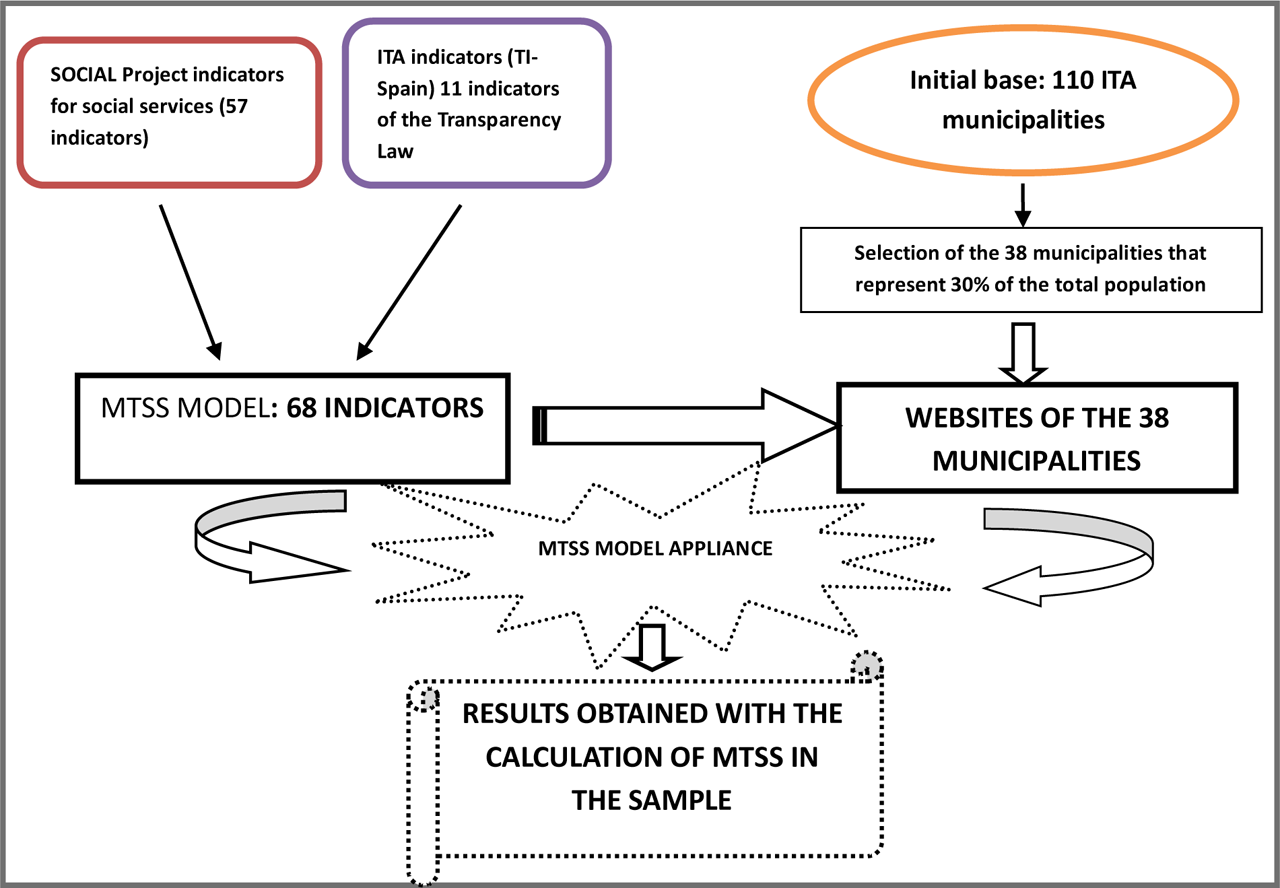
Fig. 1
MTSS Evaluation Model
Source: Own elaboration
Tab. 5
Total Time Distribution per Search Phase
| Distribution of Total Time by Phases | Minutes | Hours |
|---|---|---|
| Access to the website of the Town Hall | 3.040 | 50.7 |
| Location of the department or section | 570 | 9.5 |
| Location of MTSS indicators in social services / councils | 1.818 | 30.3 |
| Locating indicators in other web documents | 420 | 7 |
| Search for indicators in the web | 5.760 | 96 |
| Total Time | 11.608 | 193.50 |
| Total Data Searched | 2.584 | |
| Average of Time per Search/Data | 4.5 min |
[i] Source: Own elaboration
Tab. 6
Configuration of the Variable, Degree of Ease in Locating the Information by Indicator
| Degree of Ease | Significance | Average Search Time per Indicator (minutes) | Average Search Time per Indicator (seconds) |
|---|---|---|---|
| 1 | Not found | Between 2.5 and 3 minutes | 165 seconds |
| 2 | Very Hard | Between 2 and 2.5 minutes | 135 seconds |
| 3 | Hard | Between 1.5 and 2 minutes | 105 seconds |
| 4 | Easy | Between 1 and 1.5 minutes | 75 seconds |
| 5 | Very Easy | Less than 1 minutes | 30 seconds |
[i] Source: Own elaboration
Table 7
Summary of Results Obtained from the MTSS calculus*
| Nº of Present Indicators (max. 68) | Nº of Municipalities (max. 38) | PERCENTAGE PRESENCE OF INDICATORS (transparece or presence %) | TOTAL AVERAGE OF DEGREE OF EASE (facility or accessibility with values between 1 and 5) | MTSS INDICATOR (between 0 and 5) |
|---|---|---|---|---|
| 33–35 | 2 | (48%–51%) | (1.94–2.07) | (0.94–1.06) |
| 23–25 | 6 | (34%–38%) | (1.68–2.06) | (0.57–0.76) |
| 16–20 | 7 | (23%–32%) | (1.40–1.68) | (0.33–0.51) |
| 7–13 | 17 | (10%–22%) | (1.19–1.65) | (0.12–0.30) |
| 1–6 | 6 | (1%–9%) | (1.06–1.19) | (0.02–0.11) |
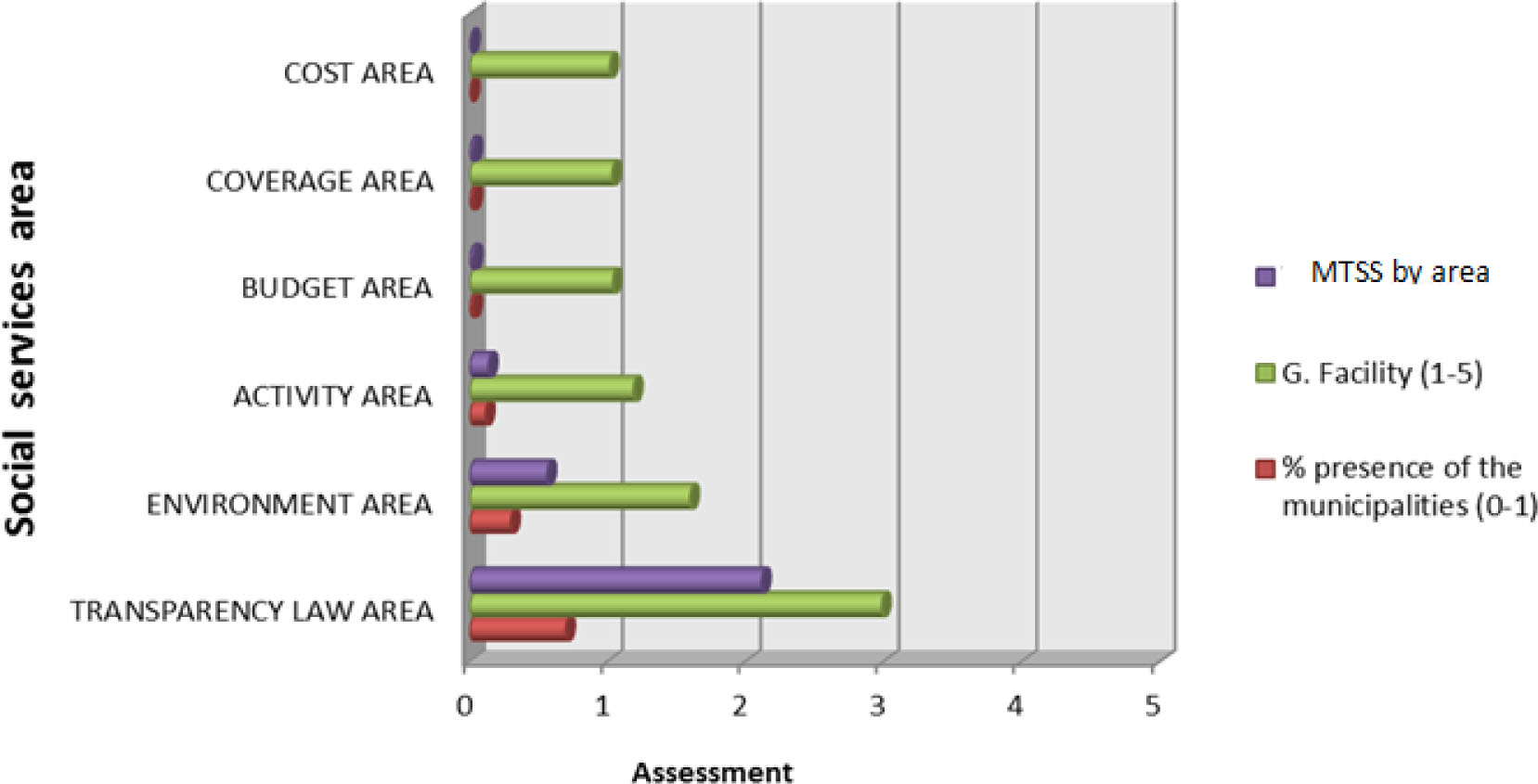
Fig. 2
Results data from the MTSS by Social Services Areas
Source: Own elaboration
Tab. 8
Valuation of Model Coefficients (MTSS)
| Beta | t | Sig. | |
|---|---|---|---|
| Constant | 5.557 | 0.000 | |
| Population | −2.513 | −1.792 | 0.082 |
| Over_65_years | 3.715 | 2.617 | 0.013 |
| Debt | −0.69 | −1.864 | 0.071 |
| Constant | 4.453 | 0.000 | |
| Male | 11.952 | 1.978 | 0.056 |
| Female | −17.014 | −2.39 | 0.023 |
| Over_65_years | 5.627 | 3.225 | 0.003 |
| R Square = 0.459 | |||
[i] Dep vble: MTSS. The first model included the variables: Population, Over_65_years, and Debt. The second model included the variables: Male, Female, Over_65_years, and Debt.
Tab. 9
% of presence of municipalities in the different Social Services
| B | Std. Error | t | Sig. | |
|---|---|---|---|---|
| (Constant) | −0.077 | 0.017 | −4.456 | 0.000 |
| % total presence by activity_area | 0.038 | 0.002 | 16.21 | 0.000 |
| % total presence by budget_area | 0.03 | 0.016 | 1.883 | 0.069 |
| % total presence by coverage_area | 0.068 | 0.012 | 5.657 | 0.000 |
| % total presence by environment_area | 0.022 | 0.002 | 9.863 | 0.000 |
| % total presence by transparency law_area | 0.03 | 0.002 | 14.563 | 0.000 |
| R square = 0.984 | ||||
[i] Dep vble: MTSS. The model included the variables: % total presence by activity_area, % total presence by budget_area, % total presence by coverage_area, % total presence by environment_area, % total presence by transparency law_area, and % total presence by cost_area.
Tab. 10
Level of Transparency by areas
| B | Std. Error | t | Sig. | |
|---|---|---|---|---|
| (Constant) | 0.16 | 0.022 | 7.211 | 0.000 |
| MTSS by budget_area | 0.42 | 0.245 | 1.718 | 0.095 |
| MTSS by coverage_area | 0.228 | 0.077 | 2.94 | 0.006 |
| MTSS by environment_area | 0.113 | 0.027 | 4.108 | 0.000 |
| MTSS by activity_area | 0.541 | 0.08 | 6.767 | 0.000 |
| R square = 0.867 | ||||
[i] Dep vble: MTSS. The model included the variables: MTSS by activity_area, MTSS by budget_area, MTSS by coverage_area, MTSS by environment_area, MTSS by transparency law_area, and MTSS by cost_area.