

1. Introduction
Agricultural output goes through numerous challenges, opportunities and determinants of the outcome of productivity differently in regions. Nigerian agricultural output had a yearly growth rate of 5.4%, with gross domestic product (GDP) growth rate, population growth and Consumer Price Index suggested as the primary determinants of local output (Muhammad-Lawal & Atte, 2006). Ethiopian agriculture remains characterised by subsistence character, small output and responsiveness to rainfall changes, although the sector bounced out of 2011 with 9% due to a record cereal output value of 19.10 million tons (Bekabil, 2014). From research on South Africa, agricultural output gets optimised with strategic interactions between foreign direct investments, agricultural credit and an increase in farm workers while reducing public spending (Mbiakop, Khobai & Fani, 2023). Agricultural mechanisation becomes a crucial driver in boosting output everywhere in the world, facilitating cultivation, irrigation, fertiliser application and harvesting operations while boosting quantity and quality of output (Ahmed, 2025). Take-up in technology, in addition to increased mechanisation, remains constantly suggested to promote productive sustainability growth.
The selection of OECD-EU member countries as the subject of this research is informed by their singular role as the world’s standard-bearers in both agricultural trade and climate action. These countries are characterised by a highly integrated institutional setting in which agricultural productivity is no longer a discrete policy objective but is instead intricately connected to the transition to energy and the protection of the environment, such as the European Union (EU’s) goal of achieving climate neutrality by 2050. The fact that these countries have advanced policy tools such as the Common Agricultural Policy and the Nitrate Directive means that they present a unique case study opportunity to examine the effects of high-level policy convergence on the Water–Energy–Food–Environment (WEFE) nexus. This is important not only for regional but also global food security, as the OECD-EU member countries are currently the world’s top food traders.
Current trends in the OECD-EU area illustrate the increasing need for this integrated approach. Although agricultural production in OECD countries has been increasing by around 1% a year since the early 1990s, direct greenhouse gas emissions have been more or less stable, increasing only by 0.1% a year. This indicates a degree of ‘decoupling’ between production and emissions, although this trend has since plateaued since 2010 as nutrient surplus and ammonia emissions have started to reverse the trend of their previous reductions (Cobourn et al., 2024). Environmental performance is a mixed bag, with some countries having made substantial cuts to their carbon footprint, but others seeing their emissions rise with the development of intensive livestock production systems.
At the same time, factors associated with climate change are transforming the agricultural environment in the region. The average global temperature has increased by 1.1°C above pre-industrial levels, and Europe has witnessed more frequent and intense extreme weather events. Since 1991, the number of droughts has doubled, and the number of storms has tripled, resulting in extreme regional disparities. In Southern Europe, the rising level of water scarcity and heatwaves threaten the region’s vital crops, such as grain maize and wheat, with a potential yield loss of up to 49% by 2050 in high-emission scenarios. At the same time, Northern Europe could witness the migration of agro-climatic belts northward, which might raise crop yields for some crops but also disrupt traditional water and land use practices (Jägermeyr et al., 2021). Such contrasting trends require a WEFE nexus approach to address the trade-offs between water extraction for irrigation and energy costs related to climate change adaptation.
An analysis on agricultural production in the OECD and European countries reveals wide gaps between sustainability performance and efficiency performance. Mıhçı and Mollavelioğlu (2011), with data envelopment analysis on 23 OECD countries during 1990–2005, concluded that few countries like Belgium, Denmark, the Netherlands and Slovakia had efficient agricultural production with green infrastructures supporting sustainability. On the contrary, Japan, Poland and Turkey showed deteriorating efficiency performance, where Turkey was among the lowest performer and experienced a decline in efficiency from 1995 onwards. These countries ought to reduce intensive labour and mechanisation uses while focusing on supply-side reform too, and reduce greenhouse gas production (Mıhçı & Mollavelioglu, 2011). OECD agricultural productivity, however, showed stupendous development since 1961, with cereal production experiencing over a 100% increase between 1960 and 2000 with only a 12% area growth for crops due to standardisations like tractor test codes and vegetable/fruit standards.
Agriculture is vital for attaining several sustainable development goals (SDGs), with 7 out of 17 SDGs having a direct association with agricultural activity (Rao et al., 2018). SDG 2 (Zero Hunger) and SDG 12 (Responsible Consumption and Production) are especially at the heart of agricultural progress, targeting the eradication of hunger, attainment of food security and enhancement of sustainability indices for farming (Bijin Philip & Suresh, 2024). Evidence proves agricultural development necessary for poverty alleviation, primarily for those countries with large rural communities whose livelihoods are based on agricultural activities (Rao et al., 2018). Policy convergence analysis establishes that countries such as Ecuador have established agricultural policies addressing SDG goals concerning productivity, income, rural infrastructure and sustainable practices (Requelme & Afonso, 2021). Implementation barriers remain, especially concerning data for SDG monitorial indices, based on lessons from the 50 × 2030 Initiative in several partner nations (Bolliger et al., 2022).
The world energy outlook is confronted with a number of difficulties driven by the growing demand and fossil fuels (Armaroli & Balzani, 2007). Existing world energy usage stands at about 13 terawatts, with the demand for crude oil reaching 1000 barrels per second worldwide (Armaroli & Balzani, 2007). Past energy consumption trends illustrate consumption increasing at 5% per year between 1955 and 1973, then slowing down to 2.7% between 1973 and 1979 and then falling 0.2% between 1979 and 1983, with the proportion of oil peaking at 47% in 1973 but falling to 40.3% between 1983 (Colombo, 1984). The energy issue stands among humanity’s greatest world problems, together with threats of a nuclear war and climate change (Chernova & Morozova, 2021). Natural gas and petroleum limited deposits make it difficult for rising energy demands to be met, while fossil fuels emit damaging pollution and greenhouse gases (Armaroli & Balzani, 2007; Fakhri, Al-Sallami & Imran, 2015). Comprehensive solutions focus on renewable energy infrastructure, nucleus fission and energy efficiency investments, with China being at the forefront of green energy investments worldwide (Colombo, 1984).
The existing global environment scenario poses severe challenges that need immediate attention and new strategies. The pandemic of COVID-19 has also shown that new environment standards need to be incorporated and has influenced several environment sectors such as atmospheric observation, water quality estimation and air quality control (Kulshrestha, 2020). Environmental challenges include remediation of pollution, water purification and climate change effects with special concerns regarding potential conflict between applications of biochar and solar energy missions and climatic targets (Kulshrestha, 2020). A review of history indicates that the root cause of environment issues lies in the fast-growing population worldwide, pressure on ecological systems, loss of species diversity, enhanced pollution, climate changes, fast urbanisation and unhealthy industrialisation. The root solution lies in the conscious and collective environment education in all levels, ranging from the primary to university level. Modern literature focuses on the interconnected human–nature relationship and underlines that environment protection is like breathing and hence requires attention towards water saving, forest protection and tree plantation.
The world food landscape is being quickly reshaped due to several inter-connected drivers. Income increase, climate change, high energy costs, globalisation and urbanisation are changing food consumption, food production and food markets, while the role of the private sector, especially food retailers, continues growing. Although hunger reduction received a new wave of attention during 2004–2005, hunger and malnutrition continue worldwide, with silent micronutrient deficiencies gaining prominence amid rising over-consumption and chronic diseases incidence in poor households. The world food industry is a large economic market employing more than 22 million people with further increase prospects (Abdurakhmanovna, 2022). As the Earth’s ability to renew resources decreases while the population grows, researchers create new trends such as circular economy concepts, cellular agriculture, alternative food ingredients such as microalgae and insects, food design solutions and digital solutions to meet food security needs (Valoppi et al., 2021).
Water plays a pivotal role towards attainment of the SDGs, with SDG 6 being about ensuring availability and sustainable management of water and sanitation for all (Pawar & Priya, 2020). Attainment of this goal accelerates attainment of other SDGs on health, food security, poverty, climate action and economic growth (Pawar & Priya, 2020). Most international river basins, however, encounter adversity on low water security necessitating integrated assessment strategies entailing physical, as well as socio-economic, factors (Gain, Giupponi & Wada, 2016). A water security index for the world indicates Africa, South Asia and the Middle East have very little water security, yet areas such as parts of the United States, Australia and Southern Europe have better performance due to better management, safety, quality and accessibility (Gain, Giupponi & Wada, 2016). Attainment of water-related SDG targets necessitates comprehension of water dynamics at the globe-to-local scale, plus interconnections between various goals towards realising results sub-optimal (Bhaduri et al., 2016). Remote technologies can facilitate the realm of monitoring, but implementation needs correlation of SDGs with public good, plus expanded societal support (Bhaduri et al., 2016).
2. Literature Review
2.1. Agriculture production and energy
The role of agriculture is dual, both as a consumer and a producer of energy, with this nexus growing more complicated with time (Spedding & Walsingham, 1976). Agriculture was traditionally a sole energy producer based on photosynthesis, which translated solar irradiance into biomass (Sulewski & Wąs, 2024). Now, agricultural sectors of industrial countries have grown highly reliant on energy from fossil fuels, consumed directly on farms and indirectly on a large scale through manufactured inputs such as tractors and manures (Spedding & Walsingham, 1976). This intensification of energy usage has vital efficiency and equity consequences, especially after sudden energy price hikes (Tyner & Hrabovszky, 1983). Agriculture has tremendous opportunities as a source of energy through several ways of bioenergy, such as ethanol, biodiesel, electricity from energy crops as well as residues and methane based on anaerobic digestion (Sulewski & Wąs, 2024). Potential ways are using agricultural residues such as manures and straws for energy generation, and the enhanced usage of legumes for cutting down fertiliser nitrogen usage (Spedding & Walsingham, 1976). Modern agriculture should consider being a prosumer of energy, a crucial player for energy transformation processes (Sulewski & Wąs, 2024).
Recent EU agricultural and energy study findings demonstrate multifaceted agricultural output–energy consumption interactions. EU agricultural output grew by 19% during 2010–2022, while the agricultural sector energy consumption also grew by 0.96%. Agricultural energy productivity fell by 10% between 2010 and 2020, however, since energy consumption grew by 12%, while output developed just by 1.36% (Wicka & Wicki, 2023). The agricultural sector presents high opportunities for renewable energy generation, headed by the Netherlands, Lithuania, Latvia and Hungary (Krukowski et al., 2024). The type of energy source for agriculture determinatively influences the agricultural results: for countries with sustainable public agricultural policies, renewable energy consumption has stimulating effects on output, whereas non-renewable energy has levelling effects, especially for less sustainable agricultural policies (Suproń & Myszczyszyn, 2024). These results demonstrate the need for encouraging EU agriculture renewable energy use while targeting the challenge of sustaining output efficiency.
Agricultural production and energy studies in OECD countries reveal complex relationships between agricultural efficiency, energy consumption and environmental performance. Selvanathan et al. (2023) established that consumption of fossil fuel increases the level of CO2 emissions by 0.76% per 1% increase while renewable energy reduces it by 0.14% per 1% increase in 24 OECD countries. Agricultural production was positively correlated with increase in the level of CO2 emissions at a value of 0.04% increase per 1% production increase. Hoang and Alauddin (2011) operated with 29 OECD countries based on exergy methods and established that livestock sector efficiency was significantly lower compared with the efficiency of the crop sector during 1990–2003. Shang et al. (2023) presented that in 31 OECD countries, the industrial sectors were more efficient compared with the agricultural sectors, while gains in productivity were observed. Mıhçı and Mollavelioğlu (2011) established Belgium, Denmark, Netherlands and Slovakia to have emerged as efficient sustainable agricultural producers while Turkey, Japan and Poland have declining efficiency performance where Turkey was among the worst performers in sustainable agriculture.
Recent empirical findings in the BRICS (Brazil, Russia, India, China, South Africa) countries have indicated that the integrated management of resources is critical for food security. Chandio et al. (2025a) employed Method of Moments Quantile Regression and robust FGLS/DKSE estimators to show that water resources and renewable energy sources have a substantial positive effect on food production at all distribution quantiles. Their results also reveal a significant bidirectional causal relationship between water resources and food production, indicating that integrated resource management policies are critical for sustainability (Chandio et al., 2025a). In addition, the importance of digitalisation has recently been recognised as a critical driver; the long-term use of mobile phones and the Internet has been found to have a substantial positive effect on food production, as it enables the flow of information and technology adoption (Chandio et al., 2025b).
2.2. Agriculture production and environment
Intensive agriculture poses substantial environment challenges to sustainability and human health. Intensive farming has led to declining natural resources in the past three decades with deleterious effects on physical landscapes and human health via chemical applications, pesticide sprays and greenhouse gas emissions (Bulut & Gökalp, 2022). Environmental issues are especially intricate in Third World nations in ecologically sensitive regions, where cultural, behavioural and financial issues add to agricultural obstacles (Clapham, 1980). A vast amount of energy sources, about 11 EJ per year, goes into agriculture, which also accounts for a substantial portion of greenhouse gas outputs with crop and livestock production (Stavi & Lal, 2013). Sustainable agricultural systems with a focus on organic farming, decreased application of chemicals and enhanced resource efficiency help correct these issues (Biswas, 1984). Practices such as reduced tillage, crop residue handling, precision farming and livestock feed modifications with the addition of policy measures to promote adoption of environment-oriented farming systems have been proposed (Stavi & Lal, 2013).
Studies on OECD and EU country relationships between agriculture and the environment yield nuanced sustainability problems. Mrówczyńska-Kamińska (2019) investigated EU nations based on input–output tables, discovering that despite increasing agribusiness services and chemical inputs in agriculture, nations enjoy falling direct material input and domestic consumption of agricultural biomass per GDP euro, revealing dematerialisation along environmentally sustainable development lines. Nations with advanced agricultural development needs meet environmental sustainability goals better. Fanelli (2019) concluded specific EU country patterns, with central, northern EU countries using identical high-impact agricultural activities, while countries within the Mediterranean region, along with northwestern nations, make use of older approaches such as using meadows, raising grazing livestock. Factor and cluster analysis established primary features of unsustainable agriculture, which categorised countries into homogeneous groups. Legg (2006) noted that agriculture remains the primary consumer of renewable resources across OECD nations, with governments setting their sights on sustainability using various economic instruments, regulations and voluntary approaches on how to manage agri-environmental concerns amidst food production efficiency.
Austria has been a pioneer for sustainable agriculture at the EU level, with the highest proportion of organic agricultural areas and some 78% of farms participating in agri-environmental schemes (Darnhofer & Schneeberger, 2007). Agricultural land use is shaped almost entirely by alpine topography, with extensive areas of permanent grasslands and alpine meadow (Groier & Loibl, 2017). Austrian success is attributable to holistic policy schemes, that is, governmental support schemes, such as the Österreichisches Programm für Umwelt und Landwirtschaft, which is one of the EU’s most sophisticated agri-environmental programmes (Groier & Loibl, 2017). Regional contrasts, nonetheless, create regionally specific problems, with nitrogen management changing extensively between regions due to natural boundary conditions, livestock intensities and farming systems (Strenge et al., 2023). While high-alpine regions have low nitrogen surpluses, but inefficient usage, lowlands have groundwater nitrate leaching despite enhanced usage of nitrogen, raising a call for regionally specific environmental management policies (Strenge et al., 2023).
2.3. Agriculture production and water
Water is at the core of agricultural activity, with irrigated agriculture occupying 20% of the cultivated land while accounting for 40% of world food supply and at least twice the productivity of rainfed ones. Water productivity should be optimised for productive, climate-resilient and water-scarce agriculture, requiring a turn towards water-efficient management strategies than the yield-per-area approach (Bahmani, Nasab & Behzad, 2013). Given that irrigation consumes approximately 70% of the world’s freshwater abstraction and is likely to witness 10%–15% reduction rates of availability during the next two decades, there is a critical need for enhanced water usage efficiency (Pawar & Khanna, 2018; Scheierling & Treguer, 2016). Promising approaches are adoption of advanced irrigation technologies like drip, sprinkler, sprinkler + drip, time precision, mulching, intercropping, and conjunctive use of surface and groundwater (Pawar & Khanna, 2018). As water economies evolve from the growing towards maturity phases, agricultural water management must harmonise production targets with conservation goals through integrated policy approaches and demand-side policies (Scheierling & Treguer, 2016).
Water resource management in the EU presents important challenges in agricultural production. Crop production in the EU dominates agricultural water usage due to technological innovation, accounting for 99% of direct agricultural water consumption (Gerveni, Fernandes Tomon Avelino & Dall’erba, 2020). Small EU crop producers have decreased water consumption due to technological influences, while Mediterranean states have managed to minimise water consumption with better water intensity measures (Gerveni et al., 2020). Optimal water resource management necessitates adequate coordination between agricultural and water policies, since existing applications exhibit inadequate coordination between these areas (van der Veeren, van der Molen & Groen, 2017). European agricultural operations arise under the authority of European policies such as the Nitrate Directive and Common Agricultural Policies, which have direct influences on water-based quality targets (van der Veeren et al., 2017). Scientific findings establish high potential in enhancing water efficiency in management while preserving agricultural productivity, with French regions being able to conserve up to almost 100% of water withdrawal in surfaces to promote irrigation (Martinho, 2020). Agricultural pollution still poses an ongoing threat, with elevated EU water sources containing high levels of nitrates, phosphates and pesticides (Scheierling, 1995).
Austria’s water used in agriculture reveals sophisticated patterns in examination under overall water footprint studies. The country’s diet regime leads to a consumption water footprint of 3,655 L per capita per day in agricultural commodities, significantly exceeding its domestic agricultural water footprint in production at 2,066 L per capita per day, qualifying Austria to be a net virtual water importer (Vanham, 2013). Water statistics in agriculture underestimates agricultural water consumption based on the narrow focus on blue water withdrawal only, although including green water consumption reveals that municipal water requirements account for only 5.8% of the total water footprint of Austria (Vanham, 2012). Area-wise disparities between water footprints of crops are substantial with sunflower, winter wheat and grain maize having highest water footprints in the semi-arid areas, in particular on poor water capability soils (Thaler, Gobin & Eitzinger, 2017). Management of climate change risk calls for careful governance of groundwater, exemplified in the case of the semi-arid Seewinkel area of Austria, where water restriction on groundwater transforms land uses from irrigated vineyard to rainfed cropland and jeopardises regional agricultural net benefits (Mitter & Schmid, 2021).
Finland’s agricultural water management and agricultural production suffer greatly due to nutrient pollution and virtual water trade. Agriculture contributes most to nutrients getting into Finnish surface waters, and agricultural lakes have greater nutrient concentrations, chlorophyll a, and turbidity than other lake types (Ekholm & Mitikka, 2006). Furthermore, despite the implementation of agri-environmental policies since 1995 according to the Water Framework Directive, trend analysis between 1976 and 2002 revealed steady water quality or growing eutrophication for agricultural lakes (Ekholm & Mitikka, 2006). Climate change adapting strategies propose that cycling nutrients through organic agricultural approaches decreases the load of inorganic nitrogen, although at the expense of yield (Rankinen et al., 2012). Finland imports a lot of virtual water, with foreign sources providing more than 90% of blue water for crop supply (Sandström et al., 2017). Finland might have the ability to decrease virtual water imports for blue water by 16% and for green water by 30% if imports of rice, soybeans and rapeseed are replaced with domestic ones such as barley, oats and field peas (Sandström, Lehikoinen & Peltonen-Sainio, 2018).
2.4. Agriculture production and food
The relationship between food production and environmental quality is one of the most volatile parts of the WEFE nexus. The current literature shows that the sustainability of food production is being undermined by the negative impacts of climatic change. The results of the analysis of different regions between 1991 and 2016 show that an increase of 1% in temperature and CO2 emissions leads to a decline of 1.93% and 0.32% in agricultural production, respectively (Chandio et al., 2023). The results highlight the need for adaptation strategies such as the enhancement of irrigation facilities and the provision of easy credit to farmers to offset the losses due to climate change (Chandio et al., 2023, 2025b).
However, aside from climatic variables, the current agricultural paradigm is highly dependent on technology and financial buffers. Recent research studies have highlighted that digitalisation, particularly the application of mobile phone technology and Internet access, is a major catalyst in the enhancement of food production through more effective resource allocation and market access (Chandio et al., 2025b). In the context of emerging economies, it has been noted that although environmental degradation is a threat, human capital and institutional quality can mitigate the effects of carbon emissions on agricultural value-added (Chandio et al., 2025a). Moreover, research studies on the ‘Energy-Climate-Agriculture’ nexus have confirmed that although the integration of renewable energy sources is a long-term positive factor, the current stability of the food sector is dependent on the effective application of agricultural land and fertiliser efficiency (Chandio et al., 2025c). Thus, in the context of OECD-EU member countries, 2.4 aims to underscore that food security is not simply a function of production quantity but rather a complex variable of environmental resilience and technology adoption.
3. Data and Methodology
3.1. Data
This research is performed on a panel of 22 countries that are members of both the OECD and the EU (OECD-EU member countries). These countries are: Austria, Belgium, Czech Republic, Denmark, Estonia, Finland, France, Germany, Greece, Hungary, Ireland, Italy, Latvia, Lithuania, Luxembourg, Netherlands, Poland, Portugal, Slovak Republic, Slovenia, Spain and Sweden. The time period covered is from 1991 to 2022. It is worth mentioning that, although the official name of the ‘European Union’ was established in 1993 with the coming into force of the Maastricht Treaty, the data for the period 1991–1992 refer to the membership of these countries in the European Economic Community. This allows for a thorough examination of the WEFE nexus over a period of 32 years of profound institutional integration and environmental policy development.
The main data sources for the GDP share of agriculture (AGR) and the consumption of renewable energy (ENERGY) were obtained from the World Development Indicators. The water abstraction data (WATER) was obtained from the FAO Aquastat database, while the food production data (FOOD) and the greenhouse gas emissions data (ENVIRONMENT) were obtained from the FAOstat database. Each of the variables was carefully matched across the different databases to ensure consistency in the panel data structure. More information on this can be found in Table 1.
Table 1.
Variables data sources
| Variable | Indicator (subsystem) | Description | Unit/measurement | Source |
|---|---|---|---|---|
| AGR | Agriculture | Share of agriculture in GDP (%) | Percent of GDP | WDI |
| WATER | Water subsystem | Total water withdrawal from agricultural, industrial and municipal sectors | Cubic meters per capita | Aquastat |
| FOOD | Food subsystem | Agricultural production of major crops (sorghum, corn, rice, wheat, beans, millets, banana, cassava, potatoes) | Tonnes | FAOSTAT |
| ENERGY | Energy subsystem | Renewable energy consumption (% of total energy use) | Percent | WDI |
| ENVIRONMENT | Environment subsystem | Total greenhouse gas emissions (CO2 + CH4 + NO2) | Kilotonnes | FAOSTAT |
Turning to data processing, the research employs a balanced panel of raw annual data for each country (N = 22, T = 32), which gives a total of 704 observations. No averaging was used in the pre-estimation processing of either the time series (years) or the cross-sectional (countries) dimension. This is done to retain the annual variance and structural breaks required by the second-generation econometric methodology, in particular the Cross-Sectionally Augmented IPS (CIPS) and Cross-Sectionally Augmented Dickey-Fuller (CADF) unit root tests and the Westerlund cointegration test.
3.2. Methodology
The research was designed to investigate the correlations among agricultural development and WEFE variables in countries that were both members of the OECD and the EU from 1991 to 2022. The research uses a panel econometric technique. The research technique chosen has a solid theoretical and empirical base, as it allows the investigation of variability both across space and time. The panel data technique is considered the most suited technique in this research as it allows the inclusion of heterogeneity not captured by traditional models, it accounts for dynamics, and it uses more data than traditional time series analyses.
The basic model of this study is defined as follows:
Here, AGR_it refers to agricultural growth (share of agriculture in GDP), WATER_it refers to total water withdrawal per capita (m3), LFOOD_it refers to natural log of food production, LENV_it refers to natural log of environment emission, and ENERGY_itise refers to the share of renewable energy sources in total energy consumption. The rest, ε_it and α_i, refer to imports, as well as characteristics of countries which show no variations through time (climate, institutions, structure of policies).
While carrying out the analysis on the OECD countries as well as the EU members, owing to the level of economic unity among the countries, it becomes unavoidable to address the issue of cross-sectional dependence (CSD), slope heterogeneity, or both in the cross-sectional structure of the data. Failure to address this challenge will result in flawed standard error estimates. For this purpose, tests were used prior to the analyses in this research. The tests used include the Pesaran (2004), Frees (1995), and Fisher (1932) tests.
The Pesaran CD test is defined as follows:
Here, , represents the correlation coefficient between the error terms of country observations i and j.The Fisher test is calculated by summing individual p-values as follows:
The key findings of these tests reveal that shocks in other countries do matter and there is panel CSD. Afterwards, in order to investigate the differences of coefficients among countries, the tests of slope heterogeneity proposed by Pesaran and Yamagata (2008), Δ and ΔAdj, were used: The expression captures the deviations of the coefficients from the overall slope. The significant outcomes from this expression show that there is variation in responses of agricultural variables to the various components of WEFE across countries. Estimation techniques can thus be applied.The following stage involves carrying out the required tests on the data in order to investigate the stationarity as well as the cointegration of the variables. The common tests (Levin-Lin-Chu, Im-Pesaran-Shin) on unit roots cannot be effectively used on data from a macro-panel because of the constraint of cross-sectional independence. Hence, the CIPS and CADF tests proposed by Pesaran (2007). The CADF test is defined as follows:
Here represents the cross-sectional average of the series.The CIPS statistic is the average of all individual CADF tests and measures stationarity while considering common shocks. The research used the Dickey-Fuller Test of Cointegration as proposed by Westerlund (2007) or the Modified Dickey-Fuller Test of Cointegration. The error correction model equation proposed by Westerlund can be stated as follows:
The negative sign of δi along with its significance shows that there is a cointegration relationship among the variables, which implies that agricultural progress and Water–Food–Energy–Ecology (WFEE) variables move together.The tests showed that, taking into account CSD and heterogeneity, standard estimation techniques will provide biased and inconsistent estimates. As a result, three robust estimation techniques, namely the Driscoll-Kraay Estimator (DKSE), Feasible Generalised Least Squares (FGLS) and Panel-Corrected Standard Errors (PCSE), were used. The Driscoll-Kraay approach accounts for heteroskedasticity, autocorrelation and cross-sectional correlations (Driscoll & Kraay, 1998). The estimate of the covariance matrix is given as follows:
The FGLS procedure produces a weighted estimate based on the variance-covariance pattern of the error terms. The PCSE method (Beck and Katz, 1995) adjusts standard errors by considering the contemporaneous correlation: All of these approaches make it feasible to get more accurate coefficients, which take into consideration the complex relationship existing in the error terms. Moreover, the outcomes derived from all three approaches will be compared among themselves in order to examine the robustness of the established model.Third, the Spectral Granger Causality Test proposed by Breitung and Candelon (2006) was employed. Differently from the normal Granger Test, this approach breaks the causality into its spectral domains. Here, it discerns the short-term (higher-frequency) impact from the long-term (lower-frequency) impact. The basic VAR(p) model is shown as follows:
At a given frequency ω, the null hypothesis that variable x does not Granger-causally explain y is tested as follows: Here, rejecting H0 indicates that there is a significant causal relationship at the relevant frequency.4. Findings
4.1. Cross sectional dependency tests
In this research, prior to the estimation of the panel data set, we analysed the independence of countries included in the data set. For countries like OECD countries or EU members, there is a strong link among the macroeconomic, environment and energy policies of the countries. There is trade, investment or technology exchange among countries. Hence, we first analysed CSD. This step is a basic requirement in formulating an accurate econometric framework. The implication of this hypothesis is that every event in every country will influence other countries. If this requirement is not considered, then the standard error estimates will be biased, the estimates will not be accurate, or there will be incorrect inferences. Hence, we analysed the null hypothesis H0, which states that there is no CSD among countries.
For this research, three different complementary tests of CSD used were Pesaran (2004), Fisher (1932) and Frees (1995). From the findings presented in Table 2 (Pesaran 78.75, Fisher 450.31, Fress 22.86), it was found that all three tests rejected H0 on a level of significance of 1%. The finding shows the existence of cross-sectional dependencies among the variables. It implies that the OECD and EU countries do not independently act on the agricultural, water, food, energy or environment variables. They act together as an outcome of regional economic and environmental unity. From an economic standpoint, the findings remarkably show consistency. The countries belonging to the OECD and EU measure their interconnectedness among themselves on agricultural markets, in the use of the different resources of water, food, energy or environment. Hence, variation in the use of resources or improvement in their productivity in one country directly influences another. Henceforth, the findings of the econometric models in the forthcoming analyses will be analysed by second-generation estimation techniques.
4.2. Unit root test
For panel data analysis, the stationarity of variables is a key test in which the possibility of spurious regression can be ruled out. If variables appear non-stationary, they could produce a significant outcome of spurious association. To address potential CSD, we employ CADF and CIPS unit root tests to verify the stationarity of the underlying series. The null and alternative hypotheses of the tests can be stated as follows.
H0: Series have a unit root (non-stationarity)
From the outcomes presented in Table 3, it can be seen that the values of the CIPS and CADF tests performed on all variables were negative and significant at the 1% significance level (p < 0.01). The outcome of this test indicated that the H0 hypothesis was rejected, meaning that all the variables presented stationarity on level (I(0)). From an econometric standpoint, the outcome of this test indicates that agricultural production, use of water resources, food production, energy consumption or environment emission series had achieved mean stationarity. As a result, all series demonstrated stable behaviour in the long run. Moreover, this provided the foundation for establishing a long-term relationship among variables. Also, it ensures the accuracy of the proposed mathematical model.
4.3. Heterogeneity slope test
For these data, the heterogeneity test used was the Pesaran and Yamagata (2008) test for differences in slope coefficients. The role of this test is to find out if the coefficients are homogeneous. This is an important consideration in an econometric study owing to variations in agricultural productivity, natural resources, energy sources or environmental policies among countries. The testing of hypotheses of the coefficients’ homogeneity is stated below:
H0: CoefficientsHomogeneous (No difference among countries)
As presented in Table 4, both the Δ and ΔAdj test statistics (Δ = −14.15, p = 0.00; Δadj = −5.15, p = 0.00) indicated significant values at the 1% significance level. The result of this test indicated that the H0 hypothesis was rejected. This implies that there is heterogeneity of coefficients among countries.
From an econometric standpoint, this finding verifies that there is no homogeneous pattern in the panel data. As such, it becomes pertinent that more robust methods of estimation be employed, which can handle this variability. Some of the techniques include the use of Driscoll-Kraay, FGLS or PCSE.
4.4. Cointegration test
After finding that the variables are stationary, it is also important to examine whether there is a long-run equilibrium relationship among the variables. Hence, both the Westerlund (2007) and Dickey-Fuller cointegration tests were used in this test. The aim of this test is to find if there is a movement of variables together in the long run. The null hypothesis of this test is given as follows:
H0: There is no cointegration among variables.
As indicated in Table 5, the result of the Westerlund (3.98, p = 0.00), Modified Dickey-Fuller (2.13, p = 0.02) and Unadjusted Dickey-Fuller (−19.37, p = 0.00) tests showed that hypothesis H0 was rejected. The findings of this research clearly confirm that the variables share a common equilibrium state in the long run. Agricultural development variables and Water, food, energy, environment variables all share a common equilibrium state in the long run. Based on the data collected, it is clear that despite the possibility of variations in the short run from an econometrician’s standpoint, they all come into equilibrium in the long run. From a standpoint of an economist, this data provides evidence of the structural relationship among countries’ agricultural developments, resources, use, and environment.
4.5. Regression results
Results of the tests of the long-run relationship among the share of agriculture in GDP, the WEFE variables, using three different methods which take into account CSD, appear in Table 6. The degree of similarity of the signs of the coefficients and the significance levels among the models provide information on the econometric robustness of the outcome.
Table 6.
Regression results (dependent variable: agr)
| Variable | DKSE | FGLS | PCSE | |||
|---|---|---|---|---|---|---|
| Coefficient | P > t | Coefficient | P > z | Coefficient | P > |z| | |
| water | 0.02* | 0.06 | 0.02*** | 0.00 | 0.02* | 0.05 |
| Lfood | −0.70 | 0.28 | −0.63 | 0.11 | −0.70 | 0.42 |
| energy | −0.04** | 0.03 | −0.03*** | 0.00 | −0.04* | 0.06 |
| Lenv | −0.82* | 0.07 | −0.87*** | 0.00 | −0.82** | 0.03 |
| Intercept | 9.64** | 0.02 | 9.03*** | 0.00 | 9.64* | 0.05 |
Based on the test of findings, a unit increase in the amount of water consumed per head will increase agricultural values by a difference of 0.02 units. The Lfood variable represents the values that are not significant. It represents a variable that varies with agriculture. However, it does not form factors that determine agriculture in the long run. There could be a number of explanations. The food output can be an effect of agricultural production. However, it can also not act as a value creator. However, it can act on principles of values that could not be directly measured. Concepts that relate to supporting agricultural values relate to its increase in production, its increase in values, its increase in quality or its increase in innovation. However, it does not relate to its increase in production. A unit increase in energy consumed will lead to agricultural values decreasing by a difference of −0.03 units. The use of energy could generate a number of explanations. The difference could come from energy price shocks that lead to an increase in costs of inputs. However, it could also generate divergence from the industrial sectors. Additionally, there could be an increase in practices that affect the environment. Environmental degradation’s explanatory variable stands at 1%. However, the agricultural values will decrease by a difference of −0.87 percentage points. The value stands as significant. The main explanation can relate to decreased fertility of the soil. However, it can also generate decreased fertility of the produce. However, it can also generate an increase in diseases affecting plants. Based on findings, water was significant. However, Lfood was not significant. Energy was suppressive. However, destruction was attributed to environmental degradation.
4.6. Spectral Granger causality approach
The significance of this test is that it enables us to differentiate between short-term and long-term effects. Table 7 shows that the relationship among variables occurs in specific frequency bands. As indicated by Table 7, there is a two-way causal relationship among agriculture and all WEFE variables.
Table 7.
Spectral Granger causality approach
| Pair | Share of ω | Band significance |
|---|---|---|
| water to agr | 0.99 | Significant (most ω) |
| water to agr | 1 | Significant (most ω) |
| water to agr | 1 | Significant (most ω) |
| Lfood to agr | 0.99 | Significant (most ω) |
| Lfood to agr | 1 | Significant (most ω) |
| Lfood to agr | 1 | Significant (most ω) |
| energy to agr | 0.99 | Significant (most ω) |
| energy to agr | 1 | Significant (most ω) |
| energy to agr | 0.5 | Significant (many ω) |
| Lenv to agr | 0.99 | Significant (most ω) |
| Lenv to agr | 1 | Significant (most ω) |
| Lenv to agr | 1 | Significant (most ω) |
Water and agricultural interests interact in almost all the frequency bands. Water use impacts agricultural interests in both the short-term and long-term bands. Agricultural practice, on the other hand, impacts the level of water demand, thus giving agriculture a feedback mechanism on water. There is a clear causal relationship between food and agricultural practices. The food chain seems to uphold the agricultural structural system. The agricultural and food cycle plays an interconnected role in development. Energy and agricultural interests interact more in the longer-term bands. Energy dependencies generate a cumulative effect. For environment/agricultural interests, all of the bands are of interest. Environmental degradation impacts both short-term and long-term sustainability. It generates additional pressures on the environment in agriculture. There thus seems to be an ecological interaction.
As can be seen from Figure 1, there is a significant degree of causality from water use on agricultural value-added across almost all of the frequency range. The prominent peaking of effects in medium-frequency bands implies that water is extremely important in the seasonal cycles of agricultural production (irrigation levels, growth seasons, etc.). The persistence in the low-frequency parts of the spectra reconfirms the importance of water in overall agricultural growth. The pattern of this causality implies that agricultural sustainability in OECD countries is dependent on sustainable water resources.
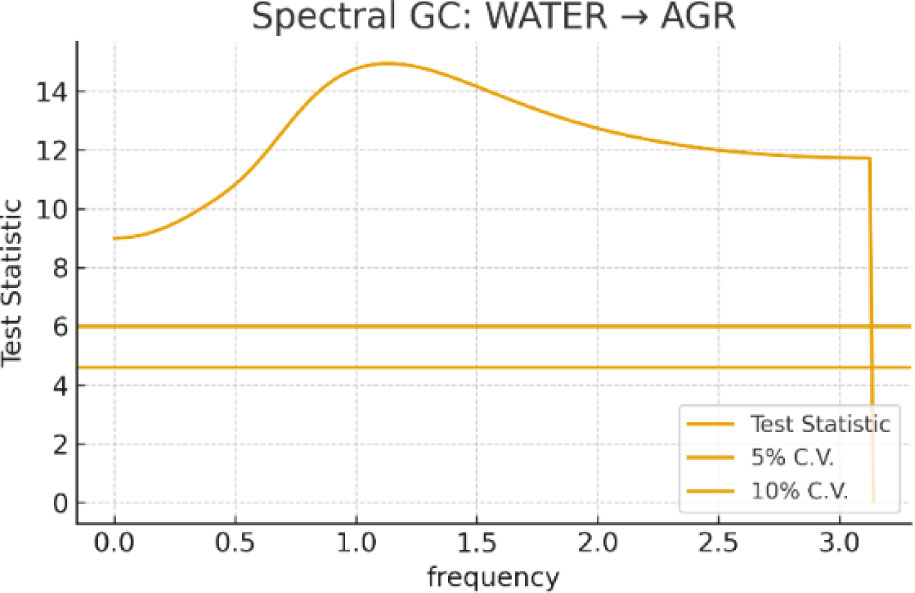
Figure 1.
Spectral GC: Water to AGR
As illustrated in Figure 2, it can be seen that the food subsystem shows a significant causal relationship with agriculture across all frequencies, which becomes more prominent in the low-frequency and high-frequency bands. The U-shaped pattern of the test statistics reveals that this positive association can become less significant during the seasons of supply–demand gaps, after which it progressively becomes significant with stable production. The outcome thus reaffirms that both agricultural and food sectors operate in a supportive link of their development structure. It can thus be concluded that the food supply chain stability plays a pivotal role in ensuring agricultural stability.
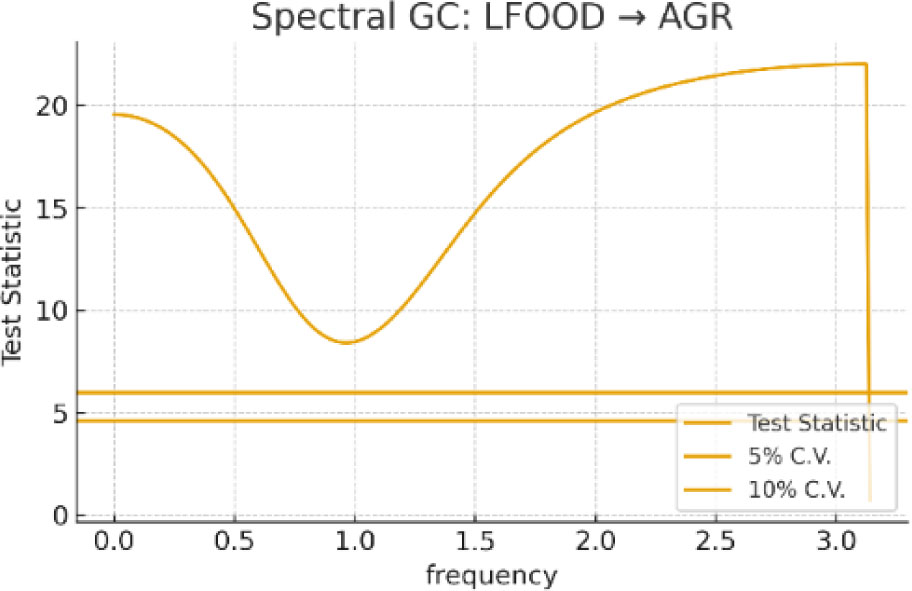
Figure 2.
Spectral GC: LFOOD to AGR
From Figure 3, it can be seen that energy consumption has a large degree of causality on agricultural value-added, especially in the medium and low-frequency spectra. This implies that the effect of increased energy consumption on agricultural development keeps accumulating. As a result, the agricultural sector becomes less competitive, given the rise in costs. The agricultural sector’s overall performance can be enhanced by policies focusing on improving energy efficiency.
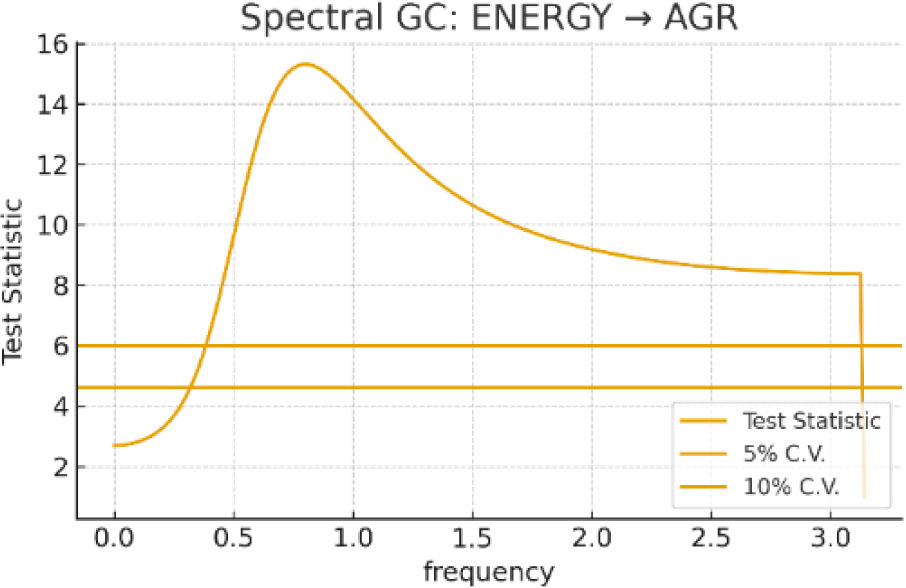
Figure 3.
Spectral GC: ENERGY to AGR
Figure 4 indicates that the environmental degradation has a strong and persistent causal effect on agricultural performance, where the association is most significant at medium frequencies. The result implies that environmental forces provide a negative effect on agricultural performance in terms of both periodic production shocks and the loss of structural productivity. The degree of effect reveals that environmental quality represents an important determinant of sustainable agriculture. Environment improvement policies, including reducing carbon emissions, can be pivotal in supporting agricultural growth in OECD countries, as well as in countries within the EU.
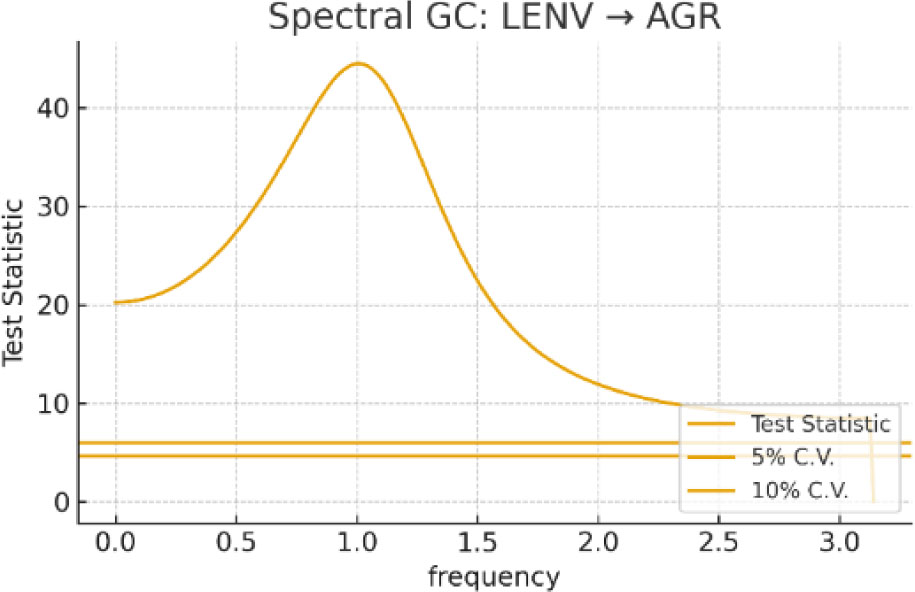
Figure 4.
Spectral GC: LENV to AGR
5. Discussion
The empirical evidence from the period of 1991–2022 on the OECD-EU data set shows that the relationship between agriculture and WEFE is influenced by both structural dependencies and the force of sustainability transformation. First, the significant positive effect of water withdrawal on agricultural value-added shows that water supply is an important production factor. This finding is in line with the result of research by Dalstein and Naqvi (2022), which showed that it is not possible to totally decouple the use of water from economic activities. The negative effect of an increase in renewable energy (RE) on agricultural value-added shows that the energy transition imposes short-term costs. This is in line with the argument by Paris et al. (2022), which stated that agricultural production is dominated by fossil fuels in the energy domain. The energy transition requires heavy investment. The significant negative effect of greenhouse gas (GHG) emission on agricultural value-added shows that there is an effect on agricultural productivity.
Although Ganda (2023) argues that environmental costs result in substantial value-added losses through greenhouse gas emissions, our results indicate a more complex situation where efficiency gains can offset such effects. This view is at odds with the earlier study conducted by Lin, Chiu and Xu (2022), which indicated that environmental food loss was a relatively inconsequential factor in the agricultural value chain. Our results are more in line with the comprehensive approach espoused by Ramarao et al. (2024), which illustrates that a comprehensive approach to agricultural production results in substantially greater productivity than sector-specific management. Moreover, although certain studies, including Michal et al. (2023), tend to indicate that management approach has a trivial effect on raw production, our overall analysis supports the view of Kausar and Rasul and Asghar (2024) that a nexus-based approach is the best strategy for maintaining agricultural growth while adhering to contemporary environmental norms.
The empirical findings on environmental degradation and energy consumption have important implications for the achievement of SDG 13 (Climate Action) and SDG 7 (Affordable and Clean Energy). Our result that GHG emissions decrease agricultural value-added by −0.87 percentage points is consistent with Chandio et al. (2022), which showed that climate change has a negative effect on production in ASEAN-4 countries. Moreover, the long-run results of Chandio et al. (2025c) in the Asian-12 countries’ context support our result that temperature change has a negative effect on agricultural sustainability, thereby supporting our conclusion that environmental quality is a major determinant of sustainable agriculture in the OECD-EU.
One of the most interesting comparisons emerges with respect to the contribution of RE. Although it is confirmed that RE has a positive influence on agricultural output in Asian countries (Chandio et al., 2025c), our regression analysis reveals that a one-unit increase in RE consumption is associated with a reduction in agricultural values of −0.03 units in the OECD-EU. This apparent contradiction can be attributed to the very high capital intensity and so-called ‘transition penalty’ involved in the upgrading of complex energy infrastructure in the developed countries. This implies that the achievement of SDG 2 (Zero Hunger) in the OECD-EU needs special financial instruments to cushion the immediate transition costs of the green transition, as also indicated by the moderating role of human capital and institutional quality in the ASEAN region (Chandio et al., 2022).
6. Conclusion and Policy Recommendations
The relevance of this research was established by exploring the impacts of agricultural development on the WEFE framework. The methodology was quantitative, with a focus on the period from 1991 to 2022. The research established that agricultural development is dependent on sustainability indexes. The agricultural sector remains dependent on water resources in the long term. The transition of the energy sector from non-renewable sources to renewable sources incurs short-term adaptation costs. Environmental degradation deeply impacts agricultural productivity. However, the fact that food production quantity does not impact agricultural development in the long term shows that agricultural food production’s relevance relies not only on quantity but on its quality.
The positive effect of water use on agricultural value-added shows that the issue of water security is still the most fundamental factor in agricultural production. Due to the rise of the threat of droughts and the rise of the issue of water scarcity, the shift to efficient use of irrigation systems and the development of climate-smart water strategies is now a priority. The negative long-term association of use of renewable energy sources with energy consumption shows that the energy transition effect continues to negatively influence the agricultural cost structure. For an effective agricultural transition, farmers must be assisted in their access to clean energy investments.
The positive effect of water use on agricultural value-added shows that the issue of water security is still the most fundamental factor in agricultural production. Due to the rise of the threat of droughts and the rise of the issue of water scarcity, the shift to efficient use of irrigation systems and the development of climate-smart water strategies is now a priority. The negative long-term association of use of renewable energy sources with energy consumption shows that the energy transition effect continues to negatively influence the agricultural cost structure. For an effective agricultural transition, farmers must be assisted in their access to clean energy investments.
Based on the above discoveries, the policy recommendations of this research can be concluded as follows.
First, it is a priority that agricultural water resources be protected by modern irrigation technology, climate-smart planning and comprehensive basin policies. Second, in order to alleviate the short-term challenge of the transition in the field of renewable energy, funds allocated to financial packages, modernisation of rural energy infrastructure as well as energy efficiency measures need to be enhanced. Third, there is a significant emphasis on the expansion of carbon pricing policies, controls on fertilisers and pesticides, as well as practices of precision farming in order to counter negative impacts of environmental pollution on agriculture. Lastly, there will be emphasised approaches on minimising food losses, recycling of waste materials as well as encouraging consumer practices.
In this regard, the overall strategic planning of the WEFE cycle can minimise adaptation costs in the short-term adaptation process. Alignment of agricultural policies focusing on the following priority interests promotes an enabling environment, unlocking a competitive, resilient and climate-smart agriculture sector in countries belonging to the OECD countries and the EU.