


Figure 1a.
The Linear Economy (AkzoNobel, 2015)
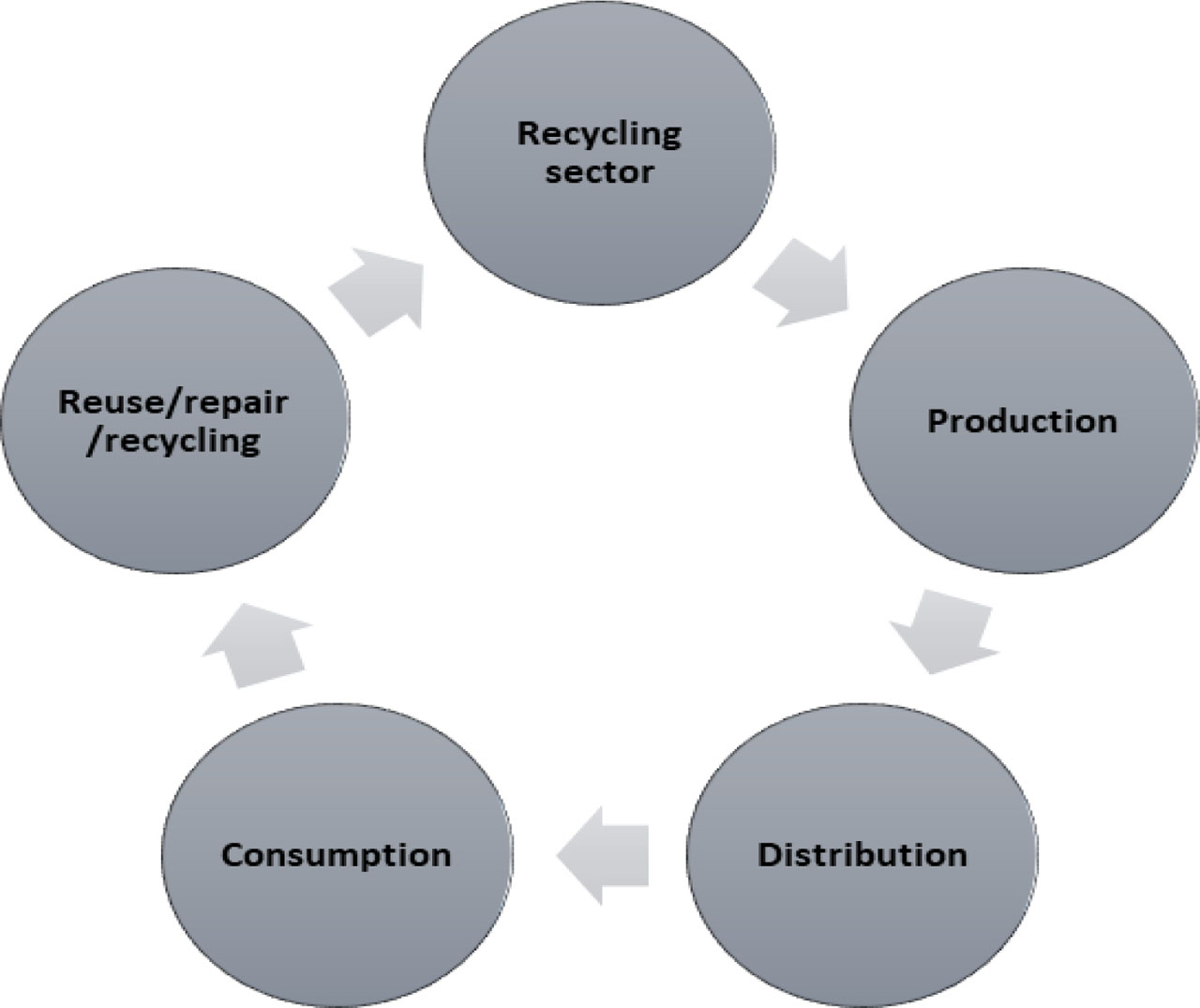
Figure 1b.
The Circular Economy (AkzoNobel, 2015)
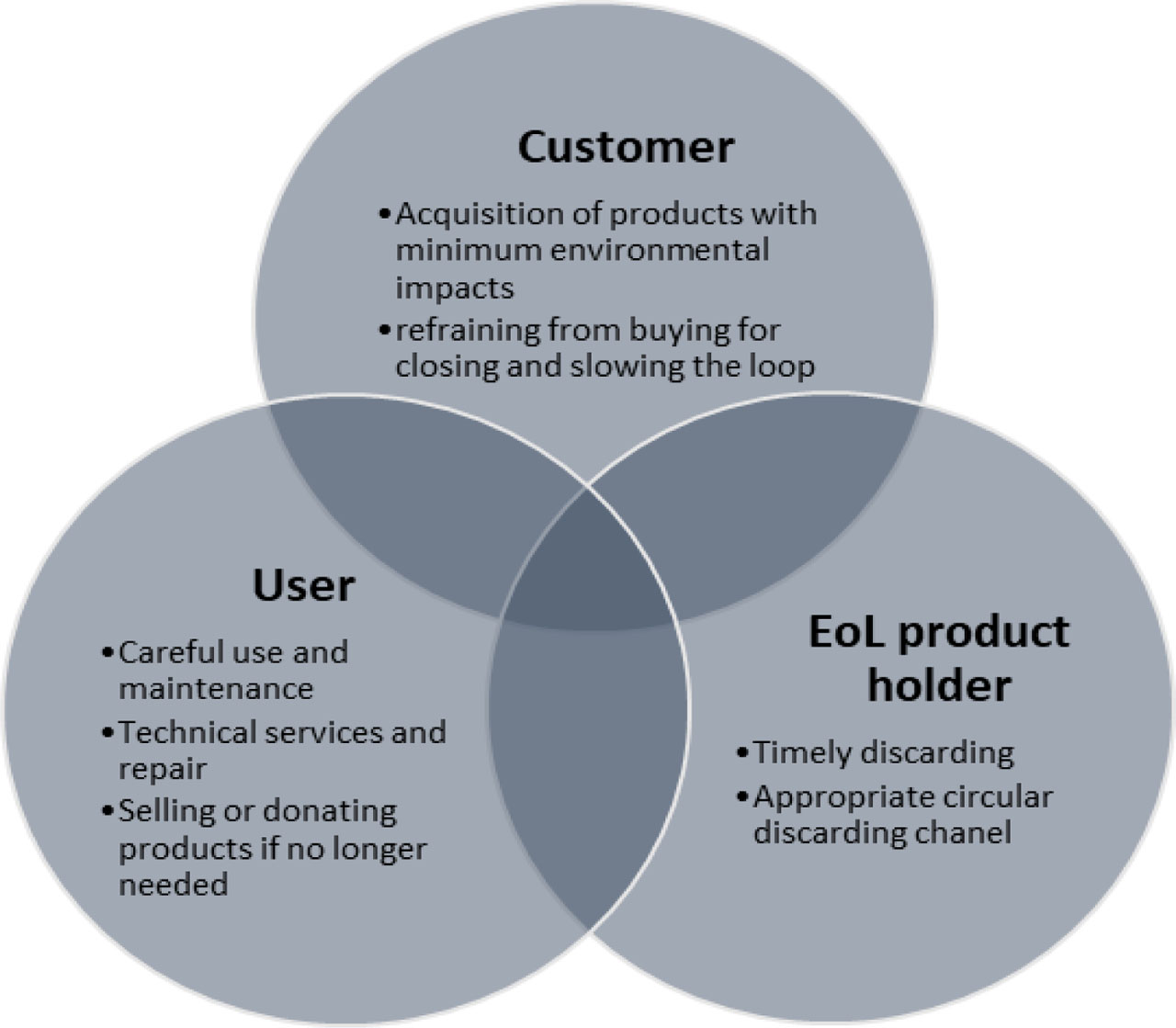
Figure 2.
Factors influencing consumer decision-making in the Circular Economy (Shevchenko et al., 2023)
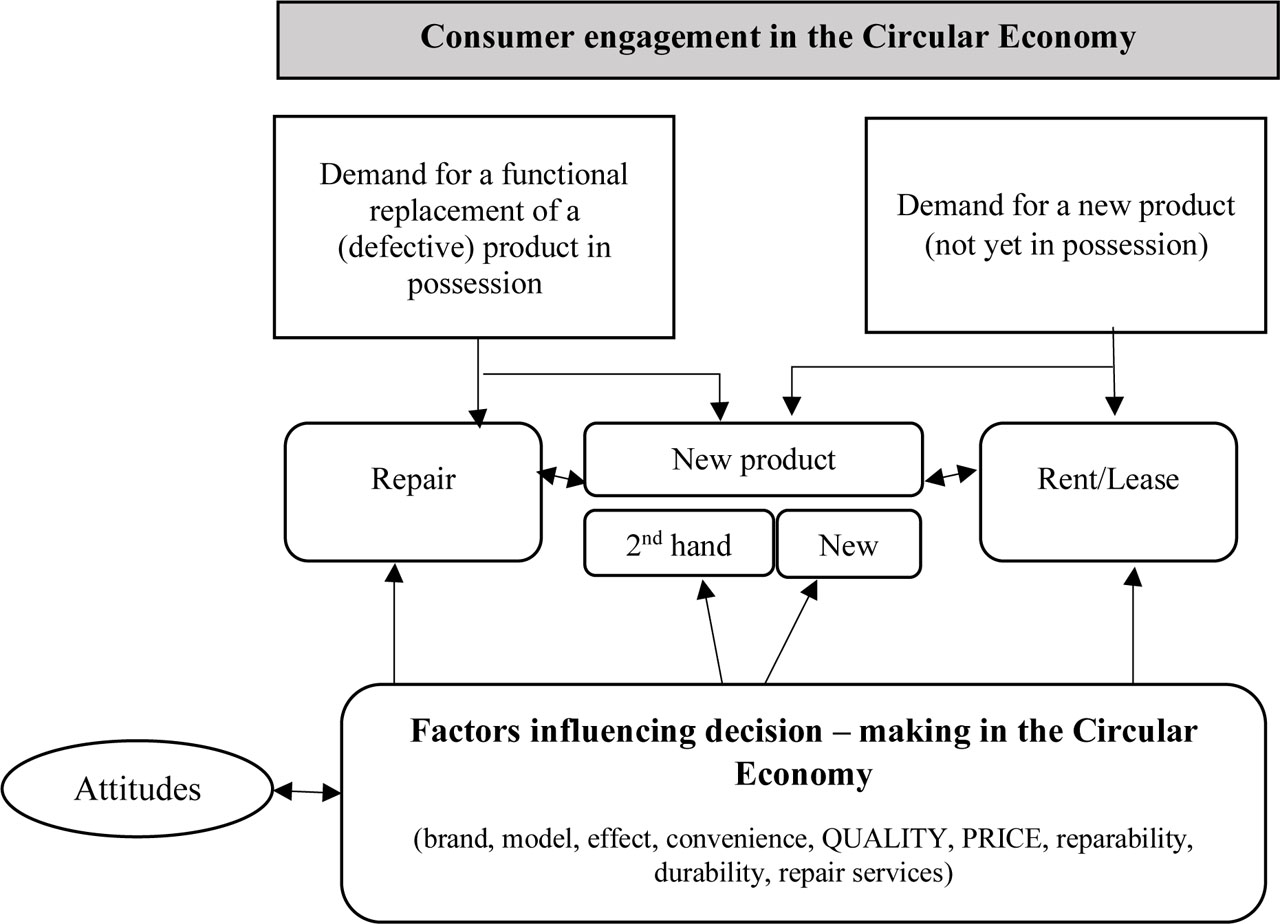
Figure 3.
Factors influencing consumers’ decisions to replace, repair or lease products (EC, 2018)
Table 1.
Correspondence analysis operation diagram (Trzęsiok, 2016)
| 1 | Creation of a correspondence matrix based on the contingency table, i.e., a relative frequency matrix |
| 2 | Transform columns and mailing matrix rows separately to get points (called row and column profiles) that represent the categories of nonmetric variables being studied |
| 3 | Finding a space with a smaller dimension and projecting into it (with possible rotation) points (profiles) obtained in point 2. The choice of space, as well as its rotation, is made in such a way that the loss of information contained in the original data is as small as possible |
| 4 | Creation of a perception map – a graphical presentation of the relationships between the categories of variables studied |
| 5 | Inference of dependencies and interpretation of results |
Table 2.
Row and column coordinates and contribution to inertia for country, generation and knowledge of the question: “Have you come across the concept of the circular economy?”. Source: own elaboration
| Row and column coordinates | Aggregate statistics for row and column points | ||||
|---|---|---|---|---|---|
| Rows | |||||
| Row | Dimension1 | Dimension2 | Mass | Quality | |
| Albania 1995 to 2012 | 1 | −0.487 | −0.060 | 0.071 | 1.000 |
| Albania 1980 to 1994 | 2 | −0.233 | −0.319 | 0.071 | 1.000 |
| Albania 1965 to 1979 | 3 | −0.513 | −0.129 | 0.036 | 1.000 |
| Albania Before 1965 | 4 | 0.258 | −0.347 | 0.014 | 1.000 |
| Poland 1995 to 2012 | 5 | 0.085 | 0.063 | 0.481 | 1.000 |
| Poland 1980 to 1994 | 6 | 0.360 | −0.100 | 0.024 | 1.000 |
| Poland 1965 to 1979 | 7 | −0.229 | 0.256 | 0.020 | 1.000 |
| Poland Before 1965 | 8 | −0.548 | −0.708 | 0.004 | 1.000 |
| Portugal 1995 to 2012 | 9 | −0.446 | 0.288 | 0.063 | 1.000 |
| Portugal 1980 to 1994 | 10 | 0.345 | 0.158 | 0.057 | 1.000 |
| Portugal 1965 to 1979 | 11 | 0.255 | −0.153 | 0.139 | 1.000 |
| Portugal Before 1965 | 12 | −0.190 | 0.032 | 0.020 | 1.000 |
| Columns | |||||
| “Yes, I know what the circular economy is” | 1 | 0.193 | −0.174 | 0.364 | 1.000 |
| “No, I’ve never heard that phrase before” | 2 | −0.481 | −0.050 | 0.224 | 1.000 |
| “I don’t know exactly what's going on” | 3 | 0.091 | 0.181 | 0.412 | 1.000 |
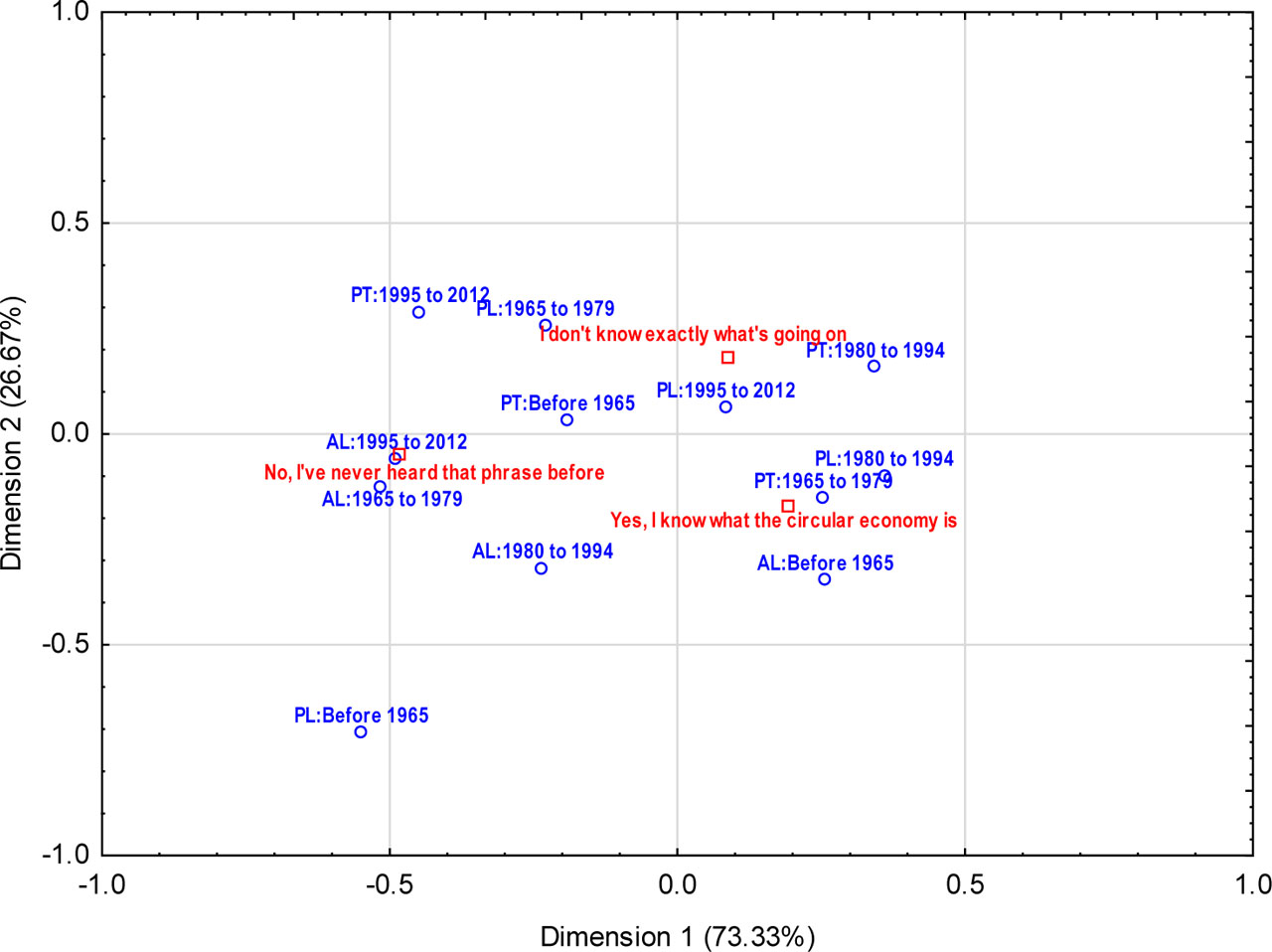
Figure 4.
Presentation for the country, generation and knowledge “Have you come across the concept of the circular economy?”. Source: Own elaboration using Statistica 13.3
Table 3.
Row and column coordinates and contribution to inertia for country, generation and knowledge for the question “Which of the following terms do you associate most with the term ‘circular economy’?”. Source: own elaboration.
| Row and column coordinates | Aggregate statistics for row and column points | ||||
|---|---|---|---|---|---|
| Rows | |||||
| Row | Dimension1 | Dimension2 | Mass | Quality | |
| Albania 1995 to 2012 | 1 | −0.183 | 0.139 | 0.072 | 0.873 |
| Albania 1980 to 1994 | 2 | −0.277 | 0.244 | 0.072 | 0.988 |
| Albania 1965 to 1979 | 3 | 0.039 | 0.571 | 0.037 | 0.991 |
| Albania Before 1965 | 4 | 0.316 | 0.446 | 0.014 | 0.862 |
| Poland 1995 to 2012 | 5 | 0.124 | −0.047 | 0.488 | 0.962 |
| Poland 1980 to 1994 | 6 | 0.072 | −0.241 | 0.025 | 1.000 |
| Poland 1965 to 1979 | 7 | 0.622 | −0.170 | 0.020 | 0.689 |
| Poland Before 1965 | 8 | −0.256 | −0.427 | 0.004 | 0.560 |
| Portugal 1995 to 2012 | 9 | −0.365 | 0.075 | 0.055 | 0.998 |
| Portugal 1980 to 1994 | 10 | −0.369 | 0.094 | 0.053 | 1.000 |
| Portugal 1965 to 1979 | 11 | −0.158 | −0.275 | 0.139 | 0.879 |
| Portugal Before 1965 | 12 | 0.725 | 0.414 | 0.020 | 0.722 |
| Columns | |||||
| Providing consumers with more durable products that will provide savings and a better quality of life | 1 | −0.269 | 0.294 | 0.148 | 0.835 |
| Includes sharing, renting, reusing, repairing, refurbishing and recycling existing materials and product | 2 | −0.060 | −0.085 | 0.693 | 0.798 |
| Actions that can lead to a reduction in waste | 3 | 0.511 | 0.332 | 0.111 | 0.985 |
| Activities that may lead to reductions in total annual greenhouse gas emissions | 4 | 0.496 | −0.436 | 0.049 | 0.759 |
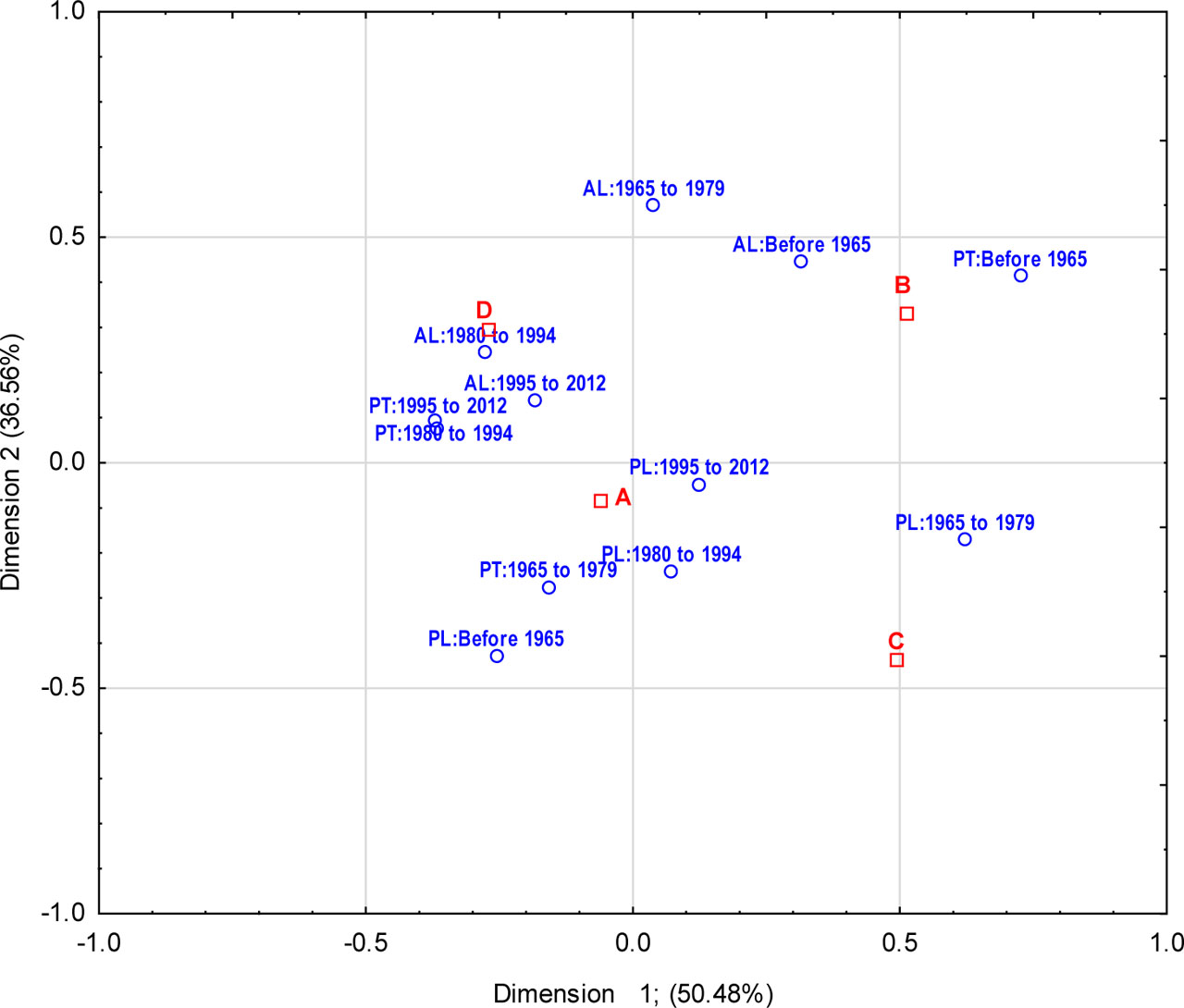
Figure 5.
Presentation for the country, generation and knowledge for the question “Which of the following terms do you associate most with the term circular economy?” A - Includes sharing, renting, reusing, repairing, refurbishing and recycling existing materials and products; B - Actions that can lead to a reduction in waste; C -activities that may lead to reductions in total annual greenhouse gas emissions; D -providing consumers with more durable products that will provide savings and a better quality of life. Source: Own elaboration using Statistica 13.3
Table 4.
Row and column coordinates and contribution to inertia for country, generation and “Where do you most often buy used products?” Source: own elaboration.
| Row and column coordinates | Aggregate statistics for row and column points | ||||
|---|---|---|---|---|---|
| Rows | |||||
| Row | Dimension1 | Dimension2 | Mass | Quality | |
| Albania 1995 to 2012 | 1.000 | −1.314 | −0.375 | 0.071 | 0.907 |
| Albania 1980 to 1994 | 2.000 | −1.196 | −0.006 | 0.071 | 0.929 |
| Albania 1965 to 1979 | 3.000 | −0.973 | −0.162 | 0.036 | 0.873 |
| Albania Before 1965 | 4.000 | −1.365 | 0.300 | 0.014 | 0.948 |
| Poland 1995 to 2012 | 5.000 | 0.543 | −0.128 | 0.482 | 0.997 |
| Poland 1980 to 1994 | 6.000 | 0.616 | 0.261 | 0.024 | 0.890 |
| Poland 1965 to 1979 | 7.000 | 0.630 | 0.278 | 0.020 | 0.817 |
| Poland Before 1965 | 8.000 | 0.617 | 1.151 | 0.004 | 0.840 |
| Portugal 1995 to 2012 | 9.000 | −0.347 | 0.233 | 0.061 | 0.960 |
| Portugal 1980 to 1994 | 10.000 | 0.085 | 0.450 | 0.057 | 0.929 |
| Portugal 1965 to 1979 | 11.000 | −0.259 | 0.191 | 0.140 | 0.885 |
| Portugal Before 1965 | 12.000 | −0.337 | 0.363 | 0.020 | 0.998 |
| Columns | |||||
| Other | 1.000 | −1.156 | 0.036 | 0.245 | 0.997 |
| Vinted | 2.000 | 0.322 | −0.181 | 0.370 | 0.936 |
| OLX | 3.000 | 0.420 | 0.261 | 0.330 | 0.963 |
| Wallapop | 4.000 | −1.073 | −0.939 | 0.010 | 0.457 |
| Allegro | 5.000 | 0.808 | −0.390 | 0.040 | 0.888 |
| 6.000 | 0.797 | −0.566 | 0.004 | 0.888 | |
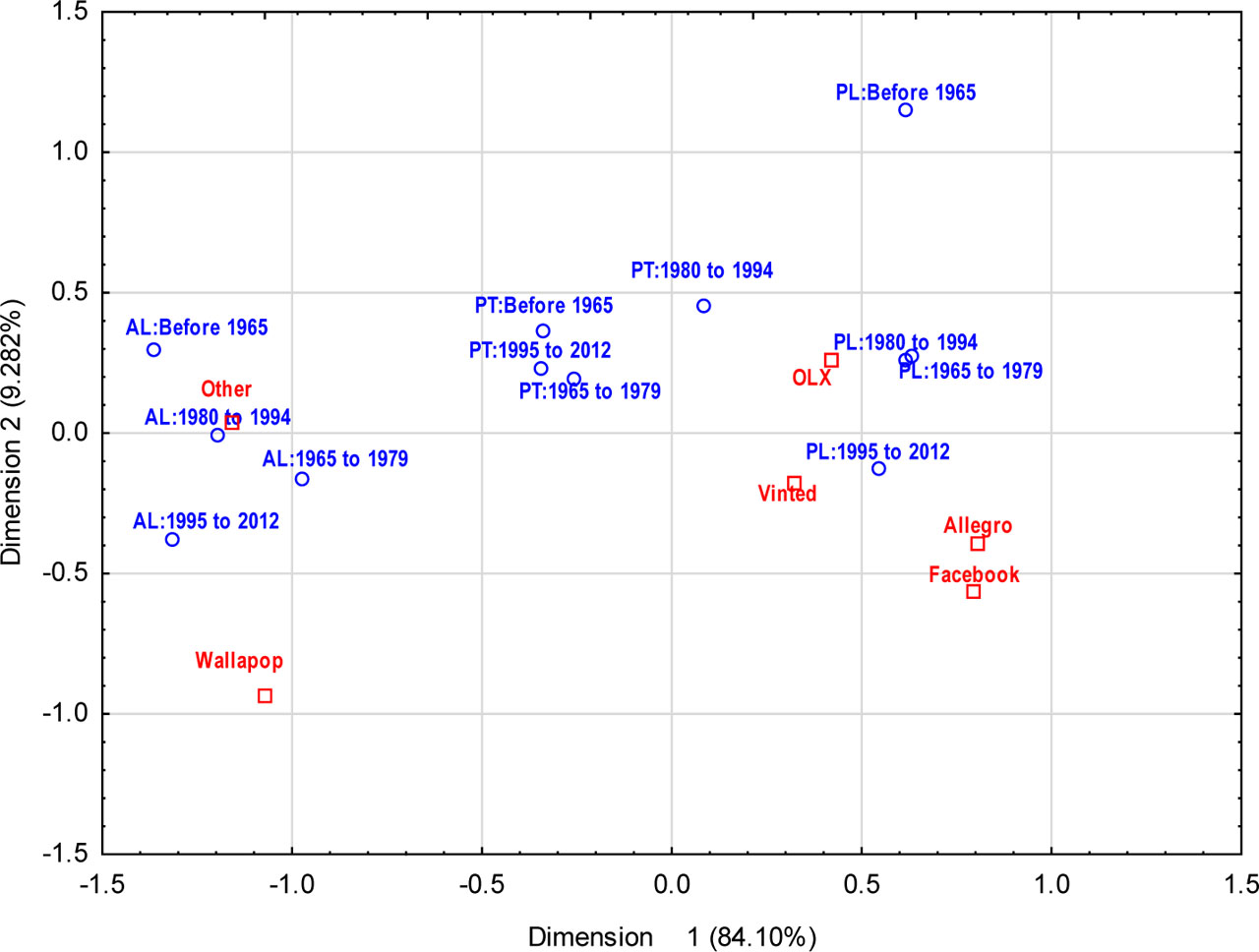
Figure 6.
Presentation for country, generation and responses to “Where do you most often buy used products?” Source: Own elaboration, using Statistica 13.3.
Table 5.
Row and column coordinates and contribution to inertia for country, generation and “What used products do you buy most often?” Source: own elaboration.
| Row and column coordinates | Aggregate statistics for row and column points | ||||
|---|---|---|---|---|---|
| Rows | |||||
| Row | Dimension1 | Dimension2 | Mass | Quality | |
| Albania 1995 to 2012 | 1 | −0.191849 | 0.534824 | 0.070707 | 0.472894 |
| Albania 1980 to 1994 | 2 | 0.051960 | 0.706800 | 0.070707 | 0.708095 |
| Albania 1965 to 1979 | 3 | −0.584115 | −0.220138 | 0.036364 | 0.545227 |
| Albania Before 1965 | 4 | −1.198459 | −0.272782 | 0.014141 | 0.733096 |
| Poland 1995 to 2012 | 5 | 0.307759 | −0.124694 | 0.480808 | 0.974455 |
| Poland 1980 to 1994 | 6 | 0.090776 | 0.303964 | 0.024242 | 0.251457 |
| Poland 1965 to 1979 | 7 | 0.095099 | −0.000663 | 0.020202 | 0.014137 |
| Poland Before 1965 | 8 | 0.431796 | −0.107556 | 0.004040 | 0.352646 |
| Portugal 1995 to 2012 | 9 | −0.023527 | 0.001238 | 0.062626 | 0.004099 |
| Portugal 1980 to 1994 | 10 | −0.259301 | −0.288581 | 0.056566 | 0.359246 |
| Portugal 1965 to 1979 | 11 | −0.452911 | 0.003187 | 0.139394 | 0.461722 |
| Portugal Before 1965 | 12 | −1.311056 | −0.351163 | 0.020202 | 0.778023 |
| Columns | |||||
| Other | 1 | −1.35968 | −0.221362 | 0.038384 | 0.823015 |
| Clothing | 2 | 0.16687 | −0.029520 | 0.640404 | 0.847949 |
| Books | 3 | −0.22194 | 0.454150 | 0.074747 | 0.365518 |
| Footwear | 4 | −0.31252 | 0.955384 | 0.024242 | 0.575607 |
| Household goods (e.g., toasters) | 5 | −0.55651 | 0.519437 | 0.026263 | 0.323437 |
| Furnishings of the apartment | 6 | −0.80131 | −0.446938 | 0.054545 | 0.820918 |
| Phones | 7 | 0.14480 | 1.356521 | 0.006061 | 0.783974 |
| Computers & Laptops | 8 | 0.39371 | −0.142679 | 0.026263 | 0.248796 |
| RTV equipment (Cooperation radio and television) | 9 | 0.08642 | −0.190468 | 0.098990 | 0.188273 |
| Sports equipment | 10 | 0.79637 | −0.454325 | 0.004040 | 0.778476 |
| Games | 11 | 0.79637 | −0.454325 | 0.002020 | 0.778476 |
| Car accessories | 12 | 0.79637 | −0.454325 | 0.002020 | 0.778476 |
| Auto | 13 | 0.79637 | −0.454325 | 0.002020 | 0.778476 |
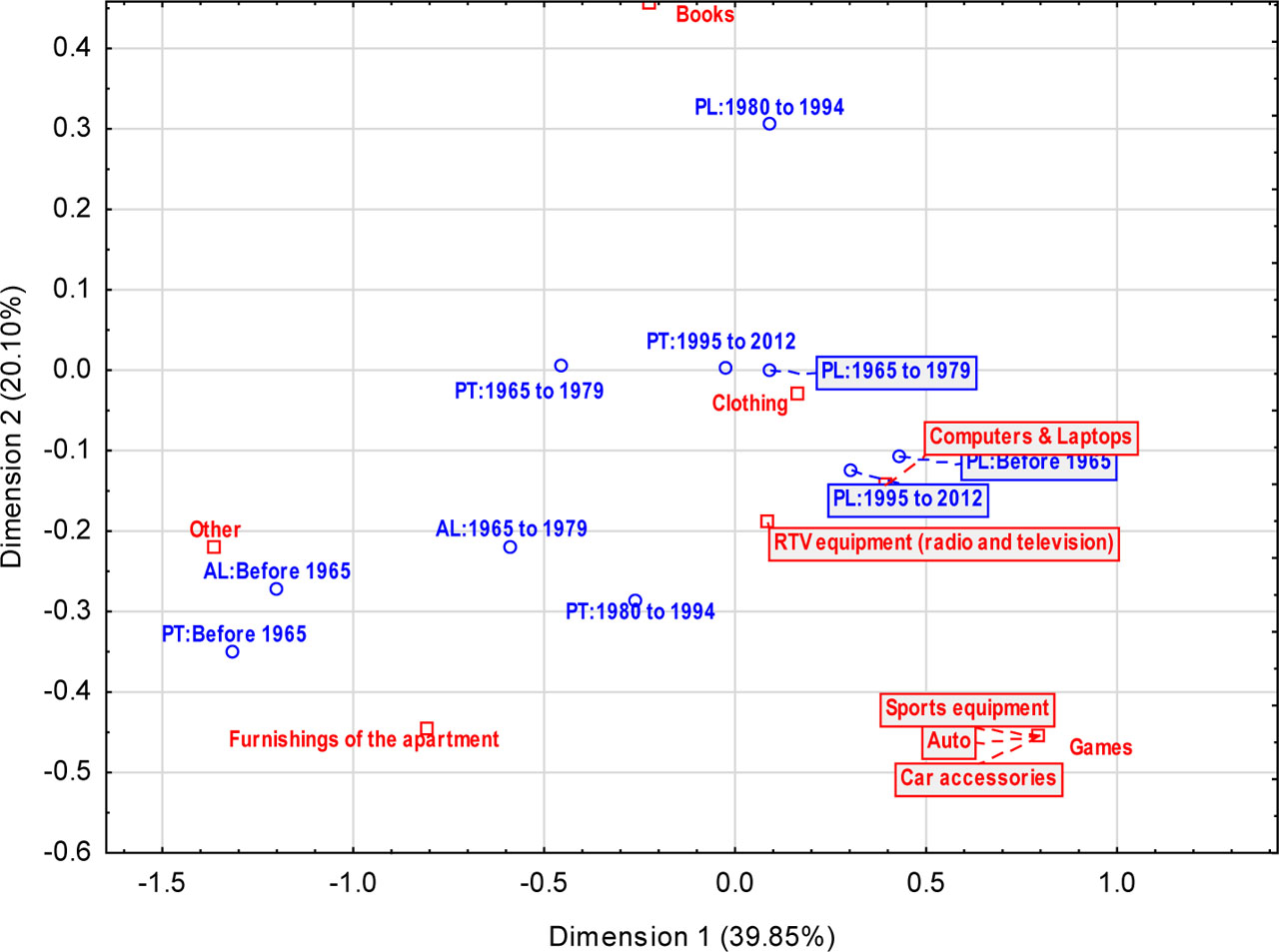
Figure 7.
Presentation for country, generation and “What used products do you buy most often?” Source: Own elaboration using Statistica 13.3
Table 6.
Summary of research results.
| No. | Analysed dependence | Summary |
|---|---|---|
| 1. | Knowledge of the assumptions of the circular economy concept and the nationality and generation of the respondent | Generations X and Z from Albania indicated the answer variant: “No, I have never heard that sentence before.” The answer “Yes, I know what the circular economy is” was clear from Polish Millennials, Albanian Baby Boomers, and Portuguese Generation X. |
| 2. | The variants of the respondents’ answers to the question „Which of the following terms do you most associate with the term ‘circular economy’”, and nationality and generation | „Includes sharing, renting, reusing, repairing, refurbishing and recycling existing materials and products” The most relevant group's answers to this option were Polish respondents from three different generations (X, Millennials and Z). |
| 3. | The place of purchase of used products respondents’ and nationality and generation | Consumers from Poland (born: 1965 – 2012) prefer OLX and Vinted as a place to buy second-hand goods. Consumers from Albania (all generations) most often indicated the answer option “Other.” The distribution of answers of respondents from Portugal did not clearly indicate preferred shopping place. |
| 4. | Types of second-hand goods and the nationality and generation of respondents | Consumers represented by Portuguese generation Z and Polish generation X mainly purchase clothes. Polish generation Z and baby boomers tend to buy used computers and laptops. |