

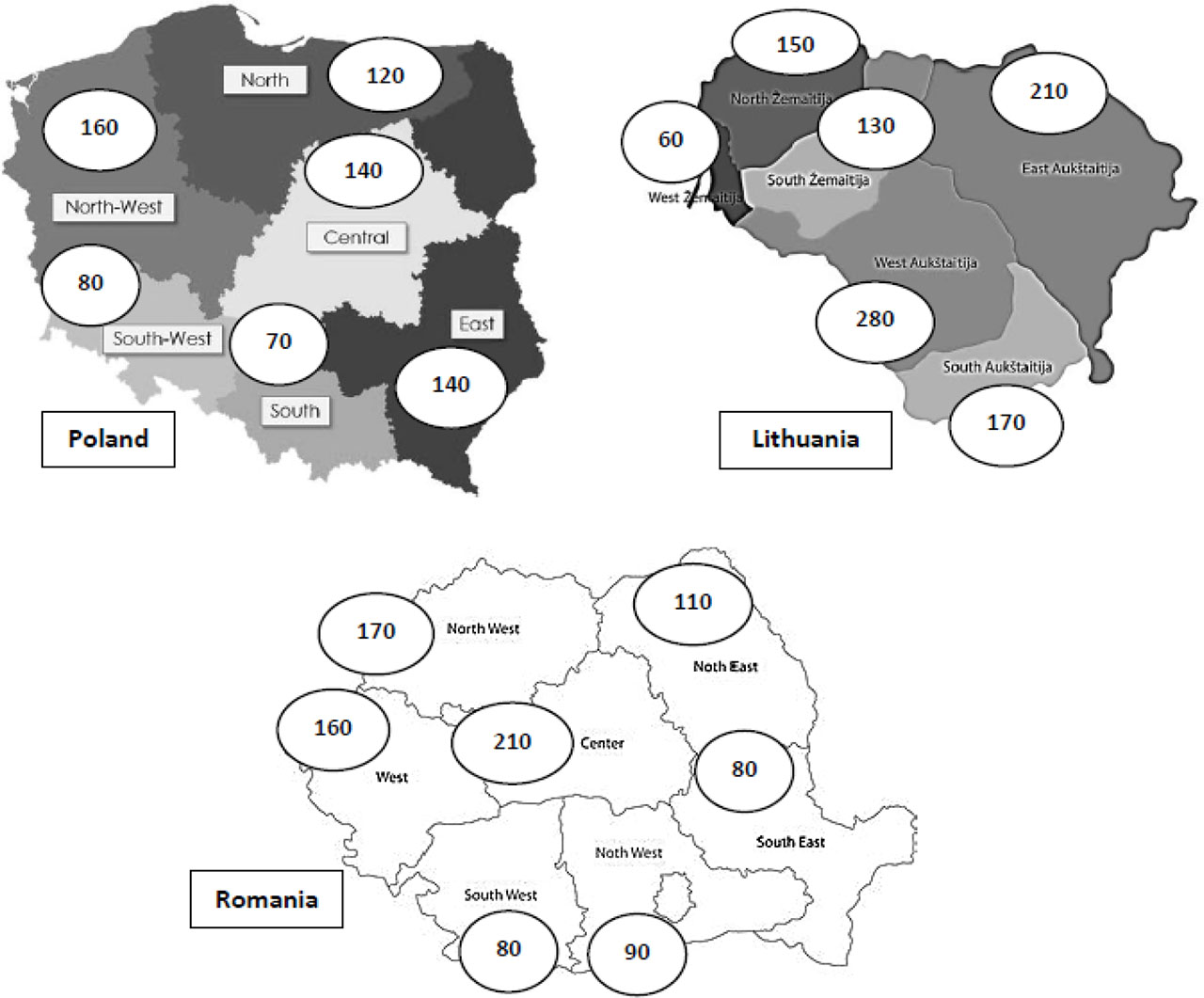
Figure 1.
Regional distribution of surveyed farms for Poland, Romania and Lithuania
Table 1.
Basic statistics for the ‘Top 20’ farms, 2020 (values in brackets for the entire population involved in the questionnaire survey)
| Farm characteristics | Average value | ||
|---|---|---|---|
| Poland | Romania | Lithuania | |
| Farm area (ha of UAA) | 13.4 (14.1) | 13.2 (12.1) | 10.3 (10.5) |
| Standard output (EUR/year) | 17.905 (12.830) | 12.650 (10.320) | 7.501 (5.614) |
| Household income (EUR/month)-only from agriculture | 1.917 (1.843) 1.076 (985) | 1.219 (1.106) 751 (693) | 1.230 (1.022) 533 (433) |
| Share of support in agricultural income | 39% (35%) | 57% (50%) | 58% (55%) |
| Estimated farm value (thous. EUR) | 209.6 (n/a) | 25.7 (24.5) | 51.5 (49.7) |
| Estimated farm liabilities (thous. EUR) | 6.6 (n/a) | 3.0 (2.6) | 0.4 (0.5) |
| Age of farm manager | 49 (49) | 46 (47) | 48 (48) |
| Level of education of farm manager* | 4.9 (4.6) | 4.8 (4.5) | 5.1 (4.9) |
[i] Note: level of education in the range from 1 to 7, where 1 - no education, 7 - higher education
[ii] Source: own performance based on questionnaire survey data
Table 2.
Variables used to determine the synthetic measure of sustainability of surveyed farms in Poland, Romania and Lithuania
| Sustainability component | Variable name | Variable type* | Weight of variable for the individual sustainability component | Weight for the synthetic measure of sustainability |
|---|---|---|---|---|
| Economic | Income gap indicator (difference between average income in the national economy and total income of the agricultural holding) | D | 0.1280 | 0,3304 |
| Subjective assessment of the household's financial situation | S | 0.3398 | ||
| Level of agricultural investment | S | 0.3356 | ||
| Estimated market value of the holding | S | 0.1967 | ||
| Social | Dwelling/house furnishing index | S | 0.1819 | 0,3089 |
| Usable floor area of dwelling/house per family member | S | 0.0959 | ||
| Participation in lifelong learning system | S | 0.1511 | ||
| Participation in social or cultural events | S | 0.2823 | ||
| Membership in an organisation, club, association, etc. | S | 0.2887 | ||
| Environmental | Livestock Units (LSU) per ha of UAA** | D | 0.1383 | 0,3608 |
| Monoculture index | D | 0.2730 | ||
| Eco-efficiency (according to DEA) | S | 0.1133 | ||
| Share of forest in the farm area | S | 0.0315 | ||
| Share of permanent grassland in the farm area | S | 0.0784 | ||
| Share of arable land covered with vegetation during winter | S | 0.1992 | ||
| Balance of soil organic matter*** | S | 0.1664 |
Note:
** Livestock Unit (LSU) - is a reference unit which facilitates the aggregation of livestock from various species and age as per convention, via the use of specific coefficients established initially on the basis of the nutritional or feed requirement of each type of animal;
*** Calculated according to the methodology of the Institute of Soil Science and Plant Cultivation in Pulawy, Poland as the ratio of the sum of the products of the area of cultivated plants, the mass of natural fertilizers produced, the mass of straw potentially intended for ploughing, and the corresponding reproduction or degradation coefficients in relation to the area sown on arable land in a given farm
Source: own performance based on questionnaire survey data
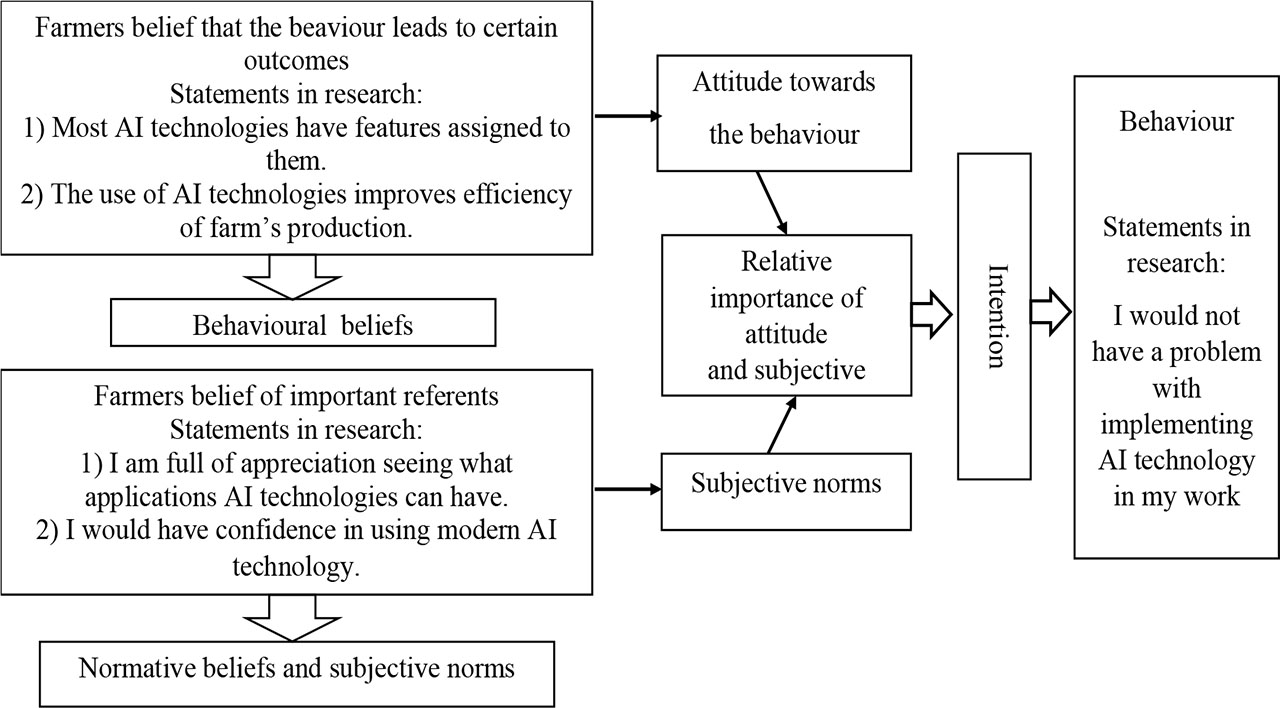
Figure 2.
Statements reflecting the influence of cognitive and subjective components on the implementation of AI technologies in the interviewed farms
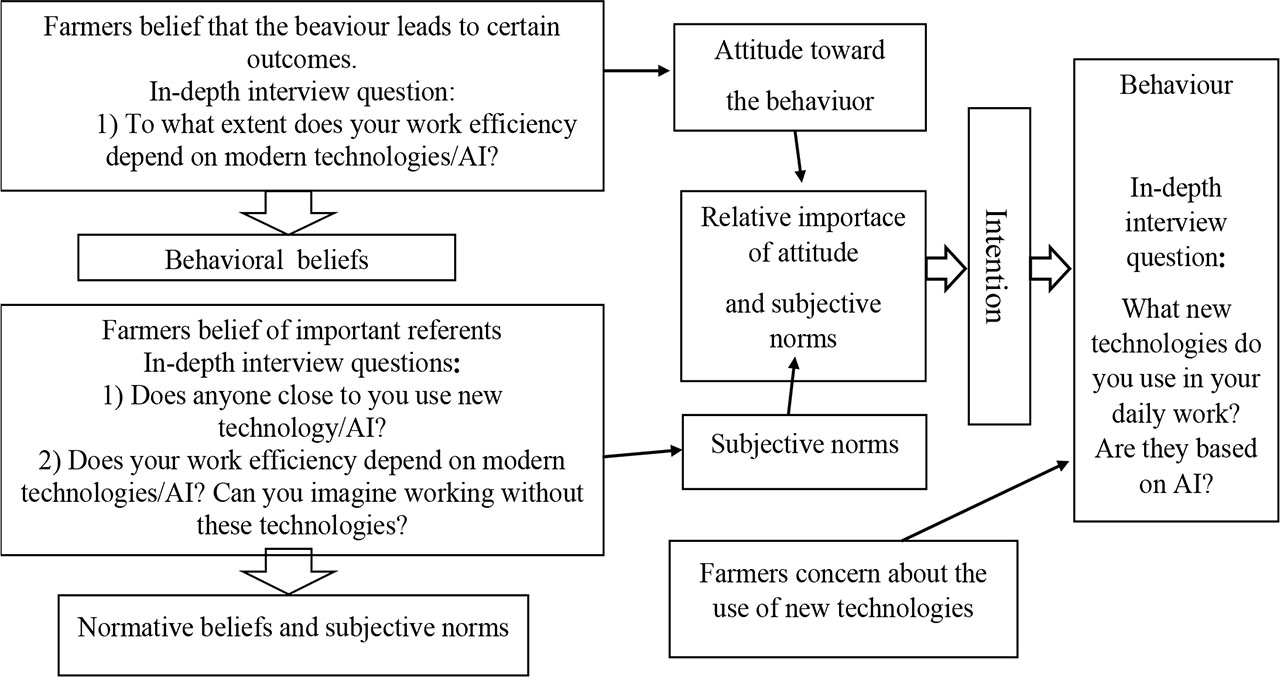
Figure 3.
Questions reflecting the influence of cognitive and subjective components and opinions on the implementation of agricultural AI technologies in the surveyed farms
Table 3.
The average value of indications regarding the statements on attitude towards AI technologies among farm owners from Poland, Romania, and Lithuania
| Component | The statement | Poland | Romania | Lithuania |
|---|---|---|---|---|
| Cognitive (Behavioural beliefs) | Most AI technologies have features assigned to them. | 5.45 | 5.20 | 5.10 |
| The use of AI technologies improves efficiency of farm's production. | 5.15 | 4.65 | 4.50 | |
| Emotional (Normative beliefs and subjective norms) | I am full of appreciation seeing what applications AI technologies can have. | 5.25 | 4.35 | 4.10 |
| I would have confidence in using AI technology. | 4,45 | 3.65 | 3.25 | |
| Behavioural (Behaviour) | I would not have a problem with implementing AI technology in my work. | 3.55 | 3.20 | 3.05 |
[i] Note: response scale from 1 to 6, where 1: totally disagree, 6: totally agree
[ii] Source: own performance based on interview data
Table 4.
The most important barriers to the use of artificial intelligence among small farms in Poland, Romania, and Lithuania
| Poland | Romania | Lithuania |
|---|---|---|
|
|
|
[i] Source: own performance based on interview data