

Table 1.
Summary of the Literature Review
| Subject | Summary | Authors |
|---|---|---|
| Economic growth | Increases stock market return | Al-Tamimi et al. (2011) |
| Amaresh et al. (2020) | ||
| Amtiran et al. (2017) | ||
| Giri and Joshi (2017) | ||
| Kalam (2020) | ||
| Montes and Tiberto (2012) | ||
| Osamwonyi and Evbayiro-Osagie (2012) | ||
| Singh et al. (2011) | ||
| Causes stock market development | Cherif and Gazdar (2010) | |
| Ho and Iyke (2017) | ||
| Yartey (2008) | ||
| Banking sector development | Causes stock market development | Dellas and Hess (2005) |
| Ho and Iyke (2017) | ||
| Pradhan et al. (2014) | ||
| Reduces stock market volatility | Dellas and Hess (2005) | |
| Financial liberalization | Reduces stock market volatility | James and Karoglou (2010) |
| Umutlu et al. (2010) | ||
| Downside volatility | Increases stock market return | Ali (2019) |
| Ang et al. (2006) | ||
| Estrada (2007) | ||
| Risk-adjusted returns | Higher in emerging markets | Atilgan and Demirtas (2016) |
Table 2.
Income Categorization Method Outcomes
| Baseline | Version 2 | Version 3 | Version 4 | Version 5 | |
|---|---|---|---|---|---|
| Frontier | Pakistan, Zimbabwe, Kenya, India, Bangladesh, Nigeria, Vietnam, Morocco, Philippines, Tunisia, Egypt, Sri Lanka, Ukraine, Indonesia, Jordan | + Lebanon, Jamaica, Colombia | + Lebanon, Jamaica, Colombia | Baseline | Baseline |
| Emerging | Lebanon, Jamaica, Colombia, South Africa, Bosnia and Herzegovina, Peru, Botswana, Brazil, Thailand, Serbia, Mexico, Turkey, Argentina, Mauritius, Kazakhstan | − Lebanon, Jamaica, Colombia + Bulgaria, Russia, Malaysia, China | − Lebanon, Jamaica, Colombia + Bulgaria, Russia, Malaysia, China | + Bulgaria, Russia, Malaysia, China | + Bulgaria, Russia, Malaysia, China |
| Early-developed | Bulgaria, Russia, Malaysia, China, Romania, Chile, Croatia, Oman, Trinidad and Tobago, Poland, Hungary, Greece, Lithuania, Bahrain, Portugal, Czech Republic, Estonia, Kuwait, Slovenia, Spain, Taiwan | − Bulgaria, Russia, Malaysia, China | − Bulgaria, Russia, Malaysia, China + Korea, Italy, United Arab Emirates | − Bulgaria, Russia, Malaysia, China | − Bulgaria, Russia, Malaysia, China + Korea, Italy, United Arab Emirates |
| Developed | Korea, Italy, United Arab Emirates, France, Japan, United Kingdom, New Zealand, Canada, Israel, Belgium, Germany, Hong Kong, Austria, Finland, Qatar, Australia, Sweden, Netherlands, Singapore, Denmark, USA, Norway, Ireland, Switzerland | Baseline | − Korea, Italy, United Arab Emirates | Baseline | − Korea, Italy, United Arab Emirates |
[i] Note: Countries are arranged in ascending order according to their GDP per capita. Categorization is based on 75 countries, and this categorization is used for all samples. The income category of a country does not change depending on the sample used. The “+” sign adds countries to the baseline list in the same category. The “−” sign removes countries from the list in the same category. “Baseline” means that the category remained unchanged compared to the baseline.
Table 3.
Comparison of MSCI and Baseline Classifications with early-developed included in developed category
| Baseline classification, ED in D | MSCI classification | Differences | |
|---|---|---|---|
| Frontier | Bangladesh, Egypt, India, Indonesia, Jordan, Kenya, Morocco, Nigeria, Pakistan, Philippines, Sri Lanka, Tunisia, Ukraine, Vietnam, Zimbabwe | Bahrain, Bangladesh, Benin, Burkina Faso, Croatia, Estonia, Iceland, Ivory Coast, Jordan, Kazakhstan, Kenya, Lithuania, Mauritius, Morocco, Nigeria, Oman, Pakistan, Romania, Senegal, Serbia, Slovenia, Sri Lanka, Tunisia, Vietnam | Egypt, India, Indonesia - emerging in MSCI classification; Ukraine and Zimbabwe, standalone |
| Emerging | Argentina, Bosnia and Herzegovina, Botswana, Brazil, Colombia, Jamaica, Kazakhstan, Lebanon, Mauritius, Mexico, Peru, Serbia, South Africa, Thailand, Turkey | Brazil, Chile, China, Colombia, Czech Republic, Egypt, Greece, Hungary, India, Indonesia, Korea, Kuwait, Malaysia, Mexico, Peru, Philippines, Poland, Qatar, Russia, Saudi Arabia, South Africa, Taiwan, Thailand, Turkey, United Arab Emirates | Argentina, Bosnia and Herzegovina, Botswana, Lebanon, Jamaica, standalone in MSCI classification; Kazakhstan, Mauritius, Serbia, frontier |
| Developed | Australia, Austria, Bahrain, Belgium, Bulgaria, Canada, Chile, China, Croatia, Czech Republic, Denmark, Estonia, Finland, France, Germany, Greece, Hong Kong, Hungary, Ireland, Israel, Italy, Japan, Korea, Kuwait, Lithuania, Malaysia, Netherlands, New Zealand, Norway, Oman, Poland, Portugal, Qatar, Romania, Russia, Singapore, Slovenia, Spain, Sweden, Switzerland, Taiwan, Trinidad and Tobago, United Arab Emirates, United Kingdom, USA | Australia, Austria, Belgium, Canada, Denmark, Finland, France, Germany, Hong Kong, Ireland, Israel, Italy, Japan, Netherlands, New Zealand, Norway, Portugal, Singapore, Spain, Sweden, Switzerland, United Kingdom, USA | Bahrain, Estonia, Oman, Romania, Slovenia, frontier; Chile, China, Czech Republic, Greece, Hungary, Korea, Kuwait, Malaysia, Poland, Qatar, Russia, Taiwan, United Arab Emirates, emerging; Bulgaria, standalone. |
| Standalone | Argentina, Bosnia and Herzegovina, Botswana, Bulgaria, Jamaica, Lebanon, Malta, Palestine, Panama, Trinidad and Tobago, Ukraine, and Zimbabwe | We chose not to use this classification, and instead added Early-developed market class. |
[i] Note: Categorization is based on 75 countries; this categorization is used for all samples. The income category of a country does not change depending on the sample used. The developed market in the table includes both early-developed and developed markets according to their own classification.
Table 4.
Comparison of MSCI and Baseline Classifications with early-developed included in emerging category
| Baseline classification, ED in E | MSCI classification | Differences | |
|---|---|---|---|
| Frontier | Bangladesh, Egypt, India, Indonesia, Jordan, Kenya, Morocco, Nigeria, Pakistan, Philippines, Sri Lanka, Tunisia, Ukraine, Vietnam, Zimbabwe | Bahrain, Bangladesh, Benin, Burkina Faso, Croatia, Estonia, Iceland, Ivory Coast, Jordan, Kazakhstan, Kenya, Lithuania, Mauritius, Morocco, Nigeria, Oman, Pakistan, Romania, Senegal, Serbia, Slovenia, Sri Lanka, Tunisia, Vietnam | Egypt, India, Indonesia, emerging in MSCI classification; Ukraine and Zimbabwe, standalone |
| Emerging | Argentina, Bahrain, Bosnia and Herzegovina, Botswana, Brazil, Bulgaria, Chile, China, Colombia, Croatia, Czech Republic, Estonia, Greece, Hungary, Jamaica, Kazakhstan, Kuwait, Lebanon, Lithuania, Malaysia, Mauritius, Mexico, Oman, Peru, Poland, Portugal, Romania, Russia, Serbia, Slovenia, South Africa, Spain, Taiwan, Thailand, Trinidad and Tobago, Turkey | Brazil, Chile, China, Colombia, Czech Republic, Egypt, Greece, Hungary, India, Indonesia, Korea, Kuwait, Malaysia, Mexico, Peru, Philippines, Poland, Qatar, Russia, Saudi Arabia, South Africa, Taiwan, Thailand, Turkey, United Arab Emirates | Bahrain, Croatia, Estonia, Kazakhstan, Lithuania, Mauritius, Romania, Serbia, Slovenia, frontier; Portugal, Spain, developed; Argentina, Bosnia and Herzegovina, Botswana, Bulgaria, Trinidad and Tobago, Lebanon, Jamaica, standalone |
| Developed | Australia, Austria, Belgium, Canada, Denmark, Finland, France, Germany, Hong Kong, Ireland, Israel, Italy, Japan, Korea, Netherlands, New Zealand, Norway, Qatar, Singapore, Sweden, Switzerland, United Arab Emirates, United Kingdom, USA | Australia, Austria, Belgium, Canada, Denmark, Finland, France, Germany, Hong Kong, Ireland, Israel, Italy, Japan, Netherlands, New Zealand, Norway, Portugal, Singapore, Spain, Sweden, Switzerland, United Kingdom, USA | Korea, Qatar, United Arab Emirates, emerging in MSCI classification |
| Standalone | Argentina, Bosnia and Herzegovina, Botswana, Bulgaria, Jamaica, Lebanon, Malta, Palestine, Panama, Trinidad and Tobago, Ukraine, Zimbabwe | We chose not to use this classification, and instead added early-developed market class. |
[i] Note: Categorization is based on 75 countries; this categorization is used for all samples. The income category of a country does not change depending on the sample used. Emerging markets in the table include both early-developed and emerging markets, according to their own classification.
Table 5.
Average Summary Statistics of Equity Indices Daily Returns
| GDP | R.A | Mean | Min | Median | Max | ASD | Skewness | Kurtosis | |
|---|---|---|---|---|---|---|---|---|---|
| First sample: 51 Countries, 2002–2022 | |||||||||
| Frontier | 3334 | 9.24% | 0.04% | −13.2% | 0.05% | 13.0% | 22.2% | −0.72 | 18.2 |
| Emerging | 6852 | 9.73% | 0.04% | −13.4% | 0.06% | 13.6% | 29.1% | −0.25 | 12.6 |
| Early_developed | 18122 | 5.43% | 0.04% | −14.9% | 0.05% | 13.1% | 24.2% | −0.52 | 19.3 |
| Developed | 50603 | 7.69% | 0.04% | −15.7% | 0.04% | 14.3% | 22.7% | −0.24 | 12.4 |
| Second sample: 75 Countries, 2010–2022 | |||||||||
| Frontier | 2804 | 0.52% | 0.03% | −13.8% | 0.03% | 9.4% | 21.7% | −1.77 | 45.4 |
| Emerging | 6921 | 0.52% | 0.02% | −14.4% | 0.02% | 9.9% | 24.8% | −1.20 | 38.4 |
| Early_developed | 17858 | 2.13% | 0.02% | −15.1% | 0.02% | 10.8% | 20.4% | −0.82 | 22.2 |
| Developed | 50603 | 6.80% | 0.02% | −17.5% | 0.01% | 10.4% | 19.7% | −0.54 | 12.3 |
[i] Note. Summary statistics use only the baseline income categorization outcome. A full list of countries in the baseline outcome can be seen in Table 2.
Table 6.
Summary Statistics for Metrics of the First Sample
| Frontier | Emerging | Early-developed | Developed | Frontier | Emerging | Early-developed | Developed | |
|---|---|---|---|---|---|---|---|---|
| Min | R.D | R.M | ||||||
| −9.1 | −12.5 | −9.6 | −10.6 | −26.6 | −31.8 | −27.3 | −24.7 | |
| Mean | 0.0 | 0.1 | 0.0 | 0.0 | 1.0 | 1.2 | 0.7 | 0.8 |
| Median | 0.1 | 0.1 | 0.1 | 0.1 | 1.3 | 1.6 | 0.9 | 1.2 |
| Max | 5.6 | 9.7 | 9.0 | 7.6 | 15.7 | 20.6 | 17.2 | 15.4 |
| Min | STD | DSTD | ||||||
| 9.3 | 9.6 | 11.0 | 8.7 | 3.8 | 3.9 | 5.1 | 4.9 | |
| Mean | 18.9 | 25.2 | 20.4 | 19.2 | 12.2 | 15.2 | 12.5 | 11.7 |
| Median | 17.2 | 22.6 | 17.8 | 16.5 | 10.9 | 13.7 | 10.7 | 9.9 |
| Max | 69.7 | 102.4 | 91.4 | 87.3 | 56.3 | 69.1 | 57.6 | 52.8 |
| Min | VaR.H | VaR.N | ||||||
| 0.7 | 0.6 | 0.9 | 0.9 | 1.1 | 0.9 | 1.2 | 1.0 | |
| Mean | 2.1 | 2.8 | 2.3 | 2.1 | 2.3 | 3.1 | 2.5 | 2.3 |
| Median | 1.9 | 2.5 | 1.9 | 1.8 | 2.0 | 2.8 | 2.1 | 1.9 |
| Max | 10.1 | 12.9 | 10.6 | 9.8 | 9.7 | 14.1 | 12.5 | 11.9 |
| Min | ES.H | ES.N | ||||||
| 0.9 | 0.7 | 1.0 | 1.0 | 1.4 | 1.7 | 1.7 | 1.3 | |
| Mean | 2.5 | 3.3 | 2.7 | 2.5 | 2.8 | 3.8 | 3.0 | 2.9 |
| Median | 2.3 | 2.9 | 2.2 | 2.1 | 2.6 | 3.4 | 2.7 | 2.5 |
| Max | 11.9 | 13.4 | 12.4 | 11.9 | 9.1 | 13.6 | 12.3 | 11.8 |
| Min | MDD | UI | ||||||
| 1.2 | 1.3 | 1.5 | 1.4 | 0.7 | 0.8 | 0.9 | 0.7 | |
| Mean | 5.7 | 7.4 | 6.1 | 5.6 | 3.3 | 4.3 | 3.5 | 3.2 |
| Median | 4.7 | 5.9 | 5.0 | 4.4 | 2.6 | 3.3 | 2.8 | 2.4 |
| Max | 33.9 | 44.5 | 38.7 | 35.2 | 21.4 | 29.8 | 24.1 | 22.9 |
[i] Note. R.D, daily return; R.M., monthly return; STD, annualized standard deviation; DSTD, annualized downside semi-deviation; VaR.H, historical 97.5% value-at-risk; VaR.N, Gaussian 97.5% value-at-risk; ES.H, historical 97.5% expected shortfall; ES.N, Gaussian 97.5% expected shortfall. For the detailed description of income categories, see Table 2.
Table 7.
Summary Statistics for Metrics of the Second Sample
| Frontier | Emerging | Early-developed | Developed | Frontier | Emerging | Early-developed | Developed | |
|---|---|---|---|---|---|---|---|---|
| Min | R.D | R.M | ||||||
| −6.4 | −8.1 | −9.3 | −10.6 | −22.9 | −23.0 | −18.4 | −16.3 | |
| Mean | 0.0 | 0.0 | 0.0 | 0.0 | 0.5 | 0.3 | 0.4 | 0.7 |
| Median | 0.1 | 0.0 | 0.0 | 0.1 | 0.7 | 0.9 | 0.3 | 0.9 |
| Max | 2.1 | 4.0 | 5.0 | 7.6 | 12.6 | 14.0 | 13.6 | 15.4 |
| Min | STD | DSTD | ||||||
| 11.1 | 13.8 | 10.9 | 8.7 | 5.7 | 7.3 | 5.6 | 5.1 | |
| Mean | 17.4 | 21.3 | 17.5 | 17.1 | 11.4 | 13.3 | 11.0 | 10.7 |
| Median | 16.0 | 19.8 | 15.9 | 15.4 | 10.2 | 12.3 | 9.3 | 9.5 |
| Max | 62.3 | 74.4 | 69.7 | 72.9 | 52.1 | 53.3 | 55.9 | 52.8 |
| Min | VaR.H | VaR.N | ||||||
| 1.0 | 1.3 | 0.9 | 0.9 | 1.2 | 1.5 | 1.2 | 1.0 | |
| Mean | 2.0 | 2.4 | 2.0 | 1.9 | 2.1 | 2.6 | 2.1 | 2.1 |
| Median | 1.8 | 2.2 | 1.7 | 1.7 | 1.9 | 2.4 | 1.9 | 1.8 |
| Max | 9.1 | 9.9 | 10.2 | 9.6 | 8.8 | 10.3 | 9.4 | 9.7 |
| Min | ES.H | ES.N | ||||||
| 1.1 | 1.5 | 1.2 | 1.0 | 1.8 | 2.1 | 1.6 | 1.3 | |
| Mean | 2.4 | 2.9 | 2.3 | 2.3 | 2.6 | 3.2 | 2.6 | 2.6 |
| Median | 2.1 | 2.6 | 2.1 | 2.0 | 2.4 | 3.0 | 2.4 | 2.3 |
| Max | 10.9 | 10.7 | 11.9 | 11.9 | 8.1 | 9.9 | 9.4 | 10.0 |
| Min | MDD | UI | ||||||
| 2.2 | 2.3 | 1.7 | 1.5 | 1.3 | 1.3 | 0.9 | 0.8 | |
| Mean | 5.5 | 6.3 | 5.3 | 4.9 | 3.2 | 3.6 | 3.1 | 2.8 |
| Median | 4.7 | 5.4 | 4.5 | 4.1 | 2.8 | 3.2 | 2.5 | 2.2 |
| Max | 30.0 | 32.6 | 30.7 | 31.3 | 20.1 | 22.6 | 21.5 | 21.0 |
[i] Note. R.D, daily return; R.M., monthly return; STD, annualized standard deviation; DSTD, annualized downside semi-deviation; VaR.H, historical 97.5% value-at-risk; VaR.N, Gaussian 97.5% value-at-risk; ES.H, historical 97.5% expected shortfall; ES.N, Gaussian 97.5% expected shortfall. For the detailed description of income categories, see Table 2.
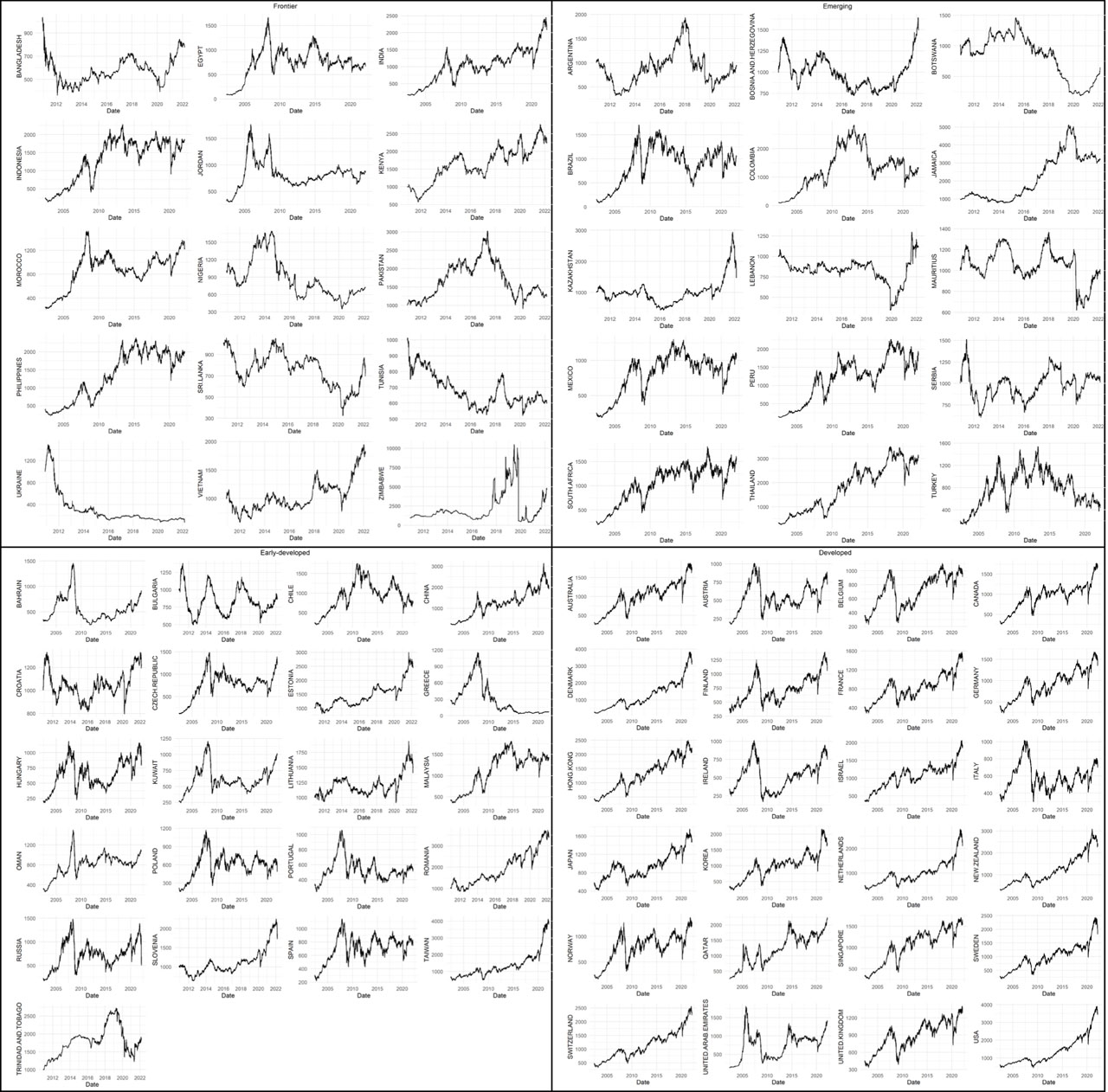
Figure 1.
Daily Fluctuations of the Country Indices
Note. This four-panel figure shows the fluctuations of the prices of equity indices divided into four groups described based on baseline classification and presented in Table 2. For each country, we present the longest time period that was selected for this research.
Table 8.
MDD for All Countries Under Investigation from Baseline Classification
| Country | Class | First (%) | Second (%) | Country | Class | First (%) | Second (%) |
|---|---|---|---|---|---|---|---|
| ARGENTINA | Emerging | 80.6 | LITHUANIA | Early-developed | 33.5 | ||
| AUSTRALIA | Developed | 66.8 | 46.5 | MALAYSIA | Early-developed | 51.9 | 47.0 |
| AUSTRIA | Developed | 76.8 | 59.3 | MAURITIUS | Emerging | 54.7 | |
| BAHRAIN | Early-developed | 83.3 | 34.4 | MEXICO | Emerging | 64.8 | 60.2 |
| BANGLADESH | Frontier | 64.9 | MOROCCO | Frontier | 55.8 | 44.3 | |
| BELGIUM | Developed | 75.1 | 47.0 | NETHERLANDS | Developed | 64.2 | 34.7 |
| BOSNIA AND HERZEGOVINA | Emerging | 48.9 | NEW ZEALAND | Developed | 65.7 | 36.5 | |
| BOTSWANA | Emerging | 87.3 | NIGERIA | Frontier | 79.2 | ||
| BRAZIL | Emerging | 75.7 | 74.2 | NORWAY | Developed | 75.2 | 53.2 |
| BULGARIA | Early-developed | 64.2 | OMAN | Early-developed | 66.2 | 36.5 | |
| CANADA | Developed | 61.5 | 43.3 | PAKISTAN | Frontier | 70.2 | |
| CHILE | Early-developed | 72.7 | 72.7 | PERU | Emerging | 67.9 | 57.8 |
| CHINA | Early-developed | 73.2 | 41.7 | PHILIPPINES | Frontier | 61.7 | 49.9 |
| COLOMBIA | Emerging | 77.6 | 77.6 | POLAND | Early-developed | 78.2 | 59.9 |
| CROATIA | Early-developed | 40.3 | PORTUGAL | Early-developed | 67.4 | 50.4 | |
| CZECH REPUBLIC | Early-developed | 67.2 | 61.1 | QATAR | Developed | 64.2 | 43.9 |
| DENMARK | Developed | 64.2 | 34.7 | ROMANIA | Early-developed | 44.3 | |
| EGYPT | Frontier | 70.3 | 58.2 | RUSSIA | Early-developed | 79.8 | 66.5 |
| ESTONIA | Early-developed | 34.5 | SERBIA | Emerging | 60..2 | ||
| FINLAND | Developed | 73.4 | 47.4 | SINGAPORE | Developed | 64.3 | 39.5 |
| FRANCE | Developed | 60.7 | 39.8 | SLOVENIA | Early-developed | 40.1 | |
| GERMANY | Developed | 62.9 | 46.4 | SOUTH AFRICA | Emerging | 63.2 | 60.8 |
| GREECE | Early-developed | 97.4 | 91.1 | SPAIN | Early-developed | 62.7 | 51.9 |
| HONG KONG | Developed | 64.4 | 32.5 | SRI LANKA | Frontier | 69.3 | |
| HUNGARY | Early-developed | 81.3 | 62.5 | SWEDEN | Developed | 68.3 | 38.2 |
| INDIA | Frontier | 74.3 | 46.2 | SWITZERLAND | Developed | 52.7 | 26.6 |
| INDONESIA | Frontier | 72.1 | 60.5 | TAIWAN | Early-developed | 60.6 | 30.8 |
| IRELAND | Developed | 83.5 | 41.0 | THAILAND | Emerging | 62.3 | 46.5 |
| ISRAEL | Developed | 41.4 | 39.4 | TRINIDAD AND TOBAGO | Early-developed | 55.0 | |
| ITALY | Developed | 70.7 | 50.5 | TUNISIA | Frontier | 48.6 | |
| JAMAICA | Emerging | 45.5 | TURKEY | Emerging | 75,6% | 75.6 | |
| JAPAN | Developed | 53.3 | 31.2 | UKRAINE | Frontier | 95.1 | |
| JORDAN | Frontier | 67.0 | 37.2 | UNITED ARAB EMIRATES | Developed | 86.1 | 58.1 |
| KAZAKHSTAN | Emerging | 66.6 | UNITED KINGDOM | Developed | 63.7 | 43.2 | |
| KENYA | Frontier | 47.2 | USA | Developed | 55.7 | 35.0 | |
| KOREA | Developed | 72.1 | 50.0 | VIETNAM | Frontier | 49.9 | |
| KUWAIT | Early-developed | 68.5 | 44.6 | ZIMBABWE | Frontier | 96.5 | |
| LEBANON | Emerging | 68.7 |
[i] Note. The first drawdown is the MD from the first sample, and the second one is the MD from the second sample. Red numbers indicate that the higher MD was in the second sample, which is covered by the first sample.
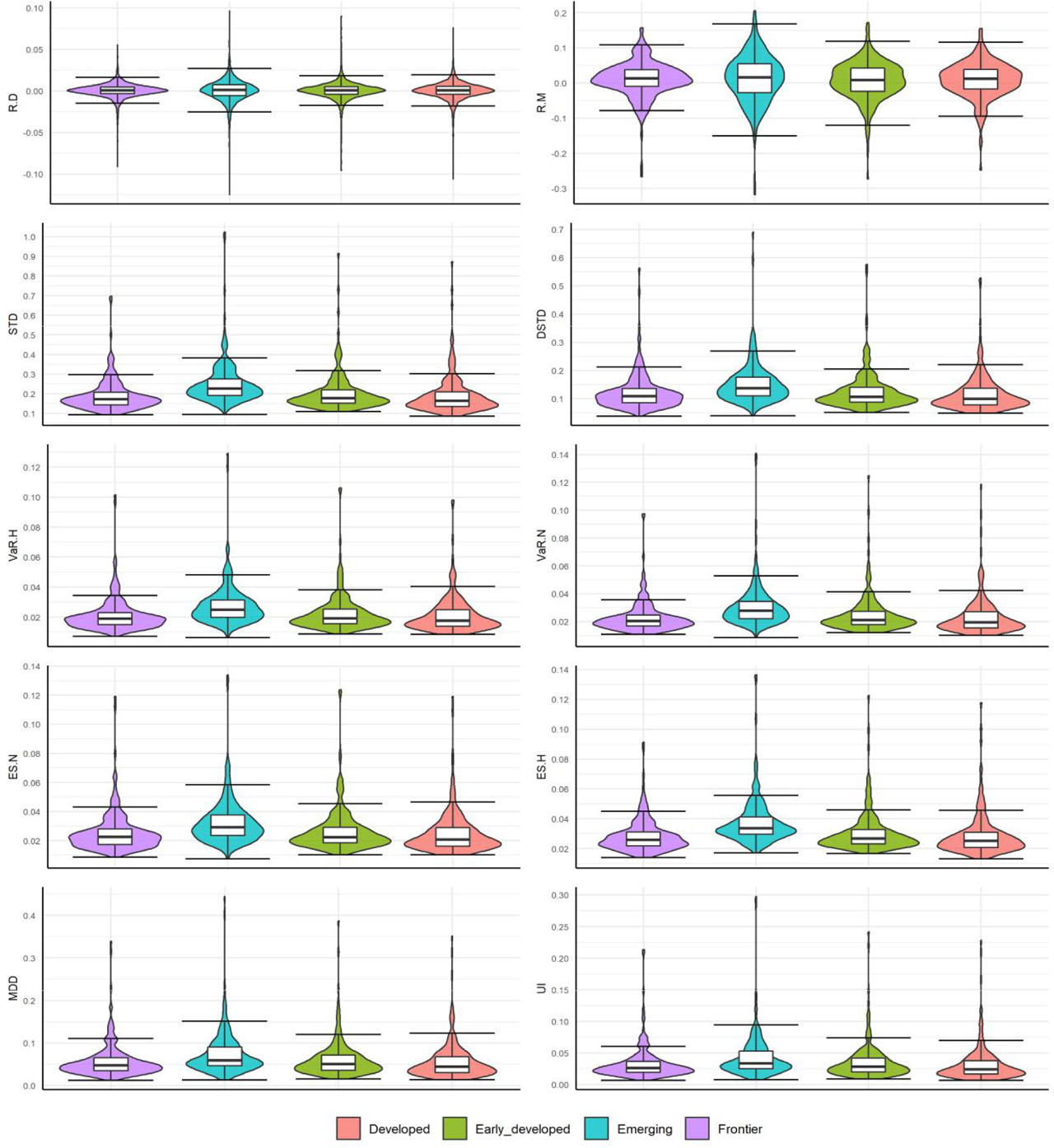
Figure 2.
First Sample Distributions
Note. R.D, daily return of four groups; R.M, monthly return; STD, annualized standard deviation; DSTD, annualized downside semi-deviation; VaR.H, historical 97.5% value-at-risk; VaR.N, Gaussian 97.5% value-at-risk; ES.H, historical 97.5% expected shortfall; ES.N, Gaussian 97.5% expected shortfall.
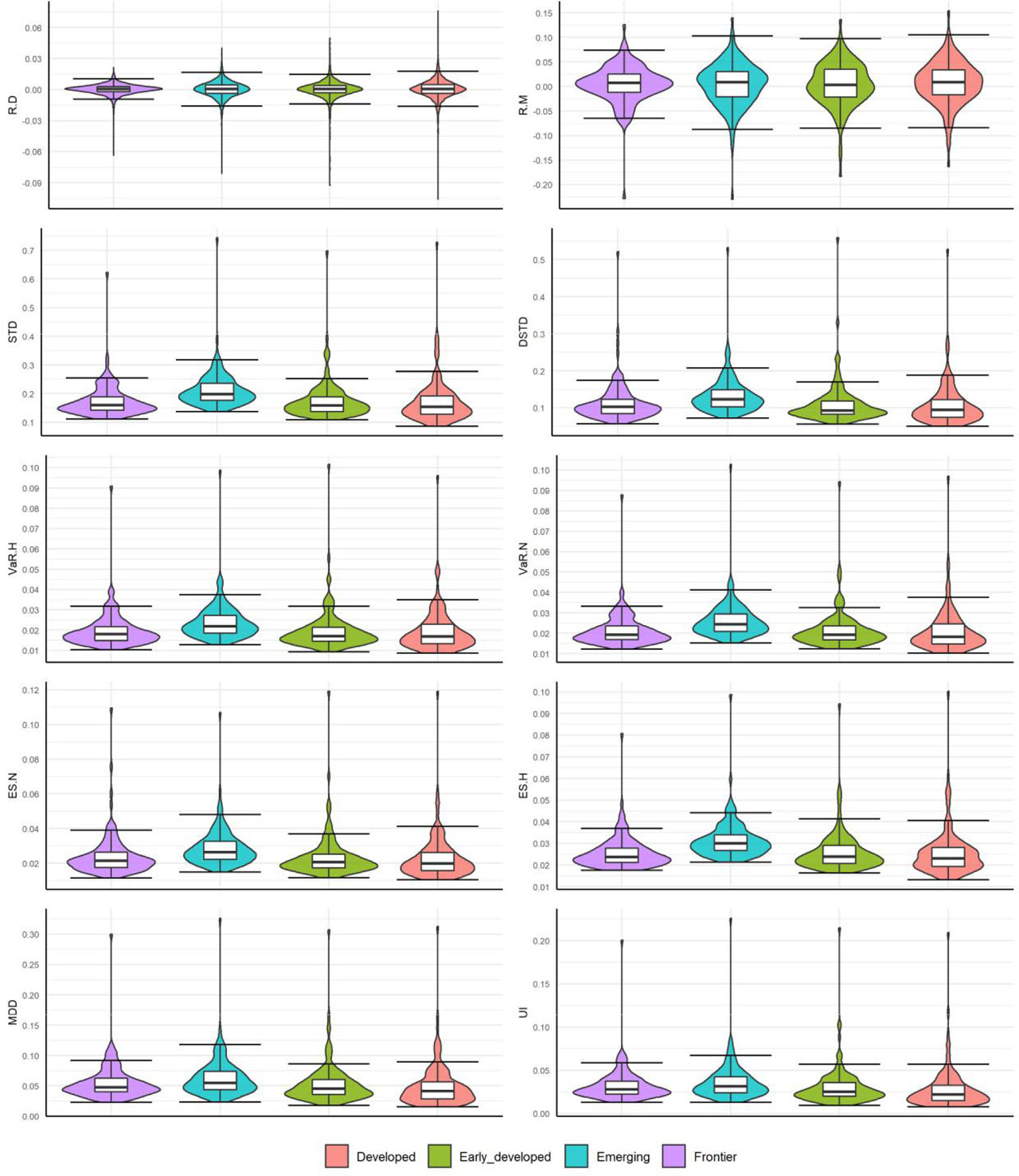
Figure 3.
Second Sample Distributions
Note. R.D, daily return of four groups; R.M, monthly return; STD, annualized standard deviation; DSTD, annualized downside semi-deviation; VaR.H, historical 97.5% value-at-risk; VaR.N, Gaussian 97.5% value-at-risk; ES.H, historical 97.5% expected shortfall; ES.N, Gaussian 97.5% expected shortfall.
Table 9.
Results of Baseline Income Categorization
| R.D | R.M | STD | DSTD | VaR.H | VaR.N | ES.H | ES.N | MDD | UI | |
|---|---|---|---|---|---|---|---|---|---|---|
| Kruskal–Wallis rank sum test p values of H statistic: | ||||||||||
| First sample | 0.201 | 0.767 | 0 | 0 | 0 | 0 | 0 | 0 | 0 | 0 |
| Pairwise Wilcoxon rank sum test p values of U statistic | ||||||||||
| F_E | - | - | 0 | 0 | 0 | 0 | 0 | 0 | 0 | 0 |
| F_ED | - | - | 0.077 | 0.479 | 0.306 | 0.077 | 0.515 | 0.096 | 0.265 | 0.185 |
| F_D | - | - | 0.34 | 0.222 | 0.453 | 0.341 | 0.515 | 0.365 | 0.265 | 0.185 |
| E_ED | - | - | 0 | 0 | 0 | 0 | 0 | 0 | 0 | 0 |
| E_D | - | - | 0 | 0 | 0 | 0 | 0 | 0 | 0 | 0 |
| ED_D | - | - | 0.008 | 0.044 | 0.078 | 0.016 | 0.06 | 0.009 | 0.027 | 0.009 |
| Kruskal–Wallis rank sum test p values of H statistic | ||||||||||
| Second sample | 0.524 | 0.91 | 0 | 0 | 0 | 0 | 0 | 0 | 0 | 0 |
| Pairwise Wilcoxon rank sum test p values of U statistic | ||||||||||
| F_E | - | - | 0 | 0 | 0 | 0 | 0 | 0 | 0.023 | 0.075 |
| F_ED | - | - | 0.761 | 0.417 | 0.513 | 0.804 | 0.463 | 0.729 | 0.097 | 0.075 |
| F_D | - | - | 0.272 | 0.086 | 0.273 | 0.159 | 0.146 | 0.457 | 0.003 | 0 |
| E_ED | - | - | 0 | 0 | 0 | 0 | 0 | 0 | 0 | 0 |
| E_D | - | - | 0 | 0 | 0 | 0 | 0 | 0 | 0 | 0 |
| ED_D | - | - | 0.282 | 0.417 | 0.513 | 0.186 | 0.463 | 0.501 | 0.089 | 0.033 |
[i] Note.: R.D, daily return of the four groups; R.M, monthly return; STD, annualized standard deviation; DSTD, annualized downside semi-deviation; VaR.H, historical 97.5% value-at-risk; VaR.N, Gaussian 97.5% value-at-risk; ES.H, historical 97.5% expected shortfall; ES.N, Gaussian 97.5% expected shortfall. F_E, frontier and emerging market pair; F_ED, frontier and early-developed market pair; F_D, frontier and developed market pair; E_ED, emerging and early-developed market pair; E_D, emerging and developed market pair; ED_D, early-developed and developed market pair.
Table 10.
Results of the Time Period Change
| R.D | R.M | STD | DSTD | VaR.H | VaR.N | ES.H | ES.N | MDD | UI | |
|---|---|---|---|---|---|---|---|---|---|---|
| Kruskal–Wallis rank sum test p values of H-statistic: | ||||||||||
| First sample | 0.695 | 0.945 | 0 | 0 | 0 | 0 | 0 | 0 | 0 | 0 |
| Pairwise Wilcoxon rank sum test p values of U statistic: | ||||||||||
| F_E | - | - | 0 | 0 | 0 | 0 | 0 | 0 | 0 | 0 |
| F_ED | - | - | 0 | 0.096 | 0.015 | 0.001 | 0.034 | 0 | 0.017 | 0.015 |
| F_D | - | - | 0.292 | 0.966 | 0.534 | 0.451 | 0.725 | 0.236 | 0.83 | 0.588 |
| E_ED | - | - | 0 | 0 | 0 | 0 | 0 | 0 | 0.006 | 0.015 |
| E_D | - | - | 0 | 0 | 0 | 0 | 0 | 0 | 0 | 0 |
| ED_D | - | - | 0.021 | 0.096 | 0.083 | 0.02 | 0.077 | 0.027 | 0.02 | 0.011 |
| Kruskal–Wallis rank sum test p values of H-statistic: | ||||||||||
| Second sample | 0.833 | 0.995 | 0 | 0 | 0 | 0 | 0 | 0 | 0 | 0 |
| Pairwise Wilcoxon rank sum test p values of U statistic: | ||||||||||
| F_E | - | - | 0 | 0 | 0 | 0 | 0 | 0 | 0.018 | 0.093 |
| F_ED | - | - | 0.287 | 0.224 | 0.548 | 0.362 | 0.447 | 0.189 | 0.17 | 0.093 |
| F_D | - | - | 0.049 | 0.098 | 0.299 | 0.072 | 0.156 | 0.03 | 0.018 | 0.002 |
| E_ED | - | - | 0 | 0 | 0 | 0 | 0 | 0 | 0 | 0.001 |
| E_D | - | - | 0 | 0 | 0 | 0 | 0 | 0 | 0 | 0 |
| ED_D | - | - | 0.287 | 0.437 | 0.548 | 0.362 | 0.447 | 0.203 | 0.17 | 0.093 |
[i] Note. R.D, daily return of the four groups; R.M, monthly return; STD, annualized standard deviation; DSTD, annualized downside semi-deviation; VaR.H, historical 97.5% value-at-risk; VaR.N, Gaussian 97.5% value-at-risk; ES.H, historical 97.5% expected shortfall; ES.N, Gaussian 97.5% expected shortfall; F_E, frontier and emerging market pair; F_ED, frontier and early-developed market pair; F_D, frontier and developed market pair; E_ED, emerging and early-developed market pair; E_D, emerging and developed market pair; ED_D, early-developed and developed market pair. Null is rejected if p value is lower than 0.05 significance level. If the null in a particular pair is rejected, then that pair has significant differences from each other.
Table 11.
p Values of the Kruskal–Wallis Test for All Income Categorization Outcomes
| R.D | R.M | STD | DSTD | VaR.H | VaR.N | ES.H | ES.N | MDD | UI | |
|---|---|---|---|---|---|---|---|---|---|---|
| First sample: 51 Countries, 2002–2022 | ||||||||||
| Version 2 | 0.279 | 0.819 | 0.153 | 0.628 | 0.419 | 0.248 | 0.548 | 0.151 | 0.32 | 0.594 |
| Version 3 | 0.428 | 0.833 | 0.121 | 0.805 | 0.432 | 0.181 | 0.543 | 0.138 | 0.277 | 0.468 |
| Version 4 | 0.231 | 0.81 | 0.014 | 0.53 | 0.14 | 0.027 | 0.305 | 0.014 | 0.095 | 0.24 |
| Version 5 | 0.358 | 0.819 | 0.01 | 0.697 | 0.138 | 0.018 | 0.293 | 0.012 | 0.081 | 0.177 |
| Second sample: 75 Countries, 2010–2022 | ||||||||||
| Version 2 | 0.484 | 0.867 | 0.145 | 0.275 | 0.233 | 0.191 | 0.238 | 0.161 | 0.156 | 0.075 |
| Version 3 | 0.583 | 0.843 | 0.097 | 0.127 | 0.164 | 0.137 | 0.156 | 0.121 | 0.111 | 0.051 |
| Version 4 | 0.507 | 0.819 | 0.022 | 0.11 | 0.067 | 0.051 | 0.082 | 0.02 | 0.289 | 0.222 |
| Version 5 | 0.622 | 0.85 | 0.03 | 0.225 | 0.095 | 0.067 | 0.117 | 0.026 | 0.384 | 0.302 |
[i] Note. R.D, daily return of the four groups; R.M, monthly return; STD, annualized standard deviation; DSTD, annualized downside semi-deviation; VaR.H, historical 97.5% value-at-risk; VaR.N, Gaussian 97.5% value-at-risk; ES.H, historical 97.5% expected shortfall; ES.N, Gaussian 97.5% expected shortfall. The null is rejected if the p value is lower than the 0.05 significance level. For the detailed description of income categories, see Table 2.
Table 12.
Pairwise Wilcoxon Test p Values for Income Versions 4 and 5
| STD | VaR.N | ES.N | STD | VaR.N | ES.N | |
|---|---|---|---|---|---|---|
| Version 4 | Version 5 | |||||
| First sample: 51 Countries, 2002–2022 | ||||||
| F_E | 0.034 | 0.037 | 0.044 | 0.031 | 0.037 | 0.044 |
| F_ED | 0.857 | 1 | 1 | 0.507 | 0.357 | 0.571 |
| F_D | 0.857 | 0.669 | 1 | 0.73 | 0.57 | 0.885 |
| E_ED | 0.034 | 0.097 | 0.023 | 0.507 | 0.555 | 0.571 |
| E_D | 0.151 | 0.315 | 0.14 | 0.020 | 0.056 | 0.014 |
| ED_D | 0.857 | 1 | 1 | 0.507 | 0.487 | 0.571 |
| Second sample: 75 Countries, 2010–2022 | ||||||
| F_E | 0.328 | - | 0.253 | 0.328 | - | 0.253 |
| F_ED | 0.716 | - | 0.803 | 0.707 | - | 0.868 |
| F_D | 0.033 | - | 0.034 | 0.031 | - | 0.028 |
| E_ED | 0.716 | - | 0.554 | 0.707 | - | 0.868 |
| E_D | 0.716 | - | 0.803 | 0.707 | - | 0.868 |
| ED_D | 0.093 | - | 0.094 | 0.223 | - | 0.205 |
[i] Note. STD, annualized standard deviation; VaR.N, Gaussian 97.5% value-at-risk; ES.N, Gaussian 97.5% expected shortfall; F_E, frontier and emerging market pair; F_ED, frontier and early-developed market pair; F_D, frontier and developed market pair; E_ED, emerging and early-developed market pair; E_D, emerging and developed market pair; ED_D, early-developed and developed market pair. The null is rejected if the p value is lower than 0.05 significance level. If the null in a particular pair is rejected, then that pair has significant differences from each other. For the detailed description of income categories, see Table 2.
Table 13.
Reference to Research Hypotheses and Questions
| RH/RQ | Verification | Details |
|---|---|---|
| RH1 | Rejected | Daily and monthly return do not depend on the level of economic development |
| RH2 | Not rejected | Volatility metrics depend on the level of economic development |
| RQ1 | Rejected | The obtained result is sensitive to varying time periods |
| RQ2 | Rejected | The obtained result is sensitive to varying income categorizations |
[i] Note. A detailed description of each hypothesis and research question may be found in the Introduction.