

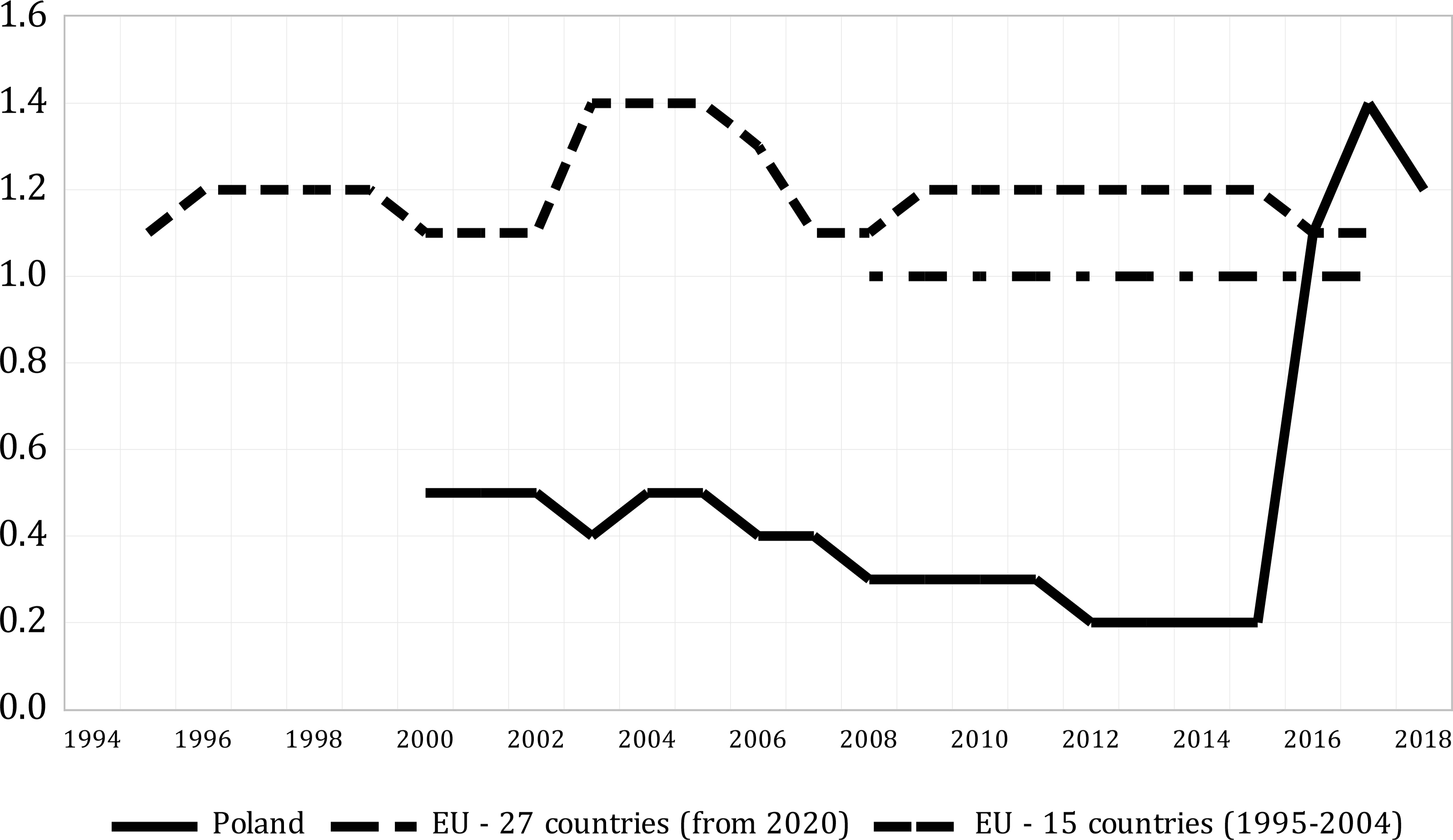
Figure 1.
GDP share of family or child allowances in Poland and the EU (in percentages, 2000–2018)
Note: ‘Family or child allowance’ is defined as periodical payments to a member of a household with dependent children to help with the costs of raising children (Eurostat, 2019, pp. 68–69)
Source: Eurostat, ESSPROS database
Table 1.
Women's employment-to-population ratio by age (in percentages, 2013, 2015 and 2019)
| Age | 15–64 | 15–24 | 25–29 | 30–34 | 35–39 | 40–44 | 45–49 | 50–54 | 55–59 | 60–64 |
|---|---|---|---|---|---|---|---|---|---|---|
| 2013 | 53.4 | 19.5 | 64.6 | 70.1 | 74.2 | 76.6 | 75.4 | 67.4 | 46.9 | 13.7 |
| 2015 | 56.6 | 21.3 | 69.8 | 72.9 | 76.2 | 77.5 | 76.5 | 70.7 | 52.4 | 18.1 |
| 2019 | 61.1 | 27.8 | 69.9 | 73.2 | 75.4 | 81.5 | 81.4 | 76.3 | 62.0 | 19.9 |
| Change in percentage points | ||||||||||
| 2013–2015 | 3.2 | 1.8 | 5.2 | 2.8 | 2.0 | 0.8 | 1.2 | 3.3 | 5.4 | 4.4 |
| 2015–2019 | 4.5 | 6.5 | 0.1 | 0.3 | −0.8 | 4.0 | 4.9 | 5.7 | 9.7 | 1.8 |
[i] Source: Authors’ calculations using Eurostat data.
Table 2.
Decomposition of changes in the employment-to-population ratio into labour supply and unemployment rate components (in log points, 2013–2015 and 2015–2019)
| 2013–2015 | ||||||||||
|---|---|---|---|---|---|---|---|---|---|---|
| Age | 15–64 | 15–24 | 25–29 | 30–34 | 35–39 | 40–44 | 45–49 | 50–54 | 55–59 | 60–64 |
| Δln(EPR) | 0.059 | 0.087 | 0.078 | 0.039 | 0.026 | 0.011 | 0.015 | 0.048 | 0.110 | 0.276 |
| Δln(LFPR) | 0.021 | −0.036 | 0.012 | 0.015 | −0.006 | −0.015 | −0.007 | 0.029 | 0.087 | 0.259 |
| Δln(1-U) | 0.038 | 0.123 | 0.066 | 0.024 | 0.032 | 0.025 | 0.022 | 0.019 | 0.022 | 0.016 |
| 2015–2019 | ||||||||||
|---|---|---|---|---|---|---|---|---|---|---|
| Age | 15–64 | 15–24 | 25–29 | 30–34 | 35–39 | 40–44 | 45–49 | 50–54 | 55–59 | 60–64 |
| Δln(EPR) | 0.076 | 0.267 | 0.002 | 0.004 | −0.011 | 0.051 | 0.062 | 0.077 | 0.169 | 0.096 |
| Δln(LFPR) | 0.032 | 0.140 | −0.047 | −0.033 | −0.039 | 0.012 | 0.017 | 0.037 | 0.138 | 0.076 |
| Δln(1-U) | 0.044 | 0.127 | 0.048 | 0.037 | 0.028 | 0.039 | 0.045 | 0.040 | 0.031 | 0.021 |
[i] Source: Authors’ calculations using data from Eurostat.
Table 3.
Changes in the share of inactive women in the population by age and reasons for economic inactivity (in percentage points; 2013–2015, 2015–2019)
| 2013–2015 | ||||||
|---|---|---|---|---|---|---|
| Age | 15–24 | 25–34 | 35–44 | 45–54 | 55–64 | 15–64 |
| Total | 0.9 | −0.9 | 0.8 | −0.6 | −3.2 | −1.0 |
| Discouragement caused by inefficiency of job seeking | −0.2 | 0.1 | 0.0 | −0.7 | 0.1 | −0.1 |
| Education, training | 0.7 | −0.2 | . | . | . | −0,5 |
| Family and household responsibilities | 0.5 | −1.0 | 0.5 | 0.9 | 1.9 | 0.6 |
| Retirement | . | . | . | −0.1 | −5.5 | −1.0 |
| Illness, disability | −0.1 | 0.1 | 0.2 | −0.7 | 0.3 | 0.0 |
| 2015–2019 | ||||||
|---|---|---|---|---|---|---|
| Age | 15–24 | 25–34 | 35–44 | 45–54 | 55–64 | 15–64 |
| Total | −4.1 | 3.1 | 1.3 | −1.9 | −1.6 | −1.6 |
| Discouragement caused by inefficiency of job seeking | −0.4 | −0.6 | −1.1 | −1.8 | −2.5 | −1.3 |
| Education, training | −4.1 | −0.3 | . | . | . | −1,7 |
| Family and household responsibilities | 0.4 | 4.1 | 2.4 | 0.9 | −0.5 | 1.6 |
| Retirement | . | . | . | −0.1 | 4.4 | 0.6 |
| Illness, disability | 0.0 | −0.1 | 0.0 | −1.0 | −2.9 | −0.9 |
[i] Note: ‘Inactive’ describes persons not seeking a job.
[ii] Source: Authors’ calculations using data from the Polish Labour Force Survey and Eurostat.
Table 4.
Results of the shift-share analysis by age group (2013–2015, 2015–2019)
| 2013–2015 | ||||||||||
|---|---|---|---|---|---|---|---|---|---|---|
| Age | 15–24 | 25–29 | 30–34 | 35–39 | 40–44 | 45–49 | 50–54 | 55–59 | 60–64 | Sum (15–64) |
| ΔEPR*s | 0.30 | 0.55 | 0.31 | 0.21 | 0.08 | 0.10 | 0.34 | 0.63 | 0.47 | 3.0 |
| Δs*EPR | −0.17 | −0.39 | 0.22 | 0.38 | 0.52 | 0.01 | −0.40 | 0.01 | 0.07 | 0.2 |
| ΔEPR*Δs | −0.02 | −0.03 | 0.01 | 0.01 | 0.01 | 0.00 | −0.02 | 0.00 | 0.02 | −0.0 |
| Sum | 0.12 | 0.13 | 0.54 | 0.61 | 0.60 | 0.11 | −0.09 | 0.65 | 0.56 | 3.2 |
| Contribution | 3.6 | 3.9 | 16.6 | 18.8 | 18.6 | 3.4 | −2.7 | 20.1 | 17.5 | 100 |
| 2015–2019 | ||||||||||
|---|---|---|---|---|---|---|---|---|---|---|
| Age | 15–24 | 25–29 | 30–34 | 35–39 | 40–44 | 45–49 | 50–54 | 55–59 | 60–64 | Sum (15–64) |
| ΔEPR*s | 1.05 | 0.01 | 0.03 | −0.10 | 0.40 | 0.43 | 0.54 | 1.13 | 0.21 | 3.7 |
| Δs*EPR | −0.34 | −0.12 | −0.42 | 0.56 | 1.31 | 1.00 | −0.37 | −0.84 | 0.13 | 0.9 |
| ΔEPR*Δs | −0.10 | 0.00 | 0.00 | −0.01 | 0.07 | 0.06 | −0.03 | −0.16 | 0.01 | −0.1 |
| Sum | 0.61 | −0.11 | −0.39 | 0.46 | 1.78 | 1.49 | 0.14 | 0.13 | 0.35 | 4.5 |
| Contribution | 13.7 | −2.4 | −8.7 | 10.3 | 39.9 | 33.4 | 3.2 | 3.0 | 7.7 | 100 |
[i] Source: Authors’ calculations using data from Eurostat.
Table 1A.
Male employment-to-population ratio by age (in percents, 2013, 2015 and 2019)
| Age | 15–64 | 15–24 | 25–29 | 30–34 | 35–39 | 40–44 | 45–49 | 50–54 | 55–59 | 60–64 |
|---|---|---|---|---|---|---|---|---|---|---|
| 2013 | 66.6 | 28.6 | 80.9 | 86.6 | 87.5 | 85.0 | 80.3 | 74.3 | 64.4 | 36.1 |
| 2015 | 69.2 | 30.5 | 81.4 | 89.0 | 89.0 | 87.7 | 84.2 | 76.4 | 67.1 | 39.7 |
| 2019 | 75.3 | 35.4 | 88.7 | 92.3 | 91.7 | 91.3 | 87.9 | 81.1 | 72.5 | 50.8 |
| Change in percentage points | ||||||||||
| 2013–2015 | 2.6 | 1.8 | 0.5 | 2.3 | 1.5 | 2.6 | 3.8 | 2.1 | 2.8 | 3.6 |
| 2015–2016 | 6.1 | 5.0 | 7.3 | 3.4 | 2.7 | 3.7 | 3.8 | 4.7 | 5.3 | 11.0 |
[i] Source: Authors’ calculations using Eurostat data.
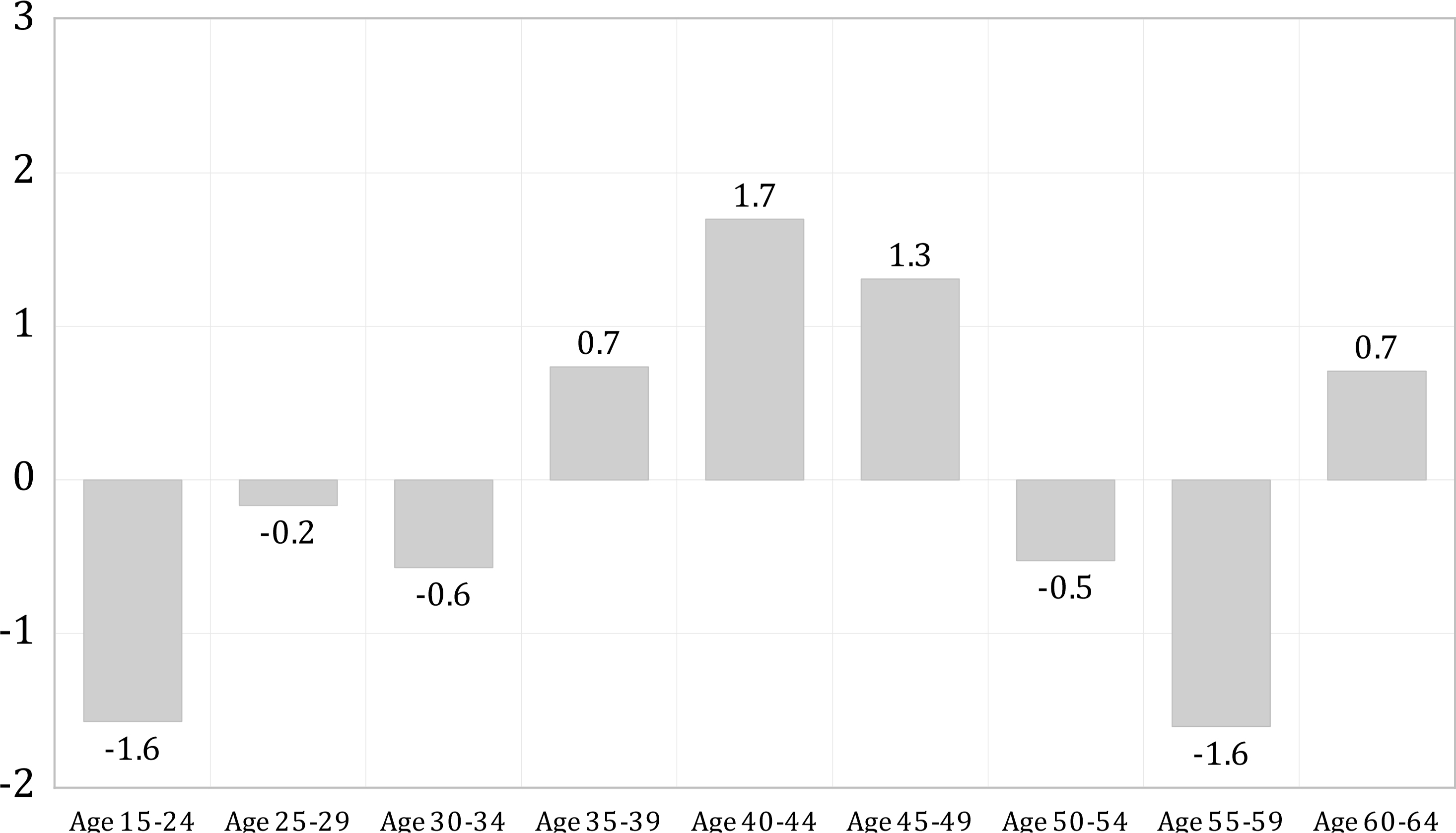
Figure 1A.
Changes in the women's population (15–64) structure by age (in percentage points, 2015–2019)
Source: Authors’ calculations using Eurostat data.