

1. Introduction
The box girder with corrugated steel webs (BGCSWs) represents an emerging composite structural system that has gained growing interest owing to its distinctive configuration and enhanced performance. Corrugated steel webs (CSWs), formed by cold-forming flat steel plates into a folded profile, offer significant advantages over conventional structural elements. The corrugated geometry itself provides superior out-of-plane stiffness and shear buckling resistance, enabling thin steel plates to carry high shear forces efficiently. This results in a marked reduction in the self-weight of the girder without compromising its load-bearing capacity. Furthermore, compared to conventional concrete bridges, the CSWs in BGCSWs are not susceptible to cracking, thereby eliminating the need for prestressing in the web and enhancing the structure’s long-term durability (Borzovic et al., 2025; Hassová et al., 2025; Jiang et al., 2015). (Borzovic et.al., 2025; Hassová et.al., 2025; Jiang et.al., 2015). Mechanically, a key benefit is the "accordion effect," whereby the corrugation drastically reduces the longitudinal stiffness of the web. This effectively decouples the web from flexural moment resistance, allowing the top and bottom concrete flanges to carry axial compressive and tensile forces more efficiently, thus optimizing material utilization (Oh et.al., 2025; Elgaaly et.al., 2025; Sayed-Ahmed, 1997). Beyond structural performance, CSWs offer practical and economic benefits. Their light weight facilitates transportation, handling, and on-site assembly, reducing construction time, cost, and improving precision through prefabrication. Furthermore, the high strength-to-weight ratio promotes more economical and sustainable designs by minimizing material use. Enhanced durability is another critical advantage, as steel webs are inherently less susceptible to the shear cracking common in reinforced concrete webs, thereby improving long-term serviceability and reducing maintenance requirements (Deng et.al., 2017). Building on these advantages, this structural form has attracted sustained academic and engineering interest since its initial proposal and first practical application in France (Moon et.al., 2009; Driver et.al., 2025), with its mechanical performance becoming a major focus of research (Sause and Braxtan, 2011; Hassanein et.al., 2013; Leblouba et.al., 2017; He et.al., 2013; Jung et.al., 2011). Research findings indicate that due to the accordion effect of CSWs, they primarily bear shear forces, and their design is governed by shear buckling behaviour. Consequently, the behaviour of these structures has been the focus of numerous valuable investigations by many scholars, further promoting the development and application of BGCSWs.
The evolution of engineering technologies and design theories has propelled the widespread use of BGCSWs in modern bridge engineering, establishing them as a solution with considerable potential for long-span bridges. The advantages of CSWs facilitate not only the achievement of longer spans but also open avenues for innovative and optimized designs. However, as the spans of these bridges increase, the accompanying rise in girder depth leads to more pronounced shear deflections in the CSWs. This effect significantly contributes to the increased deflection observed in large-span bridges, thereby shifting research focus progressively toward understanding and controlling the deflection behaviour of this structural system. Focusing on the flexural performance, Ma et al. (2021) studied a prismatic BGCSWs with a steel bottom flange subjected to multiple load cases. The analytical solutions they proposed were rigorously validated against FE simulations and experimental data. The results demonstrated that the shear deformation of CSWs is a critical component that cannot be neglected in the total deflection calculation. In a related study, an integrated assessment by Ji and Liu (2012) on BGCSWs accounted for shear lag and the webs’ unique shear deformation to analyse vertical deflection. Results from both FE modelling and experiments under diverse loading confirmed the pronounced impact of CSWs shear flexibility on the global deflection response. Employing the principle of minimum potential energy, Cheng and Yao (2016) developed a simplified analytical model to estimate the deflection of BGCSWs, and its accuracy was verified against FE simulations under different loading cases. Zhang et al. (2023) combined experimental and theoretical approaches to analyse the deflection response of an in-service prismatic BGCSWs subjected to both prestressing and self-weight. Their results demonstrated that CSWs provide negligible resistance to prestressing effects.
Recent studies have consistently confirmed the pivotal influence of shear deflection on the total deflection of BGCSWs. Several researchers have further quantified this shear deflection through scaled experiments and full-scale bridge projects. Chen et al. (2013) fabricated and tested an I-girder with CSWs, employing an integrated experimental and analytical approach to demonstrate that the shear stiffness is governed by the CSWs, which exhibit a uniform shear stress distribution over their depth. Notably, a key quantitative finding revealed that shear deflection contributed 25.8% to the total deflection, necessitating its explicit consideration in design. This conclusion is validated through field studies on real-world structures. Song et al. (2009) analysed two actual bridges and emphasized the decisive influence of shear deflection during the construction stage. Their results indicated that shear deflection accounted for a significant portion of the total deformation, underscoring the necessity of its careful consideration in geometric control practices. In a complementary study, Tang et al. (2013) derived deflection equations for continuous BGCSWs using an energy method and validated their model through field measurements. Their work confirmed that incorporating shear deflection is crucial for accurate deflection prediction. Collectively, these studies highlight the substantial impact of shear deflection on the structural response of BGCSWs, providing a foundational basis for improved deflection control and the construction of full-scale bridges. Notably, existing studies on the deflection of BGCSWs have largely been founded on the premise that flexural stiffness is provided primarily by the concrete flanges, while shear stiffness is attributed mainly to the corrugated steel webs. However, emerging evidence suggests that this conventional model is applicable predominantly to prismatic BGCSWs (Hassanein and Kharoob, 2014; Zevallos et.al., 2016; Zhou et.al., 2016; Su and Zhou 2024; Malm and Sundquist 2010). In contrast, tapered BGCSWs exhibit distinct mechanical behaviour: the effect of varying cross-sections leads to the participation of the inclined bottom flange in resisting shear forces, a contribution that becomes non-negligible, particularly in regions subjected to high bending moments. To address this specific mechanism, Su et al. [31] conducted a mechanical analysis based on a differential segment of tapered BGCSWs, clarifying the differences in shear resistance compared with prismatic sections. The authors subsequently proposed a modified method for calculating the deflection of tapered BGCSWs. Through cantilever beam tests and FE simulations, they demonstrated that shear-induced deflection cannot be ignored in tapered configurations and emphasized the necessity of incorporating this additional shear contribution into analytical models, especially in high-moment regions.
In summary, most research on BGCSWs has predominantly focused on shear behaviour, with relatively limited attention given to deflection analysis. Furthermore, existing deflection models and design codes (China Academy of Building Research, 2017; European Committee for Standardization, 2010) are grounded in the conventional prismatic girder framework. This approach simplistically attributes all shear deflection to the CSWs and all bending deflection to the concrete flanges. Only a limited number of studies have acknowledged the mechanical differences between tapered and prismatic BGCSWs. It is recognized that in tapered configurations, bending moments induce non-negligible shear deflections not only in the CSWs but also in the inclined bottom flange. This effect is particularly critical for long-span BGCSWs, which often employ tapered sections in cantilever construction, as the high bending moments near the support – combined with the varying cross-section – lead to shear deflections that cannot be ignored. To address this gap, this study proposes a systematic analytical method for predicting deflections in tapered cantilever BGCSWs. The method is developed and rigorously validated against experimental and FE simulation results.
2. Theoretical Derivation of Deflection
2.1. Deflection Calculation Model of Tapered BGCSWs
A widely adopted assumption in both design codes and conventional analytical models is that the shear force resisted by the CSWs is equivalent to the total shear force acting on the entire cross-section under external loads, which directly determines the corresponding shear deflection. Furthermore, the shear stress distribution across the CSWs is conventionally presumed to be uniform over their height, with the corresponding shear stress calculation expressed by the following formula:
Where:τ - the shear stress acting on the CSWs,
Q - the shear force on the entire cross-section,
Aw - the effective shear area of the CSWs.
However, recent studies have demonstrated that the shear stress formula mentioned above is applicable only to prismatic BGCSWs. The shear stress distribution in tapered BGCSWs differs significantly. Specifically, the applied bending moment in a tapered girder redistributes the shear forces within the cross-section (Zhou et.al, 2016). Notably, this redistribution not only changes the shear force carried by the CSWs but also results in the development of shear deflection in the inclined bottom flange and the CSWs. Accordingly, the expression for shear stress in tapered BGCSWs, derived from previous studies, is expressed as:
In Equation (2), M represents the bending moment at the calculated cross-section, Q denotes the vertical shear force over the entire section, and b is the width of the section at the point where shear stress is calculated. I indicate the moment of inertia of the cross-sectional area about the centroidal axis, and Sa refers to the static moment of the cross-sectional area about the centroidal axis of the full section. The term τQ represents the shear stress induced by the sectional shear force, which is the conventional formula adopted in existing design codes and most theoretical models. In contrast, the term corresponds to the shear stress components generated by the bending moment – a distinctive mechanical feature unique to tapered BGCSWs. Consequently, the deflection behaviour of tapered BGCSWs differs fundamentally from that of prismatic girders.
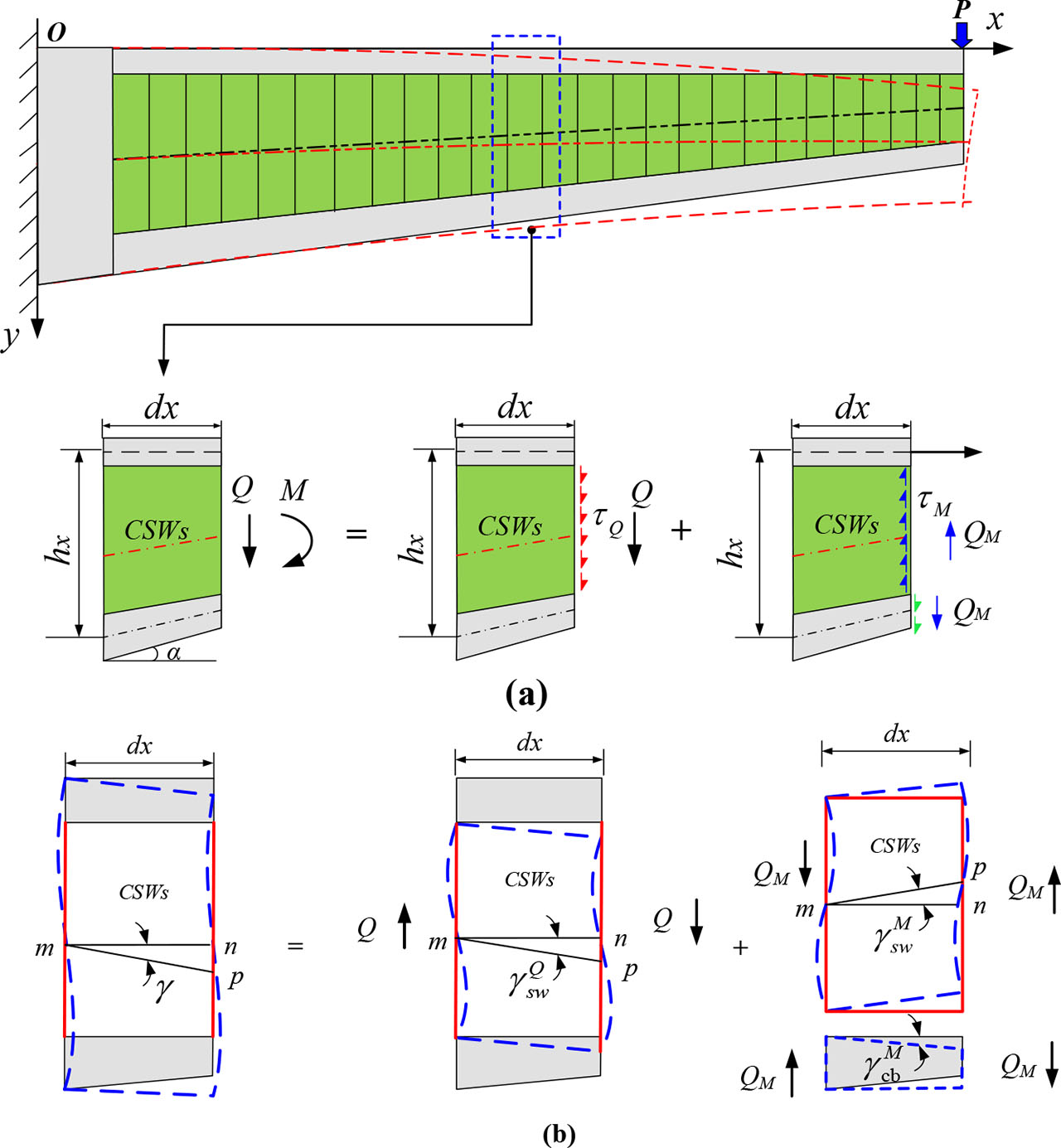
Figure 1:
Force and deflection analysis models for a cantilever tapered BGCSWs: (a) Force analysis model; (b) Deflection analysis model
To elucidate the mechanical phenomenon described by Equation (2), consider the force analysis of a tapered BGCSWs subjected to a concentrated load P, as illustrated in Figure 1(a). Under this load, the cross-section of the girder resists the combined action of bending moments and shear forces. Owing to the accordion effect, the CSWs provide negligible resistance to longitudinal bending moments. The applied shear force Q induces the corresponding shear stress within the CSWs. Based on Equation (2), it is assumed that the bending moment M induces an additional shear stress in the CSWs. Integrating over the web area yields an additional shear force QM resulting from the bending moment M in the CSWs.
Studies have demonstrated the self-equilibrating nature of the additional shear force induced by bending moments (Su et.al 2024; Su and Zhou, 2023) This means that the internal force redistributes shear across the cross-section without altering the magnitude of the total resultant shear. Consequently, a reactive shear force QM of equal magnitude and opposite direction is correspondingly imposed on the bottom flange (Figure 1(a)). It follows that the effective shear force governing the CSWs is governed by Equation (3).
The preceding analysis indicates that in tapered BGCSWs, the shear force in the CSWs can no longer be calculated based on conventional code assumptions. Rather, the applied bending moment redistributes the internal shear forces, inducing an additional shear force within the cross-section. As a result, the bottom flange also resists a significant portion of the total shear. Furthermore, Equation (3) reveals that both the magnitude and direction of this additional shear force depend on those of the bending moment M at the section. As illustrated in Figure 1(b), these additional shear forces, in turn, generate corresponding shear deflections in their respective components. Consequently, a comprehensive calculation of the total deflection must incorporate the contributions from these additional shear deflections. The total deflection can thus be expressed by the following equation:
In the above equations, yb represents the bending deflection generated by bending moment, ys represents the total shear defections, yws represents the total shear deflection in the CSWs, which is the sum of the deflections induced by both the bending moment and shear force, ybs signifies the additional shear deflection in the inclined bottom flange caused by the bending moment.
2.2. Calculation of Shear Deflection
As illustrated in Figure 1(a), the load-transfer mechanism in tapered BGCSWs diverges from that in prismatic sections. Specifically, the bending moment M triggers a redistribution of shear forces, giving rise to an additional shear component QM within the cross-section. Consequently, the total shear deflection comprises two parts: the deflection of the CSWs under the direct shear force Q, and the additional deflection induced by QM in both the CSWs and the bottom flange. This combined action demonstrates that the method for calculating shear deflection in tapered BGCSWs differs substantially from existing code provisions, necessitating further refinement. Fundamentally, the shear deflection in tapered BGCSWs is the cumulative result of the interactive effects of both bending moment and shear force. Specifically, the shear deflection mechanism, detailed in Figure 1(b), can be decomposed into two distinct parts. Firstly, the shear force Q from the applied load P is carried solely by the CSWs due to their folding effect, resulting in shear deflection confined to the CSWs. Secondly, the bending moment induces a shear force QM in the bottom flange and the CSWs, which in turn causes separate shear deflections and in each of these elements. Therefore, a complete expression for the shear deflection in a tapered BGCSWs must account for contributions from both shear forces and the bending moments, as follows:
In Equation (7), corresponds to the shear strain of the CSWs induced by the shear force. Terms and , respectively, denote the shear strains of the bottom flange and the CSWs induced by the bending moment. The parameters αsw and αcb quantify the non-uniformity of shear stress distributions across the CSWs and concrete bottom flange, respectively. Numerically, these parameters represent the ratio of the shear stress at the neutral axis to the average shear stress on their respective cross-sections. In BGCSWs, shear stress is assumed to be uniformly distributed across the webs, whereas the bending-induced additional shear stress in the bottom flange can be approximated as a linear distribution along its height. This leads to the assignment of a value of 1.0 for both αsw and αcb. Asw and Acb are the effective cross-sectional areas of the CSWs and the concrete bottom flange, respectively. Gc denotes the shear modulus of concrete, and Gseq represents the equivalent shear modulus of the CSWs. The equivalent shear modulus Gseq is determined using the following expression (Johnson and Cafolla 1997):
In Equation (8), a1 refers to the length of the flat sub-panel of the CSWs, while a2 and a3 represent the projection length and inclined length of the inclined sub-panel of CSWs, respectively. G0 is the shear modulus of the steel material. Integrating Equation (5) yields:
Equation (9) provides the analytical solution for the shear deflection of tapered BGCSWs. For cantilever girders, with the boundary condition ys |x=0 = 0, the constant term C1 in Equation (9) can be determined by applying this condition.
2.3. Bending Deflection Calculation for Tapered BGCSWs
Given that the flexural rigidity of a tapered BGCSWs is not constant along its span, it is therefore impractical to determine its bending deflection directly using standard formulas derived from material mechanics. To address this limitation and adapt classical computational methods for tapered BGCSWs, this study introduces the concept of an equivalent moment of inertia based on Simpson’s rule. As shown in Figure 2, a cantilever tapered BGCSWs of length l is longitudinally divided into n equal segments (with n being an even number). The moment of inertia at each segment division is denoted as Ij (j=0,1, 2, …, n, I0=Imin, In=Imax).
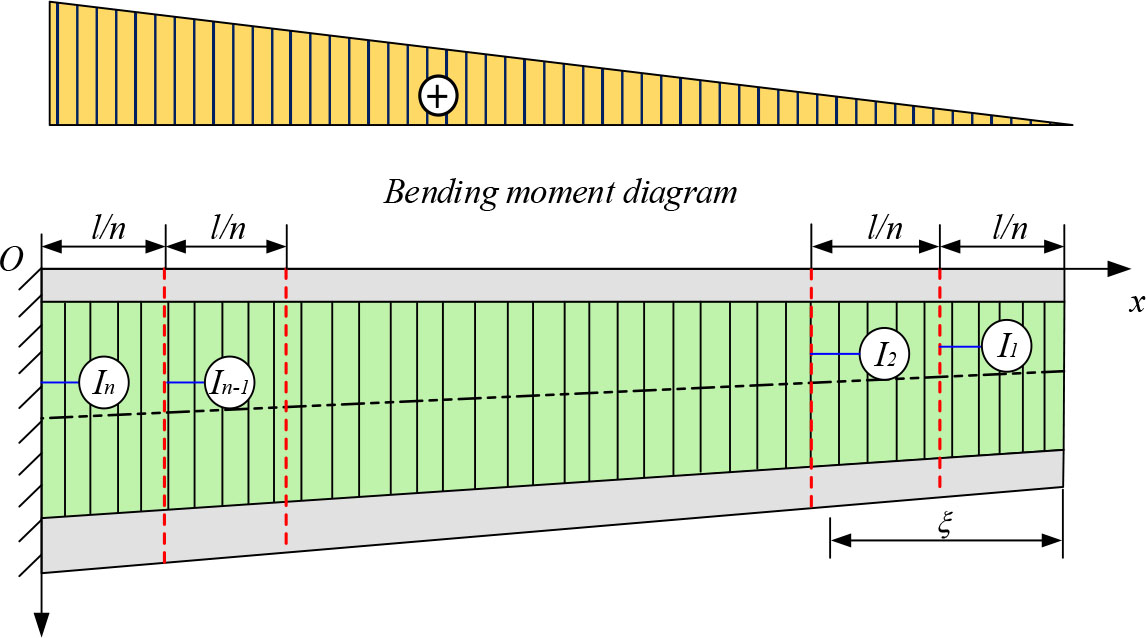
Figure 2:
Segment division of the tapered cantilever BGCSWs
According to Simpson’s integration formula:
Within the numerical integration framework, the term yi = f(ξi) (where i=0,1,2..., n) denotes the function value of the integrand f(ξi) evaluated at the discrete sampling point ξ = ξi. The parameter n specifies the total number of subintervals resulting from the discretization of the integration domain [a, b]. A key requirement for the applied method is that n must be an even integer, a condition typically imposed by composite Newton-Cotes formulas (e. g., Simpson’s rule) to ensure proper polynomial fitting over successive pairs of subintervals.
In accordance with Castigliano’s second theorem, the bending deflection for a tapered BGCSWs subjected to a concentrated force is formulated as follows:
In Equation (11), set n = 4, a = 0, b = l, . Then Equation (8) can be written as:
A common analytical simplification involves substituting the tapered BGCSWs with an equivalent prismatic member characterized by a constant equivalent moment of inertia, Ieq. The deflection of this equivalent girder under a concentrated force is then described by:
Based on the principle of equivalent action effect, equating the displacements from Equation (12) and (13) yields:
Simplifying Equation (14) yields:
The introduction of an equivalent moment of inertia enables the application of established classical mechanics of materials methods to analyse the bending deflection in tapered BGCSWs. This approach effectively simplifies the analytical procedure by transforming the variable-section problem into one governed by equivalent prismatic beam theory.
Based on the formulations given in Equation (15) and (16), the approximate differential equation for the deflection curve of a tapered BGCSW subjected to a concentrated load can be further derived and expressed in the following form:
Given the corrugated configuration, the flexural contribution of the CSWs can be omitted. The elastic modulus and equivalent moment of inertia are thereby determined using the concrete section alone.
Integrating Equation (17) yields:
Where:C1 - the constant of integration, which is determined as from the boundary condition . Consequently, Equation (18) can be written as:
Integrating Equation (19) again yields:
From the boundary condition at the fixed end of the cantilever girder, yb(0) = 0, it obtains C2 = 0. Thus, the formula for calculating the bending deflection of a tapered BGCSWs under a concentrated load is:
By substituting Equation (9) and (21) into Equation (2), the total deflection of the cantilever girder can be calculated.
3. Experimental Verification
Building upon the preceding theoretical analysis of deflection in tapered BGCSWs, this chapter focuses on validating the proposed formula that incorporates moment-induced shear deflection. The validation strategy employed a three-pronged approach: experimental testing of a tapered cantilever BGCSWs specimen, complementary numerical simulation, and a comprehensive comparative analysis of the results from these methods against the theoretical calculations.
3.1. Designing and Fabricating the Test Specimen
Aimed at investigating the deformation behaviour of tapered BGCSWs and verifying the accuracy of the theoretical approach, a full-scale experimental girder in a double-cantilever configuration was utilized, with concentrated loads acting at its free ends (Chen 2023). As depicted in Figure 3, the test specimen had a total length of 4700 mm, consisting of two cantilever girders, each with a span of 2100 mm, connected by a central crossbeam measuring 500 mm in length. The depth of the girder tapered linearly from 1030 mm at the fixed support to 740 mm at the free end. The top flange width was 1200 mm, and the bottom slab width was 650 mm. The crossbeam had a height of 1030 mm. Both the central crossbeam and the concrete flanges were reinforced with steel bars, and no prestressing was applied throughout the specimen.
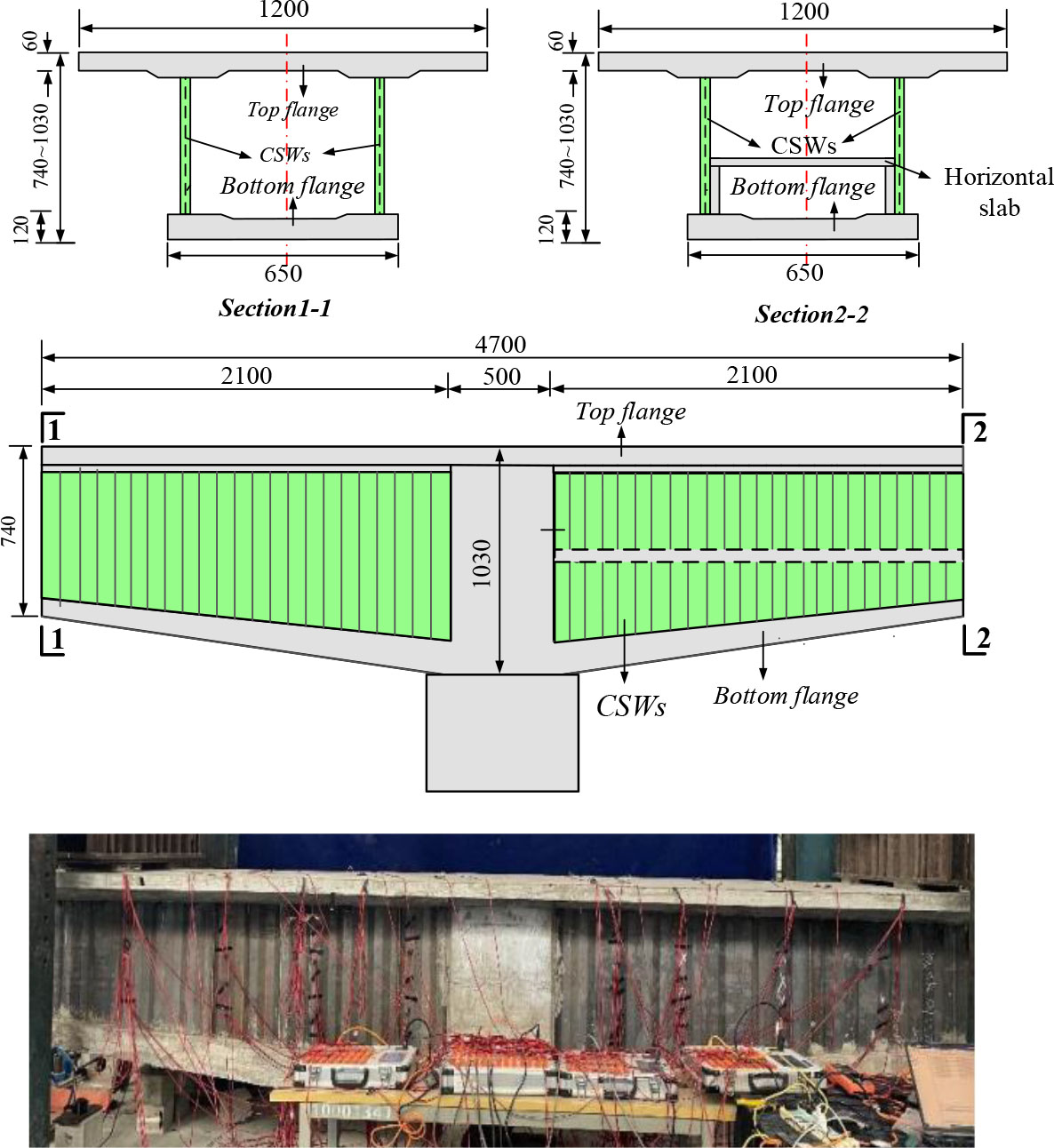
Figure 3:
Geometric dimensions of the tapered BGCSWs (units: mm)
A distinct design difference was implemented between the two sides: the CSWs on the right side were reinforced with horizontal diaphragms and partially filled with concrete, whereas those on the left side were directly embedded into the flanges without any additional encasement. The trapezoidal CSWs were fabricated from 3-mm-thick steel plates with a trapezoidal profile. Full composite action between the CSWs and the concrete top/bottom flanges was ensured using embedment connectors, which guaranteed deflection compatibility and structural integrity. All concrete components were cast using C50 high-performance concrete. The CSWs were made of Q345D-grade steel, with material properties determined from four sets of coupon tests. The average measured yield strength, ultimate tensile strength, and elastic modulus were 365 MPa, 479 MPa, and 206 GPa, respectively.
3.2. Loading and Measurement
This experimental investigation employed a static loading scheme to evaluate the structural response. As illustrated in Figure 4, the girder was cast monolithically with the pier cap and a lower crossbeam, which was anchored to the strong floor via ground anchors. This configuration simulated the fixed-end restraint condition representative of a cantilever construction stage. A symmetric loading protocol was implemented to ensure uniform transverse stress distribution. Two synchronized hydraulic jacks, each reacting against a stiff reaction frame, applied concentrated loads at points located 30 cm from the free end of each cantilever girder. Load was transferred from each jack to a distribution beam and then to the test specimen through steel bearing blocks.
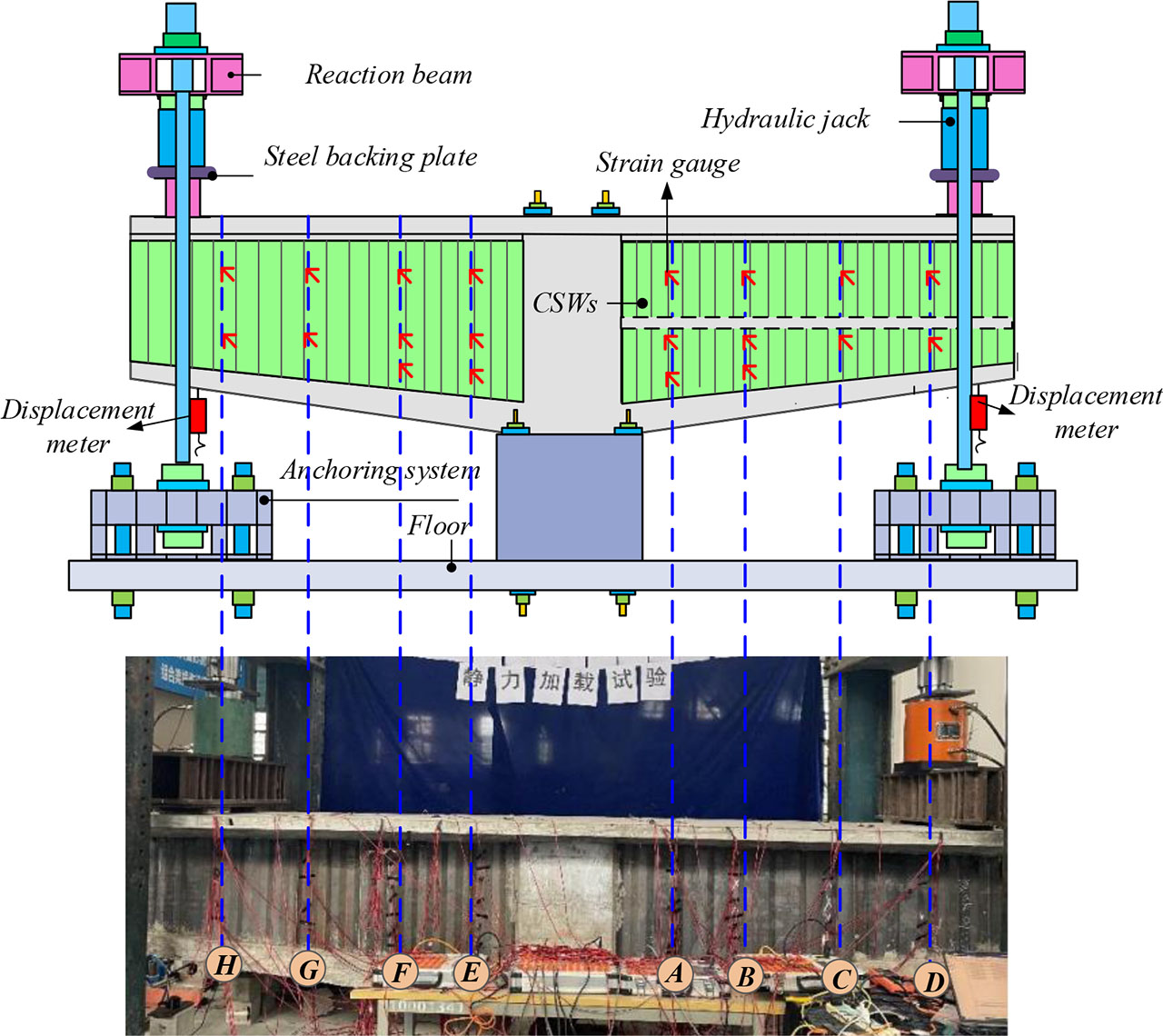
Figure 4:
Experimental loading
The entire loading process was controlled by pressure sensors, with strict synchronization maintained between the two jacks to control the loading rate at both ends. The loading regime consisted of two phases: elastic loading followed by destructive loading. The loading was applied monotonically in discrete steps of 30 kN. A preload of 20 kN was first applied to ensure proper contact between the loading apparatus and the specimen, eliminating any gaps and reducing system-compliance effects. To investigate the stress distribution on the CSWs, strain gauges were installed at eight representative sections (A to H). In addition, a displacement transducer was placed at the bottom flange of Section A (Figure 4) to monitor the deflection of the test specimen during loading. After each load increment, a stabilization period of 5 minutes was allowed before recording the measurements. Data from the transducer was then collected twice at 1-minute intervals after readings stabilized. The average of these two readings was recorded as the final deflection value for that load level to ensure data accuracy and reliability.
4. Finite Element Simulations
To validate the proposed theoretical formulation, a detailed three-dimensional FE model was developed in the commercial software ABAQUS/Standard (2021). As illustrated in Figure 5, the model discretizes the concrete top and bottom flanges using eight-node linear brick elements (C3D8R), while the thin-walled CSWs are modelled with four-node reduced-integration shell elements (S4R). A convergence study was conducted to ensure mesh-independent results, resulting in a global seed size of approximately 20 mm for the concrete parts and 15 mm along the web profile to accurately capture shear deformation. Both materials were simulated as homogeneous, isotropic, and linear-elastic, consistent with the girder’s serviceability limit state under small deformations. The elastic moduli were set to Ec = 3.45×10¹⁰ N/m2 for C50 concrete and Es = 2.06×10¹¹ N/m2 for Q345D steel, with Poisson’s ratios of 0.2 and 0.3, respectively. Full composite action between the concrete flanges and steel webs was enforced using a surface-based “tie” constraint, which kinematically couples the degrees of freedom at the interface. The experimental fixed support condition was replicated by fully constraining all translational and rotational degrees of freedom at the corresponding bearing section. The concentrated load was applied as a uniformly distributed pressure via analytically rigid loading plates to prevent unrealistic stress concentrations. This FE model serves as a reliable numerical benchmark for subsequent parametric studies and theoretical verification. Following convergence of the analysis in ABAQUS/Standard, a structured post-processing procedure was implemented. First, a series of stress paths were defined along the spanwise direction of the model. Subsequently, nodal displacement data along these paths were extracted at each designated load increment to construct and compare the corresponding deflection profiles.
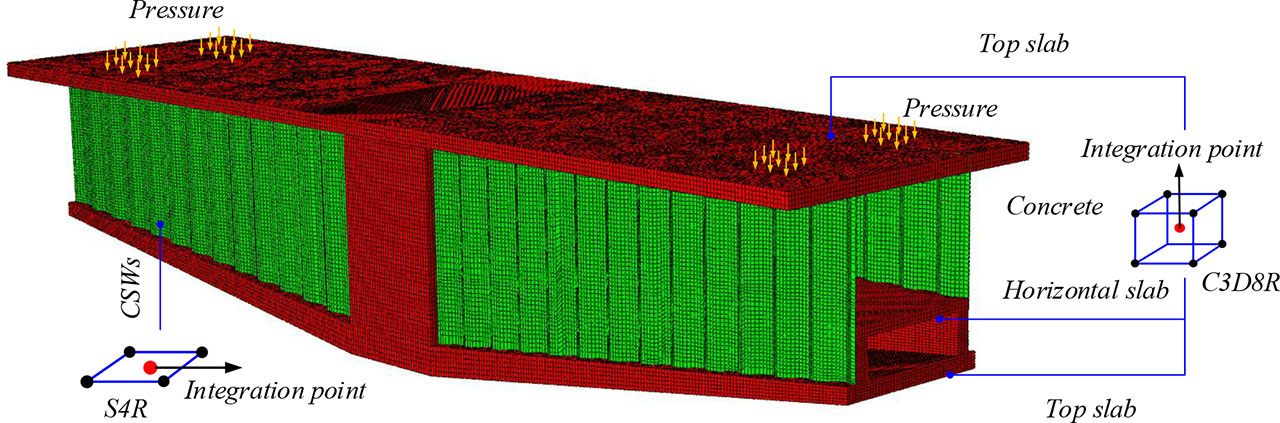
Figure 5:
Element types and loading conditions of FE model
5. Results and Discussion
5.1. Experimental Test, FE Simulation and Theoretical Calculation Results
The validation of the analytical and numerical models is demonstrated in Figure 6 through a direct comparison with experimental deflection data at two discrete control points under stepwise loading from 30 to 120 kN. The near-perfect overlap of the three datasets (experimental, theoretical and FE) across the entire load history confirms the models’ fidelity. Notably, the theoretical model maintains a high level of accuracy, with a maximum discrepancy of 8.2% compared to experiments, while its difference from the FE simulation is only 4.5%. This minor variance between the two computational approaches primarily stems from the idealized boundary conditions and perfect composite action assumed in the analytical model, whereas the FE model incorporates discrete constraints. The strong convergence of all three independent results not only verifies the core hypothesis – that the moment-induced shear contribution must be included – but also establishes the proposed method as a dependable tool for the deflection analysis and design of tapered BGCSWs.
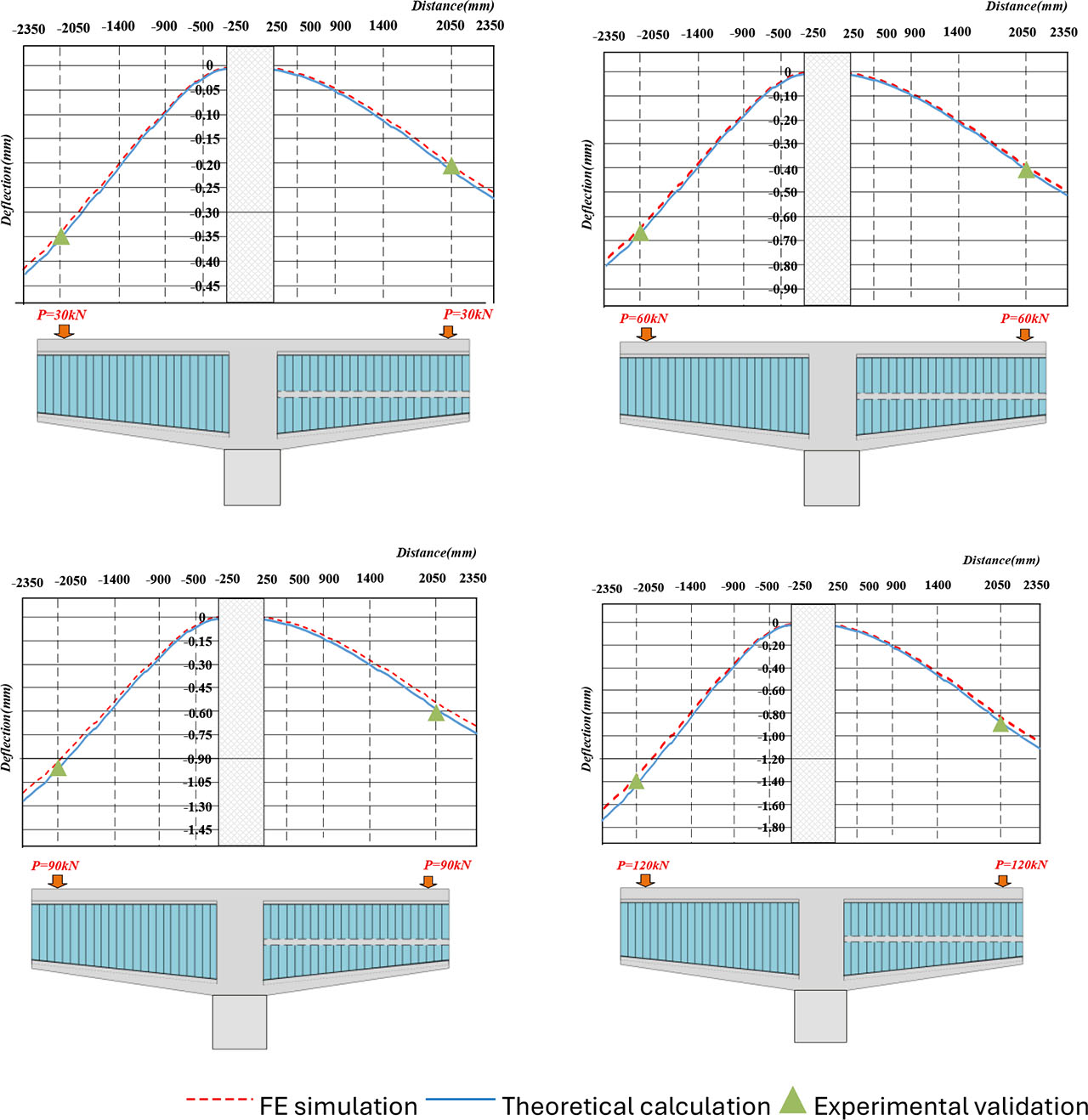
Figure 6:
Deflection results derived from three independent approaches: FE simulation, theoretical computation, and experimental validation
5.2. Analysis of Deflection in the Tapered BGCSWs
The close agreement among the FE predictions and experimental measurements validates the proposed theoretical formulas, confirming their accuracy in predicting the deflection of tapered BGCSWs. This finding underscores the necessity of accounting for the contribution of bending moments to shear deflection in the deflection analysis of such girders. To further dissect the total deflection, the individual components were quantified using the derived analytical expressions, namely Eq. (9) and Eq. (21). The resulting breakdown is comprehensively summarized in Figure 7.
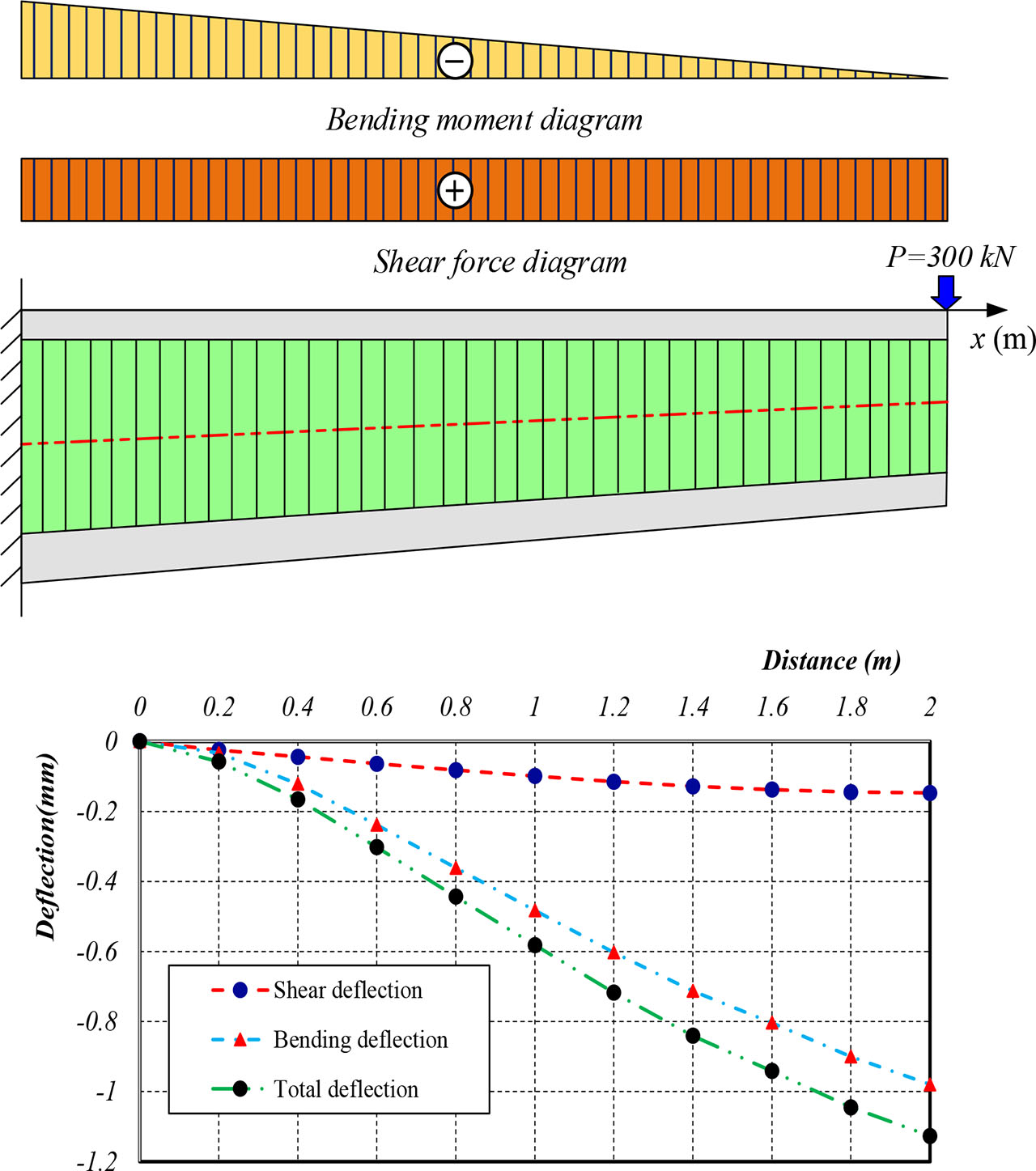
Figure 7:
Shear and bending deflections of the tapered BGCSWs
The results reveal that shear deflection accounts for a significant portion of the total deflection in BGCSWs. Under concentrated loading, the inclusion of shear deflection leads to a measurable increase in total deflection, with its contribution becoming particularly significant and non-negligible at the free end of the cantilever BGCSWs. Crucially, in tapered BGCSWs, shear deflection originates from both the direct shear force and the additional shear forces induced by bending moments in the bottom flange and CSWs.
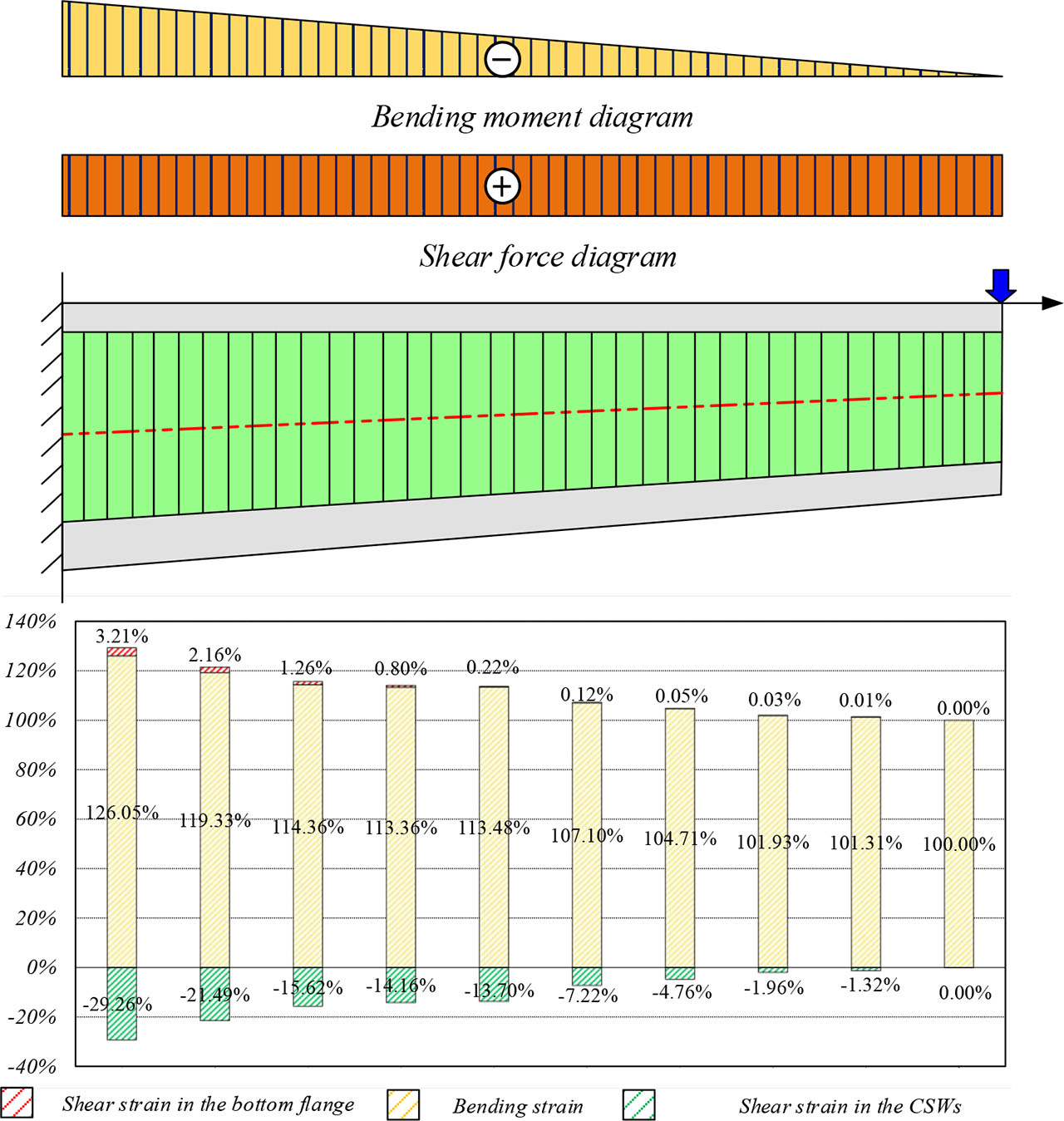
Figure 8:
Proportional contributions of deflections from bending moment and shear force
To elucidate the interplay of bending and shear on deflection in tapered BGCSWs, the total strain was decomposed into components from direct shear and bending-induced mechanisms and quantified across multiple cross-sections of the experimental girder under a 300 kN load. Figure 8 illustrates the proportional distribution of each strain component relative to the total strain. A key finding is the development of considerable shear strain within the CSWs due to bending moments, whereas the corresponding strain in the bottom flange remains minimal. Furthermore, the proportion of this bending moment-induced shear strain exhibits a distinct spatial trend, increasing monotonically from the free end towards the fixed support - closely following the gradient of the bending moment diagram. Specifically, its contribution is nearly negligible near the free end but rises to a significant 29.36% in sections adjacent to the fixed support. These results irrefutably confirm that the contribution of bending moment-induced shear strain to the total deflection in tapered BGCSWs is substantial and non-negligible. This has considerable practical implications, indicating that prevailing design approaches, which overlook this coupling effect, require revision to explicitly incorporate it, thereby enhancing predictive accuracy and ensuring structural safety.
6. Conclusion
This study presents a multi-faceted investigation into the deflection behaviour of a tapered BGCSW, employing an integrated approach of theoretical analysis, experimental testing, and FE simulation. The principal findings are summarized as follows:
A simplified methodology for calculating bending deflection in tapered BGCSWs is developed based on Simpson’s integration and Castigliano’s second theorem. By introducing the concept of an equivalent moment of inertia, the tapered BGCSWs is effectively analysed as an equivalent prismatic BGCSWs, thereby circumventing the complexity – and occasional infeasibility – of direct integration. This approach, rooted in classical elastic theory, offers a unified framework for computing bending deflections in both tapered and prismatic BGCSWs.
Furthermore, an analytical model for predicting shear deflection is established, incorporating the effects of cross-sectional variation and the accordion effect of CSWs. Unlike conventional methods that attribute the entire shear resistance to CSWs under shear force, this study reveals that in tapered BGCSWs, significant additional shear deflection is induced by bending moments. By decomposing the shear deflection components through derived analytical expressions, it is shown that the concrete bottom flange contributes negligibly to the total shear deflection, which is instead dominated by the combined action of shear force and bending moment in the CSWs.
The proposed formulation, which accounts for the shear deflection arising from bending moments due to the tapered geometry, has been validated against experimental and numerical results. A key finding is the magnitude of this shear component, which reaches about 20% of the total deflection at the free end. This evidence necessitates a combined consideration of bending and shear interactions in future design approaches.
Acknowledgements
The authors gratefully acknowledge the generous financial support from the Gansu Provincial Science and Technology Plan Project (25YFFA092) and Dingxi City Science and Technology Research Project (DX2024BZ002), which was instrumental in the successful completion of this study.
Notes
[1] Contributed by Author Contributions
W.G.H. and Z.T.L designed the study and supervised the project. Z.T.L. conducted the experiments. W.S.L performed the data analysis. X.Z.Z. contributed to manuscript writing. All authors critically reviewed and approved the final version of the manuscript and agreed to be accountable for all aspects of the work.