

1. Introduction
The foundation is a part of a structure that carries the weight of the building to the subsoil strata, the foundation must be safe against shear failure and excessive settlement. There are several methods are used for the estimation of bearing capacity in clayey soil; suitability of each method can be verified after comparing it with the practical finding. Most of studies were performed in remolded clay due to the difficulty of preparing undisturbed specimens to conduct studies of bearing capacity, therefore, this leads a difficulty in performing studies of large-scale footing size with undisturbed state, this only can be work using finite element method.
The study of Terzaghi (1943) suggested the first theory for evaluating the ultimate capacity of strip footings according to a method of limit equilibrium, where the Nc factor is 5.7 in clayey soil with undrained conditions [1]. After that in 1963, Meyerhof proposed a modification of this formula by proposing some factors like a factor of depth, factor of shape, factor of load inclination, and the value of Nc factor is 5.14 [2].
As well as to the method of limit equilibrium, there are other theories like method of limit analysis, a semi-empirical method, and method of finite element. Valverd, et al., investigated shallow foundation bearing capacity by a finite element method with three dimensions, and the results demonstrated a well compatibility of finite element to the way of limit equilibrium [3].
Zhu studied the factors of shallow foundation bearing capacity, and according to the results of the study it was observed there was a good agreement between the method of finite element to the method of limit analysis [4].
Lim introduced a chart of Nc bearing capacity factor using the Plaxis software, it was observed that for homogenous clay and all consistency of cohesion, the value of Nc factor is 5.16 and increased with normalized undrained shear strength [5].
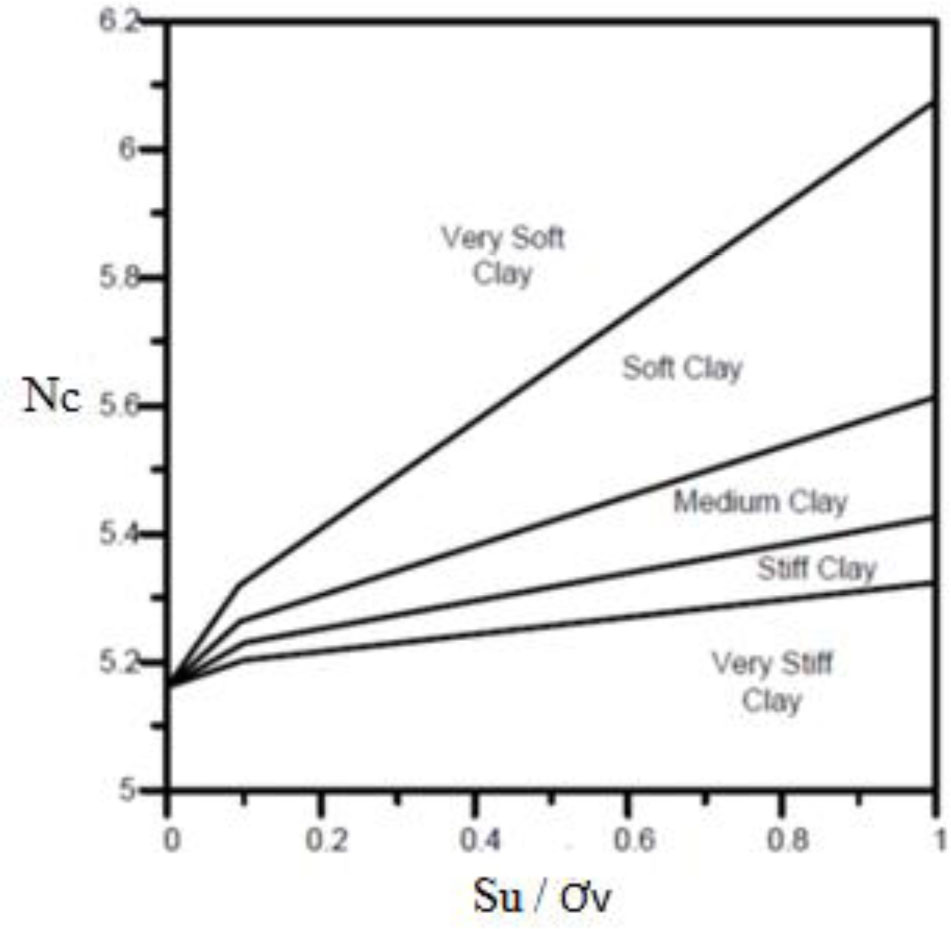
Fig. 1:
Chart of Nc factor normalized to undrained shear strength of clay.
2. Case Study
In order to achieve the research objective, it was selected practical results of the load settlement test for footing rested on undisturbed clayey soil performed by Ornek et al. [6], the footing shape is circular with a diameter of (0.9 m). The data was taken at a station of water treatment in Adana, Turkey. The soil profile with the results of the standard penetration test value are explained in Fig. (2). The top layer (0.8 m) height was extracted. A next layer of (6.2 m) depth contains silty clay soil. A last layer of low plastic soil of silty clay with sand parts (CL). Clay content, moisture content, and the undrained cohesion (cu) along the soil profile are given in Fig. (3), the average of undrained cohesion (cu) for the second layer of about (70 kPa).
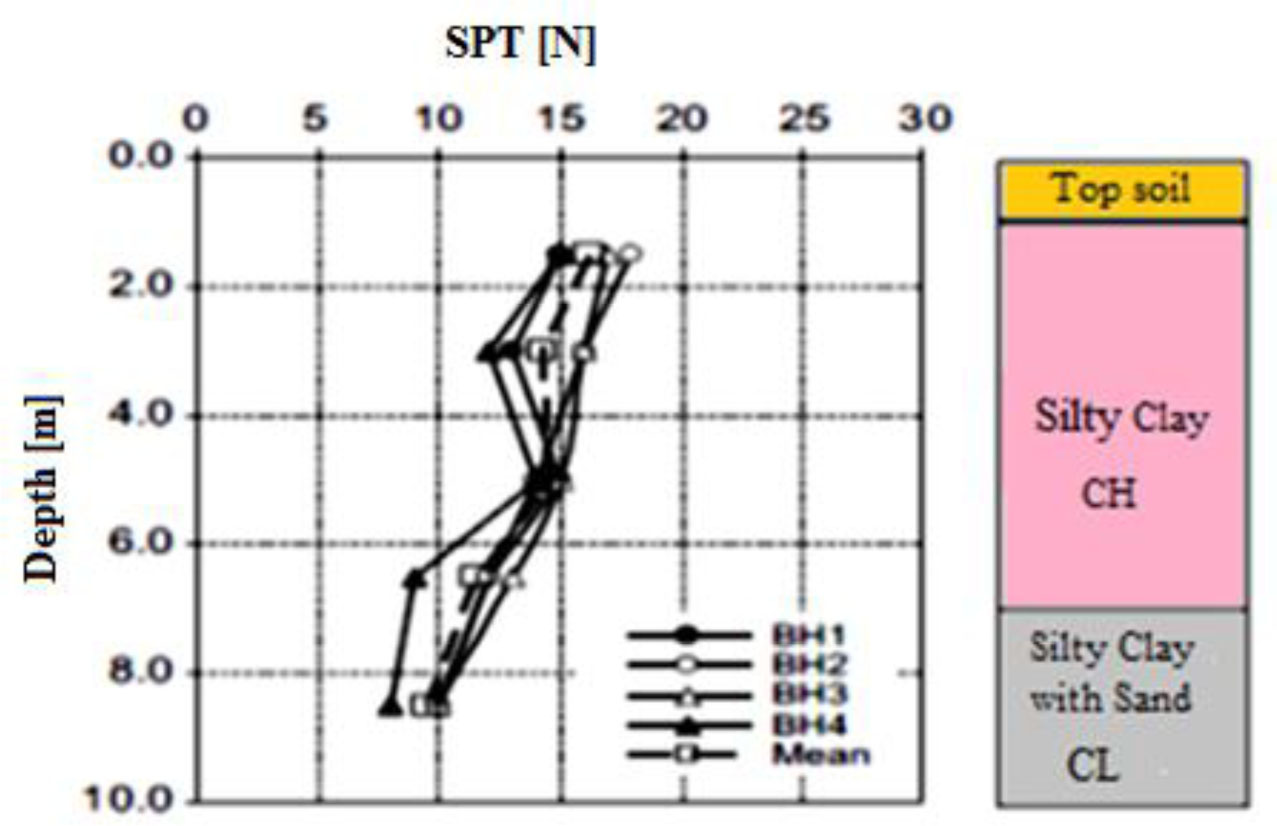
Fig. 2:
The soil profile of the case study (From Ornek et al. [6]).
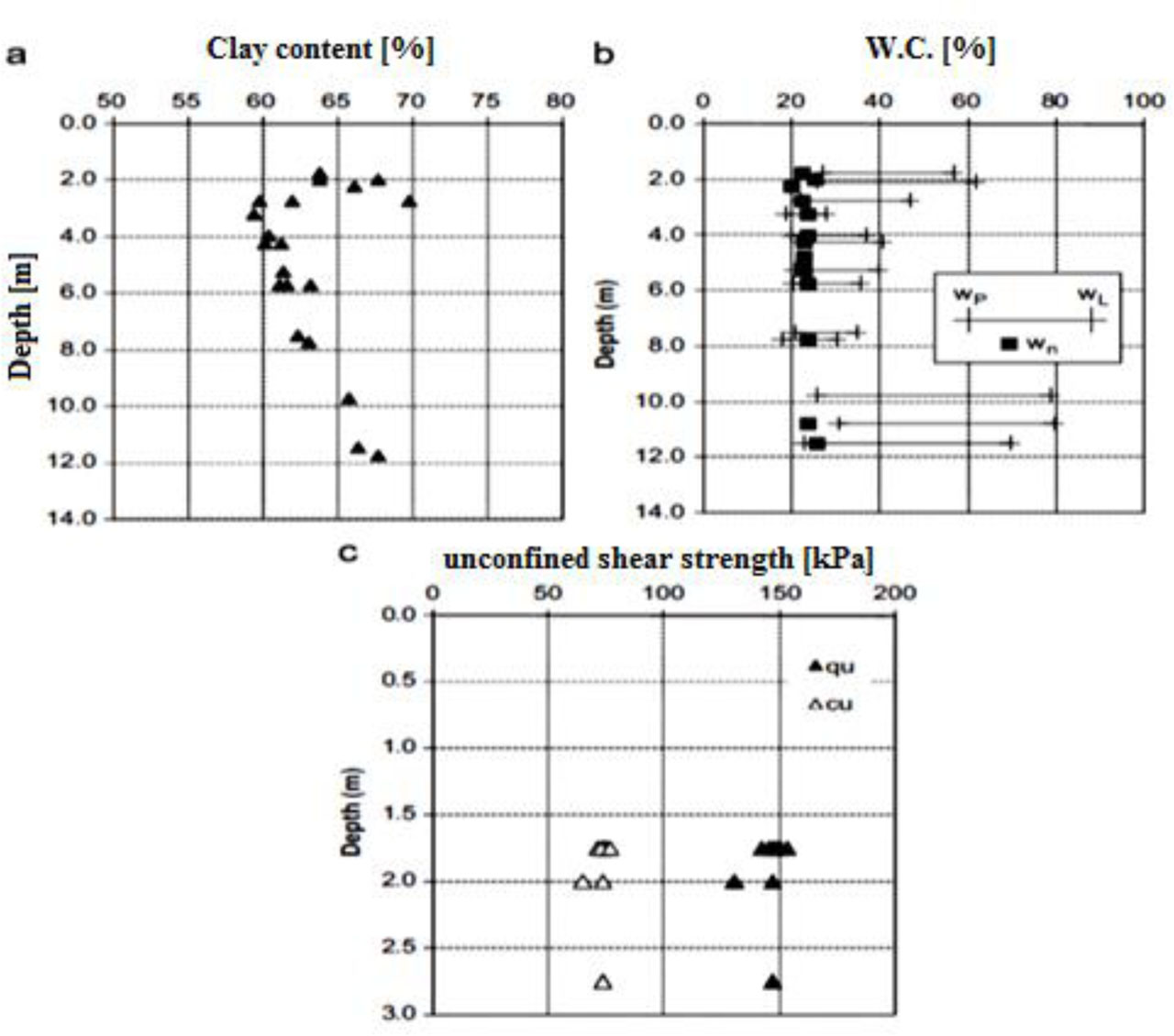
Fig. 3:
The characteristics of soil profile of case study (a) clay percentage, (b) moisture content and (c) undrained cohesion. (From Ornek et al. [6]).
3. Validation of finite element results
The finite element analysis is one of the main numerical ways that can simulate complex cases in geotechnical engineering, Plaxis software is recommended for simulation of a behavior of footing under loading [7,8,9], so it is used in this study. It used a hardening soil model to represent such cases so this study as a hardening model produces good results compared with measured practical data [10]. The input parameters of the hardening soil model adopted in the modeling of the case study are demonstrated in Table (1). According to Lee and Salgado [11] suggestion, the circular shape of footings with a diameter of (0.9 m) of footing in the case study is simulated as a square shape of (0.8 m) width. Fig. (4) shows the results of vertical displacement and a model geometry of the case study during loading. Fig. (5) demonstrates the validation for finite element results for load-settlement relationship, the results clarify that there was a well compatibility between finite element and practical results using this software.
Table 1:
The input data adopted for modeling of the case study.
| Property | Sign | State |
|---|---|---|
| Finite Element Model | HS | Hardening model |
| Behaviour of model | - | Drained |
| Modulus of Young | Eref50 | 10 MPa |
| Modulus of Oedometer (Auto. calculate) | Erefoed | 29.4 MPa |
| Modulus of Unloading (Default = 3 Eref50) | Erefur | 30 MPa |
| Cohesion | c | 70 kPa |
| Angle of Friction | Ø | 10° |
| Poisson’s Ratio | ŋ | 0.35 |
| Power of Exponential | m | 1 |
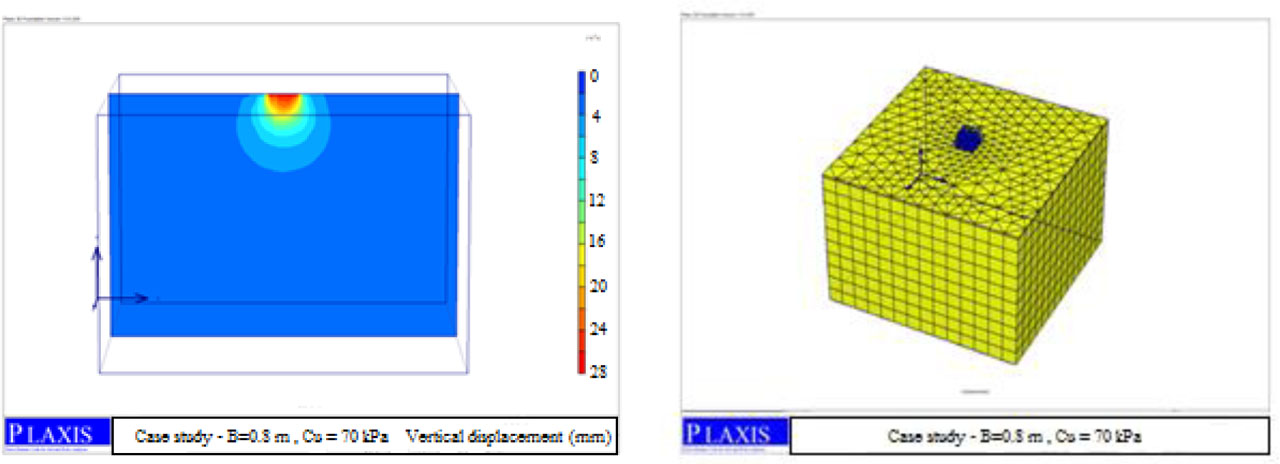
Fig. 4:
The results of vertical displacement & model geometry of the case study during loading.
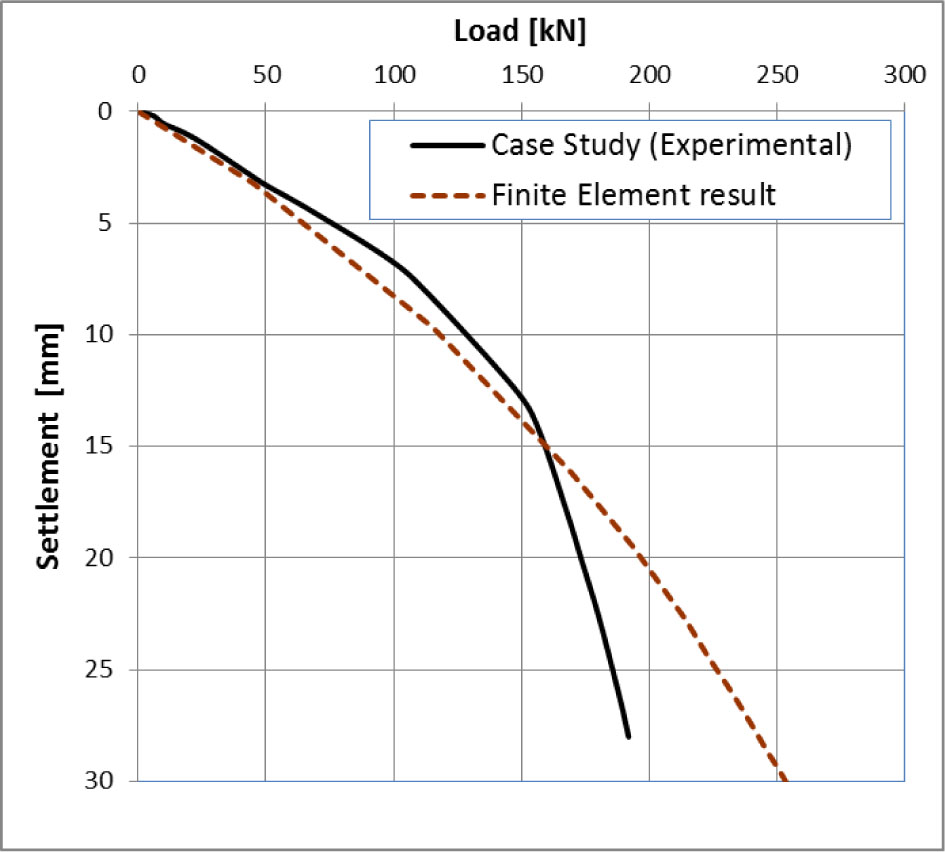
Fig. 5:
The validation of finite element results for load-settlement ressponse.
4. Results of analysis
For the purpose of evaluating the value of Nc factor, the results of the analysis are represented as settlement ratio (S/B) versus bearing ratio (q/cu), the settlement ratio refers to the ratio of settlement (S) to foundation width (B) and the last represents the ratio of applied stress (q) to clay cohesion (cu) that means Nc factor for foundation rested at surface on clayey soil.
4.1 Variation of foundation width
A square shape of footing is adopted with different widths (3 m, 7 m, and 10 m). It was used the input parameters adopted for the validation case, the foundation is subjected to uniform stress and the settlement at a node of the center of foundation. The relation between the bearing ratio versus settlement ratio of the practical case study and large-scale results is shown in Fig. (6). The maximum capacity is considered at a settlement ratio of (3%) according to the note of Ornek et al. [6]. From the results of Nc factor in Fig. (7) it could be noted that the magnitude starts from (3) to (4.5) for small-scale footing, while for a large-size foundation, the value of Nc factor depends on the width of the footing and starts from (4.5) and reaches about (6.5).
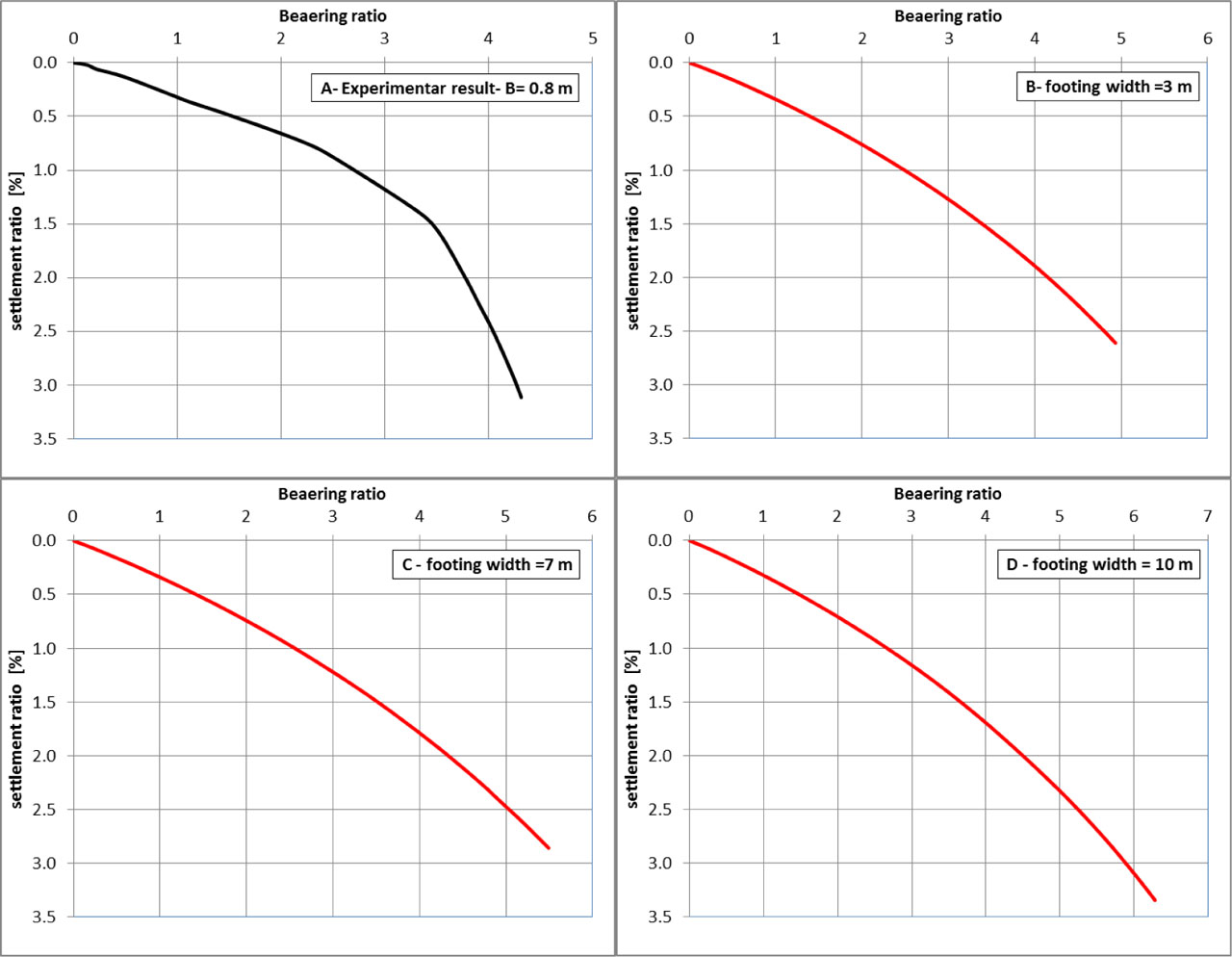
Fig. 6:
Bearing ratio versus settlement ratio results of the case study and large-scale cases.
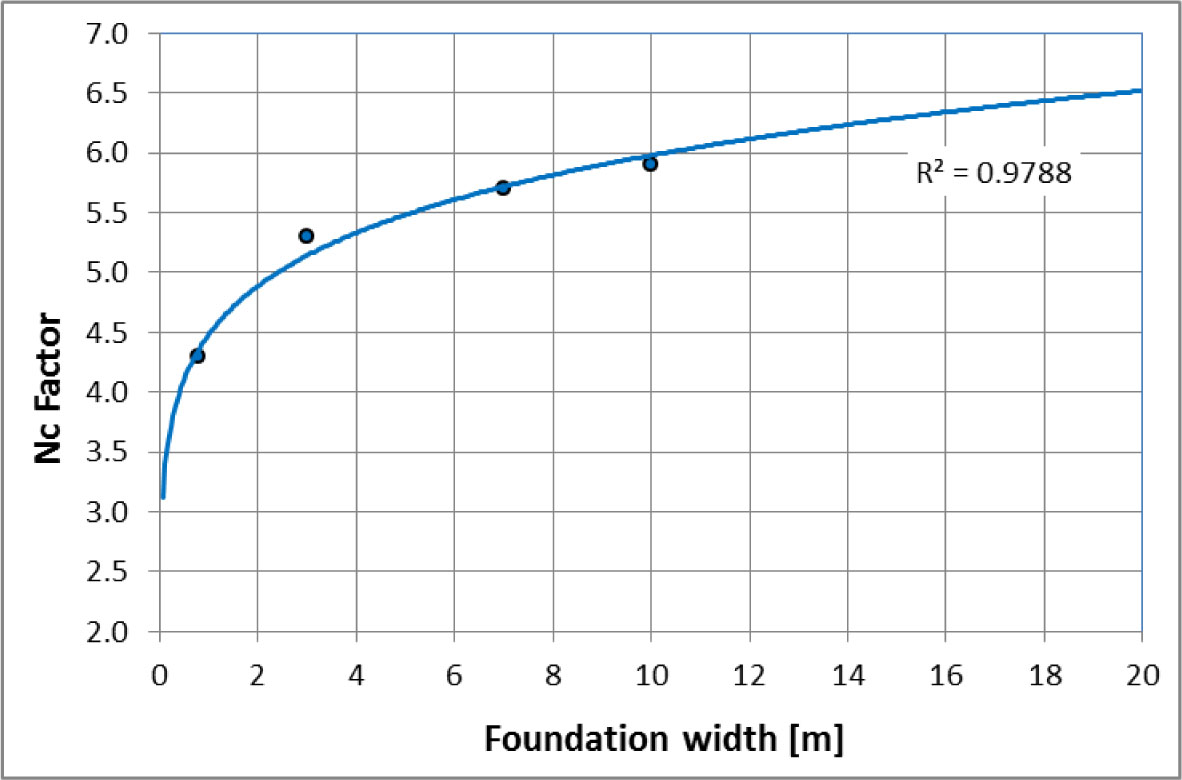
Fig. 7:
Variation of Nc factor with foundation width.
4.2 Variation of clay cohesion
In this case, a square shape of the foundation is considered with a (10 m) width, in order to investigate the Nc factor value in different soil cohesion, it was selected the cohesion of clay equal (40 kPa, 70 kPa, 100 kPa, and 200 kPa). The input parameters adopted in the analysis for these four cases are given in Table (2), where the value of modulus of elasticity considered for each case equal to (140 – 150 cu) and this ratio is in good agreement with the recommendation of Waheed and Asmael [9]. The modulus of Oedometer is automatically calculated from the program and the modulus of unloading is equal to three times of modulus of elasticity According to a default of the program.
Table 2:
The input parameters adopted in the modeling of the four cases of soil cohesion.
| Property | Cu = 40 kPa | Cu = 70 kPa | Cu = 100 kPa | Cu = 200kPa |
|---|---|---|---|---|
| Modulus of Young | 6 MPa | 10 MPa | 15 MPa | 28 MPa |
| Modulus of Oedometer | 17.6 MPa | 29.4 MPa | 44.1 MPa | 82.3 MPa |
| Modulus of Unloading | 18 MPa | 30 MPa | 45 MPa | 84 MPa |
| Cohesion | 40 kPa | 70 kPa | 100 kPa | 200 kPa |
| Angle of Friction | 10° | 10° | 10° | 10° |
| Poisson’s Ratio | 0.35 | 0.35 | 0.3 | 0.3 |
| Power of Exponential | 1 | 1 | 1 | 1 |
From Fig. (8), the increase of bearing pressure with variation soil cohesion is clearly observed. Fig. (9) illustrates the bearing ratio versus settlement ratio curve and it can be concluded that variation of soil cohesion does not affect the value of Nc factor, where it is equal to (5.8) at (3 %) settlement ratio for (10 m) foundation width.
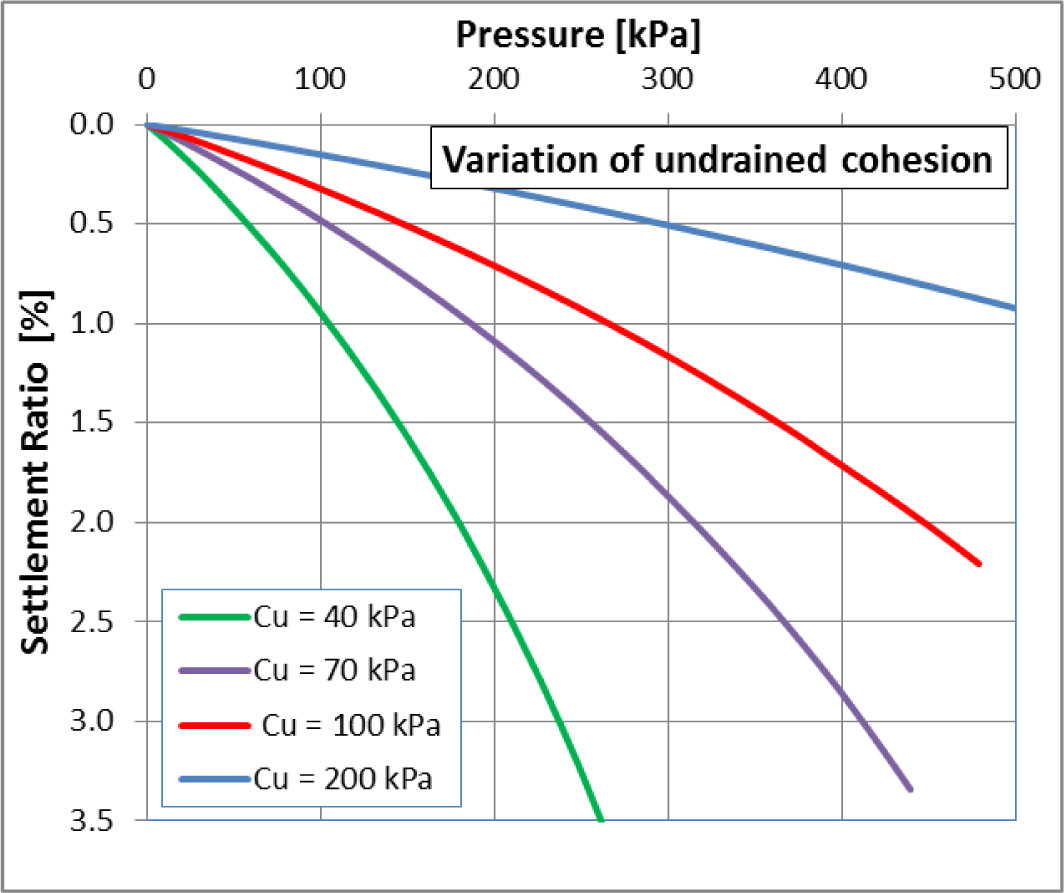
Fig. 8:
Bearing pressure against settlement ratio curve with variation soil cohesion.
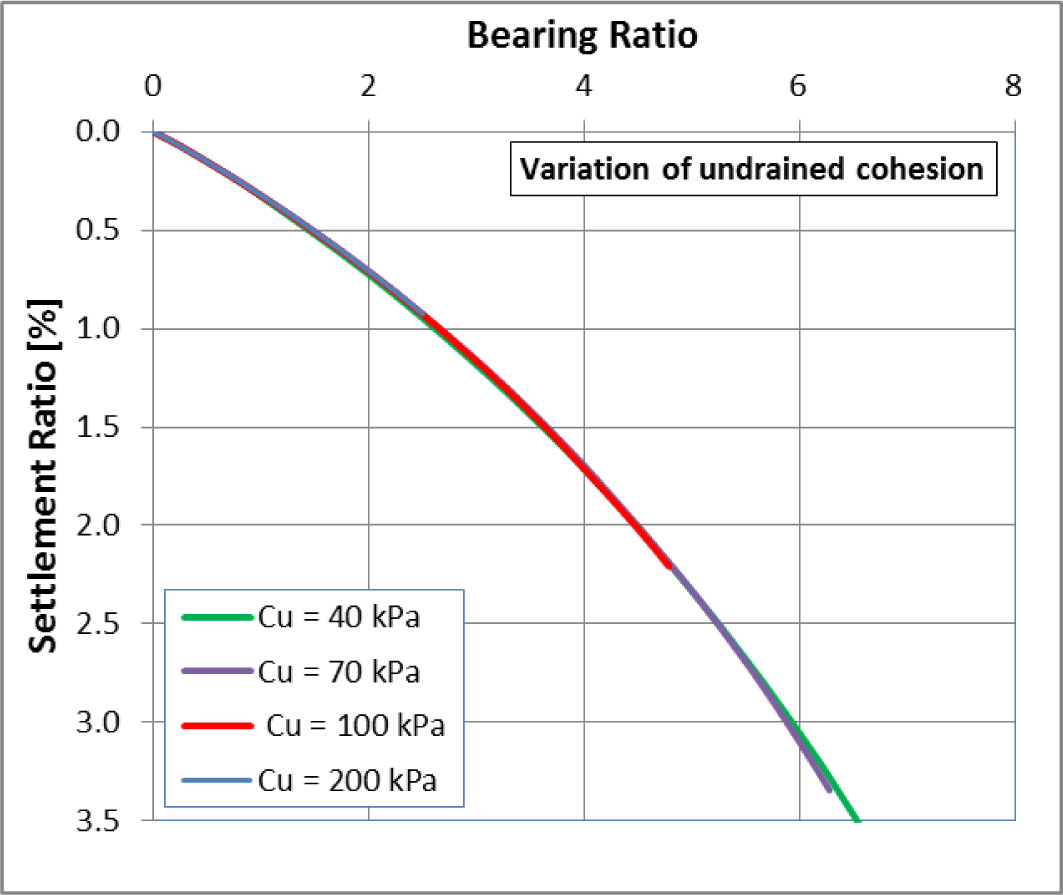
Fig. 9:
Bearing ratio against settlement ratio curve with variation of soil cohesion.
4.3 Remolded soil case
In order to assess Nc factor value for remolded clay and compare the results with the natural state, three tests are performed of a square footing of width (210 mm) in three states of cohesion that equals (20, 40, and 60 kPa). The soil properties are given in Table (3). The preparation of clay in a model tank and the layout of loading mechanism are mentioned in the study of Waheed and Asmael [12]. A settlement equal (10%) of footing width is considered to define the maximum bearing capacity as recommended by many studies [13,14,15], so from the results depicted in Fig. (10), the Nc factor equals about (2.4) for small-scale footing. Moreover, this magnitude is outside of the suggested range of the Nc factor and is; (4 to 6.18) for fully saturated clayey soil at undrained conditions [16].
Table 3:
Characteristics of clayey soil used.
| Property | Magnitude | Specification |
|---|---|---|
| Liquid limit | 46 | ASTM-D4318-2010- [17] |
| Plastic limit | 24 | ASTM-D4318-2010- [17] |
| Plasticity index | 22 | ASTM-D4318-2010- [17] |
| Specific gravity | 2.71 | ASTM-D854-2010- [18] |
| Gravel (larger than 4.75 mm) | 0 % | ASTM-D422-2010- [19] |
| Sand (4.75mm to 0.075mm) | 5 % | ASTM-D422-2010- [19] |
| Silt (0.075 mm to 0.005mm) | 43 % | ASTM-D422-2010- [19] |
| Clay (less than 0.005 mm) | 52 % | ASTM-D422-2010- [19] |
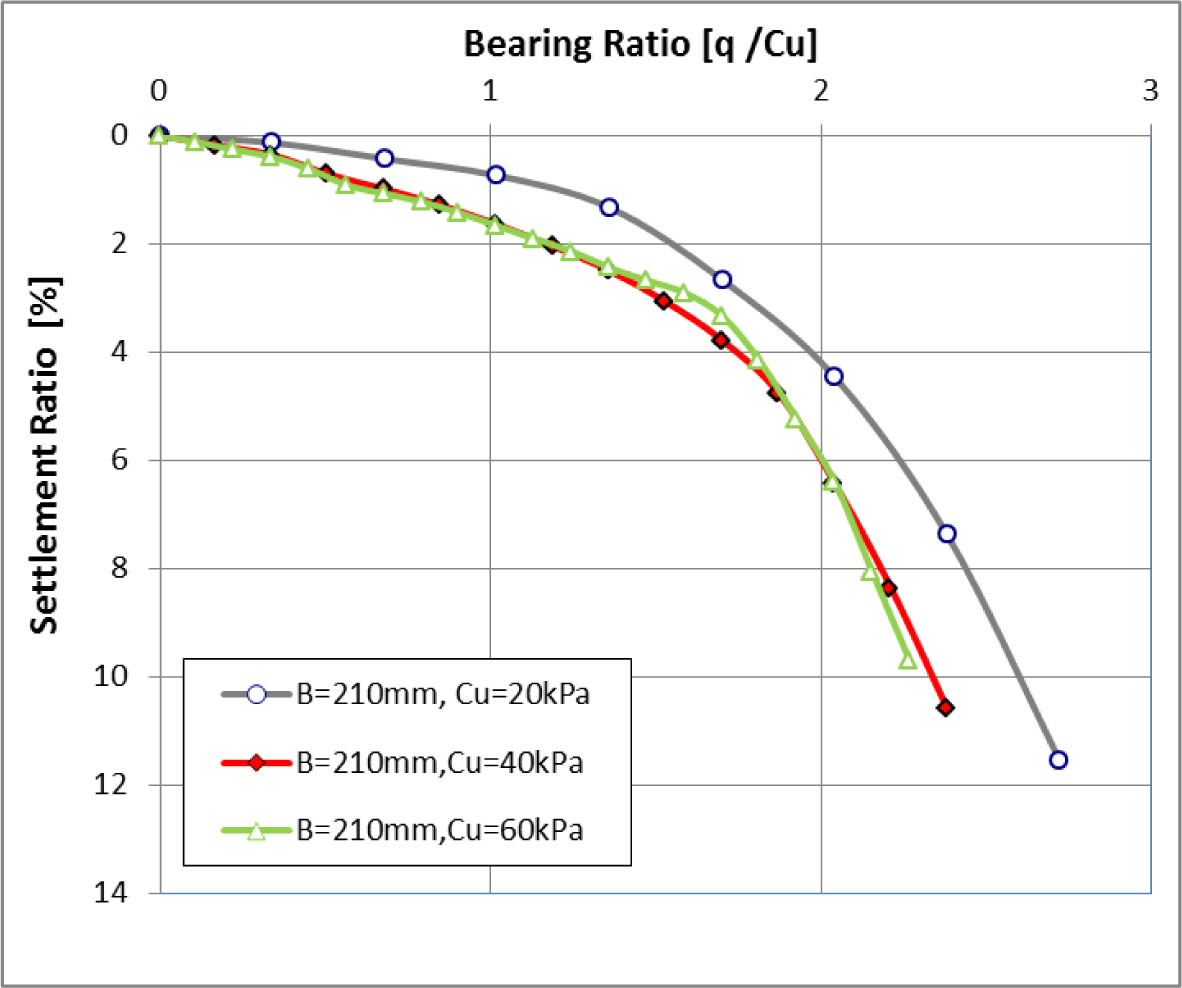
Fig. 10:
Bearing ratio against settlement ratio curve for remolded soil cases.
5. Conclusion
In this paper, experimental work is performed on a model footing in remolded clay, and a finite element analysis is performed using Plaxis software for undisturbed and remolded clay, according to the results obtained from this research the following conclusions are obtained:
1) The finite element modeling using Hardening soil model produces a very good simulation for analyzing the load-settlement curve of small and large-size foundations resting in clay bed.
2) The Nc factor of shallow foundation should be normalized with the footing width.
3) The magnitude of Nc factor is not affected by the variation of cohesion of clay.
4) The Nc factor for small-size footing is lower than large-size and in the range between (3 to 4.5).
5) For a large-size foundation, the Nc factor depends on the width of the footing and starts from (4.5) and reaches about (6.5).
6) In the case of a raft foundation width higher than 20 m, the Nc factor is not exceeded (6.5).
7) The Nc factor equals about (2.4) for small model footing in remolded clay and this value is considered outside of the suggested range which is (4 to 6.18) for fully saturated clay at undrained conditions.