

1. Introduction
In the realm of civil engineering, concrete serves as the cornerstone of construction for more than a century, establishing itself as an indispensable material across the globe. While concrete demonstrates remarkable compressive strength characteristics, its limitations in tensile and flexural behaviour remain a persistent challenge for civil engineers. A paramount concern in concrete structures lies in the manifestation of cracks as inherent defects which precipitate brittle fracture mechanisms whilst simultaneously compromising both structural serviceability and long-term durability [1]. Structural degradation of cementitious materials fundamentally originates from the nucleation and progressive propagation of interconnected microstructural fractures pervading the intricate cement matrix [1,2,3,4]. Traditional approaches were used to mitigating crack formation including the incorporation of short discrete microfibers (steel or polypropylene) into the concrete mixture [5]. However, these conventional solutions showed a limited efficacy in preventing the initial formation of microcracks within the concrete matrix. The advent of nanotechnology inaugurates a revolutionary approach to concrete enhancement, particularly through the incorporation of nanomaterials into concrete composites. This innovative technique showed a remarkable improvement in material properties, including enhanced toughness, flexural strength, tensile capacity, and durability through modifications in the nanoscale level. Empirical investigations establish that, the incorporation of nanomaterials even in minimal concentrations, fundamentally alters composite properties through molecular-level modifications, yielding quantifiable performance enhancements [6]. Within the extensive spectrum of available nanomaterials, nanosilica, graphene derivatives, Carbon Nanofibers (CNFs), and Carbon Nanotubes (CNTs) emerge as significant constituents, owing to their distinctive intrinsic properties and demonstrated capacity to augment the mechanical performance and functional characteristics of cementitious matrices. The construction sector demonstrates a systematic progression towards nanomaterial applications, attributed to their established capability to enhance mechanical strength through nanoscale void occupation, thus facilitating the development of densified and structurally robust matrices. The chemical interaction between cement and nanomaterials particularly graphene oxide, CNTs, graphene, and graphene-based derivatives) enhances a comprehensive range of properties, encompassing mechanical, thermal, electrical, and optical characteristics. Empirical evidence consistently demonstrates the beneficial effects of these nanomaterials on cement composite behviour. Numerous investigations were focused on the mechanical properties and durability aspects of nano-reinforced cement and concrete composites reveal superior behviour characteristics compared to conventional cement composites, manifesting in enhanced strength, resilience, and longevity [7,8]. The burgeoning scientific literature of the past decade has comprehensively documented the pivotal role of Graphene Oxide (GO) powder and graphene nanosheets as transformative performance-modifying agents within cement and concrete composite systems, substantiated by an expansive and robust corpus of investigative research [9,10,11,12,13,14,15,16,17]. Notable findings indicate that the incorporation of merely 0.022% GO into cement results in remarkable improvements exceeding 30% in compressive strength, flexural strength, toughness, and Young's modulus during early curing stages [18]. Furthermore, after 28 days of curing, concrete containing 0.06% GO demonstrate a 10% enhancement in compressive strength compared to normal concrete. It was also found that the efficacy of GO in enhancing the flexural strength proves particularly noteworthy, with research documenting a remarkable 75.7% improvement in composites containing 0.04% GO relative to control mixtures [19]. A research was carried out by Pan et al. [20] demonstrated that incorporating 0.05% GO with cement yielded significant improvements in mechanical properties. Where compressive strength and flexural strength increases by 15–35% and 41–58% respectively. These remarkable improvements stem from the distinctive morphology of GO sheets, which enhanced mechanical interlocking between cement particles and effectively mitigated microcrack propagation, as confirmed through detailed scanning electron microscopy analyses. The high ratio of GO facilitates the hydration process and strengthens interfacial bonding, underscoring the critical importance of further investigation into graphene-based materials for construction applications. S. Lv et al. [21] conducted work to study the effects of GO nanosheets on cement composites mechanical properties and microstructure. They found that incorporating 0.03% GO nanosheets significantly enhanced tensile, flexural, and compressive strengths by regulating hydration crystal formation, reducing brittleness, and improving toughness, suggesting potential for practical applications. Their findings identified 0.03% as the optimal concentration for maximising mechanical behviour, yielding impressive improvements of 60.7% in tensile strength and 78.6% in flexural strength after 28 days of curing. Whilst compressive strength demonstrated consistent enhancement with increasing graphene content, the rate of improvement diminished beyond 0.03%, suggesting a saturation threshold. This investigation specifically examined tensile and compressive strengths using solid graphene additives, distinguishing it from ongoing research exploring liquid-based graphene applications in concrete formulations. Further investigations by Al-Allaf et. al. [22] have demonstrated that an augmented proportion of hybrid reinforcement mechanisms substantially mitigates and constrains the propagation of microstructural fractures within composite materials.
Another experimental work carried out by Dimatar Dimov et al. [23] investigated the implications of adding graphene to cement and concrete mixtures. Their outcomes revealed notable enhancements in tensile, flexural, and compressive strengths, alongside improved durability and reduced permeability. Their study evaluated various forms of graphene, including surfactant-functionalised graphene, industrial-grade graphene nanoplatelets, and ultra-thin graphite at concentrations ranging from 0.01 g/L to 1 g/L, demonstrating consistent improvements in both compressive and tensile strengths. Yu-You Wu et al. [24] investigated the effects of GO nanosheets on concrete properties, documenting improvements in compressive strength ranging from 12.84% to 34.04% and flexural strength enhancements of 2.77% to 15.6% with GO additions between 0.02% and 0.08%. These improvements stemmed from graphene's promotion of hydration processes and strong interfacial forces, which effectively reduced microcrack propagation. The incorporation of GO demonstrates a substantive and compelling impact on the structural integrity and long-term performance characteristics of cementitious materials, with particular emphasis on enhancing concrete durability [25]. Studies by Long, Mohammed, and others demonstrate that hydration products incorporating GO significantly enhance carbonation resistance and freeze-thaw resilience in cement paste [26,27,28]. Innovative nanoscale reinforcement strategies substantively modulate the physicochemical characteristics of cementitious composites, manifesting remarkable improvements in electrical impedance and demonstrating a substantial mitigation of moisture permeability within matured specimen configurations relative to conventional reference formulations [29]. The material also beneficially influences thermal conductivity, electrical resistance, and resistance to sulfuric acid attack [30]. However, important limitations exist, particularly regarding workability. Increasing GO nanosheet content typically results in reduced slump values, indicating diminished workability [31,32,33,34].
Despite extensive research on the mechanical and durability properties of cement and concrete composites incorporating graphene-based materials, a significant gap persists in understanding the flexural behaviour of reinforced concrete beams, particularly those utilizing GO as an additive. While numerous studies have investigated the influence of GO on compressive and tensile strength, limited attention has been directed towards lightly reinforced concrete beams and their flexural performance under various load conditions. This study addresses this critical gap by focusing on the effects of incorporating GO at low concentrations (0.01% and 0.05%) on the flexural behaviour of reinforced concrete beams. The research aims to explore how GO enhances the load-bearing capacity, crack behaviour, and overall structural performance of lightly reinforced concrete beams under monotonic loading. Understanding these effects is essential for advancing the practical application of GO in structural elements, enabling the development of more resilient and efficient construction materials.
2. Experimental Setup
An investigative methodology was employed to elucidate the flexural performance modifications of lightly reinforced concrete beams through strategic incorporation of GO as a supplementary cementitious material. The experimental programme comprised two distinct phases. The initial phase was focusing on the preparing the fresh concrete and study the effect of adding GO to the concrete. The experimental design systematically investigated GO addition at incremental weight percentages of 0.01% and 0.05%, wherein GO served as an additive, rather than a complete replacement for, Portland Pozzolana Cement (CEM II). The aggregate composition, sand fraction, and aqueous content were meticulously maintained at constant levels across all experimental matrices. To mitigate potential deleterious effects associated with increased water demand and concomitant porosity escalation, a high-range water-reducing agent (superplasticizer) was judiciously introduced at 2% of the total binder mass, encompassing both CEM II and GO. This methodological intervention facilitated the maintenance of consistent w/c ratios of 0.3 and 0.35 for group 1 and group 2, respectively. A comprehensive tabulation of the complete mix proportions was delineated in Table 1.
Table 1:
Concrete Mix Design.
| Group | Mix | Cement [Kg/m3] | W/C | Fine Aggregate [Kg/m3] | Corse Aggregate [Kg/m3] | SP [Kg/m3] | Go [Kg/m3] |
|---|---|---|---|---|---|---|---|
| Group 1 | Mix 1 | 450 | 0.3 | 800 | 1000 | 9 | 0 |
| Mix 2 | 450 | 0.3 | 800 | 1000 | 9 | 45 | |
| Mix 3 | 450 | 0.3 | 800 | 1000 | 9 | 225 | |
| Group 2 | Mix 4 | 380 | 0.35 | 950 | 950 | 7.6 | 0 |
| Mix 5 | 380 | 0.35 | 950 | 950 | 7.6 | 38 | |
| Mix 6 | 380 | 0.35 | 950 | 950 | 7.6 | 190 |
Precedent to the mixing protocol, the coarse aggregate underwent a rigorous washing procedure to comprehensively eliminate fine particulates and exogenous contaminants. The mixing sequence was initiated through the uniform homogenization of sand and gravel in their desiccated state, subsequently followed by the strategic incorporation of cement and the predetermined quantities of GO. This initial dry mixing phase was sustained for a period of 4 minutes to ensure a uniform distribution of constituents. Subsequently, the water was added gradually to the dry components into the rotary mixing apparatus. To achieve optimal homogeneity among all constituents, the concrete was subjected to an extended mixing duration of approximately 5 minutes. The workability of the freshly prepared concrete was evaluated using the slump test. The test was conducted immediately following the completion of the mixing process utilizing a standard slump cone with the following dimensions i.e. height 300 mm, bottom diameter 200 mm, and top diameter 100 mm, opened at both extremities. The inner surface of the cone was thoroughly cleaned prior testing. After that the cone was placed on a smooth, horizontal and cleaned base plate. The reduction in height between the concrete mass relative to the mold was then calculated to represent the slump value. This test procedure was achieved in accordance with ASTM C143/C143M standards, ensuring consistency and reliability in the assessment of concrete workability across all mixture formulations. The compressive strength of the concrete mixtures was evaluated using three cubic specimens measuring 150×150×150 mm for each concrete mix to ensure statistical reliability. The fresh concrete was initially compacted using a vibrator to achieve optimal homogeneity prior to casting. Adequate compaction was ensured during the casting process to minimize air voids and enhance specimen consistency. Post-casting, the specimens were covered in moistened burlap to facilitate continued hydration. Subsequently, the cubes were immersed in clean, fresh water for continued hydration. Prior to the test, all specimens were taken-out from the water tank and dried. The compressive strength test was conducted after 7 and 28 days of curing. The tests were performed using a Forney Universal Testing Machine applying a compressive load at a constant rate of 1.40 kN/cm2 per minute. The load was incrementally increased until specimen failure, at which point the maximum load was recorded for strength calculation. Recognizing the fundamental importance of tensile strength in concrete behaviour, particularly its influence on structural cracking patterns and magnitudes, indirect measure of the concrete's tensile capacity i.e. splitting tensile strength tests were conducted. This parameter is crucial for determining the maximum tensile load concrete members can withstand before crack initiation. For each concrete mixture, three cylinders, measuring 200 mm in height and 100 mm in diameter were cast. The curing protocol same as that of the compressive strength specimens. The splitting tensile strength tests were performed at 7 and 28 days using ELE Universal Testing Machine. The load was applied gradually and increased consistently until specimen failure occurred. Slump test, concrete compressive strength and tensile strength results are presented in Table 2.
Table 2:
Mechanical Characteristic of the Concrete.
| Mix | Slump [mm] | Compressive Strength [MPa] | Tensile Strength [MPa] | ||
|---|---|---|---|---|---|
| 7 days | 28 days | 7 days | 28 days | ||
| 1 | 55 | 38 | 53 | 1.81 | 2.33 |
| 2 | 59 | 40 | 58 | 1.93 | 2.62 |
| 3 | 50 | 45 | 62 | 2.14 | 2.83 |
| 4 | 62 | 26 | 41 | 1.4 | 1.89 |
| 5 | 66 | 31 | 48 | 1.61 | 2.15 |
| 6 | 58 | 36 | 55 | 1.87 | 2.68 |
The second Phase of the experimental work was the fabrication and testing of six reinforced concrete beams to investigate the influence of G0 content, concrete compressive strength on the cracking behaviour of lightly reinforced concrete beam. Table 3 presents the beam designations and their corresponding details. All specimens were carefully designed to ensure flexural failure modes, with uniform cross-sectional dimensions of 150 mm in width and 250 mm in depth and a length of 1500 mm.
Table 3:
Beams Designations and Reinforcement Details.
| Beams Designation | GO [%] | Reinforcement Ratio [%] |
|---|---|---|
| B1- CO | 0 | 0.45 |
| B2- 0.01% GO | 0.01 | 0.45 |
| B3- 0.05% GO | 0.05 | 0.45 |
| B4- CO | 0 | 0.45 |
| B5- 0.01% GO | 0.01 | 0.45 |
| B6- 0.05% GO | 0.05 | 0.45 |
The longitudinal reinforcement configuration consisted of 2Ø12 bars placed in the tension zone to provide the necessary flexural capacity. To facilitate the placement of stirrups, 2Ø8 bars were placed on the compression zone. To mitigate the possibility of shear failure and promote the desired flexural behaviour during the test. A consistent shear reinforcement scheme was implemented across all specimens. This consisted of 8 mm diameter stirrups spaced at regular 75 mm intervals c/c throughout the beam length.
In this study, GO was added as a additive to the cement. All specimens were fabricated with a concrete cover of 30 mm to facilitate a proper bond development. The experimental matrix incorporated variations in two key parameters: concrete compressive strength (53 MPa and 41 MPa) and GO content (0%, 0.01%, and 0.05% by weight of cement. All beams were cast in precision-engineered wooden molds and subjected to a standardized 28-day curing regime under controlled laboratory conditions. Upon completion of the curing period, the specimens were demolded and prepared for structural evaluation using a four-point loading configuration. This testing methodology was selected to generate a constant moment region i.e. 300 mm in the central portion of the beam, thereby facilitating a more precise assessment of flexural behaviour of lightly reinforced concrete beams. The testing apparatus comprised a calibrated hydraulic actuator for applying controlled loads, a high-precision load cell for force measurement, and strategically positioned linear variable differential transformers (LVDTs) at critical points along the beam length. The beams were positioned on roller supports at both ends to simulate simply supported conditions, with the load applied symmetrically at two points about the midspan by using I section beam spreader. Beams geometry and reinforcement details were shown in Figure 1. Prior to the test, all the beams were painted in white to detect the cracks propagation and the load was then applied gradually up to failure.
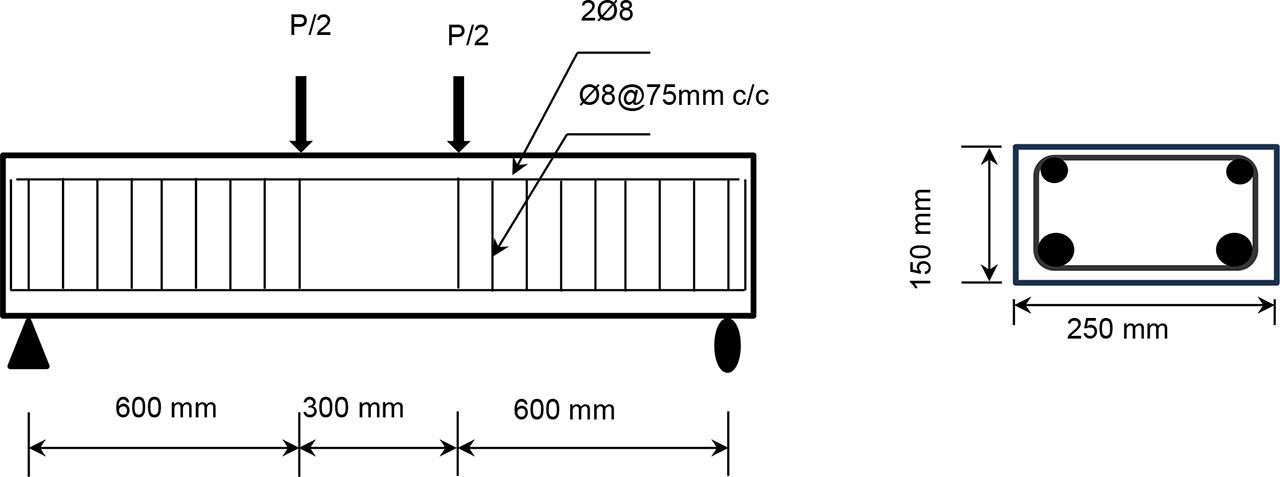
Fig. 1:
Beam Details and Cross Section (all dimensions are in mm).
3. Results and Discussions
3.1. Mechanical properties of concrete
The compressive strength and splitting tensile strength tests were conducted after 7 days and 28 days of curing. The results indicate that the mixes incorporating GO exhibited superior compressive and tensile strength compared to the control mix for both concrete groups. Figures 1(a) and (b) present a comparison of the compressive and splitting tensile strengths for both concrete mixes, highlighting the impact of varying GO percentages on their performance.
3.1.1. Compressive strength of Concrete
The incorporation of GO demonstrated significant effects on the compressive strength development of concrete mixtures at both 7 and 28 days of curing. Figure 2(a) illustrates the 7-day compressive strength results, where Group 1 (Mix 1, 2, and 3) exhibited an initial strength of 37.5 MPa at 0% GO content, which increased to 41 MPa with 0.01% GO addition, representing a 9.3% enhancement. Similarly, Group 2 (Mix 4, 5, and 6) showed a more pronounced improvement, with strength increasing from 25 MPa to 31 MPa (24% increase) at 0.01% GO content. The strength continued to improve gradually with increasing GO content up to 0.05% for both groups, reaching maximum values of 45 MPa and 37 MPa for Groups 1 and 2, respectively. These findings align with Mohammed et al. [35], who reported similar enhancement patterns in early-age strength development, though they observed peak performance at a slightly higher GO content of 0.07%. The 28-day compressive strength results, depicted in Figure 2(b), revealed a similar trend but with higher overall strength values. Group 1 showed an initial strength of 55 MPa at 0% GO, which increased to 60 MPa (9.1% improvement) with 0.01% GO addition. The strength continued to increase marginally up to 0.05% GO content, reaching a maximum value of 62 MPa. Group 2 demonstrated a more substantial relative improvement, with strength increasing from 42 MPa to 48 MPa (14.3% increase) at 0.01% GO content, ultimately reaching 55 MPa at 0.05% GO. These results contradict the findings of Chen et al. [36], who reported more modest improvements of 5–7% at similar GO dosages, possibly due to differences in GO dispersion methods and mixture proportions.
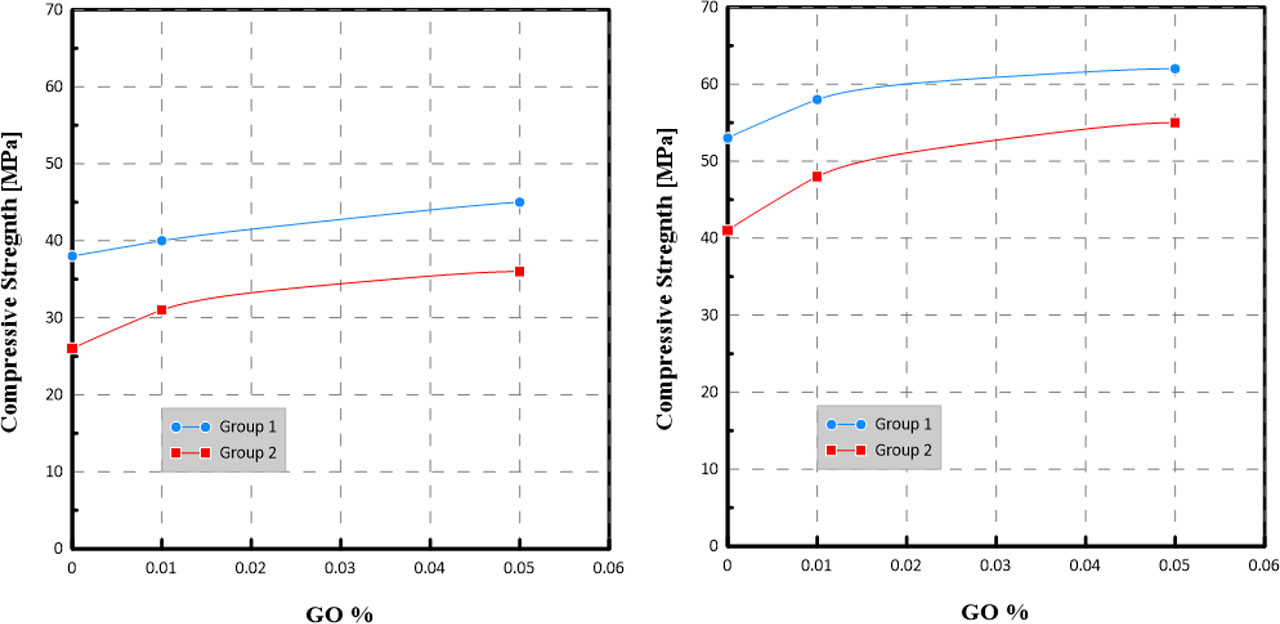
Fig. 2:
Influence of GO Content on Compressive Strength at (a) 7 Days and (b) 28 Days.
The influence of GO on compressive strength development demonstrates distinct patterns when comparing early-age (7-day) and later-age (28-day) strengths across different concrete strength categories. At 7 days, the relative enhancement effect of GO was more pronounced in Group 2 (lower strength concrete) compared to Group 1 (higher strength concrete). This observation aligns with research by Liu and Zhang [37], who documented similar trends in conventional concrete mixtures. However, our results show a more significant early-age strength gain compared to their reported values, possibly due to improved GO dispersion techniques. The 28-day strength results reveal a different pattern in GO's influence on strength development. Whereas both groups continued to show improvement with GO addition, the relative enhancement was more balanced between high and low-strength concretes. These findings partially contradict results reported by Wang et al. [38], who observed more substantial improvements in high-strength concrete at later ages. However, it strongly supports the work of Kim et al. [39], particularly regarding the optimal GO content of 0.05% and the diminishing returns beyond this threshold. The varying influence of GO between early and later ages can be explained through several mechanisms. In lower-strength concrete (Group 2), the more pronounced early-age enhancement aligns with findings by Park and Lee [40], who attributed this phenomenon to GO's accelerated hydration effects in conventional concrete mixtures. However, our research shows more substantial improvements at lower GO dosages compared to their optimal content of 0.03%.
3.1.2. Splitting Tensile Strength of Concrete
The splitting tensile strength results demonstrate notable differences between 7-day and 28-day development with GO incorporation. Figure 3(a) shows the 7-day tensile strength, where Group 1 exhibited an initial strength of 1.8 MPa, increasing to 2.0 MPa with 0.01% GO addition (11.1% enhancement). Whereas group 2 showed improvement from 1.3 MPa to 1.6 MPa (23.1% increase) at 0.01% GO content. These findings align with Zhao et al. [41], who reported similar enhancement patterns in early-age tensile strength. After 28-day of curing, the tensile strength results illustrated in Figure 3(b), which showed more substantial improvements. Group 1 tensile strength increased from 2.5 MPa to 2.8 MPa (12% improvement) with 0.01% GO addition, reaching a maximum of 3.2 MPa at 0.05% GO. While group 2 demonstrated a more significant relative improvement, from 1.8 MPa to 2.4 MPa (33.3% increase) at 0.01% GO, ultimately achieving 2.7 MPa at 0.05% GO. These results support Wu and Chen's [42] findings regarding GO's enhanced effect on tensile strength in lower-strength mixtures. The more pronounced improvement in tensile strength compared to compressive strength could be attributed to GO's unique ability to bridge microcracks and enhance the interfacial transition zone, as suggested by Li et al. [43]. However, the results presented in this paper showed higher enhancement ratios at lower GO contents compared to their reported optimal dosage of 0.03%. Both groups exhibited optimal GO content at 0.05%, with diminishing returns beyond this threshold. This aligns with recent findings by Park et al. [44], though they observed peak performance at slightly higher GO dosages. The greater relative improvement in Group 2 suggests that GO's strengthening mechanisms are particularly effective in enhancing the tensile properties of conventional concrete mixtures, possibly due to better dispersion in more porous matrices.
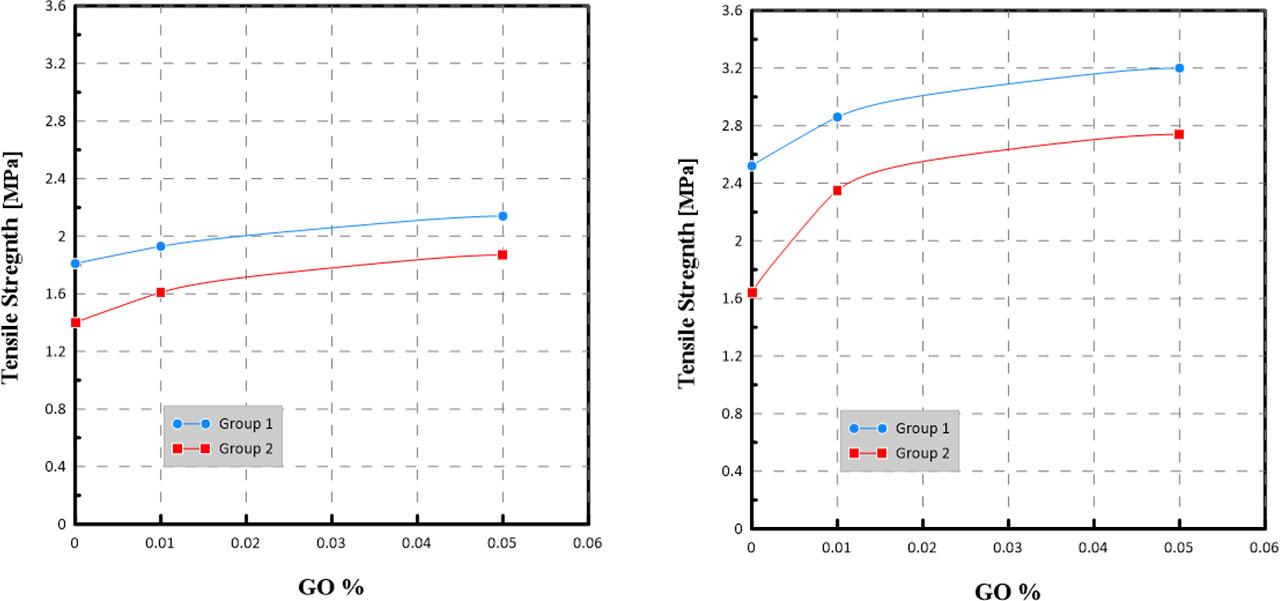
Fig. 3:
Influence of GO Content on Splitting Tensile Strength at (a) 7 Days and (b) 28 Days.
3.2. The Influence of Graphene Oxide on the Structural Performance of Lightly Reinforced Concrete Beams
The experimental investigation into the incorporation of GO in lightly reinforced concrete beams presents compelling evidence of enhanced structural performance across varying concrete strengths. Through detailed analysis of load-deflection behaviour, ultimate capacity, and ductility characteristics, this study reveals significant improvements attributable to GO addition, with particularly noteworthy effects observed in lower-strength concrete specimens.
The load-deflection behaviour, as illustrated in Figure 4, demonstrates that for high-strength concrete specimens, the addition of GO results in notable improvements in ultimate load capacity and overall structural response. The beam containing 0.05% GO (B3- 0.05% GO) achieved an ultimate load of 75 kN, representing a 17.19% increase compared to the control specimen (B1-CO, 64 kN). Similarly, the 0.01% GO specimen (B2- 0.01% GO) exhibited a 6.25% enhancement, reaching 68 kN. These improvements are accompanied by increased initial stiffness and more pronounced yield plateaus, particularly in specimen B3. The enhanced initial stiffness suggests improved elastic behaviour and better crack resistance in the pre-yield region, attributable to the nano-reinforcement effect of GO particles within the concrete matrix. In contrast, the lower-strength concrete series, depicted in Figure 5, demonstrates even more substantial improvements with GO incorporation. The control specimen (B4-CO) achieved an ultimate load of 42 kN, whilst the addition of 0.01% GO (B5- 0.01% GO) and 0.05% GO (B6- 0.05% GO) resulted in remarkable increases to 54 kN and 61 kN, respectively. These improvements represent substantial enhancements of 28.57% and 45.24%, suggesting that GO influence is particularly pronounced in lower-strength concrete matrices. This phenomenon may be attributed to GO superior ability to enhance the microstructural properties and bond characteristics in relatively weaker concrete compositions, potentially through improved hydration processes and enhanced interfacial transition zones between aggregate and paste.
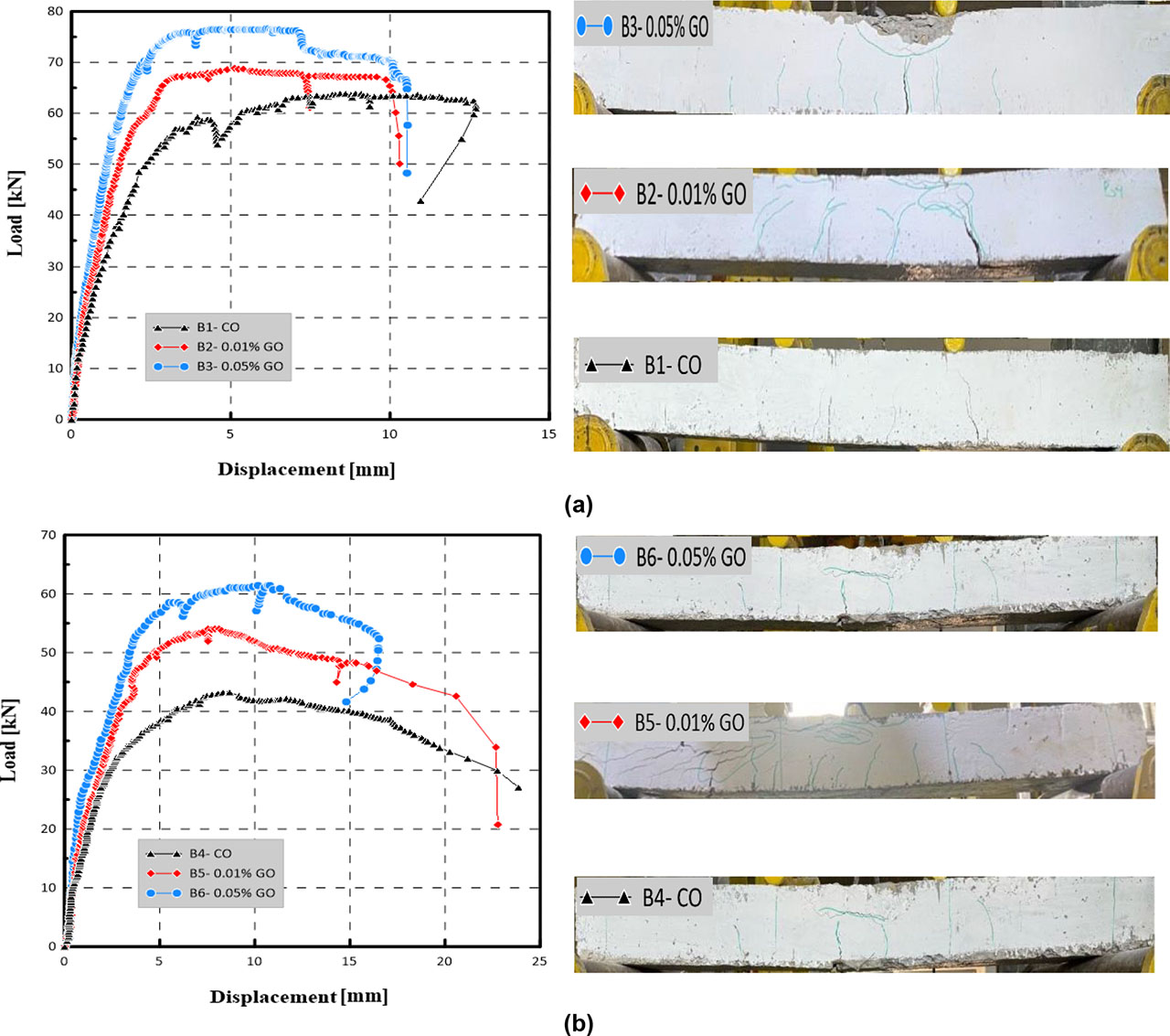
Fig. 4:
Load-Deflection Behaviour (a) Group 1 (b) Group 2.
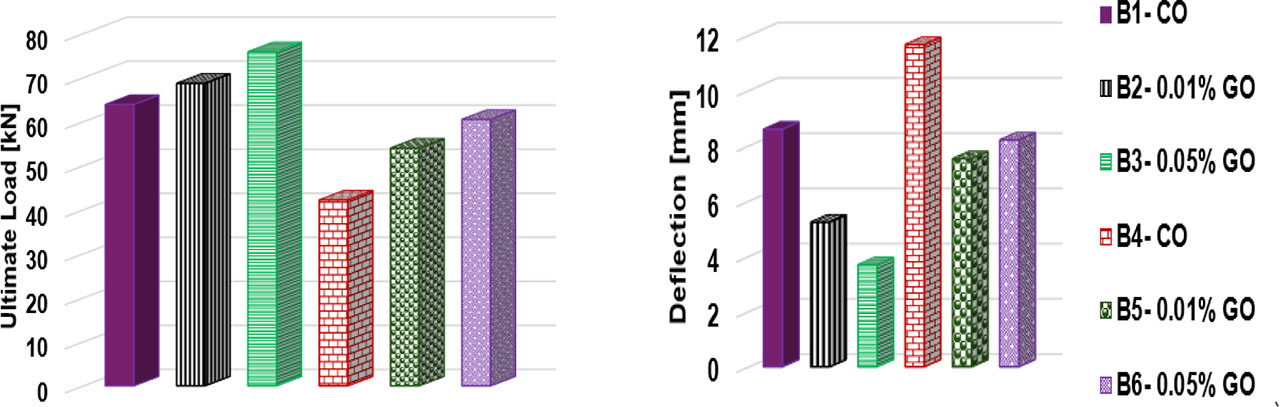
Fig. 5:
Effect of Graphene Oxide Content on Deflection and Ultimate Load Capacity of Reinforced Concrete Beams.
The comparative analysis of ultimate deflections, as presented in Figure 7a, reveals interesting trends in structural ductility. The high-strength beams exhibited ultimate deflections ranging from 4 to 8 mm, whilst the lower-strength beams demonstrated notably larger deflections between 8 and 12 mm. This behaviour is further substantiated by the ductility indices as presented in Table 5. Where the low-strength series showed a remarkable increase from 4.2 (B4-CO) to 7.5 (B6-0.05% GO), compared to the more modest improvement from 4.1 to 4.8 in the high-strength series. The enhanced ductility in lower-strength specimens suggests that GO addition effectively mitigates the inherent brittleness typically associated with concrete, particularly in compositions with lower compressive strength. A particularly noteworthy observation pertains to specimen B3- 0.05% GO, which exhibited unique behaviour characterised by sudden load drop, indicating reinforcement rupture rather than conventional yielding. This behaviour suggests that the enhanced matrix strength provided by 0.05% GO in high-strength concrete may necessitate careful consideration of reinforcement design to fully exploit the improved concrete properties. The phenomenon highlights the importance of achieving balanced design when incorporating GO, particularly in high-strength applications where the enhanced matrix properties may alter the traditional failure mechanisms.
Table 4:
Cracking Load, Ultimate Load, Deflections, and Ductility of Reinforced Concrete Beams with Different Graphene Oxide Contents.
| Parameter | B1-CO | B2-0.01% GO | B3-0.05% GO | B4-CO | B5-0.01% GO | B6-0.05% GO |
|---|---|---|---|---|---|---|
| Pcr [kN] | 35 | 40 | 45 | 25 | 30 | 35 |
| Δcr [mm] | 1.5 | 1.2 | 1.0 | 1.8 | 1.5 | 1.2 |
| Pu [kN] | 64 | 68 | 75 | 42 | 54 | 61 |
| Δu[mm] | 6.2 | 5 | 4.8 | 7.5 | 8 | 9 |
| Ductility* | 4.1 | 4.2 | 4.8 | 4.2 | 5.3 | 7.5 |
The toughness characteristics, as evidenced by the area under the load-deflection curves, demonstrate consistent enhancement with increasing GO content. Mechanical characterization through load-deflection curve analysis reveals a systematic enhancement of material toughness, demonstrating consistent performance improvements across compositional variations. The investigative findings illuminate particularly notable toughness progression within lower-strength compositional series, wherein microstructural modifications manifest substantial mechanical resilience.
The observed toughness characteristics substantiate a superior energy absorption mechanism, presenting profound implications for structural applications subjected to dynamic loading environments and seismic stress conditions. The fundamental enhancement of toughness can be attributed to sophisticated microstructural bridging mechanisms that effectively mitigate and arrest micro-fracture propagation, consequently optimizing the post-critical mechanical response of the cementitious matrix
This improvement is particularly pronounced in the lower-strength series, where specimen B6- 0.05% GO exhibited the highest toughness among all tested beams. The enhanced toughness suggests superior energy absorption capacity, which could be particularly beneficial in applications requiring improved resistance to dynamic loading or seismic events. The increased toughness can be attributed to GO's ability to bridge micro-cracks and enhance the post-cracking behaviour of the concrete matrix.
Analysis of the initial cracking loads, as indicated by Pcr values in Table 5, reveals that GO addition consistently increases the cracking resistance of the beams. For the high-strength series, Pcr increased from 35 kN (B1-CO) to 45 kN (B3-0.05% GO), while in the lower-strength series, it improved from 25 kN (B4-CO) to 35 kN (B6-0.05% GO). These improvements suggest that GO effectively enhances the tensile strength of concrete, potentially through improved stress transfer mechanisms and reduced micro-crack propagation.
The experimental findings conclusively demonstrate that GO incorporation yields substantial improvements in the structural performance of lightly reinforced concrete beams, with particularly pronounced effects in lower-strength concrete. The optimal GO content appears to be 0.05% for both strength ranges, though the magnitude of improvement varies significantly between them. These results suggest that GO modification could be particularly advantageous in applications where enhanced flexural performance and energy absorption capacity are desired, especially in lower-strength concrete applications where the performance enhancement is most significant.
The comprehensive enhancement in both strength and ductility characteristics suggests that GO represents a promising avenue for concrete modification, potentially offering a viable solution for improving the performance of reinforced concrete structures. However, the observed behaviour of specimen B3 underscores the importance of considering the interaction between enhanced matrix properties and reinforcement design in optimising structural performance. The improved cracking resistance and post-cracking behaviour indicate that GO-modified concrete could potentially lead to more durable structures with extended service life and enhanced resistance to environmental factors.
These findings contribute valuable insights to the growing body of knowledge regarding GO application in structural concrete and provide a foundation for further research into optimal implementation strategies. Future investigations might focus on the long-term durability aspects, cost-effectiveness analysis, and potential applications in various structural elements under different loading conditions. The study also highlights the need for developing specific design guidelines for GO-modified concrete structures to ensure optimal utilisation of the enhanced material properties.
3.3. Mode of Failure
The failure mode analysis of the high-strength concrete beam series (B1-CO, B2-0.01% GO, and B3-0.05% GO) reveals distinctive crack patterns and failure mechanisms that warrant detailed examination. As evidenced in Figure 4 a, all specimens exhibited characteristic flexural behaviour with vertical cracks initiating in the maximum moment region.
The control specimen (B1-CO) displayed typical flexural cracking patterns, with initial cracks appearing at the beam soffit and propagating vertically upward. The crack spacing appears relatively uniform, indicating effective stress transfer between concrete and reinforcement. Based on the visual assessment of the crack patterns, the maximum crack width in the control specimen is estimated to be approximately 0.35-0.40 mm at failure, which is consistent with typical observations in lightly reinforced concrete beams. With adding 0.01% GO i.e. B2- 0.01% GO, the crack pattern shows notable refinement. The cracks appear more numerous but with reduced crack widths, estimated to be in the range of 0.25–0.30 mm at failure. This reduction in crack width, approximately 25% compared to the control specimen, suggests enhanced crack control properties imparted by the GO. This behaviour correlates with the load-deflection curve in Figure 4 a. Where B2 demonstrates improved ductility compared to the control specimen. Most notably, specimen B3- 0.05% GO exhibits the most refined crack pattern among the three specimens, with estimated maximum crack widths of 0.20-0.25 mm prior to failure. This represents a significant reduction of approximately 40% compared to the control specimen. However, the load-deflection curve indicates a sudden load drop at approximately 75 kN, suggesting crashing the concrete rather than gradual yielding. The relatively small crack widths observed before failure indicate superior crack control provided by the higher GO content, likely due to enhanced bond characteristics and improved stress distribution within the matrix.
This transition in failure modes and crack width characteristics highlights a crucial consideration for design practice: when incorporating GO at higher concentrations in high-strength concrete, the traditional assumptions of ductile flexural failure may need reassessment. The enhanced matrix properties and reduced crack widths, while beneficial for durability considerations, may necessitate increased reinforcement ratios to maintain the desired ductile failure mechanism and prevent sudden reinforcement rupture. The observed crack width reductions demonstrate GO's significant potential for improving serviceability performance, particularly in applications where crack control is a primary design consideration.
Whereas the failure mode analysis of the lower-strength concrete beam series (B4-CO, B5-0.01% GO, and B6-0.05% GO) exhibits distinct cracking patterns and failure characteristics that merit detailed examination. The control specimen (B4-CO) demonstrates wider crack spacing and more pronounced crack widths, estimated to be approximately 0.45–0.50 mm at failure. This behaviour is typical of lower-strength concrete, where reduced tensile strength leads to more concentrated crack development. The load-deflection curve shows gradual strength degradation post-peak, indicating typical ductile flexural failure. Specimen B5-0.01% GO shows improved crack distribution with estimated maximum crack widths of 0.35–0.40 mm, representing a 20% reduction compared to the control. The crack pattern indicates better stress distribution and enhanced crack control, correlating with the improved load-carrying capacity shown in Figure 4 b. The more distributed cracking pattern suggests enhanced bond characteristics between reinforcement and concrete matrix. The specimen containing 0.05% GO i.e. B6-0.05% GO exhibits the most refined crack pattern, with estimated maximum crack widths of 0.25–0.30 mm, approximately 40% less than the control specimen. The increased number of cracks with reduced widths indicates superior stress distribution and crack control properties. The load-deflection curve shows significant improvement in both strength and ductility, maintaining stable post-peak behaviour without sudden failure.
Unlike the high-strength series, all specimens in the lower-strength group maintained ductile flexural failure modes without reinforcement rupture. This observation suggests that GO addition is particularly effective in enhancing the performance of lower-strength concrete without compromising the desired failure mechanism. The progressive reduction in crack widths with increasing GO content demonstrates the material's effectiveness in enhancing serviceability performance, particularly in concrete with lower initial strength
4. Conclusion
1) GO incorporation significantly enhances the mechanical properties of concrete, with compressive strength improvements of up to 17% and 45% for high and low-strength concrete, respectively. The optimal GO content was consistently found to be 0.05% by weight of cement, beyond which diminishing returns were observed.
2) The influence of GO on structural performance was more pronounced in lower-strength concrete beams, where ultimate load capacity increased by 45.24% compared to 17.19% in high-strength specimens. This suggests GO modification is particularly beneficial for enhancing the performance of conventional concrete structures.
3) Analysis of crack patterns revealed that GO addition resulted in significant crack width reduction, with up to 40% decrease in maximum crack widths for both strength categories. This improvement in crack control characteristics indicates enhanced durability potential and superior serviceability performance.
4) GO modification demonstrated notable improvements in ductility, particularly in lower-strength concrete where the ductility index increased from 4.2 to 7.5. However, in high-strength concrete, excessive GO content (0.05%) led to reinforcement rupture, highlighting the need for balanced design considerations.
5) The initial cracking load showed consistent improvement with GO addition, increasing by 28.6% and 40% for high and low-strength beams respectively, indicating enhanced tensile strength and crack resistance properties.
6) While GO demonstrates significant potential for concrete enhancement, the research highlights the importance of considering strength-specific design modifications, particularly in high-strength applications where traditional reinforcement designs may need adjustment to accommodate the enhanced matrix properties.
Acknowledgement
The authors express their gratitude to the support of Researchers Supporting Project number (RSP2025R290), King Saud University, Riyadh, Saudi Arabia