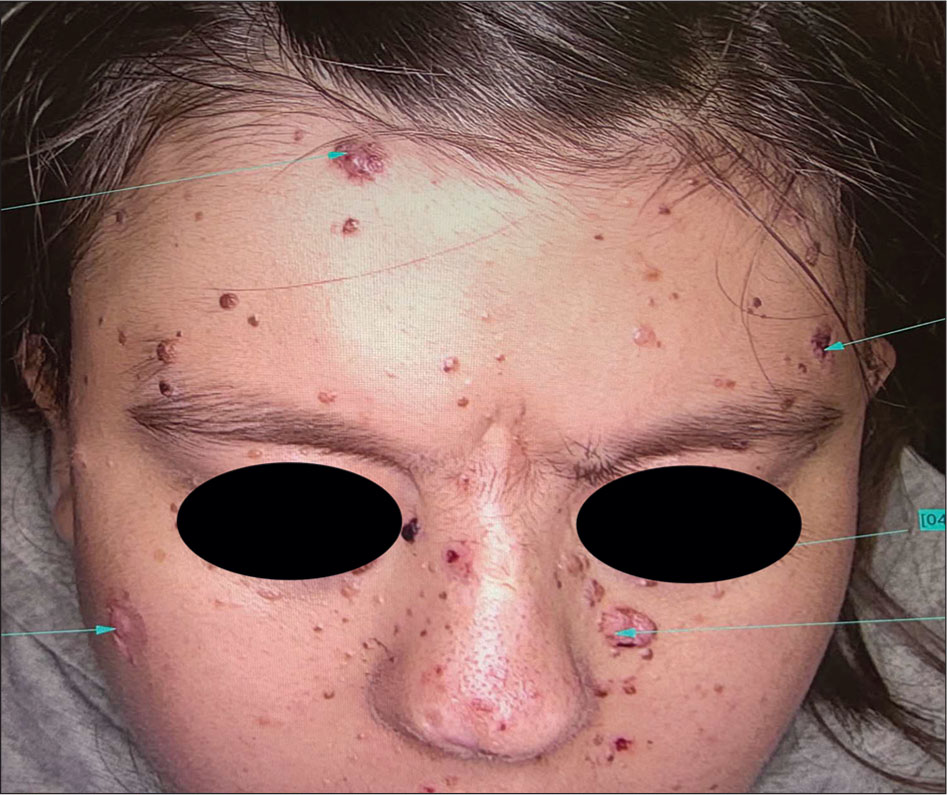
Figure 1.
Clinical presentation showing multiple facial papules, nodules, erosions, crusts, scars and milia.
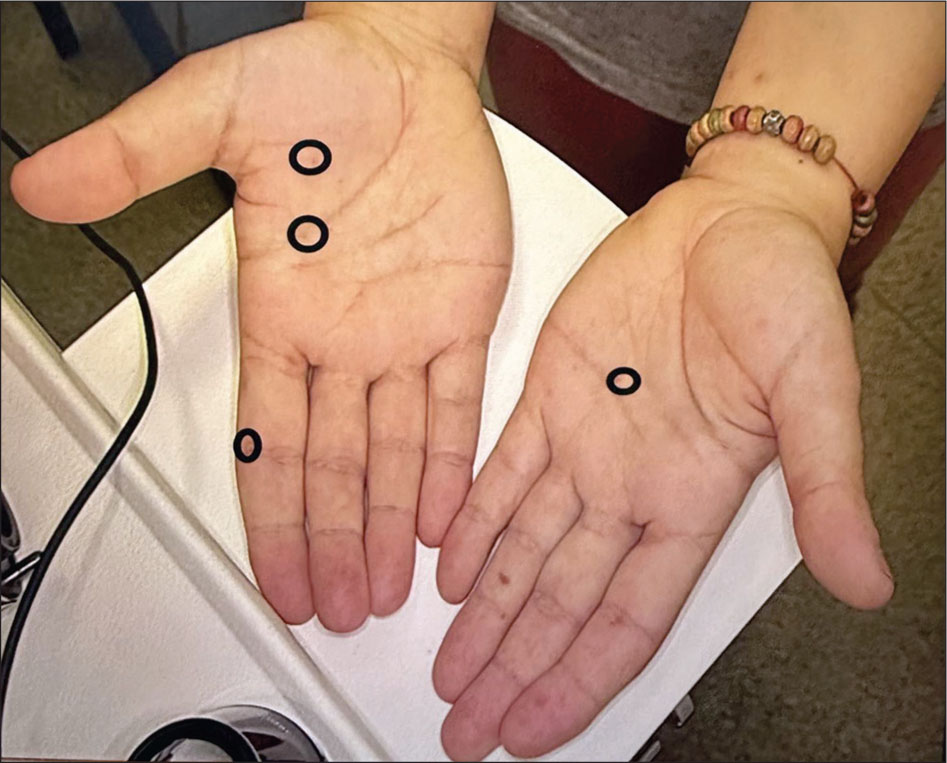
Figure 2.
Palmar pitting observed on physical examination.
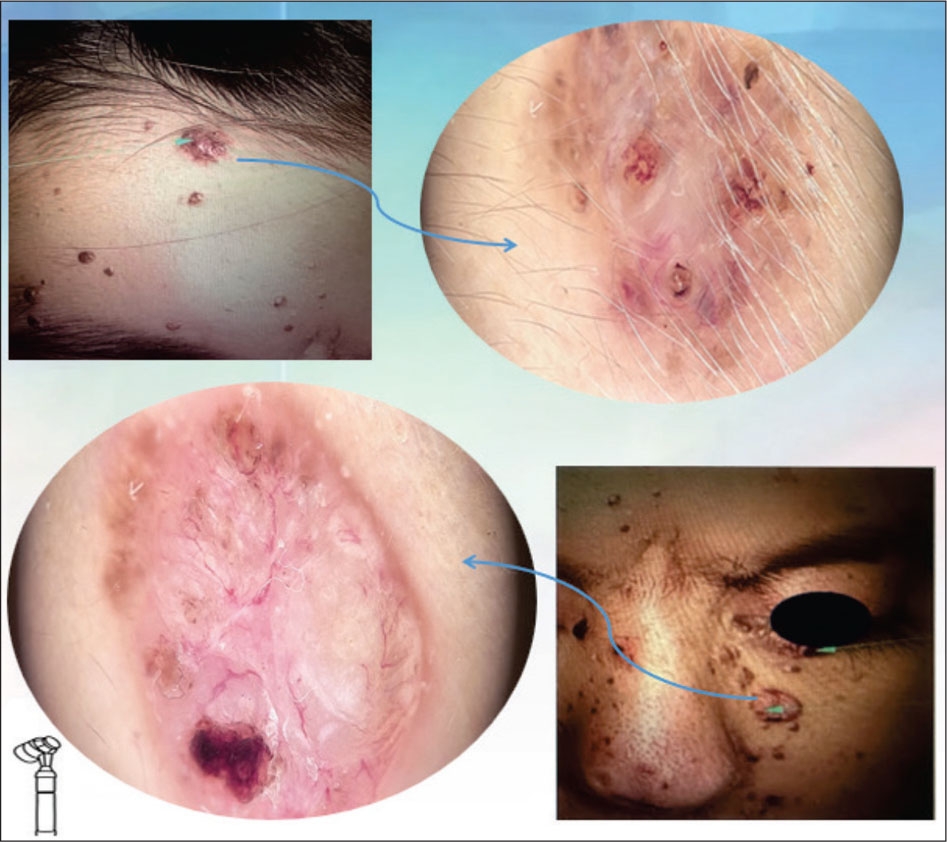
Figure 3.
Dermoscopy of selected facial lesions demonstrating arborizing vessels, blue-gray ovoid nests, ulceration, white scales and shiny white perpendicular lines.
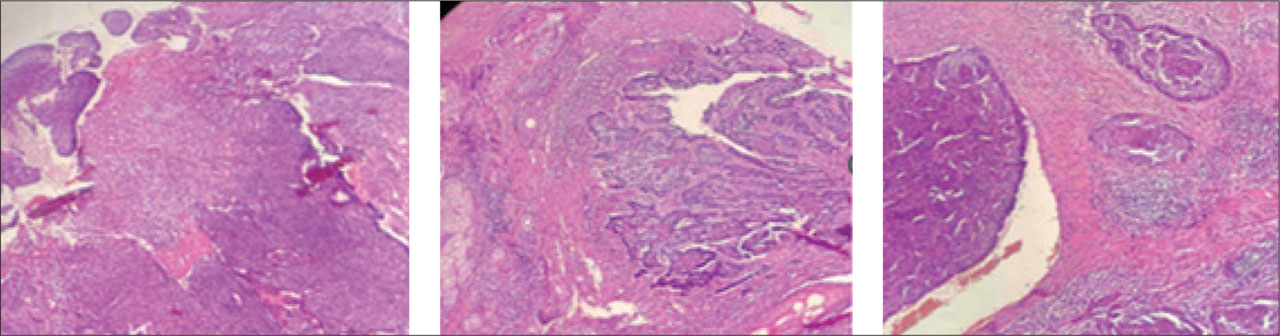
Figure 4.
Histopathology of basal cell carcinoma showing dermal aggregates of atypical basaloid cells with peripheral palisading and inflammatory infiltrate. Hematoxylin and eosin stain, original magnification x200.
Table 1.
Diagnostic criteria relevant to the present patient.
| Criterion type | Examples from guideline | Present patient |
|---|---|---|
| Major criteria | Multiple BCCs before young adulthood; palmar or plantar pits; odontogenic keratocysts; falx cerebri calcification; desmoplastic medulloblastoma; first-degree relative with BCNS | Multiple BCCs at age 15; palmar pits |
| Minor criteria | Ocular abnormalities; skeletal anomalies including kyphoscoliosis; macrocephaly; rib anomalies; cardiac/ovarian fibroma; cleft lip/palate | Strabismus; kyphoscoliosis |
| Molecular support | PTCH1 or SUFU pathogenic variant; copy-number loss may be relevant when phenotype is broader than classical GGS | MLPA-detected deletion involving 9q22.3, the region containing PTCH1 |
Table 2.
Classical GGS, 9q22.3 deletion syndrome and the present patient.
| Feature | Classical GGS | 9q22.3 deletion syndrome | Present patient |
|---|---|---|---|
| Genetic mechanism | Usually PTCH1, SUFU or PTCH2 sequence variant | Copy-number deletion involving 9q22.3, often including PTCH1 | MLPA deletion involving 9q22.3 |
| Multiple BCCs | Common | Reported, especially with PTCH1 loss | Present, histologically confirmed |
| Palmar pits | Common | Possible | Present |
| Odontogenic keratocysts | Common | Variable | No available data |
| Falx cerebri calcification | Common | Variable | No available data |
| Developmental disability | Not a dominant typical feature | Common | Present, with speech articulation disorder |
| Hearing loss | Uncommon | Reported | Conductive hearing loss |
| Cardiovascular findings | Cardiac fibroma may occur | Congenital anomalies may occur | Kinked aorta |
| Skeletal abnormalities | Rib/vertebral anomalies, kyphoscoliosis | Reported | Kyphoscoliosis |
| Dermoid cyst | Not classical | May occur in broader syndromic contexts | Nasal-root dermoid cyst |
Table 3.
Selected 9q22.3/PTCH1 deletion literature relevant to the present case.
| Reference | Year | Main contribution | Relevance |
|---|---|---|---|
| Muller et al. [12] | 2012 | Defined 9q22.3 microdeletion phenotype including craniosynostosis, hydrocephalus, macrosomia and developmental delay | Supports broader developmental phenotype(array-confirmed) |
| Shimojima et al. [13] | 2009 | Reported clinical features of array-confirmed microdeletion 9q22.3 involving PTCH1 | Supports PTCH1-containing deletion phenotype |
| Yamamoto et al. [14] | 2009 | Further delineated 9q22 deletion with basal cell nevus/Gorlin association | Supports overlap concept |
| de Ravel et al. [15] | 2009 | Highlighted early non-Gorlin findings in PTCH1-containing microdeletion | Supports syndromic interpretation |
| Isidor et al. [17] | 2013 | Associated array-confirmed 9q22.3 microdeletion with Wilms tumor risk | Relevant to genetic counseling and surveillance |
| Ewing et al. [21] | 2021 | Minimal PTCH1 deletion case | Supports genotype-phenotype correlation |
| Kieny et al. [22] | 2018 | Multiple BCCs in array-confirmed 9q22.3 microdeletion treated with vismodegib | Closest dermatologic comparator |