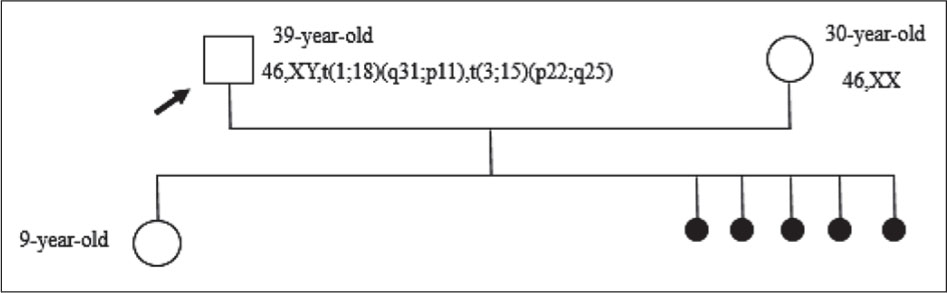
Figure 1.
Pedigree of the couple. The proband (arrow) is a male carrier of a double reciprocal translocation. The couple has a history of recurrent pregnancy loss (indicated by spontaneous abortions).
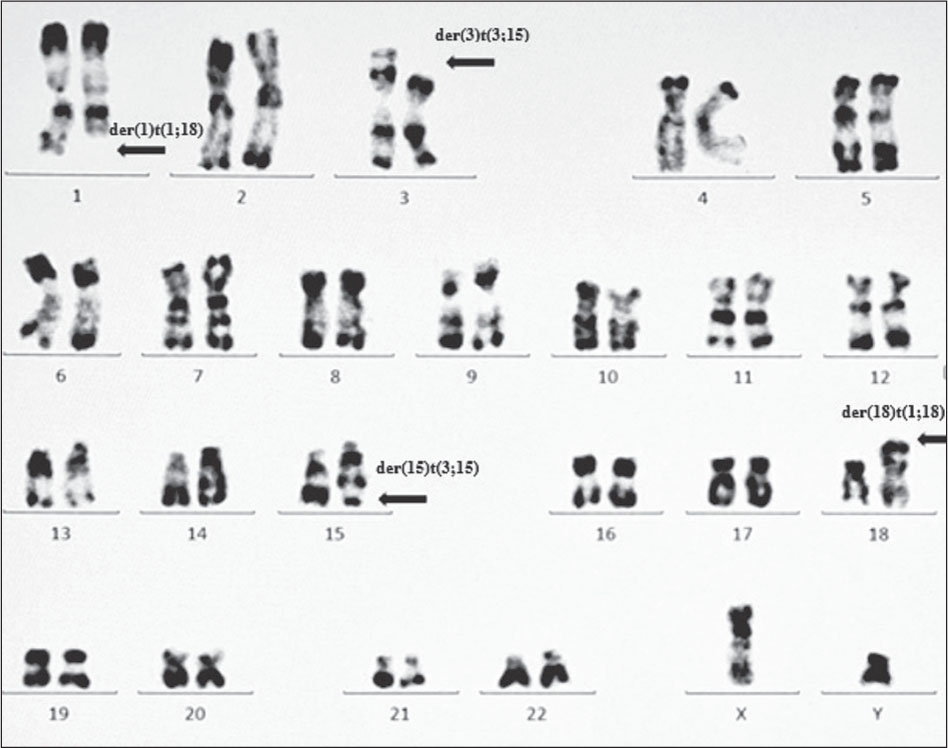
Figure 2.
Karyotype image of the husband carried two reciprocal translocations between chromosomes 1 and 18, 3 and 15 (46,XY,t(1;18)(q31;p11),t(3;15)(p22;q25)). Arrows indicate the derivative chromosomes.
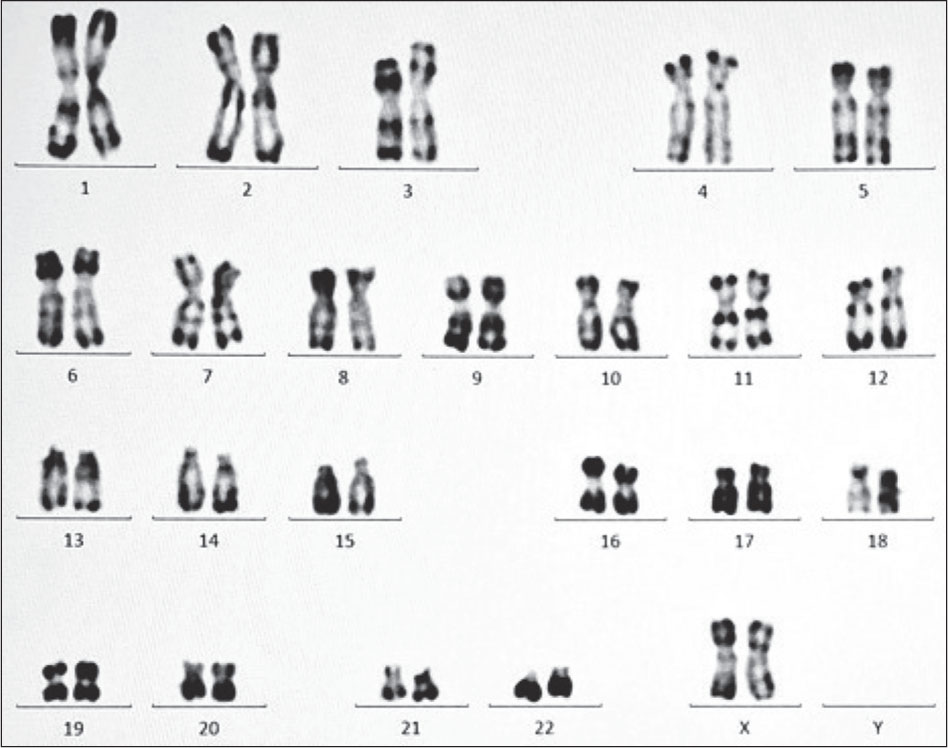
Figure 3.
Normal karyotype image of the wife (46,XX)
Table 1.
Comparison of double reciprocal translocations in the literature
| Study | Chromosomes involved | Inheritance pattern | Reproductive history |
|---|---|---|---|
| Usyal et al.(18) | 3;18 + 13;14 | Familial | Male infertility and miscarriages in female carriers |
| Pierron et al.(26) | 13;14 + 21;22 | De novo | Male infertility |
| Barros et al.(27) | 1;19 + 6;14 | Familial | 4 miscarriages |
| Bijlsma et al.(28) | 2;6 + 7;12 | Familial | 1 miscarriage + child with trisomy 12p |
| Vieira et al.(29) | 13;15 + 13;19 | De novo | Pregnancy complications + child with dup 15q syndrome and another with Angelman syndrome |
| Tabor et al.(11) | 5;7 + 5;12 | Familial | 3 miscarriages + daughter carrier one translocation |
| Ferfouri et al.(30) | 1;16 + 8;9 | t(1;16) de novo t(8;9) familial | Normal fertility with 85% unbalanced sperm |
| Gupta et al.(5) | 1;3 + 2;14 + 9;11 | De novo | Multiple in vitro fertilization failures |
| Sinkar and Devi.(19) | 2;12 + 4;16 | Familial | 2 miscarriages + child carrier one translocation |
| Simioni et al.(10) | 3;7 + 15;18 | De novo | Proband with developmental delay, hypotonia and dysmorphic features |
| Our study | 1;18 + 3;15 | Unknown | 5 miscarriages + phenotypically normal child |
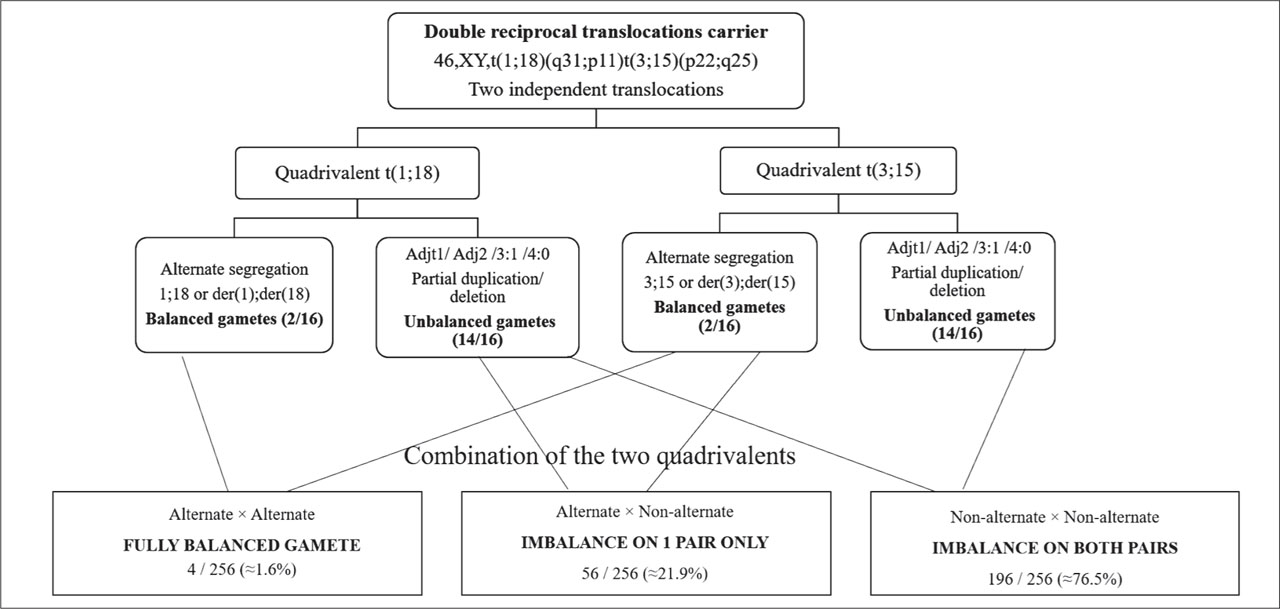
Figure 4.
Theoretical gametic outcomes of meiotic segregation in a carrier of two independent balanced reciprocal translocations t(1;18) and t(3;15).
Each quadrivalent segregates via 5 modes - alternate, adjacent-1, adjacent-2, 3:1, and 4:0 - producing16 possible gametes per translocation and 256 combined. Only alternate segregation of both quadrivalents produces a balanced gamete (4/256, ≈1.6%); all other combinations result in unbalanced gametes. Segregation-mode frequencies are theoretical and assume independence between the two translocations; in practice, alternate segregation predominates.
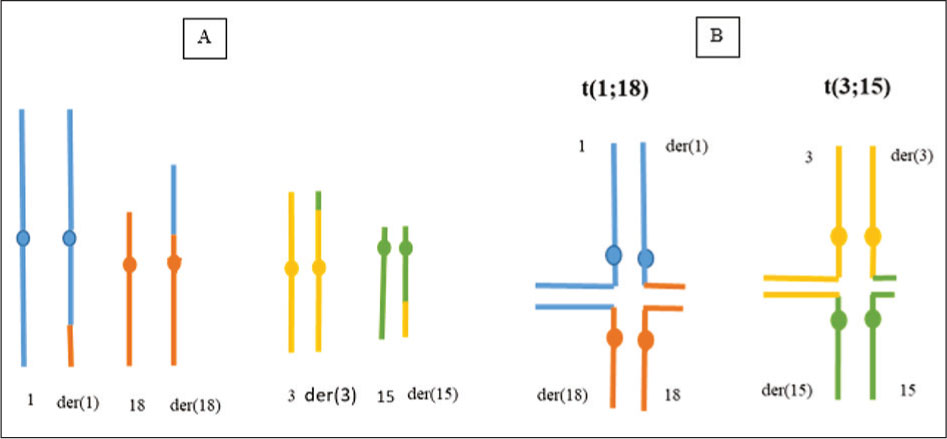
Figure 5.
Schematic representation of the double reciprocal translocation in the father.
A: Partial karyogram showing the two translocations t(1;18) (q31;p11) and t(3;15)(p22;q25)
B: Corresponding diagram of chromosome pairing at the pachytene stage, illustrating the quadrivalent formation.