INTRODUCTION
Myc-binding Protein 2 (MYCBP2), also called PAM (protein associated with Myc), located on chromosome 13 is a large E3 ubiquitin-protein ligase that serves dual roles as a ubiquitin ligase and a signaling hub that regulates various events in the nervous system [1]. With a single conserved orthologue in rodents (Phr1), zebrafish (Phr/Esrom), Drosophila (Highwire) and C. elegans (RPM-1), MYCBP2 is essential for nervous system development across species. It plays important role in maintaining cellular protein homeostasis by targeting proteins for ubiquitin-mediated degradation, a process that is particularly vital in neurons due to their complex and dynamic protein requirements. Additionally, MYCBP2 is essential for neuronal development, with key functions in axon growth and guidance. It also contributes to synaptic function and plasticity by modulating the stability and activity of synaptic proteins [2,3,4,5].
Although MYCBP2 has been studied for over two decades in various model organisms and numerous variants of uncertain significance (VUS) have been reported, definitive evidence establishing its role in neurodevelopmental disorders is still limited [6,7,8]. In 2023, a distinct neuro-developmental disorder was identified in a cohort of eight patients, each with a different de novo variant in MYCBP2 gene. Clinical evaluation showed that patients displayed variable corpus callosum defects, along with a wide range of neurobehavioral issues, including developmental delay, intellectual disability, epilepsy and autistic features. This condition was named MYCBP2-related developmental delay with corpus callosum defects (MDCD) [9]. Gene editing in live model organisms conducted as part of this study indicated that certain variants in MYCBP2 cause irregular axon development, increased autophagosome formation within axons, atypical behavioral responses and are likely responsible for this newly identified clinical condition.
To date, all reported cases involving pathogenic variants in the MYCBP2 gene have been associated with distinct de novo mutations. In this report, we present the first family identified with a novel, likely pathogenic MYCBP2 variant, and we discuss our findings in the context of previously reported cases.
MATERIALS AND METHODS
Case presentation
We present a family (mother and her two sons) who were referred to our laboratory for genetic testing for neuro-developmental disorder. The mother was 28 years old with mild intellectual disability, speech difficulties and dysmorphic facial features. She had seizures since childhood and received anti-seizure medication since then. The mother has four brothers, two of whom have mild intellectual disability but declined genetic testing. No information is available regarding the medical history of her parents (Figure 1).
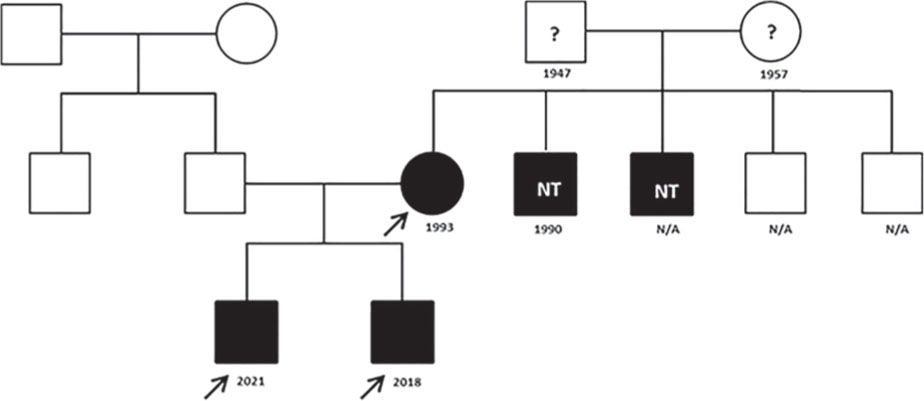
Figure 1.
Pedigree of the family showing inheritance of the variant. The arrow indicates the positive tested family members. Filled symbols represent affected individuals in the family. NT-Not Tested, meaning that genetic testing was not performed. ?-Not available for phenotypic examination or genetic testing.
The first child was a 3-year-old boy at the time of genetic testing. He was born at 37 weeks of gestation and required a two-month stay in an incubator due to pulmonary complications. He began walking at the age of two. During clinical reevaluation at age five, he was largely non-verbal, using only a few words. Clinical findings included microcephaly, strabismus, and dysmorphic facial features.
The second child was a 9-month-old boy at the time of genetic testing. He was born at 36+ weeks of gestation and spent one month in an incubator. He also presented with microcephaly and dysmorphic facial features. Follow-up clinical reevaluation was not possible after two years post-diagnosis.
Clinical findings for the affected family members, along with previously reported individuals carrying pathogenic MYCBP2 variants, are summarized in Table 1.
Table 1.
Clinical findings in the present family and individuals reported in the literature with MYCBP2 pathogenic variants.
| Reference | our study | Bertoli-Avella et al., 2021 | AlAbdi et al., 2023 | |||||||||||
|---|---|---|---|---|---|---|---|---|---|---|---|---|---|---|
| Case | Mother | Son 1 | Son 2 | Case 1 | Case 2 | Case 3 | Case 4 | Case 5 | Case 6 | Case 7 | Case 8 | Case 9 | Case 10 | Case 11 |
| Variant NM_015057.5 | c.7311del, p.(L2438Wfs*3) | c.7311del, p.(L2438Wfs*3) | c.7311del, p.(L2438Wfs*3) | c.2940-2delA | c.12095A>G; p.(Y4032C) | c.11915A>C; p.(H3972P) | c.8005C>T; p.(R2669*) | c.9896T>G; p.(V3299G) | c.11840A>T; p.(D3947V) | c.11843T>A; p.(L3948Q) | c.11888C>T; p.(T3963I) | c.13647+1 G>C | c.13669C>T; p.(R4557C) | c.13406C>A; p.(T4469K) |
| De novo mutation | unknown | no | no | yes | yes | yes | yes | yes | yes | yes | yes | yes | yes | yes |
| Sex | female | male | male | unknown | unknown | unknown | male | male | male | male | male | female | male | male |
| Age at genetic test (years) | 28 | 3 | 9 months | unknown | unknown | unknown | 12 | 20 | 16 | 3 | 6 | 4 | 6 | 2.5 |
| Intelectual dissability | yes/moderate | yes/moderate | yes/ | yes | yes | yes | yes/severe | no | yes | not tested | yes | no | yes/moderate | not tested |
| Epilepsy/Seizures | yes | no | NA | no | no | yes | yes | no | no | abnormal | no | no | yes | no |
| Developmental delay | yes | yes | Yes | yes | yes | yes | yes | yes | yes | yes | yes | no | yes | yes |
| Motor delay | N/A | yes | N/A | yes | N/A | N/A | no | no | yes | yes | yes | yes | yes | yes |
| Speech | difficult to understand | delayed, non-verbal | N/A | N/A | N/A | N/A | non-verbal | yes | difficult to understand | delay | yes | no | mostly non-verbal | mostly non-verbal |
| Corpus callosum defect | N/A | N/A | N/A | N/A | yes | N/A | yes | N/A | yes | yes | yes | N/A | no | N/A |
| Facial dysmorphism | yes | yes | yes | yes | N/A | N/A | yes | yes | yes | yes | yes | yes | no | no |
Molecular and bioinformatics analysis
Informed consent for genetic testing was obtained from the mother. Whole exome sequencing (WES) analysis for the mother and her two sons was performed on DNA extracted from peripheral blood cells. Library preparation for WES analysis was done using the Twist Human Core+RefSeq+Mitochondrial Panel (Twist Bioscience, San Francisco, California, USA) and sequencing reads were generated by Illumina Nova Seq 6000 instrument (Illumina Inc., San Diego, California, USA). Enriched fragments were sequenced as paired-end reads (2x101bp). Sequencing and bioinformatics analyses for mapping the sequenced fragments and calling the variants (with interval padding of 30bp on both sides of the targeted regions) were performed at an accredited Referral Laboratory – CeGaT GmbH, Tübingen, Germany.
Variants were annotated, filtered and prioritized using online tool Franklin by Genoox (https://franklin.genoox.com). For filtering by population frequency, we used gnomAD v.2.1.1 and v4.1.0 databases [10] and our in-house database (of 1415 samples). Nomenclature of the variants followed the recommendation of the American College of Medical Genetics and Genomics (ACMG) guidelines [11]. In addition to Franklin automated ACMG classification, we have used the online tool AutoPVS1 [12] to determine whether truncating variants trigger nonsense-mediated decay (NMD). As a part of the WES analysis, copy number variation (CNV) calls were also obtained. Public database ClinVar and published articles were used to investigate the presence of other pathogenic variants in MYCBP2 gene. Conventional Sanger sequencing was used to validate the variants.
RESULTS
Exome sequencing revealed a novel loss of function variant in MYCBP2 gene [NM_015057.5: c.7311del, p.(Leu2438Trpfs*3), chr13-77140935-GA-G (hg38)] in exon 50 (out of 83) in the mother and her two sons in heterozygous state. Analysis of copy number variant (CNV) calls from WES did not reveal any pathogenic chromosomal rearrangements.
The c.7311del variant has not been reported in any publicly available databases or in our in-house cohort of approximately 1,415 exomes. According to ACMG criteria we classified this variant as likely pathogenic (used criteria: PVS1, PM2). AutoPVS1 predicted that the variant will cause NMD and suggested “very strong” strength level for PVS1 criterion. CADD score for the variant was 22.5 (https://cadd.gs.washington.edu/snv). Data from gnomAD v.4.1.1 show that the MYCBP2 gene is a highly constrained gene in the human population with very high scores on intolerance to truncating variants since pLI (probability of being loss-of-function intolerant) is 1 and LOEUF (loss-of-function observed / expected upper bound fraction) is 0.204. To date, the ClinVar database lists a total of 14 pathogenic/likely pathogenic (6 nonsense, 2 frameshift, 3 missense, 2 splice and 1 synonymous variant that is predicted to destroy the splice donor site), however the majority of the reported variants in ClinVar database are VUS (n=468) including 436 missense, 28 loss of function and 4 non-coding transcript variants.
DISSCUSION
In the last years, the clinical significance of MYCBP2 variants was uncertain due to the absence of conclusive functional and genetic evidence. Although, MYCBP2 gene is not associated to any phenotype in OMIM, ClinGen or GenCC (accessed 20 June 2025), several studies reported possible associations with autism and intellectual disability [6,7,13]. Furthermore, a study employing a machine learning–based approach to predict autism risk genes identified MYCBP2 as a potential novel candidate associated with autism spectrum disorder [14]. In a study aimed at uncovering novel gene-disease associations, MYCBP2 was proposed as a candidate gene for neurodevelopmental disorders. The authors identified three de novo variants (two missense and one splicing) in individuals presenting with global developmental delay, intellectual disability, microcephaly, and seizures. These findings suggest a potential association between MYCBP2 variants and neurodevelopmental and neurological phenotypes [15].
Recently, Grill and his research team proposed a new disorder named MYCBP2-related developmental delay with corpus callosum defects (MDCD) after analyzing eight patients with overlapping spectrum of neurodevelopmental phenotypes including corpus callosum abnormalities, developmental delay, intellectual disability, epilepsy and autistic features [9]. They found distinct de novo variants in MYCBP2 gene in each patient (six missense, one nonsense and one splicing variant). To understand the functional consequences of the identified MYCBP2 variants, they employed CRISPR/Cas9 gene editing techniques in model organisms like C. elegans. Their experiments demonstrated that the variants lead to abnormal axon development and increased autophagosome formation in subcellular axonal compartments. Specifically, C. elegans models carrying human-like mutations exhibited altered behavioral responses and impaired axon growth, mirroring the neurodevelopmental challenges observed in affected patients. However, the outcomes from the functional experiments differed depending on the type of mutation, with missense variants exhibiting a partial loss-of-function, whereas the nonsense variant [NM_015057.4:c.8005C>T; p.(R2669*)] demonstrated a pronounced loss-of-function effect on the protein.
To our knowledge, we present the first family with novel likely pathogenic loss of function variant in MYCBP2 gene. The c.7311del, p.(Leu2438Trpfs*3) variant causes a frameshift that alters the reading frame and is predicted to result in NMD due to the presence of an early stop codon. The variant will result in C terminal truncation that removes several important domains including RING and tandem cysteine (TC) domain. The C-terminal region is crucial for the protein ubiquitin ligase activity and interactions with other cellular components, particularly in processes related to neurodevelopment and synaptic regulation [16]. The variant is located in the same domain, MBD as the truncating variant R2669* reported previously by AlAbdi et al [9]. The R2669* variant was identified in a patient presenting with severe intellectual disability, seizures, nonverbal status, mild thinning of the corpus callosum and facial dysmorphism. Similarly, our three patients exhibited many of these previously reported phenotypic features, including intellectual disability, motor delay, speech difficulties, facial dysmorphism and microcephaly. The mother had a history of seizures and has been on antiepileptic therapy since childhood. One of the most important pathological hallmarks of the disorder was defects in corpus callosum that was observed in half of the previously reported patients with MDCD. Obtaining brain MRI scans from our patients would have been valuable for further characterization, but the family declined further communication, preventing us from assessing potential corpus callosum abnormalities.
To the best of our knowledge, this is the first reported family carrying a likely pathogenic MYCBP2 variant. The clinical findings from our patients offer important insights and expand the limited phenotypic spectrum associated with MYCBP2 pathogenic variants. Our study further underscores the critical role of MYCBP2 in the pathogenesis of neurodevelopmental disorders and contributes to the phenotype of the recently recognized MYCBP2-related developmental and degenerative (MDCD) syndrome.