INTRODUCTION
Early pregnancy loss (EPL) is defined as spontaneous pregnancy loss before 12 completed gestational weeks. Its etiology is multifactorial, involving genetic, anatomic, endocrine, immunological, and environmental factors. Chromosomal abnormalities account for approximately 50–60% of EPLs, with trisomy being the most common, followed by monosomy × and triploidy [ 1, 2, 3]. These aberrations are typically de novo, and recurrence risk is generally not elevated in the couples.
Recurrent pregnancy loss (RPL), defined as two or more consecutive early losses, affects up to 5% of couples. Compared with sporadic losses, chromosomal abnormalities are less frequent in RPL, suggesting that additional genetic mechanisms may contribute [4].
While the contribution of chromosomal anomalies is well established, the role of monogenic disorders in euploid EPL remains incompletely defined. The advent of next-generation sequencing technologies, particularly whole-exome sequencing (WES), has expanded the capacity to detect pathogenic variants underlying Mendelian disease. WES enables identification of the majority of coding disease-causing variants and has become an essential tool in rare disease diagnostics [5, 6].
However, only a limited number of studies have applied WES to POCs from early losses, and many included heterogeneous gestational ages or selected fetuses with ultrasound-detected anomalies. Consequently, the prevalence and spectrum of monogenic causes in typical first-trimester euploid EPL remain insufficiently characterized.
Recent studies that applied WES to POCs have reported pathogenic or likely pathogenic variants in genes implicated in a broad spectrum of disorders, including multisystem developmental syndromes, cardiac malformations, skeletal dysplasia, kidney disorders, and central nervous system abnormalities [7, 8, 9, 10, 11]. These findings support the hypothesis that a subset of early pregnancy losses may be attributable to rare, deleterious variants in genes critical for early embryonic development.
In this study, we analyzed 66 euploid POCs from EPL occurring exclusively before 12 gestational weeks using WES. By focusing on this carefully defined cohort, we aimed to assess the prevalence and biological spectrum of potentially pathogenic variants contributing to early embryonic demise.
MATERIALS AND METHODS
EPL tissue samples
WES was performed on 66 euploid POCs derived from 60 unrelated couples. In six families, two losses were analyzed. Gestational age ranged from 6 to 12 weeks (mean 8.23 ± 1.25), and maternal age ranged from 20 to 42 years (mean 30.9 ± 5.18). Couples reported 2–13 prior losses (mean 3.56 ± 2.14) and 0–2 live births (0.28 ± 0.57). Of the POCs, 34 were male and 32 female (M:F = 1.09:1); 32 originated from Macedonian and 34 from Albanian families. Full demographic and clinical details are provided in Supplementary Table S1.
DNA extraction, maternal-cell contamination testing, and chromosomal screening
Genomic DNA was extracted from two to three chorionic villus fragments or fetal tissue of approximately 2 mm2 using the MagCore Super automated nucleic-acid extractor (RBC Bioscience). An in-house QF-PCR assay, targeting short tandem repeats on chromosomes 13, 18, 21, X, and Y, was applied to exclude maternal-cell contamination and detect triploidy [12, 13, 14]. MLPA (MRC-Holland) subtelomeric probe mixes were used to screen for numerical or large structural chromosomal anomalies [2, 3]. Samples negative by both assays proceeded to WES.
Whole-exome sequencing, variant prioritization, interpretation strategy, and confirmation
Libraries were prepared with the Twist Human Core + RefSeq + Mitochondrial panel (Twist Bioscience) and sequenced on an Illumina NovaSeq 6000 with 2 × 100 bp paired-end reads. Reads were aligned to the GRCh38 reference genome using BWA-MEM v0.7.15 [15]. The mean on-target depth exceeded 100x, with at least 98% of bases covered at >=10x. Single-nucleotide variants (SNVs) and small insertions/deletions (indels) were called using GATK v4.3 HaplotypeCaller with 25 bp exon padding and annotated with Ensembl VEP v106 [16,17]. CNV analysis was performed on exome depth-of-coverage data using the CeGaT pipeline; only high-confidence, clinically relevant CNVs were considered reportable, and clinically relevant CNVs were validated by array comparative genomic hybridization (4x180k, Oxford Gene Technologies/Agilent Technologies) and/or MLPA.
Variants were classified according to American College of Medical Genetics and Genomics ACMG/AMP guidelines as pathogenic, likely pathogenic, variant of uncertain significance (VUS), likely benign, or benign [18]. Analysis was performed exome-wide rather than being restricted to a predefined gene list, with prioritization of rare coding and splice-site variants in genes. Variant review incorporated population frequency, predicted functional consequence, known gene-disease validity, expected inheritance model, segregation data when available. Population-frequency assessment relied on gnomAD v2.1.1 and v4.0 and an internal dataset of 1513 WES samples. Variants above the allele-frequency thresholds used in our diagnostic pipeline were generally deprioritized unless previously established as pathogenic.
Clinical significance was assessed using Franklin (Genoox) and VarSome, followed by manual curation. All reported P/LP variants and selected VUS discussed as possible contributors were confirmed by Sanger sequencing. Primers designed with Primer3 and PCR conditions are listed in Supplementary Tables S2 and S3. Parental studies were performed in all cases, using Sanger sequencing, MLPA, or arrayCGH as appropriate. QF-PCR was the principal method used to exclude maternal-cell contamination and triploidy.
RESULTS
Diagnostic yield
Whole-exome sequencing (WES) was performed on 66 euploid products of conception (POCs) from early pregnancy losses (EPLs) occurring before 12 gestational weeks. A molecular diagnosis, defined as pathogenic or likely pathogenic (P/LP) variant(s) consistent with the expected mode of inheritance, was established in 13/66 POCs (19.7%), including one large de novo 21q22.12-q22.3 duplication encompassing DYRK1A and RUNX1.
An additional 9/66 POCs (13.6%) harbored findings considered possible monogenic contributors rather than definitive diagnoses. The remaining 44/66 cases (66.7%) had no reportable variant. Figure 1 summarizes the overall classification of cases represented among reportable findings.
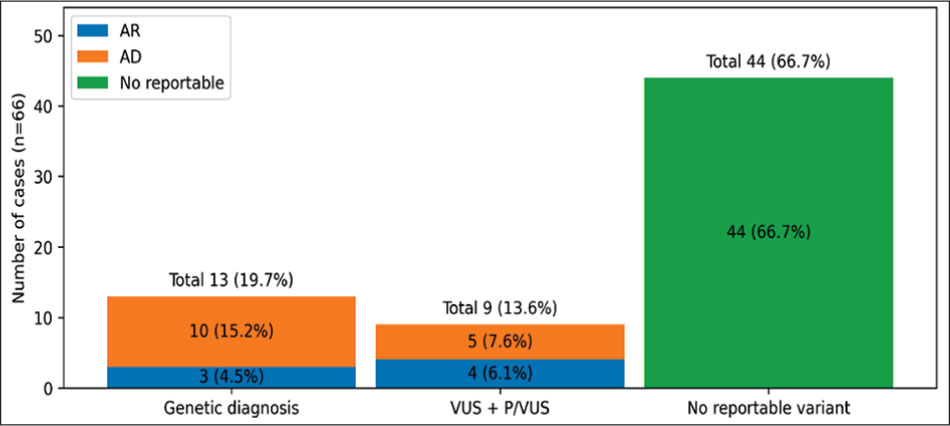
Figure 1.
Overview of molecular findings in 66 euploid early pregnancy losses. Diagnostic summary showing cases with a genetic diagnosis, possible monogenic contribution (VUS + P/VUS), and no reportable variant, with autosomal recessive (AR) and autosomal dominant (AD) findings indicated where applicable
Interpretive categorization
To reduce overinterpretation, reportable findings were further stratified into three categories: (1) genes plausibly associated with prenatal or early embryonic lethality, (2) genes causing severe congenital disorders not typically considered embryonically lethal, and (3) genes linked to later-onset or susceptibility phenotypes. Detailed molecular data and this interpretive framework are summarized in Tables 1 and 2. Figure 2 provides an overview of the reportable findings according to interpretive category and the major developmental or organ systems represented.
Table 1.
Detailed overview of variants detected by WES in euploid EPL and their molecular characteristics
| Case | Gene | Reference sequence | Variant | Protein change | Zygosity | Inheritance | Type of variant | Known / Novel | ACMG classification | ACMG criteria |
|---|---|---|---|---|---|---|---|---|---|---|
| 1. Genes plausibly associated with prenatal or early embryonic lethality | ||||||||||
| Definitive molecular diagnoses | ||||||||||
| Abp-411 | CPLANE1 | NM_001384732.1 | c.1819delT;7817T>A | p.Tyr607ThrfsTer6; p.Leu2624Ter | hom | M/F | Frameshift | Known | Pathogenic | PVS1; PM2; PP5/PVS1; PM2; PP5 |
| Abp-445 1 | CPLANE1 | NM_001384732.1 | c.1819delT;7817T>A | p.Tyr607ThrfsTer6; p.Leu2624Ter | het | F | Frameshift; Nonsense | Known | Pathogenic | PVS1; PM2; PP5/PVS1; PM2; PP5 |
| c.5820+3_5820+6del | exon 29 skipping | het | M | Splice site | Novel | Pathogenic | PS3, PM2; PM3; PM4; PP3 | |||
| Abp-4942 | DHCR7 | NM_001360.3 | c.452G>A | p.Trp151Ter | het | F | Nonsense | Known | Pathogenic | PVS1; PM2; PP5 |
| c.964-1G>C | altered splicing | het | M | Splice site | Known | Pathogenic | PVS1; PM2; PP5 | |||
| Abp-5452 | DHCR7 | NM_001360.3 | c.452G>A | p.Trp151Ter | het | F | Nonsense | Known | Pathogenic | PVS1; PM2; PP5 |
| c.964-1G>C | altered splicing | het | M | Splice site | Known | Pathogenic | PVS1; PM2; PP5 | |||
| Abp-5511 | CPLANE1 | NM_001384732.1 | c.1819delT;7817T>A | p.Tyr607ThrfsTer6; p.Leu2624Ter | het | F | Frameshift; Nonsense | Known | Pathogenic | PVS1; PM2; PP5/PVS1; PM2; PP5 |
| c.5820+3_5820+6del | exon 29 skipping | het | M | Splice site | Novel | Pathogenic | PVS1; PM2; PP5/PVS1; PM2; PP5 | |||
| Possible monogenic contributors | ||||||||||
| Abp-501 | GBA1 | NM_000157.4 | c.1444G>T | p.Asp482Tyr | het | M | Missense | Known | VUS | PM2; PM3; PP3 |
| c.1226A>G | p.Asn409Ser | het | F | Missense | Known | Likely pathogenic | PM1; PM2; PM5; PP2; PP3; PP5 | |||
| Abp-694 | PKHD1 | NM_138694.4 | c.107C>T | p.Thr36Met | het | M | Missense | Known | Likely pathogenic | PM2; PM5; PP3; PP5 |
| c.10883C>T | p.Thr362Ile | het | F | Missense | Known | VUS | PM2; PM3 | |||
| Abp-825 | RPGRIP1L | NM_015272.5 | c.2771G>A | p.Ser924Asn | het | M | Missense | Known | VUS | PM2, PM3 |
| c.3295-2A>G | / | het | F | Splice site | Known | Likely pathogenic | PVS1; PM2; PP5 | |||
| 2. Genes causing severe congenital disorders not typically considered embryonically lethal | ||||||||||
| Definitive molecular diagnoses | ||||||||||
| Abp-251 | SLC6A1 | NM_003042.4 | c.740C>A | p.Pro247His | het | de novo | Missense | Novel | Likely pathogenic | PM2; PM5; PP2; PP3 |
| Abp-716 | RBM8A | NM_005105.5 | c.-21G>A | / | het | M | Missense/noncoding | Known | Pathogenic, low penetrance | PS3, PM3 |
| 1q21.1-q21.2 | hg19 | chr1:143,767,833-149,400,542 | / | het | F | Deletion | Known | Pathogenic | 2A; 3B; 4L >1 point | |
| Abp-799 | NF1 | NM_001042492.3 | c.4600C>T | p.Arg1513Ter | het | F | Nonsense | Known | Pathogenic | PVS1; PM2; PP5 |
| Abp-801 | DSG2 | NM_001943.5 | c.2315del | p.Leu772Ter | het | M | Nonsense | Novel | Likely pathogenic | PVS1; PM2 |
| Abp-825 | DVL1 | NM_001330311.2 | c.1961dup | p.Pro657AlafsTer50 | het | F | Frameshift | Novel | Likely pathogenic | PVS1; PM2 |
| Possible monogenic contributors | ||||||||||
| Abp-80 | PAH | NM_000277.3 | c.842C>T | p.Pro281Leu | het | M | Missense | Known | Pathogenic | PS3, PM2; PM5; PP2; PP3; PP5 |
| c.*19G>T | / | het | F | Missense/noncoding | Known | VUS | PM3; BS1; BS2; BP7 | |||
| Abp-87 | PRDM6 | NM_001136239.4 | c.1057G>A | p.Asp353Asn | het | M | Missense | Known | VUS | PM2 |
| Abp-166 | TBX18 | NM_001080508.3 | c.1570C>T | p.His524Tyr | het | M | Missense | Known | VUS | PM2; PP3; PP5 |
| Abp-233 | SCN5A | NM_000335.5 | c.3911C>T | p.Thr1304Met | het | F | Missense | Known | VUS | PM2, PP3, PP5 |
| Abp-577 | TSC1 | NM_000368.5 | c.3113_3119del | p.Ser1038ThrfsTer51 | het | F | Frameshift | Novel | VUS | PVS1(moderate); PM2 |
| Abp-781 | MYH3 | NM_002470.4 | c.3137G>A | p.Arg1046Gln | het | M | Missense | Known | VUS | PM2; PP3 |
| 3. Genes linked to later-onset or susceptibility phenotypes | ||||||||||
| Abp-668 | VWF | NM_000552.5 | c.3797C>T | p.Pro1266Leu | het | M | Missense | Known | Likely pathogenic | PM1; PM2; PM5; PP5 |
| Abp-809 | F5 | NM_000130.5 | c.1601G>A | p.Arg534Gln | hom | M (hom)/F (het) | Missense | Known | Pathogenic, low penetrance | PS3, PS4 |
| Additional distinct pathogenic copy-number finding | ||||||||||
| Abp-972 | 21q22.12-q22.3dup | hg19 | chr21:33,398,108-43,587,648 | / | het | de novo | Duplication | Known | Pathogenic | 3C; 4L >1 point |
Table 2.
Zygosity, inheritance, OMIM-associated diseases, and interpretive grouping of the detected genes
| Case | Gene | Variant | Accession number | AF (gnomAD) | Internal frequency | OMIM disease/s; Inheritance | Major developmental / organ system |
|---|---|---|---|---|---|---|---|
| 1. Genes plausibly associated with prenatal or early embryonic lethality | |||||||
| Definitive molecular diagnoses | |||||||
| Abp-411 | CPLANE1 | c.1819delT;7817T>A | rs777686211; rs749523755 | 0.0001554; 0.00002390 | 0.0077 | 614615, Joubert Syndrome 17, AR; 277170, Orofaciodigital syndrome VI, AR | Multi-system |
| Abp-4451 | CPLANE1 | c.1819delT;7817T>A | rs777686211; rs749523755 | 0.0001554; 0.00002390 | 0.0077 | 614615, Joubert Syndrome 17, AR; 277170, Orofaciodigital syndrome VI, AR | Multi-system |
| c.5820+3_5820+6del | / | / | 0.0017 | ||||
| Abp-4942 | DHCR7 | c.452G>A | rs11555217 | 0.0007759 | 0.0084 | 270400, Smith-Lemli-Opitz syndrome, AR | Multi-system |
| c.964-1G>C | rs138659167 | 0.003854 | 0.0042 | ||||
| Abp-5452 | DHCR7 | c.452G>A | rs11555217 | 0.0007759 | 0.0084 | 270400, Smith-Lemli-Opitz syndrome, AR | Multi-system |
| c.964-1G>C | rs138659167 | 0.003854 | 0.0042 | ||||
| Abp-5511 | CPLANE1 | c.1819delT;7817T>A | rs777686211; rs749523755 | 0.0001554; 0.00002390 | 0.0077 | 614615, Joubert Syndrome 17, AR; 277170, Orofaciodigital syndrome VI, AR | Multi-system |
| c.5820+3_5820+6del | / | / | 0.0017 | ||||
| Possible monogenic contributors | |||||||
| Abp-501 | GBA1 | c.1444G>T | / | / | 0 | 608013, 230800, 230900, 231000, 231005, Gaucher disease types perinatal death, I, II, III, IIIC, AR | Multi-system |
| c.1226A>G | rs76763715 | 0.002235 | 0.0067 | ||||
| Abp-694 | PKHD1 | c.107C>T | rs137852944 | 0.0005094 | 0.0014 | 263200, Polycystic kidney disease 4, with or without hepatic disease, AR | Kidney anomalies |
| c.10883C>T | rs147700643 | 0.00005312 | 0 | ||||
| Abp-825 | RPGRIP1L | c.2771G>A | rs142234650 | / | 0 | 611561, Meckel syndrome 5, AR; 611560, Joubert syndrome 7, AR | Ciliopathies/multi-system |
| c.3295-2A>G | rs1258182460 | / | 0 | ||||
| 2. Genes causing severe congenital disorders not typically considered embryonically lethal | |||||||
| Definitive molecular diagnoses | |||||||
| Abp-251 | SLC6A1 | c.740C>A | / | / | 0 | 616421, Myoclonic-atonic epilepsy, AD | Neurologic |
| Abp-716 | RBM8A | c.-21G>A | rs139428292 | 0.01794 | >2% | 274000, Thrombocytopenia-absent radius syndrome, AR | Multi-system |
| 1q21.1-q21.2 | chr1:143,767,833-149,400,542 | / | / | 0 | |||
| Abp-799 | NF1 | c.4600C>T | rs760703505 | 0.000007957 | 0 | 162200, Neurofibromatosis, type 1, AD | Multi-system |
| Abp-801 | DSG2 | c.2315del | / | / | 0 | 610193, Arrhythmogenic right ventricular dysplasia 10, AD | Cardiac |
| Abp-825 | DVL1 | c.1961dup | / | / | 0 | 616331, Robinow syndrome, autosomal dominant 2, AD | Skeletal |
| Possible monogenic contributors | |||||||
| Abp-80 | PAH | c.842C>T | rs5030851 | 0.0001026 | 0.0010 | 261600, Phenylketonuria, AR | Metabolic |
| c.*19G>T | rs372637021 | 0.002029 | 0 | ||||
| Abp-87 | PRDM6 | c.1057G>A | rs202224762 | 0.0002604 | 0.0010 | 617039, Patent ductus arteriosus 3, AD | Cardiac |
| Abp-166 | TBX18 | c.1570C>T | rs760905589 | 0.000008061 | 0.0010 | 143400, Congenital anomalies of kidney and urinary tract 2, AD | Kidney anomalies |
| Abp-233 | SCN5A | c.3911C>T | rs199473603 | 0.0001649 | 0 | 601144, Brugada syndrome 1, AD; 601154, Cardiomyopathy, dilated, 1E, AD; 603830, Long QT syndrome 3, AD | Cardiac |
| Abp-577 | TSC1 | c.3113_3119del | / | / | 0.00035 | 191100, Tuberous sclerosis-1, AD | Multi-system |
| Abp-781 | MYH3 | c.3137G>A | rs142002449 | 0.0004031 | 0.0010 | 193700, Arthrogryposis, distal, type 2A (Freeman-Sheldon), AD | Skeletal |
| 3. Genes linked to later-onset or susceptibility phenotypes | |||||||
| Abp-668 | VWF | c.3797C>T | rs61749370 | 0.0008322 | 0.0010 | 193400, von Willebrand disease, AD/AR | Blood |
| Abp-809 | F5 | c.1601G>A | rs6025 | 0.01752 | >3% | 188055, Thrombophilia 2 due to activated protein C resistance, AD; 614389, {Pregnancy loss, recurrent, susceptibility to, 1}, AD | Blood |
| Additional distinct pathogenic copy-number finding | |||||||
| Abp-972 [U] | 21q22.12-q22.3 | chr21:33,398,108–43,587,648 | / | / | 0 | /, 21q22 Duplication Syndrome | Multi-system |
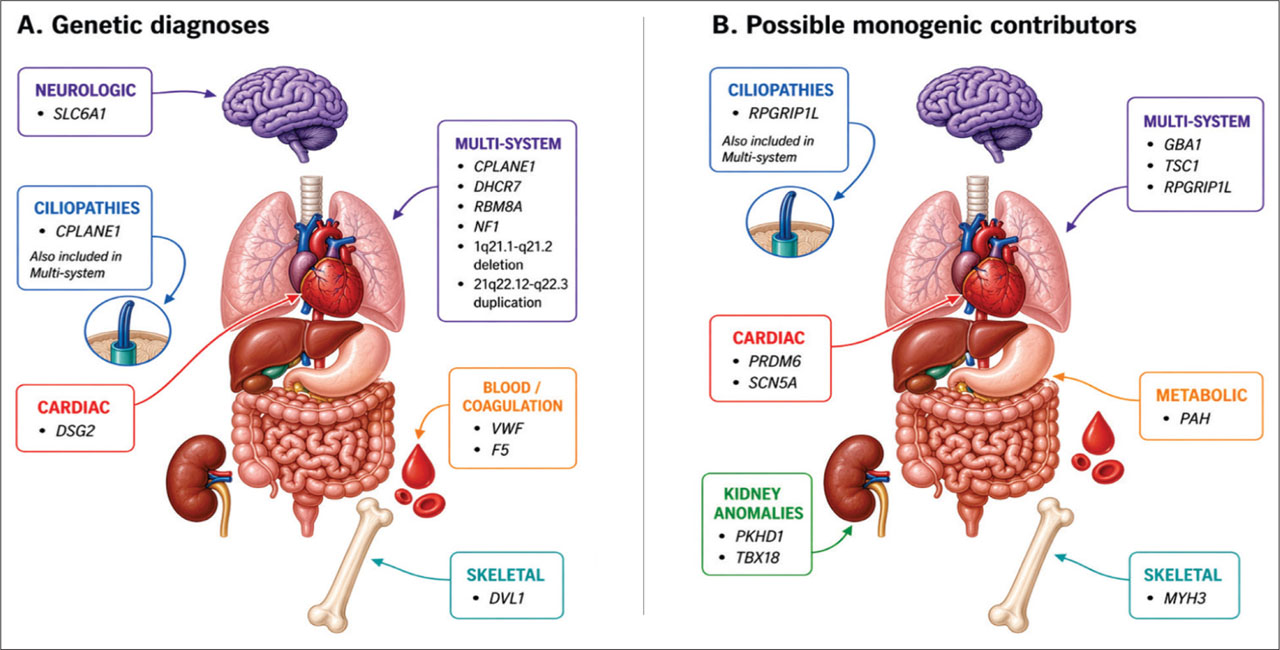
Figure 2.
Overview of the identified genetic findings grouped by major developmental or organ-system association. (A) Genetic diagnoses, including definitive molecular diagnoses, and the pathogenic copy-number finding 21q22.12-q22.3 duplication. (B) Possible monogenic contributors. Genes are mapped to their principal affected systems, including neurologic, cardiac, blood/coagulation, kidney anomalies, skeletal, metabolic, ciliopathies, and multi-system involvement. CPLANE1 and RPGRIP1L are shown in both ciliopathy and multi-system categories because of their broader phenotypic effects.
Segregation findings according to interpretive categorization
Among genes plausibly associated with prenatal or early embryonic lethality, molecular diagnoses were identified in cases with biallelic pathogenic variants in CPLANE1 and DHCR7, while additional potential monogenic contributors included biallelic combinations in GBA1, PKHD1, and RPGRIP1L. Parental testing was available in all cases and confirmed biparental inheritance in recessive findings. Pedigree analysis of families with definitive molecular diagnoses and, in selected cases, recurrent affected pregnancy losses (Figure 3).
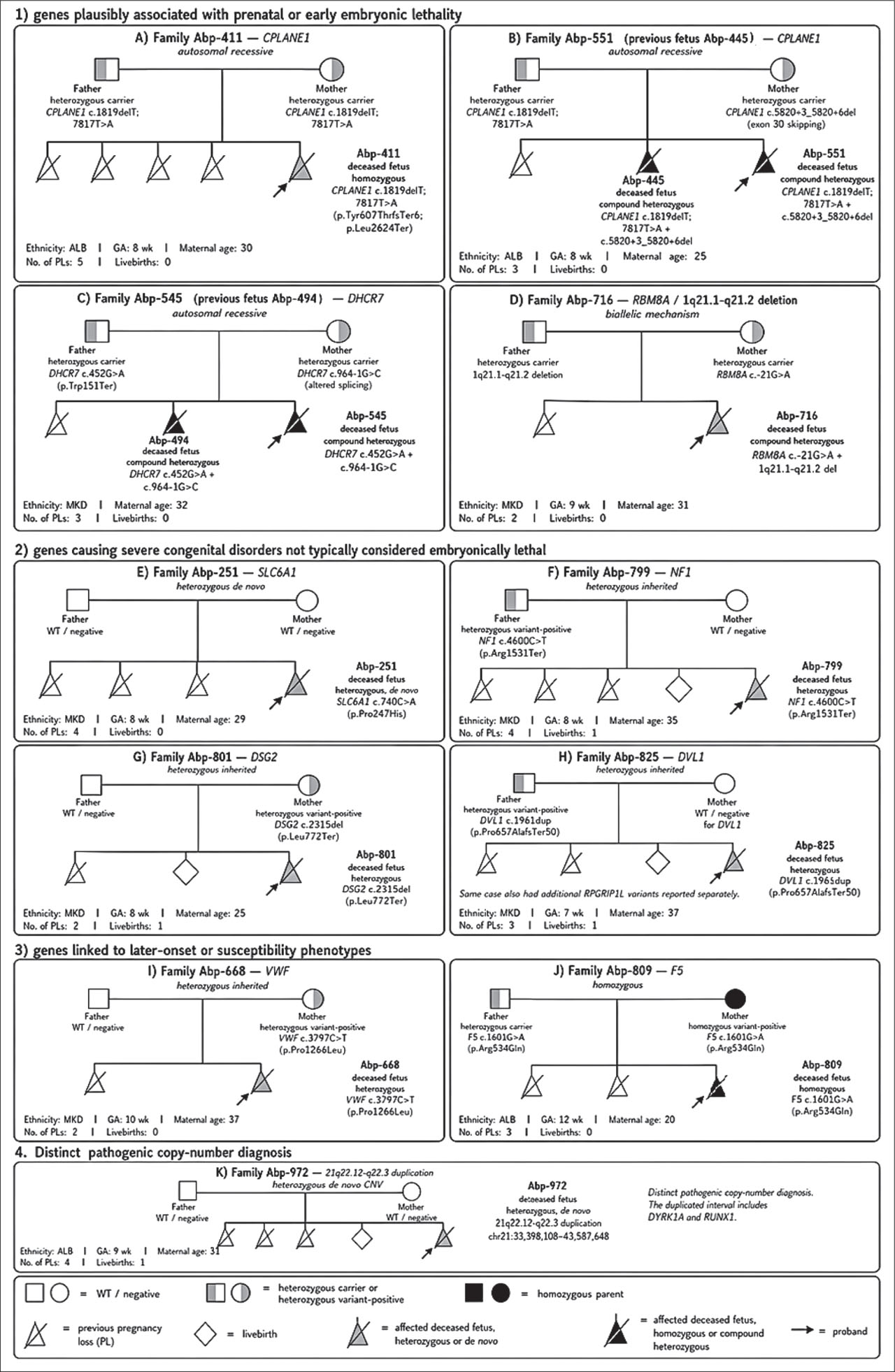
Figure 3.
Pedigrees of families with definitive molecular diagnoses in the euploid early pregnancy loss cohort, grouped according to interpretive category. Previous losses, livebirths, and affected fetuses are shown for each family, and recurrent affected fetuses are integrated into the same pedigree when present.
Among genes causing severe congenital disorders not typically considered embryonically lethal, molecular diagnoses consisted of heterozygous variants in SLC6A1, NF1, DSG2, DVL1, and one RBM8A-associated case with the characteristic combination of the low-penetrance regulatory variant and the recurrent 1q21.1-q21.2 deletion. The potential contributory subset included heterozygous VUS in MYH3, PAH, PRDM6, SCN5A, TBX18, and TSC1. All heterozygous variants were inherited from one parent, with exception of SLC6A1: c.740C>A which occurred de novo; parental phenotypic information was not available.
Among genes linked to later-onset or susceptibility phenotypes, reportable findings included homozygous F5: c.1601G>A and heterozygous VWF: c.3797C>T variants.
One de novo 21q22.12-q22.3 duplication represented a distinct pathogenic copy-number diagnosis.
Variant spectrum and predicted molecular consequences according to interpretive categorization
Genes plausibly associated with prenatal or early embryonic lethality.
This category was dominated by biallelic truncating and splice-disrupting variants in CPLANE1 and DHCR7, which led to molecular diagnosis. A notable finding was the novel CPLANE1: c.5820+3_5820+6del variant, previously shown to disrupt splicing and cause exon skipping. Potential contributory cases included compound-heterozygous P/LP and VUS combinations in GBA1, PKHD1, and RP-GRIP1L, highlighting missense variants such as GBA1: p.Asp482Tyr and p.Asn409Ser, PKHD1: p.Thr36Met and p.Thr362Ile, and RPGRIP1L: p.Ser924Asn.
Genes causing severe congenital disorders not typically considered embryonically lethal
This category was dominated by simple heterozygous findings. Several novel variants were identified, including SLC6A1: p.Pro247His, DSG2: p.Leu772Ter, DVL1: p.Pro657AlafsTer50, NF1: p.Arg1513Ter, while the RBM8A-associated case reflected the expected combination of the low-penetrance regulatory variant and the recurrent 1q21.1-q21.2 deletion. Additional potential contributory findings were mainly heterozygous missense VUS variants, including MYH3: p.Arg1046Gln, PRDM6: p.Asp353Asn, TBX18: p.His524Tyr, and SCN5A: p.Thr1304Met, TSC1: p.Ser1038ThrfsTer51 and PAH: p.Pro281Leu.
Genes linked to later-onset or susceptibility phenotypes
This category included missense variants in F5 and VWF, namely F5: c.1601G>A (p.Arg534Gln) and VWF: c.3797C>T (p.Pro1266Leu).
Copy number variants (CNV)
Structural alterations across the reportable cohort also included the 1q21.1-q21.2 deletion in the RBM8A-associated case and the de novo 21q22.12-q22.3 duplication involving DYRK1A and RUNX1.
Predicted molecular consequences
Predicted effects were consistent with variant class: truncating variants are expected to cause loss of function, and splice-site variants such as DHCR7: c.964-1G>C, RPGRIP1L: c.3295-2A>G, and the CPLANE1: c.5820+3_5820+6del are predicted to disrupt normal splicing. Missense variants were more difficult to interpret, but those retained were prioritized based on rarity, in silico prediction, ACMG-based classification, and gene-disease relevanceThe functional effects of the identified variants at the RNA or protein level were not directly evaluated and therefore remain inferential, except for the CPLANE1: c.5820+3_5820+6del variant, which has previously been demonstrated to cause exon 29 skipping [7]. Protein change, variant class, classification, and allele frequencies for all reportable variants are provided in Tables 1 and 2.
DISCUSSION
Over the past decade, whole-exome sequencing (WES) has become an important tool in clinical genetics laboratories. With steadily decreasing costs, WES has been increasingly adopted as a first-tier approach in postnatal rare-disease diagnostics [19]. In addition, improvements in analytical pipelines have extended its potential utility to include CNV inference from exome data [20]. In prenatal genetics, WES has shown relatively high diagnostic yields in fetuses with ultrasound-detected anomalies, supporting its expanding role in prenatal evaluation [21].
In EPL, chromosomal abnormalities remain a major genetic contributor, but the potential role of monogenic causes in euploid POCs is still incompletely defined. Recent reports have started to describe single-gene findings in euploid fetal material; however, many studies include wide gestational ranges extending beyond the first trimester and apply heterogeneous sequencing and interpretation strategies, which may limit direct comparisons across cohorts and may complicate conclusions for losses occurring specifically before 12 gestational weeks [22,23]. Published data increasingly suggest that genes essential for early development and multiple organ systems may be represented among genetic findings in EPL cohorts [8,24].
In this study, we analyzed 66 euploid POCs from EPL occurring exclusively before 12 gestational weeks using WES and identified clinically relevant monogenic findings in a substantial subset of cases. A molecular diagnosis in the conceptus was established in 13/66 POCs (19.7%), and in an additional 9/66 POCs (13.6%) we identified findings that may represent a possible monogenic contribution, including compound heterozygosity with a pathogenic variant plus a VUS in autosomal recessive genes and VUS findings in autosomal dominant genes.
A key interpretive distinction in this study is between identifying a molecular diagnosis in the conceptus and establishing that the diagnosis plausibly explains the pregnancy loss. Not all pathogenic or likely pathogenic findings carry the same degree of etiologic relevance to EPL. This distinction is particularly important for genes associated with later-onset, variably expressive, incompletely penetrant, or susceptibility phenotypes. Accordingly, our interpretation framework emphasizes levels of causal confidence rather than treating all P/LP findings as equally explanatory for first-trimester loss.
Our molecular diagnostic yield of 19.7% is close to the 22% pathogenic/likely pathogenic abnormality-detection rate reported by Zhao et al. in the largest directly comparable exome study of chromosomally preselected products of conception [8]. However, comparisons across studies should be interpreted cautiously, because published cohorts differ substantially in specimen type, gestational window, prior exclusion of aneuploidy/CNVs, sequencing design, and the definition of a “positive” result. Several other reports used exploratory variant-prioritization or burden-based frameworks rather than ACMG-style diagnostic classification, and some included recurrent miscarriage or broader fetal/perinatal death cohorts rather than first-trimester euploid POCs. These methodological differences likely explain much of the variability in reported yields and reinforce the need to compare studies within the context of cohort design rather than by percentage alone [10, 11,24,36, 37, 38, 39]. A likely strength of the present study is the deliberate restriction to euploid losses before 12 gestational weeks, which reduces heterogeneity and allows a more focused assessment of monogenic findings in early miscarriage tissue. At the same time, our yield should be interpreted in light of our distinction between a molecular diagnosis in the conceptus and evidence that the finding explains EPL, as not all diagnosed conditions are equally likely to be directly causal for first-trimester loss.
To contextualize this heterogeneous gene set, we interpreted implicated genes within three biological categories: (1) genes plausibly associated with prenatal or early embryonic lethality, (2) genes causing severe congenital disorders not typically considered embryonically lethal, and (3) genes linked to later-onset or susceptibility phenotypes. This framework allows a more explicit separation of molecular diagnosis from etiologic inference.
Category 1: Genes plausibly associated with prenatal or early embryonic lethality
Molecular diagnosis in the conceptus (CPLANE1, DHCR7)
Among the autosomal recessive findings, CPLANE1 and DHCR7 represent some of the most plausible candidates for involvement in euploid EPL because biallelic pathogenic variants in these genes are associated with severe developmental disorders and have been discussed in the setting of fetal or perinatal lethality in other reports [25]. In our cohort, recurrent biallelic findings in unrelated families strengthen the biological plausibility of these genes as contributors to EPL.
For CPLANE1, associated with Joubert syndrome and related ciliopathy phenotypes, we observed biallelic variants in unrelated families, including a complex allele (c.1819delT;7817T>A) that appears enriched in our population and may warrant further investigation, particularly in families with recurrent EPL and Albanian ancestry [7]. While definitive causality in EPL cannot be inferred from sequencing alone, repeated observations of biallelic disruption in genes linked to severe developmental phenotypes support a role in early developmental non-viability.
Similarly, for DHCR7, we identified compound heterozygosity involving well-established pathogenic alleles associated with severe Smith-Lemli-Opitz syndrome (SLOS). Severe SLOS phenotypes have been reported with major developmental abnormalities, and both variants have been previously associated with pregnancy loss and/or severe pre-/neonatal phenotype [25].
Potential monogenic contribution (RPGRIP1L, PKHD1, GBA1)
Additional genes in this category include RPGRIP1L, PKHD1, GBA1 in which we identified compound heterozygosity involving a pathogenic variant and a VUS (AR genes). While these genes have been implicated in severe prenatal disorders, the specific variant combinations identified in our cohort lack sufficient evidence for definitive pathogenic classification [26, 27]. Therefore, these findings should be interpreted as possible contributors, pending functional validation and replication in independent cohorts.
Category 2: Genes causing severe congenital disorders not typically considered embryonically lethal
Molecular diagnosis in the conceptus (DSG2, DVL1, NF1, RBM8A, SLC6A1)
A second group comprised genes associated with severe developmental or multisystem disorders that are more often recognized postnatally than in the setting of very early pregnancy loss. This group included DSG2, DVL1, NF1, RBM8A, and SLC6A1. Detection of such findings establishes a molecular diagnosis in the conceptus but does not, by itself, prove etiologic attribution for EPL. Their contribution may range from biologically relevant to incidental or context-dependent, depending on the gene, variant type, penetrance, and the presence of additional fetal, placental, maternal, or environmental factors.
For DSG2 and other genes related to cardiac development or electrophysiology, a mechanistic connection to first-trimester loss remains indirect. Similarly, NF1 and SLC6A1 are well-established disease genes, but neither is classically regarded as a standard explanation for very early embryonic demise. We therefore interpret these findings as clinically meaningful molecular diagnoses with variable and often uncertain explanatory power for EPL. [28, 29, 30]
The RBM8A-associated TAR genotype identified in our cohort merits particularly careful interpretation. TAR syndrome results from compound inheritance of a null allele, typically the 1q21.1 deletion, in trans with a hypomorphic RBM8A regulatory allele such as c.-21G>A. Thus, c.-21G>A is not independently causative and becomes clinically relevant only in the presence of the deletion. In our cohort, this combined genotype supports a bona fide molecular diagnosis in the conceptus, although its precise contribution to early gestational loss remains to be clarified in larger datasets [31].
Possible monogenic contribution (MYH3, PAH, PRDM6, SCN5A, TBX18, TSC1)
The potential monogenic contribution subset in this category comprised genes with roles in cardiac development (PRDM6), fetal arrhythmia (SCN5A) or kidney anomalies (TBX18), skeletal development (MYH3), metabolic disease (PAH) and multisystem growth regulation (TSC1) [32,33]. Although there is biological plausibility for some of these findings, particularly those involving cardiac developmental pathways, the available evidence is insufficient for definitive pathogenic attribution in the present cohort. These variants are therefore interpreted conservatively as possible contributors rather than established causes of EPL.
Category 3: Genes linked to later-onset or susceptibility phenotypes
This group included findings in F5 and VWF, both of which were classified as P/LP at the molecular level but are more difficult to interpret as direct causes of first-trimester loss. These variants may reflect susceptibility, maternal-fetal interaction, placental factors, or other context-dependent mechanisms rather than classic monogenic embryonic lethality.
The identification of fetal homozygosity for Factor V Leiden in a case with maternal homozygosity is noteworthy, but it should be regarded as hypothesis-generating rather than directly explanatory for EPL. Likewise, the mechanistic link between a VWF finding and early embryonic demise remains uncertain. Accordingly, these results are best interpreted as clinically relevant findings of uncertain etiologic weight in relation to EPL [34].
More broadly, the diagnostic variants in our cohort spanned multiple disease categories, mirroring patterns reported in previous studies [35, 36, 37, 38, 39, 40, 41, 42]. The repeated recovery of similar functional categories across independent cohorts supports the view that disruption of core developmental pathways contributes to a subset of euploid EPL. At the same time, the presence of susceptibility or later-presenting diagnoses in early losses highlights that some findings may reflect allele-specific severity, variable expressivity, reduced penetrance, or coincident maternal and/or environmental factors rather than direct monogenic causation.
Recurrent biallelic findings in CPLANE1 and DHCR7 in unrelated families represent some of the strongest candidates for involvement in euploid EPL because they affect genes linked to severe developmental disorders and were observed more than once in the cohort as well as in other previously published studies [7, 25]. In contrast, the RBM8A case highlights the importance of integrated SNV/CNV interpretation, because the diagnosis depends on the combination of the regulatory c.-21G>A allele with the 1q21.1 deletion in trans. Finally, de novo findings such as SLC6A1 c.740C>A and the 21q22.12-q22.3 duplication clearly establish molecular diagnoses in the conceptus, but their direct explanatory value for first-trimester loss remains more uncertain and remains to be clarified.
Limitations and future directions
This study has several limitations. The cohort size is moderate and may not capture the full spectrum of rare variation contributing to EPL. Moreover, fetal-only WES, while practical in a diagnostic setting, limits the ability to identify all de novo variants, detect parental mosaicism, and confidently phase biallelic findings in every case; trio-based sequencing, when feasible, may improve interpretation [43]. In addition, detailed fetal phenotyping is inherently limited in first-trimester pregnancy-loss tissue, which restricts robust genotype–phenotype correlation.
Functional validation remains particularly important for novel variants and VUS, and future studies incorporating detailed family segregation data, transcriptomic, proteomic, model-system, and bioinformatic approaches will be needed to strengthen causal inference and further clarify the molecular effects of these variants [40, 41, 42, 43].
CONCLUSION
Whole-exome sequencing identified a molecular diagnosis in the conceptus in 19.7% (13/66) of euploid early pregnancy losses occurring before 12 gestational weeks. Our findings suggest that monogenic variants may contribute to a subset of euploid EPL cases, although the strength of evidence varies considerably across detected variants. The integration of WES into the evaluation of recurrent euploid pregnancy loss holds promise but should be interpreted with caution. Further studies incorporating functional analyses, larger cohorts, and parental data are needed to clarify causality and to define the clinical utility of such approaches in genetic counseling, recurrence-risk assessment, and reproductive planning.
ACKNOWLEDGMENTS
We thank all gynecologists and couples that contributed to the study.
Notes
[3] Ethics Committee Approval
The study was approved by the Ethics Subcommittee for Medicine, Pharmacy, Veterinary Medicine, and Dentistry of the Macedonian Academy of Sciences and Arts (03-203/2 from January 25, 2024). Written informed consent was obtained from all participants.
[4] Contributed by Author Contributions
Concept- Gj.B.; D.P.K; Design-D.P.K; Supervision-D.P.K; Materials-K.K.S.; Data Collection- Gj.B, P.N, M.T.; K.K.S.; Analysis or Interpretation- Gj.B, P.N., M.T.; D.P.K.; Literature Review- Gj.B, D.P.K.; Writing- Gj.B, D.P.K.; Critical Review- Gj.B, P.N., K.K.S., D.P.K.
Notes
SUPPLEMENTARY TABLES
Supplemental Table S1.
Detailed overview of the demographic and clinical characteristics of the EPL studied group
| Sample ID | Fetal sex | Ethnic origin | Gestational age (weeks) | Maternal Age | No. of PLs (n) | Livebirths (n) | |
|---|---|---|---|---|---|---|---|
| 1 | Abp-2 | F | MKD | 8 | 42 | 4 | 1 |
| 2 | Abp-26 | F | ALB | 7 | 30 | 5 | 0 |
| 3 | Abp-76 | M | MKD | 8 | 31 | 3 | 0 |
| 4 | Abp-80 | F | ALB | 6 | 26 | 6 | 0 |
| 5 | Abp-87 | M | ALB | 9 | 29 | 4 | 1 |
| 6 | Abp-166 | F | ALB | 7 | 38 | 12 | 0 |
| 7 | Abp-233 | F | MKD | 8 | 40 | 4 | 0 |
| 8 | Abp-251 | M | MKD | 8 | 29 | 4 | 0 |
| 9 | Abp-2581 | F | MKD | 8 | 31 | 11 | 0 |
| 10 | Abp-266 | F | MKD | 7 | 32 | 4 | 0 |
| 11 | Abp-2722 | M | ALB | 11 | 28 | 4 | 0 |
| 12 | Abp-278 | F | ALB | 9 | 24 | 4 | 2 |
| 13 | Abp-303 | F | ALB | 8 | 29 | 2 | 0 |
| 14 | Abp-312 | M | ALB | 12 | 27 | 3 | 1 |
| 15 | Abp-357 | M | MKD | 9 | 41 | 3 | 0 |
| 16 | Abp-367 | M | ALB | 8 | 30 | 3 | 0 |
| 17 | Abp-3722 | M | ALB | 9 | 29 | 6 | 0 |
| 18 | Abp-395 | M | MKD | 9 | 27 | 3 | 1 |
| 19 | Abp-404 | M | ALB | 7 | 28 | 3 | 0 |
| 20 | Abp-407 | M | ALB | 8 | 35 | 3 | 0 |
| 21 | Abp-411 | M | ALB | 8 | 30 | 5 | 0 |
| 22 | Abp-4443 | F | MKD | 9 | 27 | 2 | 0 |
| 23 | Abp-4454 | F | ALB | 10 | 24 | 2 | 0 |
| 24 | Abp-4575 | M | ALB | 9 | 27 | 3 | 0 |
| 25 | Abp-488 | M | ALB | 8 | 34 | 3 | 1 |
| 26 | Abp-494 | M | MKD | 7 | 32 | 3 | 0 |
| 27 | Abp-501 | F | ALB | 8 | 31 | 7 | 0 |
| 28 | Abp-5176 | F | ALB | 8 | 25 | 1 | 0 |
| 29 | Abp-5514 | F | ALB | 8 | 25 | 3 | 0 |
| 30 | Abp-562 | M | ALB | 6 | 32 | 3 | 0 |
| 31 | Abp-577 | F | MKD | 8 | 41 | 3 | 1 |
| 32 | Abp-5897 | F | MKD | 8 | 36 | 2 | 0 |
| 33 | Abp-5901 | M | MKD | 8 | 35 | 13 | 0 |
| 34 | Abp-591 | F | MKD | 8 | 35 | 4 | 0 |
| 35 | Abp-6013 | F | MKD | 8 | 28 | 3 | 0 |
| 36 | Abp-604 | M | ALB | 9 | 29 | 4 | 0 |
| 37 | Abp-642 | F | ALB | 9 | 25 | 3 | 0 |
| 38 | Abp-6565 | M | ALB | 7 | 29 | 4 | 0 |
| 39 | Abp-6657 | M | MKD | 7 | 37 | 3 | 0 |
| 40 | Abp-666 | M | MKD | 7 | 33 | 4 | 0 |
| 41 | Abp-668 | M | MKD | 10 | 37 | 2 | 0 |
| 42 | Abp-677 | F | MKD | 8 | 31 | 4 | 0 |
| 43 | Abp-682 | F | ALB | 9 | 26 | 2 | 0 |
| 44 | Abp-694 | M | ALB | 9 | 23 | 2 | 0 |
| 45 | Abp-699 | M | MKD | 12 | 29 | 2 | 0 |
| 46 | Abp-715 | F | ALB | 8 | 26 | 4 | 0 |
| 47 | Abp-716 | F | MKD | 9 | 31 | 2 | 0 |
| 48 | Abp-722 | M | MKD | 6 | 34 | 3 | 0 |
| 49 | Abp-729 | F | MKD | 8 | 36 | 2 | 0 |
| 50 | Abp-734 | M | ALB | 7 | 24 | 3 | 1 |
| 51 | Abp-741 | M | ALB | 9 | 22 | 3 | 0 |
| 52 | Abp-746 | M | MKD | 8 | 32 | 2 | 1 |
| 53 | Abp-781 | F | MKD | 9 | 33 | 2 | 0 |
| 54 | Abp-786 | F | ALB | 8 | 27 | 2 | 0 |
| 55 | Abp-799 | M | MKD | 8 | 35 | 4 | 1 |
| 56 | Abp-801 | F | MKD | 8 | 25 | 2 | 1 |
| 57 | Abp-809 | M | ALB | 12 | 20 | 3 | 0 |
| 58 | Abp-812 | F | MKD | 6 | 36 | 3 | 1 |
| 59 | Abp-8136 | M | ALB | 8 | 30 | 3 | 0 |
| 60 | Abp-825 | F | MKD | 7 | 37 | 3 | 1 |
| 61 | Abp-833 | F | MKD | 7 | 39 | 2 | 0 |
| 62 | Abp-859 | M | ALB | 8 | 31 | 2 | 3 |
| 63 | Abp-864 | M | ALB | 9 | 24 | 3 | 0 |
| 64 | Abp-866 | F | MKD | 8 | 42 | 3 | 1 |
| 65 | Abp-900 | M | MKD | 8 | 37 | 2 | 0 |
| 66 | Abp-972 | F | ALB | 9 | 31 | 4 | 1 |
Supplemental Table S2.
Designed PCR primer sequences used in the confirmation and segregation analyses.
| Gene | Variant | Primer name | Primer nucleotide sequence (5′>3′) | PCR length (nt) |
|---|---|---|---|---|
| CPLANE1 | c.1819delT | CPLANE1_c.1819_F | CCACCAATGAGTCTTGAGCTG | 732 |
| CPLANE1_c.1819_R | AAGAACGCCAAAGTGATGCTAT | |||
| c.7817T>A | CPLANE1_c.7817_F | TGGGTTTGTAGGAGGAGAGGT | 471 | |
| CPLANE1_c.7817_R | CATACTTCCTGCTCCTTTTCCT | |||
| c.5820+3_5820+6del | CPLANE1_c.5820_F | GCCACACAGCATGGCTATATT | 431 | |
| CPLANE1_c.5820_R | TCTCAAGGCTCATCTGGGAT | |||
| DHCR7 | c.452G>A | DHCR7_c.452_F | GTGAAGCAAGTTCCATCCCC | 586 |
| DHCR7_c.452_R | GCAGAACCAAAGGATGGACTC | |||
| c.964-1G>C | DHCR7_c.964-1_F | GCAGAACACGCTCTTGACAG | 721 | |
| DHCR7_c.964-1_R | CAGGTAGAAGGCAGGTAGAGTT | |||
| RBM8A | c.-21G>A | RBM8A_ex1_F | TGAAGGGGGCGGAATCTCTA | 353 |
| RBM8A_ex1_R | TGCGTGTTTTTACCGTGCAG | |||
| NF1 | c.4537C>T | NF1_ex35_F | TGGTCCTGAGGTCTTTTTGG | 560 |
| NF1_ex35_R | TGTTGTCTTCACTCCCTGGT | |||
| F5 | c.1601G>A | FV-Leiden_F | TGATGCCCAGTGCTTAACAA | 265 |
| FV-Leiden_R | TCACACTGGTGCTAAAAAGGA | |||
| TSC1 | c.3113_3119del | TSC1_ex23_F | GGCTCTCAGAAAGGCTACTGG | 436 |
| TSC1_ex23_R | CATCCTCCGAATGTGGACAG | |||
| VWF | c.3797C>T | VWF_ex28_F | ACCGGGATCACAATGACCTT | 632 |
| VWF_ex28_R | GTAGGGCTCAGAAGTGTCCA | |||
| SLC6A1 | c.740C>A | SLC6A1_ex8_F | AAATGTGAGCTGGTTGGCTC | 432 |
| SLC6A1_ex8_R | AAACCTGGTCTACAGTGAGGG | |||
| DSG2 | c.2315del | DSG2_ex14_F | GCCCACTTGACTCAGATCCT | 590 |
| DSG2_ex14_R | TGGGTCCCATTTCTCTTTCCTTA | |||
| DVL1 | c.1961dup | DLV1_ex15_F | GGTTGTTCTGGACGTGGC | 722 |
| DLV1_ex15_R | GGTCTTCCTCATCCCAGGAG | |||
| RPGRIP1L | c.2771G>A | RPGRIP1L_2771G_A_F | GGGGTGGCAGCTTAGTTCTT | 389 |
| RPGRIP1L_2771G_A_R | CCTGGCTAGTTCACATGGTAG | |||
| c.3295-2A>G | RPGRIP1L_3295-2_F | AGGCCAATGGGCTTCTTTTCT | 3211 | |
| RPGRIP1L_3295-2_R | GATGGTGATGTCATCGGCTG | |||
| RPGRIP1L_3295-2_seq | GCAGAGGTGGGCGGATCATGAG | |||
| PAH | c.842C>T | PAH_ex7_F | GCCAGCAATGAACCCAAACC | 239 |
| PAH_ex7_R | TCTTTTCATCCCAGCTTGCAC | |||
| c.*19G>T | PAH_ex13_F | ACAAGTGGCCCATTTTGATGGT | 402 | |
| PAH_ex13_R | GGCCCATTTTGATGGTGTTTT | |||
| GBA | c.1444G>T | GBA_ex10_F | CTGCCTCTCCCACATGTGA | 391 |
| GBA_ex10_R | CAAAAGGGGATGGGTGTGC | |||
| c.1226A>G | GBA_EX9_F | CTTTTCTGCATCGCAGTCCA | 459 | |
| GBA_EX9_R | TCCCACATGTGACCCTTACC | |||
| PKHD1 | c.107C>T | PKHD1_ex3_F | CAGGCCCACTTTTACACCTG | 423 |
| PKHD1_ex3_R | GGGGCTTCTGATGATGTGTTT | |||
| c.10883C>T | PKHD1_ex61_F | ATCAGCCCTCATTTGGATGTGA | 537 | |
| PKHD1_ex61_R | TTCCATTCACTTGGCCCTCA | |||
| PRDM6 | c.1057G>A | PRDM6_ex5_F | ATTGGTTGCTGGGGACAATC | 380 |
| PRDM6_ex5_R | AGTGAACCACGTTTCATGAGT | |||
| TBX18 | c.1570C>T | TBX18_ex8_F | GCAACTGGATGAAACAGGGG | 1074 |
| TBX18_ex8_R | CTCCAACCCTTGCCTTGTAAC | |||
| SCN5A | c.3911C>T | SCN5A_ex22_F | CACGGCCATAGGACATCAGA | 268 |
| SCN5A_ex22_R | TGTTCCCATCCTCCCCATTT | |||
| MYH3 | c.3137G>A | MYH3_ex25_F | TCTTCTGAAACTGGAGGCCC | 345 |
| MYH3_ex25_R | CTTGCAAAGCATTTGTTCCCA |
Supplemental Table S3.
PCR mixture and cycling conditions used for Sanger sequencing for confirmation and phasing of the detected variants on WES analysis.
| PCR master mix content: | Volume (ul) |
|---|---|
| H2O | 16.1 |
| 10xB2 buffer | 2.5 |
| 25mM MgCl2 | 1.3 |
| 2.5 mM nucleotide mix | 2 |
| 10mM Forward primer | 1 |
| 10 mM Reverse primer | 1 |
| HotFire Polymerase 1U/ul | 0.1 |
| DNA (100ng/ul) | 1 |
| Total volume: | 25 |
| PCR cycling conditions: | |
| 95°C/15 min | x1 cycle |
| 95°C/30 sec | x33 cycles |
| 59°C/30 sec | |
| 72°C/45 sec | |
| 72°C/10 min | x1 cycle |