INTRODUCTION
Cerebral autosomal dominant arteriopathy with sub-cortical infarcts and leukoencephalopathy (CADASIL) is a hereditary cerebral small-vessel disease of the brain, and the leading monogenic cause of adult-onset ischemic stroke and vascular dementia. It is clinically characterized by migraines with aura, recurrent ischemic strokes, cognitive and behaviour impairments and dementia and shows typical histological lesions in the muscular arteries[1]. Magnetic resonance imaging (MRI) reveals lacunar infarcts and confluent white matter hyperintensities (WMHs), predominantly in the anterior temporal lobes and external capsules, with cerebral microbleeds (CMBs) also present in some cases[2].
The disease is caused by pathogenic variants in NOTCH3 (MIM: 600276), mapped to 19p13.12 and first identified as the disease’s causative gene in 1996, which encodes a conserved transmembrane receptor expressed primarily in vascular smooth muscle cells (VSMCs) and pericytes that governs vascular development and homeostasis via regulating the proliferation, differentiation, maturation, migration and apoptosis of these cells[3]. Most classical pathogenic variants are cysteine-altering missense mutations in the gene’s exons 2–22, which encode the 34 epidermal growth factor-like repeats(EGF-like repeat) of the NOTCH3 extracellular domain; such mutations disrupt disulfide bond formation and protein folding, leading to NOTCH3 dysfunction[4]. Disruption of NOTCH3 function leads to VSMC degeneration, vascular basement membrane thickening, and the accumulation of granular osmiophilic material (GOM) in the vessel wall, the pathological hallmark of CADASIL[5]
In this study, we describe a Chinese patient with an atypical CADASIL phenotype carrying a novel heterozygous frameshift mutation in the NOTCH3 gene. The patient presented with migraine and recurrent cerebral infarction as the primary manifestations.
Case presentation
A 56-year-old Chinese female (Figure 1A, II:6, the proband) was admitted to the hospital with migraines without aura and recurrent stroke. At age 22, she began to have migraines. The migraine frequency was 4 days per month, and the duration of each headache was 2 to 3 hours. She denied the history of other types of aura, tinnitus, or hearing loss. She had a 20-year history of essential hypertension, with irregular blood pressure control. The patient denied a history of smoking, alcohol consumption, diabetes mellitus or hyperlipidemia. The patient experienced her first stroke at the age of 35, resulting in residual left limb weakness and unsteady gait, but able to walk unaided. Two months ago, the patient suffereda recurrent cerebral infarction, marking the second occurrence of this condition. She suddenly felt weakness and hypoesthesia in her left limb, leading to her unable to walk by herself, and requiring a wheelchair, accompanied by speech impairment and cognitive dysfunction. This admission occurred due to recurrent episodes of varying degrees of dizziness. There was no consciousness disorder, anxiety, depression, hallucination, impulsive or aggressive behavior. Nurological examination revealed that her speech was characterized by reduced clarity and fluency. The patient exhibited leftward gaze and central facial paralysis on the left side. Muscle strength in the left limb was assessed as grade 4, while a positive Babinski sign was observed on the right side. There is a coarse decline noted in advanced neurological functions including memory, calculation, comprehension, orientation, and judgment. No abnormalities were detected in other neurological systems. Inspection of laboratory indexes: electrolytes, liver function, kidney function, blood glucose, urine routine, myocardial enzyme spectrum, blood homocysteine, procalcitonin, blood culture, items of rheumatism and antiphospholipid antibodies, preoperative infection indicators, antinuclear antibody spectrum, antivasculitis antibody spectrum, did not reveal any significant abnormalities. Electromyography revealed bilateral median nerve damage, indicating peripheral neuropathy. MRI using T2-weighted and fluid attenuation inversion recovery (FLAIR) sequences demonstrated diffuse WMHs predominantly involving the bilateral periventricular white matter, semioval center, and basal ganglia regions (Figure 2A–F). Susceptibility weighted imaging (SWI) further revealed multiple CMBs distributed across the cerebral hemisphere, bilateral thalamus, cerebellar hemispheres, and brain stem (Figure2 G–K). Magnetic resonance angiography (MRA) findings showed no evidence of vascular stenosis or occlusion in the examined vessels (Figure2 L).
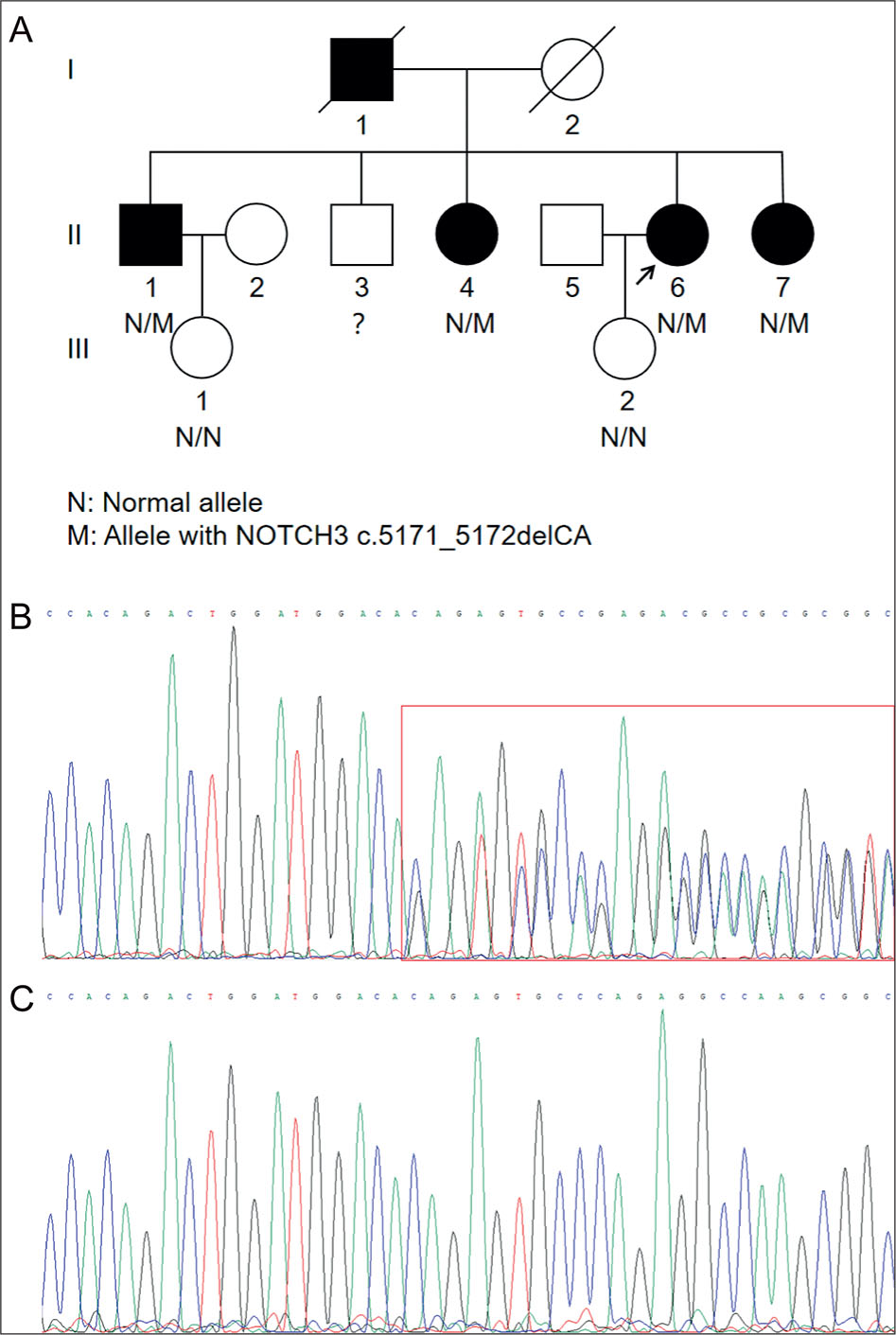
Figure 1:
A, Pedigree of the patient’s family. Squares denote male family members; circles denote female family members; slashed symbols represent deceased family members; fully shaded symbols represent symptomatic family members; arrows indicate the proband. B, Sequence of heterozygous c.5171_5172delCA mutation. C, Wild-type NOTCH3 sequence.
Upon admission to the hospital, the patient received treatment with aspirin and statins. While the dizziness improved following treatment, there was no significant improvement noted in speech fluency or limb strength compared to baseline. Following discharge from the hospital, the patient’s symptoms disappeared. We followed up with the patients six and twelve months after discharge, and there were no other symptoms except occasional episodic migraine.
As regards family history, her father (Figure 1A, I:1) died at the age of 70 after a cerebral infarction, and her mother (Figure 1A, I:2) died at the age of 85. She had an eldest brother (Figure 1A, II:1) suffered from hydrocephalus and psychiatric disorders at the age of 71. The proband’s elder sister (Figure 1A, II:4) who had a headache with stroke and younger sister (Figure 1A, II:7) only had headaches and high blood pressure. The patient’s niece (Figure 1A, III:1) and daughter (Figure 1A, III:2) were all healthy. Brain MRI of the proband’s eldest brother (Figure 1A, II:1) revealed multiple confluent patchy hyperintensities involving the bilateral frontal, temporal and parietal lobes, bilateral corona radiata as well as the semioval center (Figure 3M–Q), along with passive triventricular hydrocephalus (Figure 2N) and bilateral hippocampal atrophy and degeneration (Figure 2M). Brain MRI of the proband’s younger sister (Figure 1A, II:7) performed multiple patchy hyperintense lesions on T2-FLAIR sequences involving the bilateral semioval center and corona radiata (Figure 2R–T). Other family members failed to follow up and could not participate in the study.
The patient is Han from Shandong Province, China. Informed consent was obtained from all participants, and DNA was extracted from their peripheral blood samples of using a Genomic-tip kit (QIAGEN, Hilden, Germany) for subsequent genetic analysis. Whole-exome sequencing (WES) was performed by Axeq Technologies (Ray-Lee Biotech, Shanghai, China) on the extracted DNA to identify gene mutations. Exonic regions were captured with the Agilent SureSelect Human All Exon V6 kit, and high-throughput sequencing was conducted on the Illumina HiSeq X Ten platform to screen for potential pathogenic gene mutations. Subsequently, suspicious mutation sites detected by whole-exome sequencing were verified using direct Sanger sequencing. Independent PCR amplification and bidirectional sequencing were performed to ensure accuracy. Interpretation followed American College of Medical Genetics and Genomics (ACMG) guidelines using Mobidetails and Alamut Visual. The proband (Figure 1A, II:6), her eldest brother (Figure 1A, II:1), and two sisters (Figure 1A, II:4 and II:7) were detected to carry a novel heterozygous frameshift mutation, c.5171_5172delCA (p.Thr1724fs17), in the NOTCH3 gene (Figure 1B), whereas the proband’s niece and daughter showed no genetic mutation (Figure 1C). The novel heterozygous frameshift mutation, c.5171_5172delCA, p. (Thr1724fs17), in the NOTCH3 gene has not previously been reported. It was also not present in major databases including the gnomAD, Clinvar, dbSNP, HGMD pro and LOVD, thus representing a novel etiology in the CADASIL Chinese family.
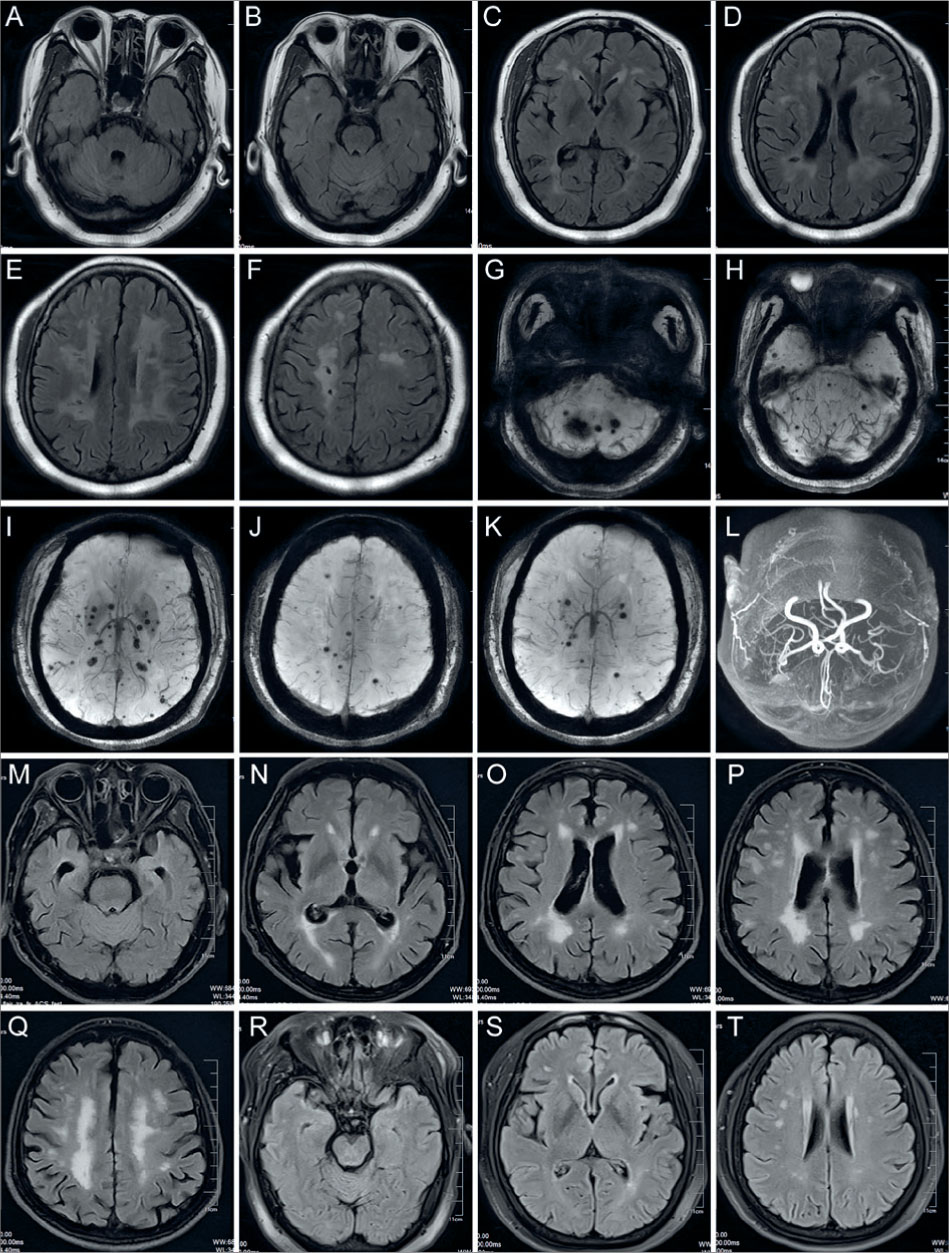
Figure 2:
Brain MRI findings of the proband and affected family members. A–L, Brain MRI features of the proband. A–F, T2-weighted and fluid-attenuated inversion recovery (FLAIR) sequences show diffuse white matter hyperintensities (WMHs) predominantly in the bilateral periventricular white matter, centrum semiovale, and basal ganglia. G–K, Susceptibility-weighted imaging (SWI) reveals multiple cerebral microbleeds (CMBs) in the cerebral hemispheres, bilateral thalami, cerebellar hemispheres, and brainstem. L, Magnetic resonance angiography (MRA) demonstrates no vascular stenosis or occlusion in the examined vessels. M–Q, Brain MRI of the proband’s eldest brother (Figure 1A, II:1) shows multiple confluent patchy hyperintensities involving the bilateral frontal, temporal, and parietal lobes, bilateral corona radiata, and centrum semiovale, with concomitant passive triventricular hydrocephalus (N) and bilateral hippocampal atrophy and degeneration (M). R–T, Brain MRI of the proband’s younger sister (Figure 1A, II:7) shows multiple patchy hyperintensities on T2-FLAIR sequences involving the bilateral centrum semiovale and corona radiata.
DISCUSSION
CADASIL is an inherited cerebral small artery disease in middle aged adults. The predominant clinical features include migraine attacks, recurrent subcortical ischemic strokes or transient ischemic attacks, cognitive decline, and psychiatric symptoms[6]. The clinical presentation of this patient included ischemic stroke and left limb dysfunction, consistent with the phenotypic spectrum observed in previous studies of CADASIL patients from various ethnic backgrounds[7, 8]. Approximately 30% of patients with CADASIL experience migraine attacks, often presenting as the initial symptom of the disease. The prevalence of migraines varies geographically, with higher rates observed in Europe and lower reported rates in Asian countries. A study conducted in Asian countries revealed a relatively low migraine prevalence of 5%[9]. Interestingly, the patient included in this study reported a history of migraines, which contradicts the comparatively low incidence of migraines among CADASIL patients in Asian populations. Although headaches consistent with migraine are common in patients with CADASIL, the association between migraine and CADASIL-related genetic variants remains uncertain[10]. We also found that the proband and her eldest brother presented with cognitive dysfunction, which may be attributed to age-related loss of NOTCH3, leading to a gradual decline in vascular function and subsequent neurodegenerative disease[11]. Considering the patient’s long-standing hypertension, arteriolosclerosis caused by hypertension may contribute to CADASIL progression.
Neuroimaging revealed extensive WMHs, notably excluding the involvement of the temporal poles, which did not align with the typical neuroimaging characteristics observed in CADASIL[12, 13]. The absence of anterior temporal pole lesions, which are typically found in CADASIL, is regarded as a distinctive feature of the recessive form[14]. Increased deep white matter hyperintensity and lacune burdens were linked to ischaemic stroke, whereas cerebral microbleeds and superficial cerebral atrophy showed an inverse association with migraine with aura[15]. In the present study, the proband exhibited diffuse WMHs in the bilateral periventricular white matter, semioval center, and basal ganglia, with no WMHs observed in the temporal poles or external capsule. These findings suggest that the absence of temporal pole WMHs may represent a neuroimaging hallmark of NOTCH3 frameshift variants, distinguishing them from classical cysteine-altering missense variants. An increasing number of studies have reported a higher prevalence of CMBs in patients with CADASIL. The prevalence of CMBs in CADASIL varies across different cohort studies, with the white CADASIL population showing a range from 25% to 35.5%[ 16, 17, 18]. In contrast, studies conducted in Asian countries have reported a higher prevalence ranging from 54.9% to 87.5%[19, 20]. This suggests that the occurrence of CMBs is more common in Asian populations compared to white populations. Furthermore, as the disease progresses, there is an observed increase in CMBs counts specifically within the frontal lobe, temporal lobe, and thalamus regions of the brain. Interestingly, this increase appears to be more rapid than in other brain regions. Additionally, while CMBs burdens in the thalamus show a strong association with disease duration, it does not seem to correlate with cognitive performance[21]. In our study, we found that CMBs were distributed throughout various brain regions, including the frontal lobe, temporal lobe, thalamus, brainstem and cerebellar hemispheres. These findings seemed to correlate with recurrent migraines and gait instability experienced by the patient, while her advanced cognitive functions, such as cognition, memory, and calculation abilities, are gradually declining.
Genetic diagnosis of individuals at risk may provide novel treatments for CADASIL[22]. We identified a novel heterozygous frameshift mutation, c.5171_5172delCA, p. (Thr1724fs17), in the NOTCH3 gene through genetic testing of a mainland Chinese family with CADASIL. According to ACMG/AMP criteria, the variant was classified as a likely pathogenic variant (PVS1_Strong + PM2_Supporting + PP3_Supporting). In silico predictions indicated that this mutation causes premature translational termination, yielding a truncated protein or nonsense-mediated mRNA decay and thereby significantly impairing NOTCH3 protein structure and function. The mutation located in exon 28 of NOTCH3 is atypical for classical CADASI, which is most commonly caused by cysteine-altering missense variants in EGF-like repeats[23]. NOTCH3 frameshift mutations and loss-of-function (LoF) variants mediate pathogenicity through a mechanism of loss of normal protein function, which impairs or completely ablates the physiological function of wild-type NOTCH3 in regulating VSMCs[24]. This stands in stark contrast to the pathogenic mechanism of classical cysteine-altering mutations. The phenotype of the patient in this study, caused by an autosomal dominant heterozygous frameshift mutation and accompanied by atypical neuroradiological features, is not classical CADASIL but rather a spectrum manifestation of NOTCH3-related cerebral small vessel disease (CSVD)[25]. Recent work by Pablo Iruzubieta et al.[26] has demonstrated that NOTCH3-related disorders represent a broader spectrum, strongly influenced by variant type and zygosity. In that study, biallelic loss-of-function variants were mainly associated with early-onset leukovasculopathy, while heterozygous loss-of-function variants were often asymptomatic or showed mild phenotypes. In this context, the pathogenic role of a heterozygous frameshift variant in classical CADASIL remains uncertain. Moreover, there have been limited reports on frameshift NOTCH3 gene variants, making it necessary to further investigate their association with the CADASIL phenotype. In this regard, the frameshift NOTCH3 c.5171_5172delCA, p. (Thr1724fs17) mutation has not been previously reported. The controversy surrounding whether frameshift NOTCH3 gene mutations are linked to the classical CADASIL phenotype in affected patients remains unresolved.
Disorders within the NOTCH3 mutation spectrum are characterized by prominent clinical and genetic heterogeneity, where mutation location and type are the major determinants of marked phenotypic differences[26]. Reported NOTCH3 frameshift variants usually occur in homozygous or compound heterozygous states missense mutation. In 2004, Maria et al. reported the first case of CADASIL associated with a frameshift mutation. The clinical presentation of their patient was highly similar to that of our proband, and they used muscle biopsy to demonstrate that NOTCH3 mutations may be linked to mitochondrial dysfunction[27]. In a study from Italy[27], a patient with novel 5-bp deletion leading to a frameshift (from amino acid 127 to amino acid 158) mutation with premature termination of translation (stop codon at amino acid 159) presented with the mildly increased clinical severity. In this patient, the classic clinical features of the disease were observed in conjunction with severe fatigue. In a separate study[28], a 43-year-old female patient was found to have a novel NOTCH3 frameshift variant in exon 18 (NM_000435.2:c.2853_2857delTCCCG), resulting in a frameshift and premature stop codon introduction. The patient’s initial symptom was migraine without aura, and MRI revealed bilateral subcortical T2-hyperintense lesions, notably without specific involvement of the temporal pole. Detailed neuropsychological testing did not reveal any significant abnormalities. This presentation appears similar to that observed in our study. A recent report described a novel homozygous frameshift variant (NM_000435.3:c.2985_2991del; NP_000426.2: p.(Gln996ArgfsTer274)) in a 12-year-old Moroccan girl presenting with global developmental delay, spastic tetraplegia, epilepsy, and bilateral periventricular white matter abnormalities[29]. These findings suggest that the newly identified NOTCH3 variant does not manifest as a typical CADASIL phenotype. In summary, the presence of typical CADASIL features, such as WMHs in the temporal pole on imaging, necessitates a comprehensive consideration of core clinical manifestations, including headache, stroke, cognitive impairment, and family history. When brain MRI reveals WMHs, lacunar infarcts, cerebral microbleeds, and brain atrophy, the possibility of CADASIL should be suspected. Genetic testing is recommended for patients with a family history. CADASIL is the most common hereditary cerebral small vessel disease worldwide. There is currently no proven therapy to prevent or reverse the progression of the disease. In our case, the patient was treated with aspirin and statins, which ameliorated only some of the symptoms. This case underscores the importance of early diagnosis. We identified a rare non-cysteine altering NOTCH3 frameshift mutation that co-segregates with the disease phenotype in a Chinese family, expanding the genetic spectrum of CADASIL. Further functional studies are needed to clarify the pathogenic mechanisms underlying NOTCH3-related vasculopathies.
Acknowlegements
We are deeply grateful to the patient for her participation in this study.
Notes
[1] Declaration of Interest.
The authors report no conflicts of interest. The authors alone are responsible for the content and writing of this article.
[2] Ethics approval and consent to participate
This study was approved by the Ethics Committee of Shandong First Medical University.
[3] Consent for publication
Written informed consent for publication of their clinical details and clinical images was obtained from all participants. A copy of the written consent is available for review by the Editor of this journal.
[4] Availability of data and materials
The datasets generated and analyzed during the current study are available in the GenBank repository, under accession number BankIt2854890 seq1 PQ115184.
[5] Financial disclosure Funding
This study was supported by Shandong Provinci al Natural Science Foundation [ZR2021MH059]. The funders played no role in the designing study, in collecting, ana lyzing, and interpreting the data, in writing this report, or in the decision to submit it for publication.