INTRODUCTION
Multiple myeloma (MM) makes up 10% of hematological malignancies and 1% of all cancers. It is mostly seen in men, and the median age is reported to be about 65 years old [1]. MM, which causes excessive production of monoclonal light chain and heavy chain, is a malign disease of plasma cell [2]. Autologous stem cell transplantation (ASCT) after high dose chemotherapy is the favored standard treatment in fit patients diagnosed with MM. The International Staging System (ISS) was made based on levels of serum albumin and beta-2 microglobulin. Yet in the revised ISS, in addition to the ISS, added factors such as serum lactate dehydrogenase (LDH) and deletion of 17p, t (4; 14), t (14; 16) are evaluated by interphase fluorescence in situ hybridization (FISH) [1-3].
The circadian clock (CC), which is governed via the main center of mammalian physiology in the superior chiasmatic nucleus, plays a role in the arrangement of behavior of biological and physiological, as per the light cycle and dark cycle in the daily period [4, 5]. This center forms a link with a complex neurohumoral network via temperature daily rhythms, photic signals by retina, social stimuli and diet. The circadian rhythm (CR) is regulated by CR pathway genes, the mammalian CC mechanism has interlocking transcription-translation feedback loops, controlled at the molecular level by a set of genes, including NPAS2, BMAL1, CLOCK, period genes (PER-1, -2, and -3), cryptochrome circadian regulator 1 (CRY-1 and -2), NR1D-1 and -2. Previous studies showed that changes of expression in these genes play a role in immune cells and in the functions and expression of cytokines [4, 5]. The physiology of the immune system has a 24-hour CR, and most of these cells express genes of CR. Circadian gene expressions affect many mechanisms including cellular and cytolytic functions and cytokine synthesis. Thus, dysregulation or mutation of PER-3 or other clock genes has been related with some cancers [6].
The CC Protein PER-3 (rs57875989) is situated on chromosome 1p36.23 and has a polymorphic domain that expresses 4 or 5 copies of the 54-bp tandem repeat sequence (variable number tandem repeat, VNTR). This variation, resulting from the deletion or insertion of 18 amino acids, is linked to mood and sleep disturbances and circadian preference in humans [6]. The PER-3 polymorphism plays an important role in CR disorders, dysregulation of immune system and expression of cytokines [4-8]. It has been suggested that immune dysregulation associated with the PER-3 polymorphism contributes to chronic inflammatory processes or diseases, and cancer biogenesis [6]. A previous study demonstrated interaction between PER-3 polymorphism and markers associated with chronic inflammation, including interleukin (IL)-1, -6, interferon-gamma (IFN-Ɣ), and tumor necrosis factor-alpha (TNF-α), and IL-6 expressions. These were higher in patients with 4/5 or 5/5 PER-3 gene polymorphism compared to patients with the 4/4 polymorphism [6]. It is suggested that the 4/5 or 5/5 PER-3 genotype is more common in premenopausal breast cancer [9]. Thus, there is increasing interest in studies investigating the relationship between PER-3 gene polymorphisms and pre-cancerous processes and auto-inflammatory/-immune diseases.
In this study, we intend to investigate the distributions and clinical efficacy of the PER-3 gene polymorphism in MM patients.
MATERIAL AND METHODS
One hundred fifty patients (over 18 years old), diagnosed with MM in Hematology Clinic of Gaziantep University between January 2007 - 2009, and 100 healthy persons were included in this study. Demographic characteristics, first-line treatments, clinical scores (Durie-Salmon stages, ISS score, Eastern Cooperative Oncology Group (ECOG) score), laboratory variables, status of survival (overall (OS) and progression-free (PFS)) were recorded.
All patients were suitable for ASCT at first evaluation and following four courses on bortezomib-cyclophosphamide and dexamethasone (VCD) at partial remission (PR), ASCT was carried out. Following 24 months, lenalidomide-dexamethasone (LD) was used as maintenance.
The genotypes of 4R/4R-5R, 5R/5R and alleles of 4R and 5R on PER-3 gene of patients with ASCT and healthy controls; were statistically compared before treatment. In addition, these genotypes, the effects of on PFS and OS were investigated. Study approval was obtained from Gaziantep University Ethics Committee (07-2007/40).
Isolation Method
DNA isolation via peripheral blood leukocytes was measured by the saline precipitation method [10]. Genotypes of PER-3 gene polymorphism were studied by polymerase chain reaction- (PCR) and agarose gel electrophoresis method [11].
Statistical Analysis
According to the Kolmogorov-Smirnov test, quantitative variables that fit the normal distribution were shown as mean±standard deviation, but those that did not fit were shown as median (minimum and maximum). Comparisons between qualitative measures expressed as numbers and percentages (%) were made using Chi-square or Fisher’s exact tests. Post-hoc analysis was evaluated with Bonferroni correction for intergroup comparisons. Variables associated with different gene variants were determined in the multivariate logistic regression model adjusted for gender and age. Regression results are shown with odds ratio (OR) and 95% confidence interval (CI). Hardy Weinberg Equilibrium (HWE) was performed via the De-Finetti program (online HWE and Association Testing-Institut für Humangenetik, Munich, Germany). All analyses were performed with IBM SPSS version v21.0 (IBM Corp, Armonk, NY, USA), and a p-value less than 0.05 was considered statistically significant.
RESULTS
The median age was 56 years (range: 32-70). The 10-years OS was 79%, while the 10-years PFS was 47% with a median of 52.7 months. The mortality rate was 15.3% (n:23) (Table 1.).
Table 1.
Clinical features and treatment regimens of MM patients
| Multiple Myeloma | Control | Control | p | |||
|---|---|---|---|---|---|---|
| median | na (%) | median | nb (%) | |||
| Age | 56 (32-70) | 53 (28-68) | 0.140* | |||
| Gender | Female/Male | 77/73 (51.3/48.7) | 55/45 (55/45) | 0.367& | ||
| MM Subtypes | κ/λ | 83/39 (68/32) | ||||
| G/A | 79/18 (65/15) | |||||
| Light chain | 25 (20) | |||||
| Stage (Durie-Salmon) | II/III | 38/84 (25/75) | ||||
| A/B | 91/31 (79/21) | |||||
| IPI | I | 39 (32) | ||||
| II/III | 34/50 (28/40) | |||||
| ECOG | >1 | 12 (10) | ||||
| Hemoglobin | gr/dL | 10.4 (6.2-15) | ||||
| Leukocyte | mm3 | 7200 (2760-18500) | ||||
| Platelet | 103μL | 172 (69-406) | ||||
| C-reactive protein | mg/dL | 8 (2.1-352) | ||||
| LDH | IU/L | 212 (93-1037) | ||||
| B2-microglobulin | mg/L | 4.9 (1.5-48) | ||||
| Albumin | gr/L | 3.5 (1.6-5.1) | ||||
| Treatment | VCD, ASCT, LD | |||||
| OS (10-years, %) | (79) | |||||
| PFS (10-years, %) | (47) – 52.7 months | |||||
| Relapse | 63 (42) | |||||
| Mortality | 23 (15.3) | |||||
| Follow-up duration, months, (range) | 36.1 (4.1-155.2) |
**MM: Multiple myeloma, IPI:International Prognostic Index, ECOG:Eastern Cooperative Oncology Group, CRP:C-reactive protein, LDH: Lactate dehydrogenase, OS: Overall survival, PFS: Progression free survival, VCD: Bortezomib-cyclophosphamide and dexamethasone, LD: Lenalidomide- dexamethasone, ASCT: Autologous stem cell transplantation
According to PER-3 gene variants, 4R/4R, 4R/5R and 5R/5R polymorphisms and 4R and 5R alleles did not differ between the MM and control groups (Table 2.).
Table 2.
Comparison of frequencies of PER-3 gene variants between patients with MM and healthy controls
| PER3 | Genotype | Multiple Myeloma | Healthy Controls | OR Exp(B) | 95% CI | p |
|---|---|---|---|---|---|---|
| Genotypes | n=a (%) | n=100 (%) | ||||
| PER-3 | 4R/4R | 70 (46.7) | 42 (42) | 0.657* | 0.285-1.517* | 0.325* |
| 4R/5R | 64 (43.3) | 44 (44) | 0.745* | 0.320-1.734* | 0.494* | |
| 5R/5R | 16 (10.7) | 14 (14) | 1.363& | 0.633-2.935& | 0.434& | |
| Allele | ||||||
| 4R | 204 (67.5) | 128 (64) | ||||
| 5R | 98 (32.5) | 72 (36) | 1.159& | 0.796-1.689& | 0.443& |
Table 3 shows the results of evaluating prognostic factors in terms of PFS and OS. In the 10-year survival analysis, the rate was shown as a percentage if it was above 50%, and as a month if it was below 50%. Median PFS in the 5R/5R genotype was found to be significantly longer, albeit low, at 86% (p = 0.046). In the statistical analysis performed between the 4R/4R genotype and other genotypes, the PFS of patients with this genotype was found to be significantly shorter with 40.4 months (p = 0.026).
Table 3.
Comparison of PFS and OS with prognostic factors of patients with MM
| PFS* | Log Rank p-value | os*,# | Log Rank p | |||
|---|---|---|---|---|---|---|
| n | 52.7 | 77# | ||||
| Gender, n | Female / Male | 73/77 | 89.3 /39.2 | 0.080 | 66# / 69# | 0.690 |
| Age, n | <65 / >65 | 130/20 | 54.3 / 40.4 | 0.230 | 56# / 54# | 0.058 |
| Stage (Durie-Salmon), n | II/III | 38/84 | 28.5 / 54.3 | 0.257 | 87.1 / 99.1 | 0.229 |
| A/B | 91/31 | 40.4 / 65.0 | 0.277 | 55# / 51# | 0.301 | |
| IPI, n | I | 39 | 69.3 | 99.1 | ||
| II | 34 | 40.4 | 70# | |||
| III | 50 | 52.7 | 0.764 | 88.2 | 0.026 | |
| ECOG, n | < 1 / >1 | 109/12 | 47.1 / 28.5 | 0.959 | 53# / 31.4 | 0.301 |
| LDH (IU/L), n | <480 / >480 | 116/7 | 52.7 / 17 | 0.086 | 53# / 17 | 0.001 |
| CRP (mg/L), n | <5 / > 5 | 51/71 | 54.3 / 52.7 | 0.686 | 85# /99.1 | 0.057 |
| PER3 | 4R/4R | 70 | 40.4 | 74# | ||
| 4R/5R | 64 | 69.3 | 57# | |||
| 5R/5R | 16 | 86# | 0.046 | 100# | 0.349 | |
| PER-3 | 4R/4R | 70 | 40.4 | 63# | ||
| 4R/5R -5R/5R | 80 | 89.6 | 0.028 | 99.1 | 0.738 |
Table 4 shows the multivariate analysis. It was observed that patients with the 4R/4R genotype would have a risk of 2.049 times of shorter PFS (p= 0.009) (Figure 1.).
Table 4.
Multivariate analysis of 150 MM patients (Cox proportional hazard model backward)
| PFS | ||||
|---|---|---|---|---|
| Exp (B) | %95 CI | p | ||
| PER-3 | 4R/4R | 0.488 | 0.284-0.837 | 0.009 |
| LDH | ≥480 | 0.441 | 0.170-1.141 | 0.091 |
| Gender | Female/Male | 0.604 | 0.357-1.022 | 0.060 |
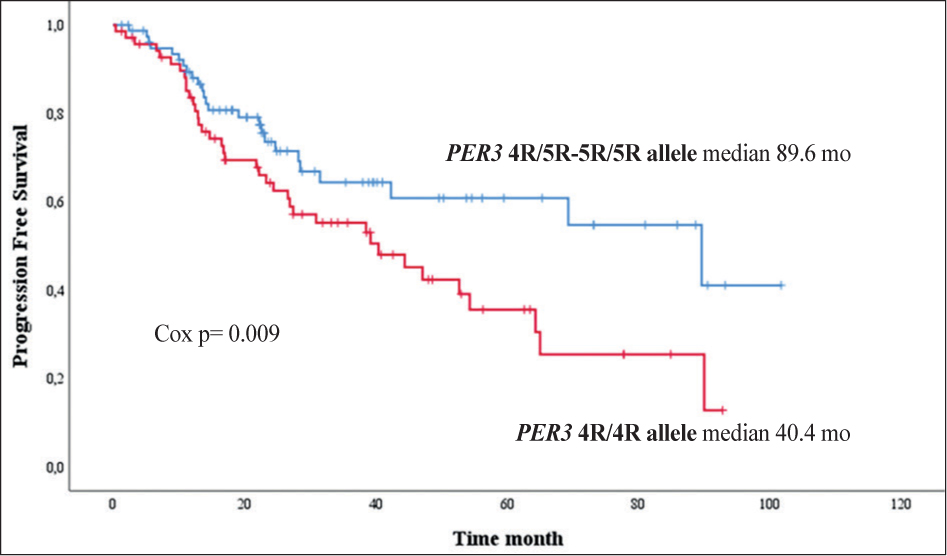
Figure 1.
Progression free survival curves: 4R/4R and 4R/5R-5R/5R
DISCUSSION
This study is the first to report on the association between CR and MM. Literature data on CR and hematological malignancies are also limited; there are related studies on solid malignancies.
In a current study from 2021 by Dagmura et al. [12], CR and pancreatic cancer (PC) were studied. The frequency of the 4R/3R, 3R/3R genotypes, and 3R allele of PER-2 VNTR in patients with PC were higher than in the healthy controls (p < 0.001, for all). PER-2 VNTR 4/5 genotype was found to be related to perineural invasion (p = 0.040). The genotype and allelic distributions of the PER-3 VNTR variant were similar between the groups (p> 0.05). In this study, a significant relationship between PER-2 and perineural invasion, which can be a marker of poor prognosis, was demonstrated.
Geng et al. [13] examined the association of PER-3 gene variants (rs1012477, 4/5-repeat) with solid malignancies. In the meta-analysis, data were collected from a total of 8 separate studies, and no relationship was found between PER-3 gene variants and cancer susceptibility. The articles covered in the study were related to prostate, breast cancer, glioma and colorectal cancer (CRC). In another study from 2013 [14], the relationship between CRC and CR was investigated, and the polymorphism of 311T > C on CLOCK-1 gene did not affect the outcome of patients with CRC, yet it increased the risk of developing CRC. The evaluation of 4/5 repeat allele polymorphism in PER-3 was similar in terms of allele and genotype distributions between the control group and the CRC group. A previous study showed that the 5-repeat PER-3 VNTR sequence is related with increase of colorectal adenoma development [15]. Although there was no difference in cancer susceptibility in our study, the fact that the 4R/4R genotype was associated with shorter PFS is an important point for treatment responses.
Clinical data on hematological malignancies and PER-3 polymorphisms is limited. In a study on diffuse large B-cell lymphoma patients from 2015 [16], PER-3 rs10462020 variant was significantly different in OS between groups of mutated and non-mutated genotypes (p = 0.047). In another study in the same year [17], 9 different CR gene expressions were examined in cases of newly diagnosed acute myeloid (AML) and lymphoblastic leukemia (ALL). In AML patients, the expressions of PER-1, -2, CRY-1, -2, timeless, muscle and brain aryl hydrocarbon receptor nuclear translocator (ARNT) -like 1 (BMAL-1) were downregulated, while CK1ε was up-regulated. In patients with ALL, the expressions of PER-3 and CRY-1 were downregulated, while CK1ε and timeless were up-regulated. Improvement in PER-3 expression was detected in attained remission patients with AML and ALL, while this was not detected in relapsed patients after treatment. The CC genes were changed in acute leukemia patients, and PER-3 upregulation is related with an improved clinical outcome.
The relationship of CR genes with sleep disturbance has been extensively studied. Guess et al. [6] found that the 4/4 genotype showed more physical fatigue and sleep disturbances. Sleep disturbance and increased inflammation or inflammatory markers have been the subject of many studies [18–20]. In these studies there is a positive correlation between sleep disturbance and increased vascular endothelial growth factor (VEGF) concentration. VEGF contributes to the pathogenesis of MM. It plays a role in myeloma development, bone marrow microenvironment interaction, disease progression and drug resistance. VEGF and VEGF receptor expression is increased in myeloma bone marrow [21]. Anti-VEGF treatment strategies are also discussed in the treatment of myeloma. In addition, proteosome inhibitors, immunomodulatory drugs (IMIDs) and bisphosphonates, which are the cornerstones of MM treatment, have also been shown to reduce VEGF levels [21]. In our study, the 4R/4R genotype, which is significantly associated with sleep disorder and physical fatigue, high VEGF level is thought to be related. Therefore, a significant short PFS constitutes the most important result of the study.
This study had also some important limitations. OS may not have differed significantly due to the narrowing of the patient population when the genotype was divided into gene variant subgroups. In addition, not evaluating synchronous cytokines is another important limitation. There were also deficiencies in patient data in terms of comorbidity or genetic mutation subtypes, and it was therefore not possible to analyze them together.
In conclusion, this study contributes to the literature in terms of MM and PER-3 gene polymorphism. Although no significant results were obtained in terms of MM pathogenesis, it was revealed that the 4R/4R genotype had a statistically significant short PFS. It is thought that this information will shed light on new studies in terms of the therapeutic effect and pathogenesis in MM.
ABBREVIATIONS
MM
ASCT
ISS
R-ISS
LDH
FISH
SCN
PER
CC
CRY
CR
VNTR
TNF-α
IFN-Ɣ
IL-1
IL-6
CRP
OS
PFS
VCD
PR
LD
PCR-RFLP
OR
CI
HWE
PC
CRC
AML
ALL
BMAL1
TIM
VEGF
IMID
DECLARATIONS
[14] Conflicts of interest Conflict of Interest: None to declare.
[15] Availability of Data and Materials: The authors declare that data supporting the findings of this study are available within the referenced articles.
[16] Contributed by Authors’ Contributions: All authors contributed to the editing of the manuscript. IS wrote the manuscript and made tables.
[17] Ethics Approval and Consent to Participate: Ethical committee approval was received (Faculty of Medicine, Gaziantep University, approval year and number: 2018/78) and the patients and control subjects gave informed consent before the beginning of the study. The experimental procedures were based on the Declaration of Helsinki and relevant institutional regulations.
[18] Patient Consent for Publication: Informed consent obtained as well as written forms from all of our patients to publish.
Acknowledgements
We respectfully remember all the colleagues we lost in the COVID-19 fight.